Quick Answer
Key Takeaways
- Exceptional leadership is built on foundations, not personality, charisma or technical skill alone.
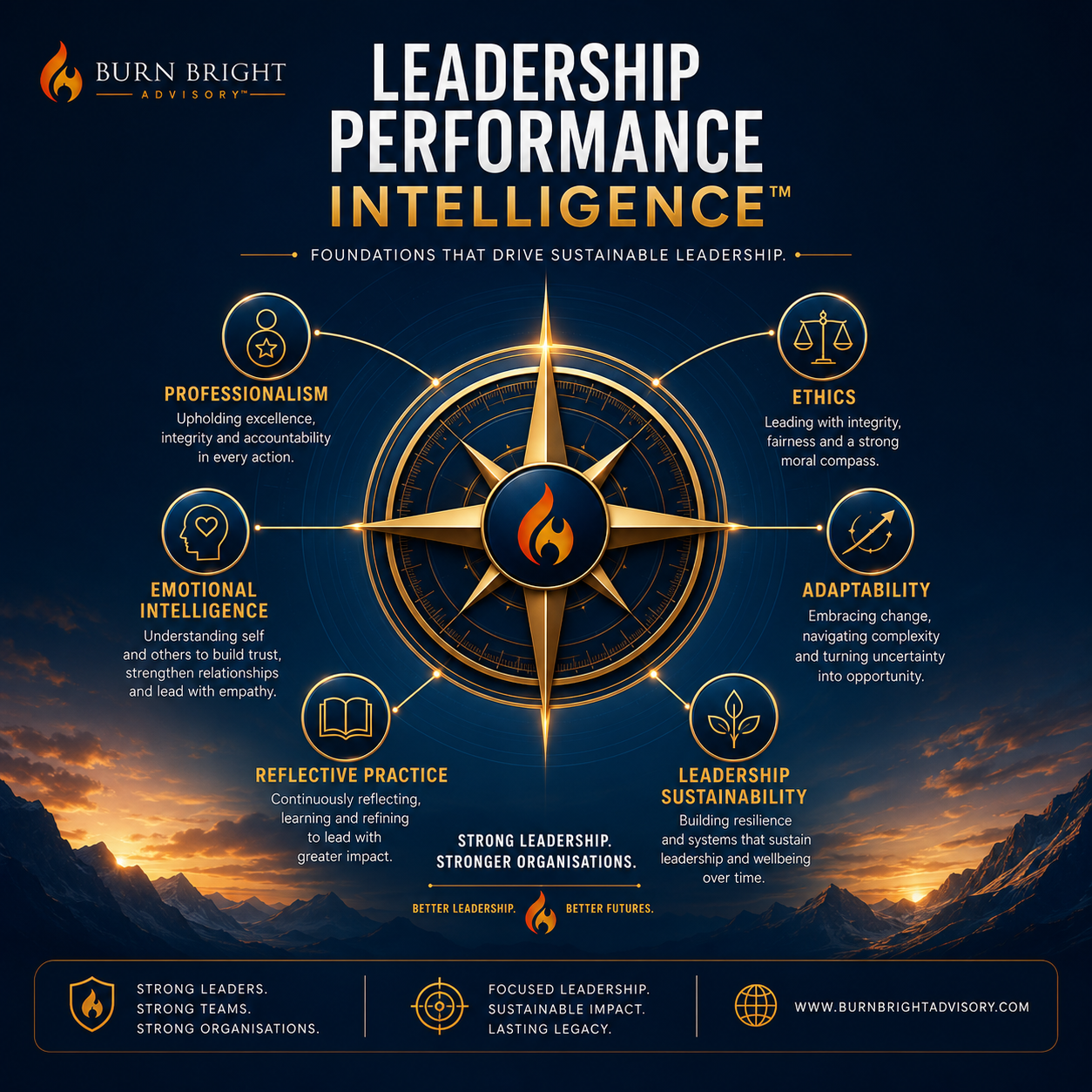
- The Leadership Intelligence Compass™ organises six interacting domains: Professionalism, Ethics, Reflective Practice, Emotional Intelligence, Adaptability and Leadership Sustainability.
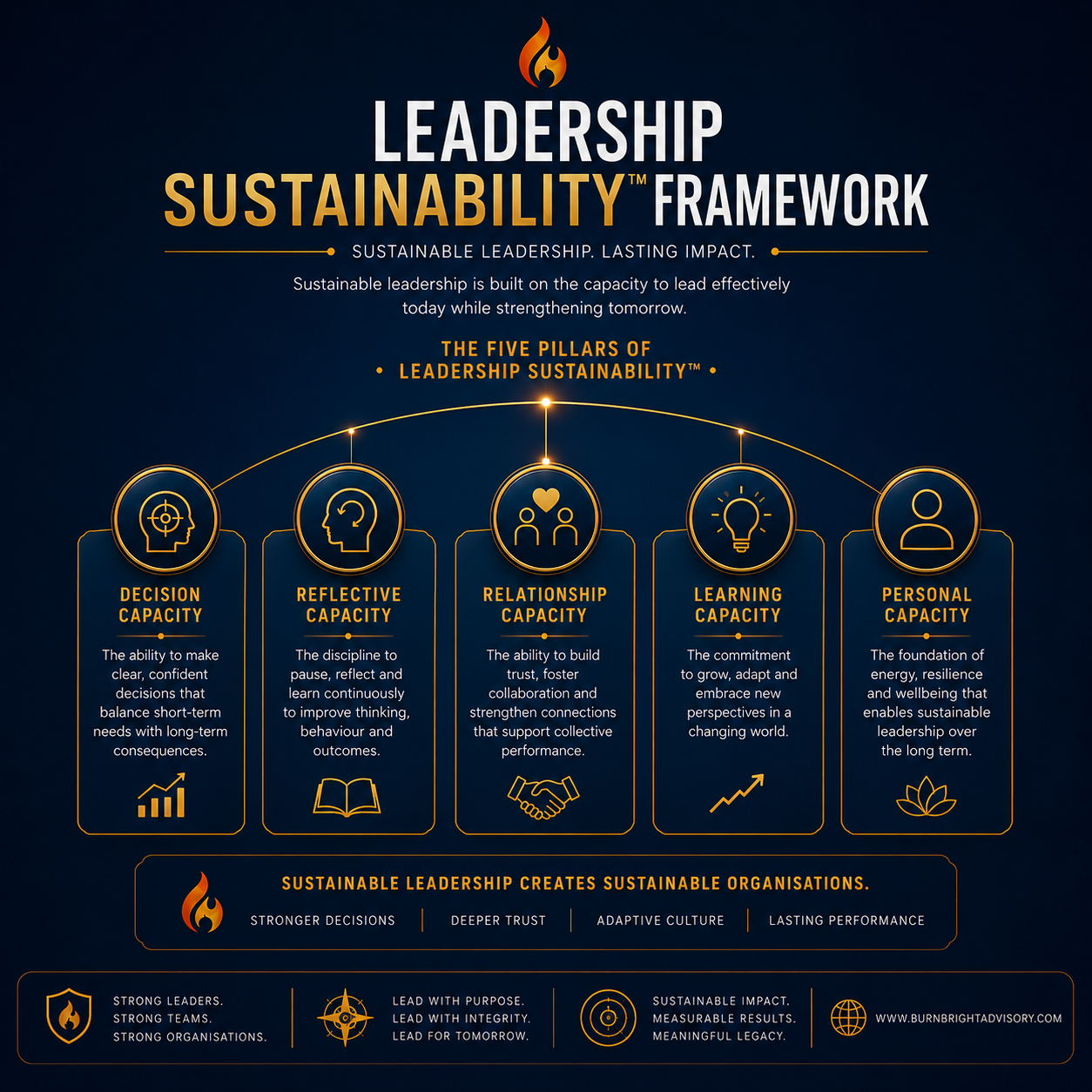
- Leadership Sustainability™ protects five critical capacities: decision, reflective, relationship, learning and personal capacity.
- Sustainable organisations build leadership capacity, not dependency on one exceptional leader.
- Reflection is what converts leadership experience into leadership expertise.
Foundations of Leadership Performance Intelligence™: The Leadership Framework Every Modern Leader Needs
Leadership is often misunderstood. For decades, organisations have searched for the perfect leadership style, personality profile or competency framework capable of producing exceptional leaders. New theories regularly emerge, promising transformational results through charisma, emotional intelligence, agile thinking or strategic vision.
While each contributes valuable insight, none fully explains why some leaders consistently perform well across changing environments while others struggle despite possessing similar qualifications or experience.
The answer lies beneath visible leadership behaviours.
Exceptional leadership is built upon strong foundations.
Just as a building depends on the integrity of its structural framework, sustainable leadership depends upon a combination of interconnected capabilities that reinforce one another over time. Weak foundations may remain hidden during periods of stability but become exposed during uncertainty, crisis or organisational change.
Leadership Performance Intelligence™ provides a comprehensive way of understanding these foundations — recognising leadership as an evolving system of professional judgement, reflective capability, ethical decision-making, emotional regulation and continuous learning, enabling leaders to respond intelligently to complexity rather than simply reacting to immediate challenges.
Featured Snippet
Why Traditional Leadership Models Are No Longer Enough
Modern leaders operate in environments characterised by continuous disruption. Digital transformation, artificial intelligence, geopolitical uncertainty, workforce expectations and economic volatility have fundamentally altered what effective leadership requires.
Technical expertise alone is insufficient.
Charisma alone is unreliable.
Experience alone cannot guarantee effective judgement.
Many organisations continue investing heavily in leadership development while simultaneously experiencing increasing levels of leadership burnout, decision fatigue, employee disengagement and executive turnover.
Understanding Leadership Performance Intelligence™
Leadership Performance Intelligence™ is Burn Bright Advisory’s integrated framework for understanding how leaders sustain high performance throughout increasingly complex professional environments. It recognises that leadership effectiveness emerges through the interaction of multiple intelligence domains rather than from individual traits or behaviours.
These capabilities continually influence one another. For example:
- Ethical judgement shapes strategic decisions
- Emotional intelligence influences professional relationships
- Reflective practice strengthens future decision-making
- Knowledge development supports adaptability
- Professionalism reinforces organisational trust
- Leadership sustainability protects long-term performance capacity
When these domains develop together, leaders demonstrate greater consistency, resilience and effectiveness across changing situations. Rather than relying on personality or experience, Leadership Performance Intelligence™ creates a repeatable system for sustainable leadership growth.
The Leadership Intelligence Compass™
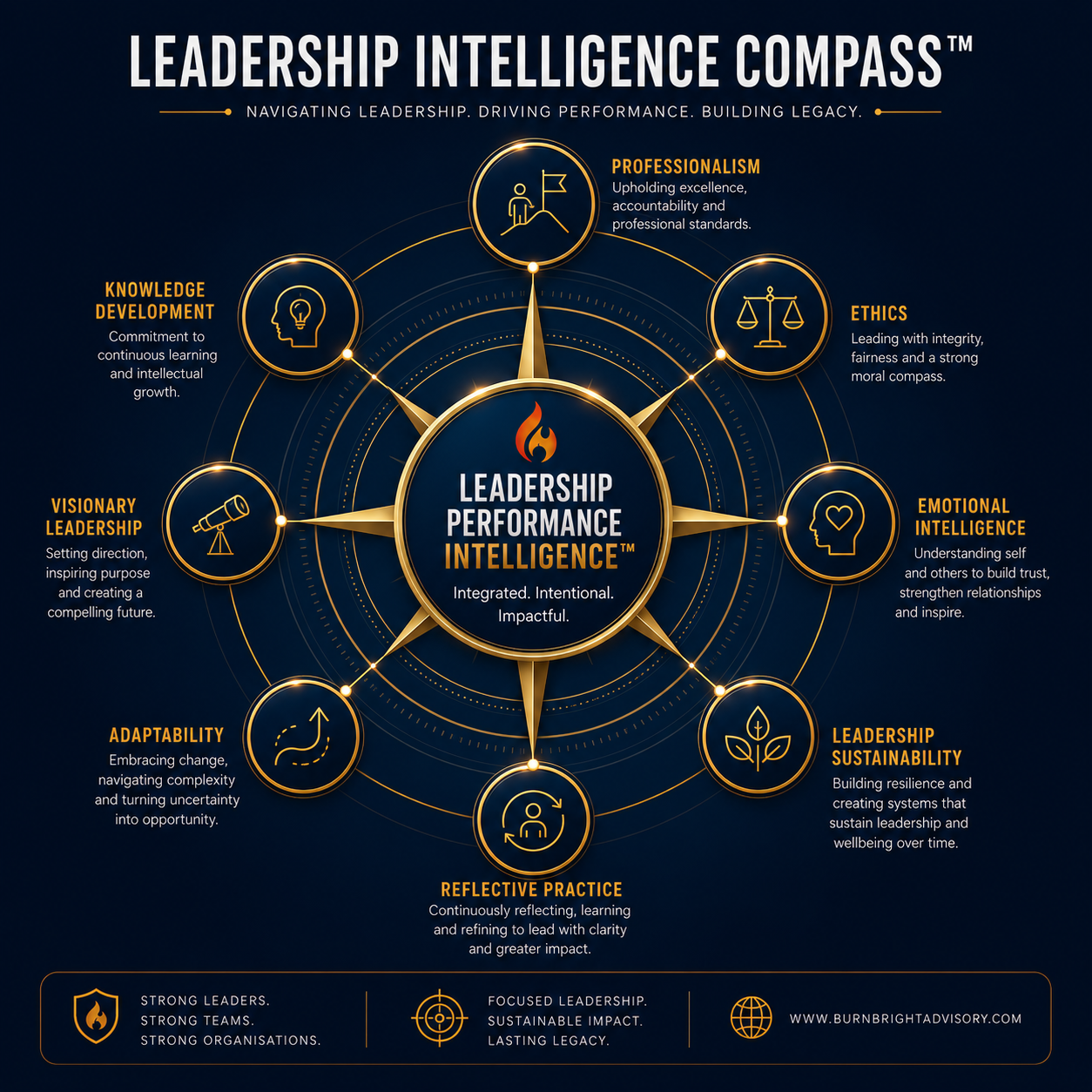
The Leadership Intelligence Compass™ provides the organising framework for Leadership Performance Intelligence™. Each intelligence domain represents an essential component of leadership capability.
Domain
Professionalism Intelligence™
Professionalism establishes credibility. It shapes how leaders communicate, make commitments, demonstrate accountability and build organisational confidence.
- Professional leaders create consistency
- Consistency builds trust, and trust enables influence
Domain
Ethics Intelligence™
Leadership decisions rarely involve simple right-or-wrong choices. Ethics Intelligence™ strengthens decision quality by providing structured moral reasoning that supports integrity, transparency and responsible leadership.
- Ethically grounded leadership builds stronger cultures and greater employee trust
Domain
Reflective Practice Intelligence™
Reflection transforms experience into learning. Many leaders accumulate years of experience without significantly improving judgement, because experience alone does not guarantee learning.
- Reflective leaders evaluate decisions, assumptions, behaviours, outcomes and unintended consequences
- Reflection is a performance capability, not an academic exercise
Domain
Emotional Intelligence™
Emotional Intelligence™ enables leaders to regulate their own behaviour while accurately interpreting the emotional dynamics influencing teams, stakeholders and organisational culture.
- Improves conflict resolution, communication, engagement, trust and collaboration
- Enhances professional judgement rather than replacing logic
Domain
Adaptability Intelligence™
Today’s leaders rarely manage stable environments. Adaptability Intelligence™ enables leaders to remain effective despite uncertainty by encouraging flexibility, learning agility and evidence-informed decision making.
- Avoids becoming trapped by outdated assumptions or rigid thinking
- Continuously recalibrates approach while maintaining strategic direction
Leadership Foundations Create Sustainable Performance
Leadership success should never be measured solely by short-term organisational outcomes. High-performing organisations increasingly recognise the importance of sustainability — creating positive outcomes without exhausting leaders, damaging organisational culture or compromising ethical standards.
This requires leaders to balance competing demands across multiple dimensions:
- organisational performance
- employee wellbeing
- strategic priorities
- operational delivery
- innovation
- governance
- continuous improvement
Leadership Performance Intelligence™ therefore measures leadership success not simply by what leaders achieve today, but by their capacity to continue leading effectively tomorrow.
Building Leadership Capacity Rather Than Leadership Dependency
One of the greatest misconceptions in leadership development is that organisations become stronger by creating stronger individual leaders. In reality, sustainable organisations build stronger leadership capacity — the collective ability of people throughout an organisation to make sound decisions, solve problems, collaborate effectively and continuously improve performance.
When organisations become dependent upon one exceptional leader, they create significant organisational risk. Knowledge becomes concentrated, decision-making slows, succession becomes difficult and innovation declines because others become reluctant to contribute.
High-performing leaders ask different questions:
- How do I develop future leaders?
- How do I strengthen organisational thinking?
- How do I improve collective decision-making?
- How do I create systems that continue performing without constant intervention?
Leadership is not measured by how indispensable a leader becomes.
It is measured by how capable the organisation becomes because of that leader.
Leadership Sustainability™: Protecting Performance Over Time
Leadership burnout has become one of the defining challenges of modern organisations. Across business, healthcare, education and public services, leaders are expected to deliver continuous improvement despite increasing complexity and limited resources — a pattern that often produces impressive short-term results but gradually erodes decision quality, creativity and resilience.
Sustainable leaders deliberately manage five critical areas:
1 Decision Capacity
Every decision consumes mental energy. Leaders who attempt to solve every problem personally experience decision fatigue, increasing the likelihood of poor judgement and inconsistent priorities.
- Create decision-making frameworks, delegate authority and establish clear governance
2 Reflective Capacity
Reflection creates space for learning. Without structured reflection, organisations repeat mistakes, overlook emerging risks and miss opportunities for innovation.
- Sustainable leaders schedule time to think — not simply time to act
3 Relationship Capacity
Leadership is fundamentally relational. Trust, collaboration and influence depend upon maintaining healthy professional relationships with colleagues, teams and stakeholders.
- Consistent investment in relationships strengthens organisational resilience
4 Learning Capacity
Continuous learning enables adaptability. Rather than relying exclusively on previous experience, sustainable leaders remain intellectually curious, actively seeking new perspectives, evidence and ideas.
- Learning becomes a strategic leadership capability, not an occasional activity
5 Personal Capacity
Physical health, emotional wellbeing and psychological resilience directly influence leadership performance. Ignoring these dimensions ultimately reduces organisational effectiveness.
- Wellbeing is a strategic leadership responsibility, not a personal luxury
Applying Leadership Performance Intelligence™ Across Sectors
Although leadership principles remain consistent, their application varies across professional environments.
Business Leadership Intelligence™
Business leaders must balance commercial performance with innovation, customer expectations, workforce engagement and organisational growth — strengthening strategic decision-making, culture, innovation capability and organisational resilience beyond quarterly performance indicators.
School Leadership Intelligence™
Educational leadership extends beyond administration. School leaders shape learning cultures, professional development, safeguarding, curriculum improvement and community engagement — improving teacher development, reflective practice and student outcomes.
Healthcare Leadership Intelligence™
Healthcare leaders make decisions that influence both organisational performance and patient outcomes. Clinical expertise alone is insufficient — exceptional ethical judgement, emotional intelligence, communication and adaptability are required.
Public Service Leadership Intelligence™
Public sector leaders operate within highly accountable environments where competing stakeholder expectations are constant, requiring transparent governance, ethical decision-making, community trust and organisational resilience.
Leadership Reflection: Turning Experience into Expertise
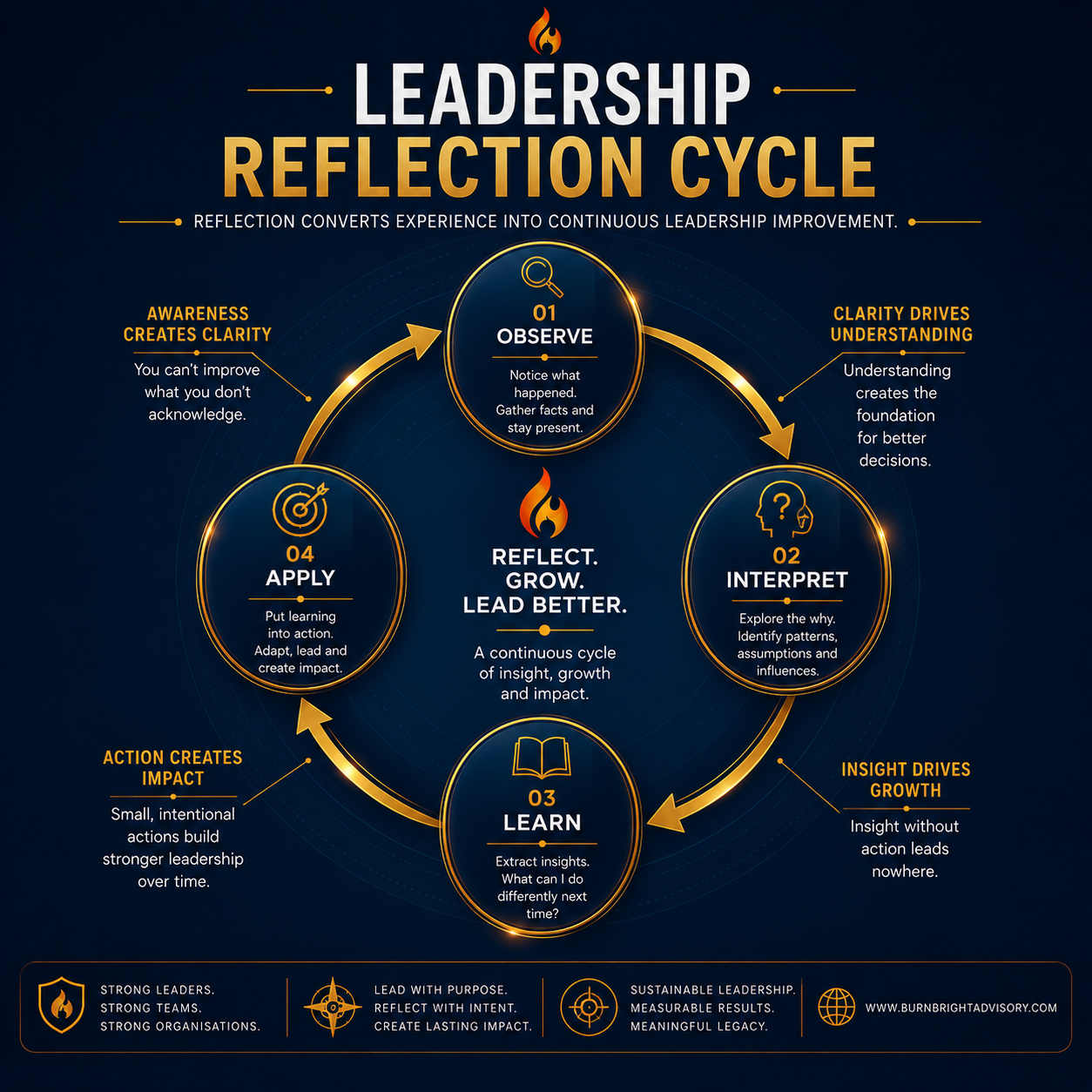
Experience alone does not create expertise. Without reflection, experience simply becomes repetition. Leadership Reflection™ provides a structured process for converting everyday leadership experiences into long-term professional capability.
Step 1 Observe
What happened? Describe the situation objectively before forming conclusions.
Step 2 Interpret
Why did it happen? Consider organisational factors, assumptions, behaviours and external influences.
Step 3 Learn
What insights emerged? Identify patterns that can improve future leadership practice.
Step 4 Apply
What will change? Translate reflection into practical behavioural improvements.
This reflective discipline gradually strengthens judgement, improves decision-making and accelerates professional growth.
Leadership Performance Intelligence™ as a Leadership Development System™
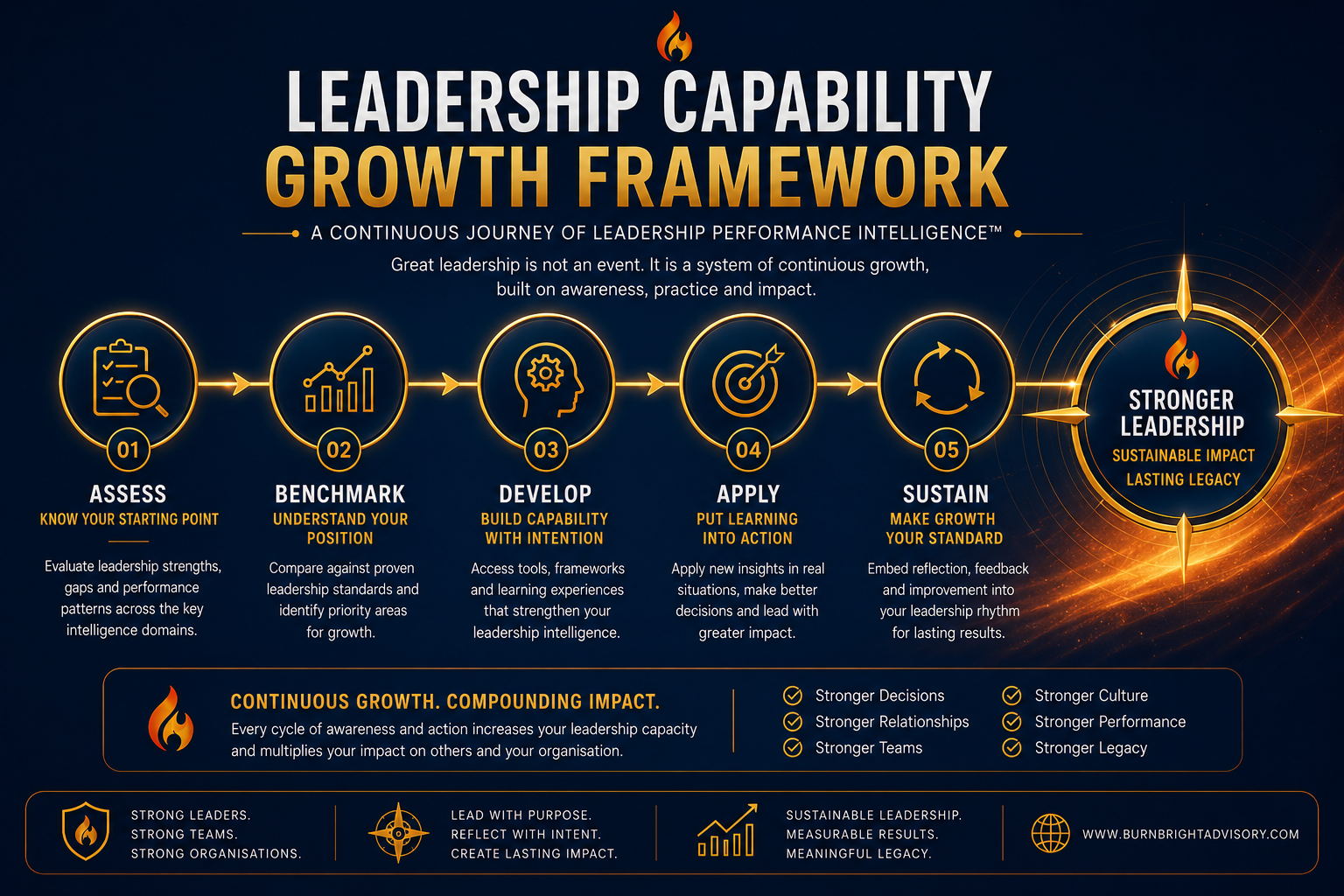
Traditional leadership development often consists of isolated workshops or one-off training events. Leadership Performance Intelligence™ instead functions as a continuous Leadership Development System™ that integrates learning into everyday leadership practice, including reflection, assessment, benchmarking, capability development, practical application and continuous evaluation.
Case Study: Building Sustainable Leadership Foundations
A rapidly growing professional services organisation experienced declining employee engagement despite strong financial performance. Managers consistently reported the following barriers:
Instead of introducing another leadership training programme, the organisation adopted a Leadership Performance Intelligence™ approach. Leaders began by assessing their foundational capabilities across professionalism, ethics, reflective practice, emotional intelligence and adaptability. Three organisational changes followed:
- structured reflection sessions after major projects
- delegated decision-making frameworks
- leadership sustainability planning focused on workload and capacity management
Within twelve months the organisation reported improved employee engagement, stronger cross-functional collaboration, faster strategic decision-making, reduced voluntary turnover and increased leadership confidence.
Why Leadership Foundations Matter More Than Ever
Organisations increasingly operate in environments characterised by ambiguity rather than certainty. Leaders rarely possess complete information — they must make decisions despite uncertainty. In these environments, leadership foundations become decisive, providing:
- greater confidence under pressure
- better ethical judgement
- improved strategic thinking
- enhanced collaboration
- sustainable decision-making
- stronger organisational cultures
Leadership Performance Intelligence™ therefore represents more than another leadership framework. It provides an integrated model for developing leaders capable of thriving within complexity while strengthening those around them.
Leadership Reflection Questions
Leadership Foundations
- Which leadership foundations are currently my strongest?
- Which leadership capability requires the greatest investment over the next 12 months?
- How consistently do my daily behaviours reflect my leadership values?
Leadership Performance Intelligence™
- How effectively do I balance organisational performance with leadership sustainability?
- Which decisions do I routinely make that could be delegated?
- How often do I create opportunities for others to lead?
Reflective Practice
- When was the last time I deliberately reflected on a difficult leadership decision?
- What recurring leadership challenge keeps appearing in my work?
- What assumptions might be limiting my effectiveness?
Leadership Sustainability™
- Am I building a leadership career that is sustainable over the next decade — or simply surviving the current quarter?
Action Steps
Leaders wishing to strengthen their Leadership Performance Intelligence™ can begin immediately.
Week One: Capability Review
Complete a personal leadership capability review. Identify your three greatest leadership strengths and one foundation requiring immediate improvement.
Week Two: Protected Reflection Time
Commit thirty minutes each week to review significant decisions, leadership challenges, stakeholder relationships, lessons learned and improvement opportunities.
Week Three: Review Workload Distribution
Ask what you should stop doing, what should be delegated, and what systems can replace repetitive leadership tasks.
Week Four: Build Leadership Capacity in Others
Identify one emerging leader and actively coach, mentor or develop them. Leadership becomes sustainable when capability grows throughout the organisation rather than remaining concentrated in one individual.
What is Leadership Performance Intelligence™?
Leadership Performance Intelligence™ is Burn Bright Advisory’s integrated leadership framework that combines multiple leadership capabilities into a practical system for sustainable leadership effectiveness.
How is Leadership Performance Intelligence™ different from leadership competency models?
Traditional competency models typically assess isolated skills. Leadership Performance Intelligence™ examines how multiple leadership capabilities interact to influence judgement, organisational culture and long-term leadership performance.
Who is Leadership Performance Intelligence™ designed for?
The framework applies across all sectors including business, education, healthcare, public services, charities and entrepreneurial organisations, supporting executives, senior leaders, middle managers and emerging leaders.
Why are leadership foundations important?
Strong foundations improve decision quality, strengthen organisational trust, increase adaptability and help leaders sustain high performance during periods of uncertainty.
What is Leadership Sustainability™?
Leadership Sustainability™ focuses on protecting leadership capacity over time by managing workload, decision fatigue, reflection, wellbeing and continuous professional growth.
Can Leadership Performance Intelligence™ be measured?
Yes. Leadership capability can be assessed through structured diagnostics, reflective evaluation, benchmarking and organisational performance indicators.
How does the Leadership Intelligence Compass™ support leadership development?
The Compass™ provides a structured framework for developing interconnected leadership capabilities including Professionalism Intelligence™, Ethics Intelligence™, Reflective Practice Intelligence™, Emotional Intelligence™, Adaptability Intelligence™ and Leadership Sustainability™.
Where should organisations begin?
Most organisations benefit from beginning with a comprehensive Leadership Intelligence Assessment™ to establish capability benchmarks before developing targeted leadership development plans.
How Strong Are Your Leadership Foundations?
Take the free Leadership Burnout Self-Assessment to understand which of your leadership foundations need the most investment right now.
Free Leadership Intelligence
Get Weekly Leadership Insights
Join thousands of leaders receiving practical strategies on burnout prevention, workload design, and sustainable performance every week.