Quick Answer
Key Takeaways
- Leadership is an internal capability before it is an external behaviour — visible actions are only sustainable when built on strong personal foundations.
- Five foundational capabilities appear consistently across high-performing leaders: self-awareness, professionalism, reflective practice, emotional intelligence and leadership sustainability.
- Leadership Performance Intelligence™ treats leadership as an integrated system of nine domains rather than a checklist of isolated skills.
- Technical expertise alone no longer guarantees leadership effectiveness in complex, fast-changing organisations.
- Leadership foundations apply consistently across business, education, healthcare and public service.
Leadership Foundations: Why Sustainable Leadership Begins With Self-Leadership
Leadership has never been more visible — or more misunderstood.
Every day we see leaders making decisions that shape organisations, influence communities and determine the wellbeing of employees, students, patients and citizens. Yet despite unprecedented investment in leadership development, many organisations continue to experience declining engagement, increasing burnout, ethical failures and poor organisational performance.
The challenge is not a shortage of leadership programmes. It is a misunderstanding of what leadership actually is.
Too often leadership development begins with communication techniques, strategic planning or management tools. While these competencies are valuable, they represent only the visible outcomes of something much deeper. Sustainable leadership is built from the inside out.
Just as a building relies on strong foundations before additional floors can be constructed, effective leadership depends upon internal capabilities that determine how leaders think, behave and make decisions. Without these foundations, even highly talented individuals eventually encounter limitations that affect both their own performance and the people they lead.
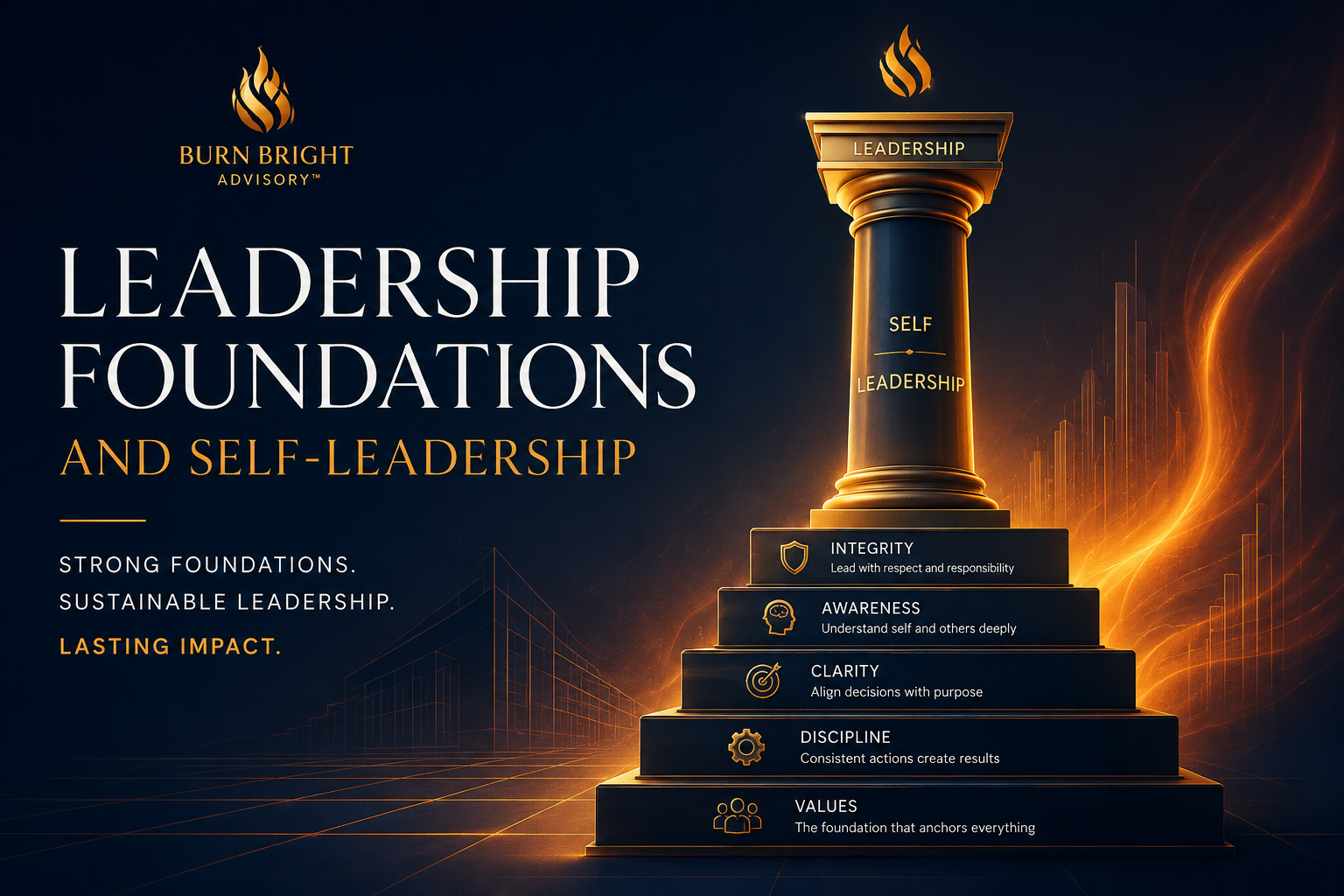
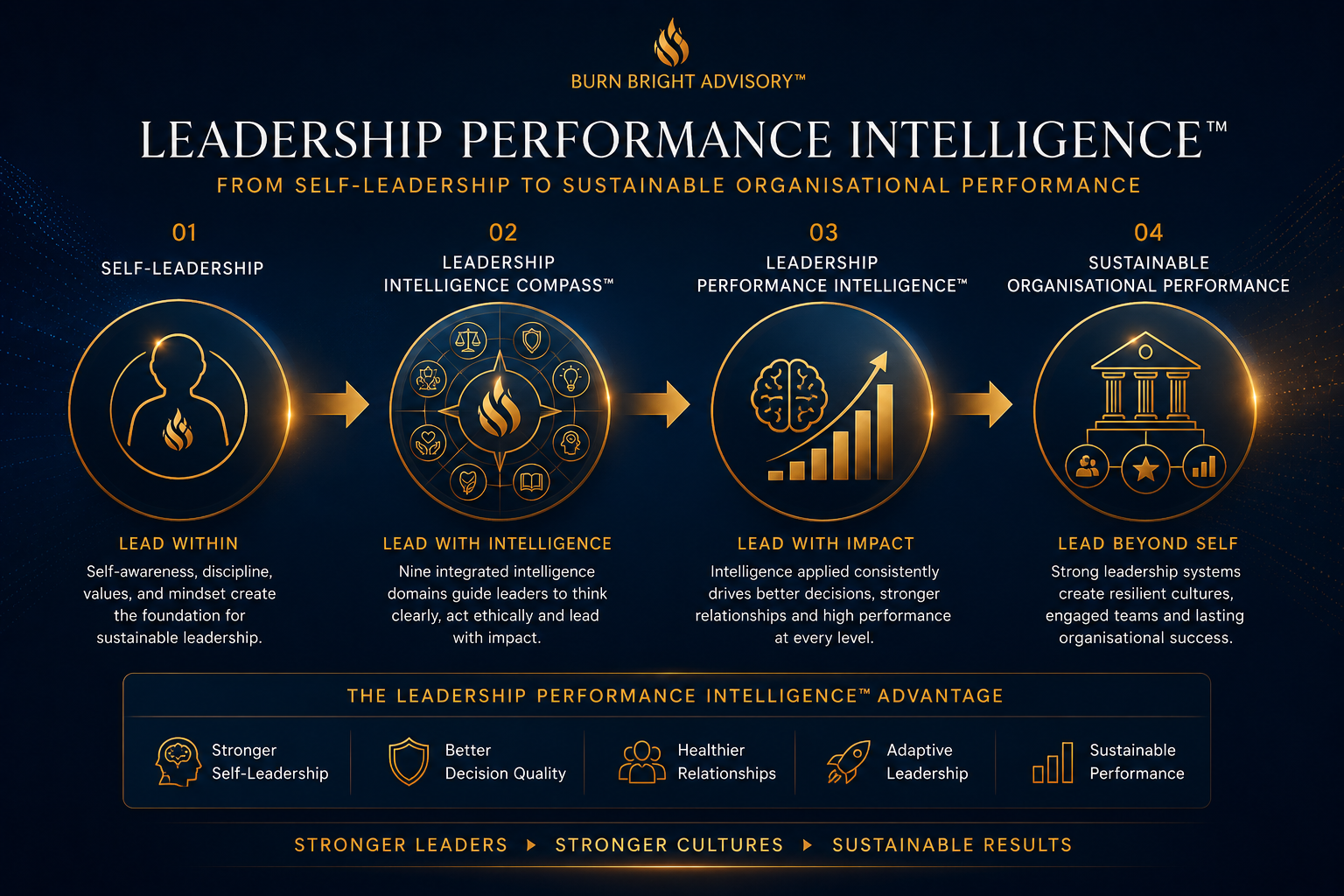
At Burn Bright Advisory™, this principle forms the basis of Leadership Performance Intelligence™ — a comprehensive framework that views leadership not as a position or personality trait, but as an integrated capability that can be intentionally developed throughout a professional career.
Featured Snippet
Leadership Is an Internal Capability Before It Is an External Behaviour
Many leadership models focus almost exclusively on observable behaviours:
- Communicating vision
- Managing performance
- Motivating teams
- Influencing stakeholders
- Delivering organisational outcomes
These are certainly important. However, behaviour is only the visible expression of internal capability.
Two leaders may deliver exactly the same presentation, yet one inspires confidence while the other creates uncertainty. Two managers may face identical organisational challenges, yet one remains composed while the other becomes reactive. The difference is rarely technical knowledge. It is the quality of the internal leadership system supporting every decision.
It begins with how you think.
How you interpret uncertainty.
How you regulate emotion.
How you evaluate competing priorities.
How willing you are to learn.
How consistently your actions reflect your values.
These internal processes determine every external leadership behaviour.
Understanding Leadership Performance Intelligence™
Leadership Performance Intelligence™ recognises that sustainable leadership performance emerges through the interaction of multiple capabilities rather than one dominant leadership style. Instead of asking leaders to imitate successful executives or follow generic leadership formulas, the framework encourages continuous capability development across interconnected domains, including Professionalism Intelligence™, Ethics Intelligence™, Constructivism Intelligence™, Adaptability Intelligence™, Visionary Leadership Intelligence™, Reflective Practice Intelligence™, Knowledge Development Intelligence™, Emotional Intelligence™ and Leadership Sustainability™.
Each capability strengthens the others. Improving emotional intelligence enhances communication. Improving reflective practice improves judgement. Improving professionalism strengthens trust. Improving adaptability increases resilience. Together they create a leadership system capable of performing consistently under pressure.
This systems perspective distinguishes Leadership Performance Intelligence™ from traditional competency models, which often assess isolated skills without considering how those capabilities interact.
Why Leadership Foundations Matter More Than Ever
The demands placed upon modern leaders continue to expand. Leaders are expected to navigate uncertainty, lead hybrid teams, manage technological disruption, balance competing stakeholder expectations, support employee wellbeing, deliver organisational performance, drive innovation and maintain ethical standards.
Many organisations respond by providing more technical training. Yet technical competence alone rarely solves leadership challenges. Consider three examples.
Across every sector, the pattern remains remarkably consistent. Leadership challenges are increasingly human challenges. The strongest leaders therefore invest as much in developing themselves as they do in developing organisational strategy.
Self-Leadership: The First Responsibility of Every Leader
Leadership begins with the ability to lead oneself. This principle appears throughout philosophy, psychology and contemporary leadership research because it reflects an enduring truth. People rarely follow what leaders say. They follow what leaders consistently demonstrate.
Self-leadership involves intentionally managing:
- Behaviour
- Decision-making
- Emotional responses
- Professional standards
- Continuous learning
- Personal wellbeing
- Ethical judgement
It requires leaders to become students of themselves. Rather than asking “How do I influence my team?”, effective leaders first ask “How do I improve the quality of my own thinking?” This shift transforms leadership from reactive management into deliberate professional practice.
The Five Essential Leadership Foundations
Although leadership is complex, several foundational capabilities consistently appear across high-performing leaders regardless of sector.
1. Self-Awareness
Self-awareness is the starting point of all meaningful leadership development. Leaders who understand their strengths, limitations, values and behavioural patterns make better decisions because they recognise the assumptions influencing their judgement. Without self-awareness, experience can reinforce ineffective habits rather than improve performance.
Reflective leaders continually examine:
- What happened?
- Why did it happen?
- What assumptions influenced my decision?
- What could I improve next time?
Leadership growth therefore depends less on experience itself and more on the quality of reflection applied to experience.
2. Professionalism
Professionalism extends beyond appearance or organisational etiquette. Professionalism Intelligence™ reflects the consistent alignment between competence, integrity, accountability and respectful behaviour. Professional leaders keep commitments, demonstrate reliability, maintain high standards, communicate respectfully, accept responsibility and build trust through consistency.
Trust is rarely created through isolated moments of excellence. It develops through repeated demonstrations of professionalism over time — one of the strongest predictors of leadership credibility.
3. Reflective Practice
High-performing leaders rarely rely solely on instinct. Instead, they intentionally create opportunities to think. Reflection transforms experience into learning. Without reflection, organisations repeat mistakes. With reflection, organisations build wisdom.
Reflective Practice Intelligence™ encourages leaders to pause before reacting, evaluate outcomes objectively and continuously refine their leadership approach — a habit that becomes increasingly valuable as organisational complexity increases.
4. Emotional Intelligence
Leadership is fundamentally relational. Every decision influences people. Every conversation shapes culture. Every response communicates priorities. Emotional Intelligence enables leaders to understand both their own emotional responses and those of others.
Rather than suppressing emotion, emotionally intelligent leaders learn to interpret it constructively. They recognise stress before burnout occurs, conflict before relationships deteriorate, disengagement before performance declines, and uncertainty before resistance emerges.
5. Leadership Sustainability
One of the greatest misconceptions about leadership is that effectiveness requires constant sacrifice. Many talented leaders attempt to solve every problem personally. Initially this appears admirable. Eventually it becomes unsustainable.
Leadership Sustainability™ recognises that long-term organisational success depends upon preserving leadership capacity. Sustainable leaders delegate effectively, establish healthy boundaries, develop future leaders, protect decision-making capacity and balance performance with wellbeing.
Leadership Intelligence Compass™: Building Leadership as an Integrated System
Traditional leadership development often treats leadership as a collection of isolated competencies. One programme focuses on communication, another on strategy, another on emotional intelligence. While each capability has value, leaders rarely experience challenges in isolation. A difficult conversation requires emotional intelligence, professionalism, ethical judgement, adaptability and reflective practice simultaneously.
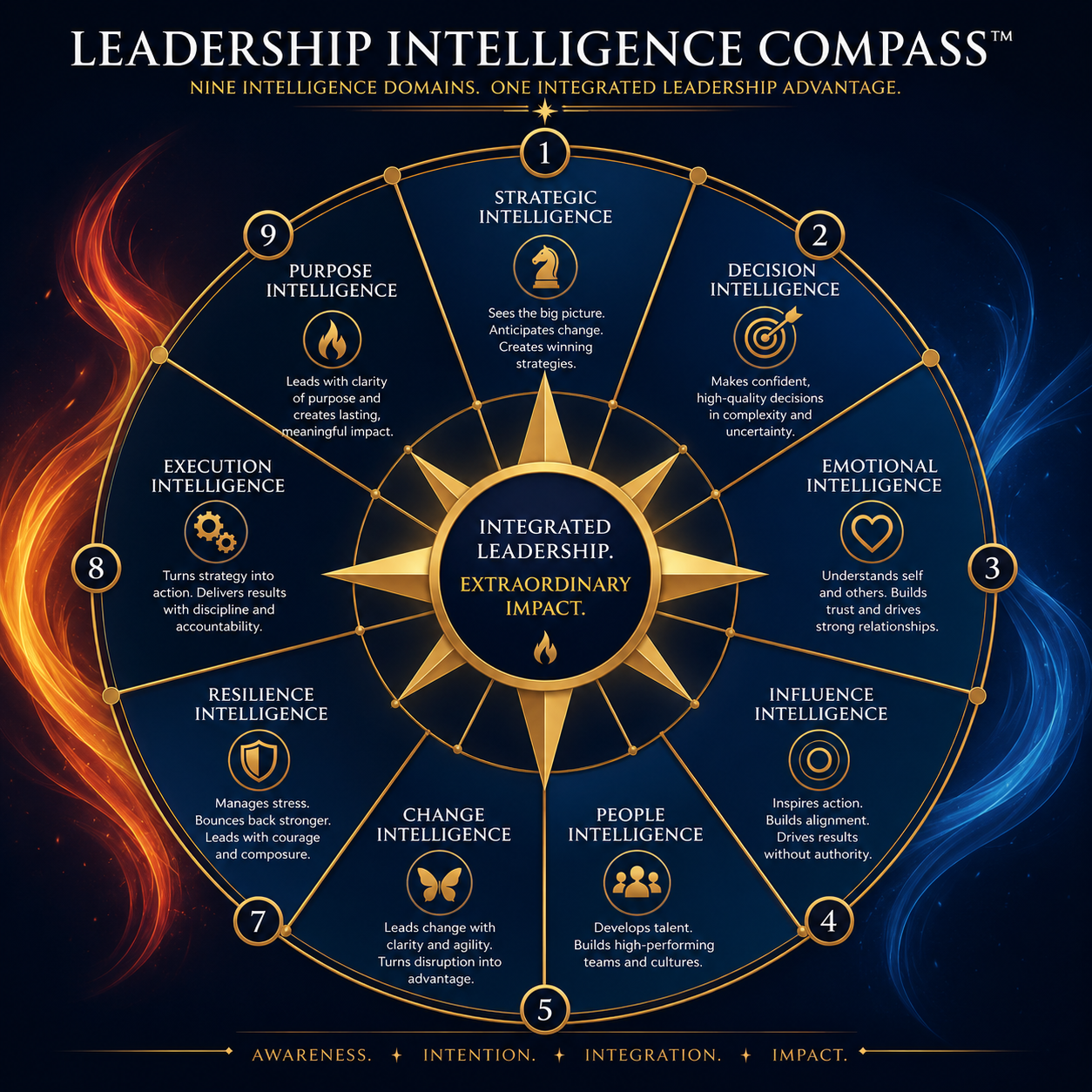
Leadership Performance Intelligence™ therefore views leadership as an integrated system rather than a checklist of competencies. The Leadership Intelligence Compass™ provides this integrated framework. Rather than asking “Which leadership style should I use?”, the Compass encourages leaders to ask which capability is strongest, which capability is limiting effectiveness, how these capabilities interact, and which area to intentionally develop next.
The Nine Domains of the Leadership Intelligence Compass™
Domain 1
Professionalism Intelligence™
The visible expression of leadership credibility. People trust leaders who consistently demonstrate reliability, competence and accountability.
- Personal responsibility
- Consistent behaviour
- Ethical professionalism
Domain 2
Ethics Intelligence™
Enables leaders to evaluate decisions beyond immediate organisational outcomes, asking who benefits, who is disadvantaged, and what the long-term consequences are.
Domain 3
Constructivism Intelligence™
Focuses on building meaning rather than simply collecting knowledge — questioning assumptions and integrating multiple perspectives.
Domain 4
Adaptability Intelligence™
Enables leaders to remain effective despite uncertainty through learning agility, cognitive flexibility and resilience during disruption.
Domain 5
Visionary Leadership Intelligence™
Combines strategic thinking with organisational purpose to communicate compelling futures and translate strategy into practical action.
Domain 6
Reflective Practice Intelligence™
Transforms experience into expertise by regularly examining decisions, interactions and outcomes to accelerate professional development.
Domain 7
Knowledge Development Intelligence™
Encourages evidence-informed practice, intellectual curiosity and lifelong learning, since knowledge depreciates rapidly.
Domain 8
Emotional Intelligence™
Allows leaders to understand emotions, regulate reactions, communicate effectively, resolve conflict and build trust.
Domain 9
Leadership Sustainability™
Focuses on preserving long-term leadership capacity through healthy workload management, delegation, resilience and succession planning.
Leadership Foundations Across Every Sector
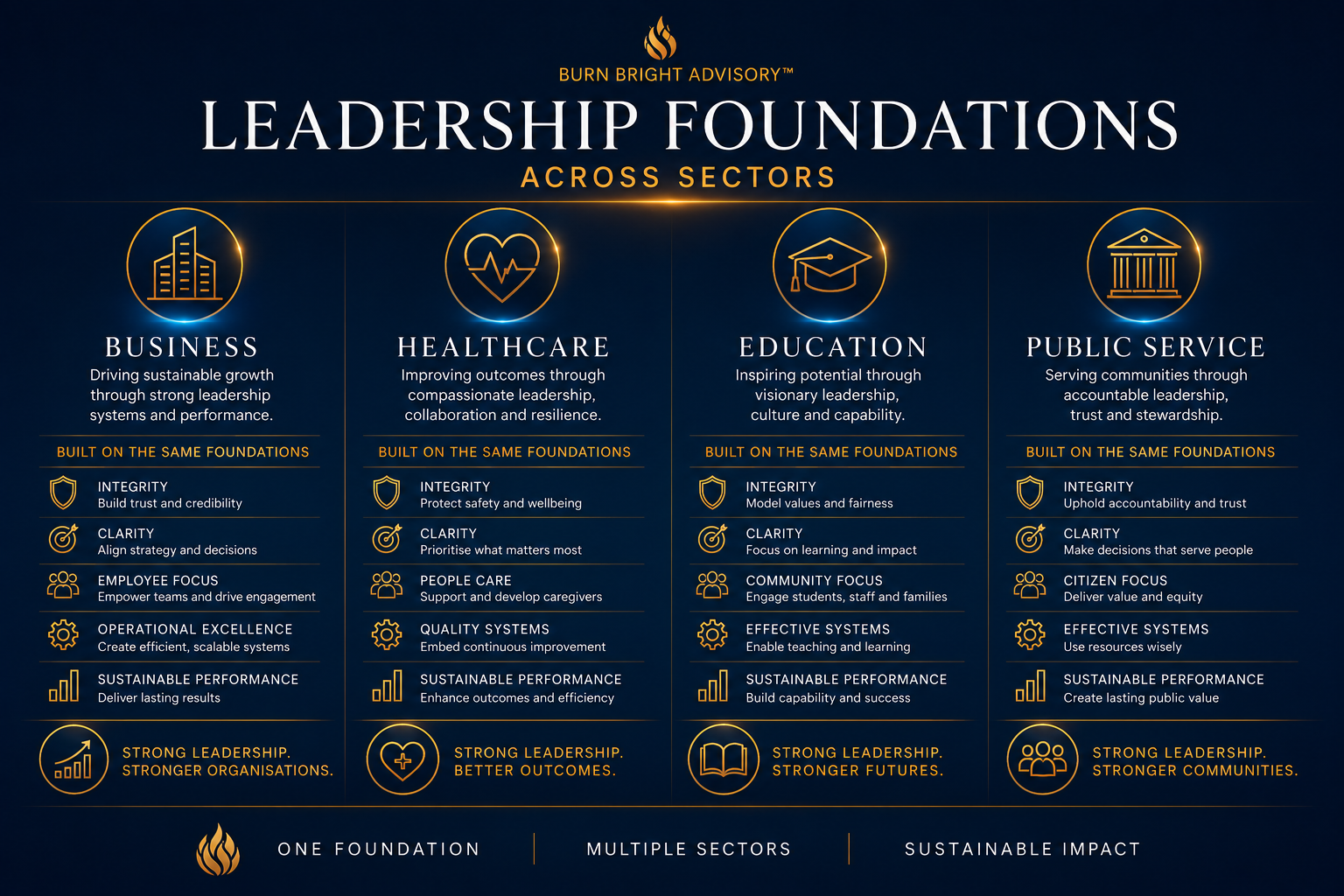
Although leadership contexts differ, the underlying foundations remain remarkably consistent.
Business
Leadership foundations help executives make better strategic decisions, develop high-performing teams, improve organisational trust, reduce burnout and strengthen innovation.
Education
Leadership foundations help educational leaders improve staff engagement, strengthen reflective practice and build psychologically safe learning cultures.
Healthcare
Leadership foundations support healthcare leaders by improving multidisciplinary collaboration, patient-centred decision-making and workforce wellbeing.
Public Service
Leadership foundations strengthen ethical governance, public trust, transparent decision-making and adaptive leadership during crises.
A Practical Leadership Performance Intelligence™ Framework
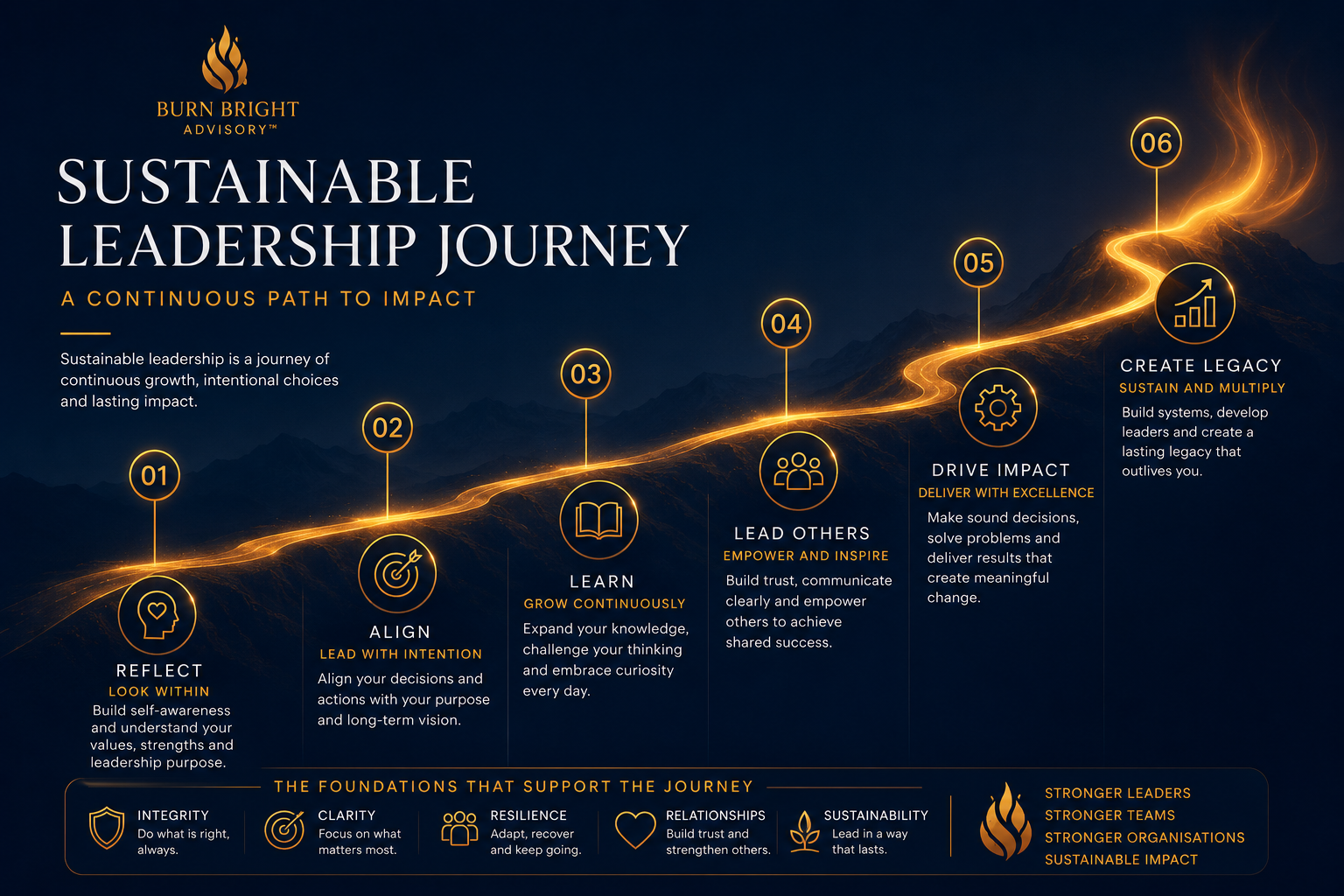
Leadership development should be intentional rather than accidental. The following five-stage framework provides a practical starting point.
Stage 1 Reflect
Focus: Self-awareness
Key question: What is influencing my leadership today?
Stage 2 Assess
Focus: Capability
Key question: Which leadership domain needs development?
Stage 3 Develop
Focus: Continuous learning
Key question: What new capability should I intentionally strengthen?
Stage 4 Apply
Focus: Daily leadership
Key question: How can I apply this in practice?
Stage 5 Review
Focus: Reflective practice
Key question: What have I learned, and what needs refinement?
Rather than seeking perfection, leaders continuously strengthen capability over time. Small improvements, consistently applied, produce substantial long-term leadership growth.
Practical Action Steps
Leadership foundations are built deliberately through consistent practice rather than occasional inspiration.
Week One: Increase Self-Awareness
Schedule thirty minutes for uninterrupted reflection, record three recent leadership decisions, identify the assumptions behind each, and ask one trusted colleague for honest leadership feedback.
Week Two: Strengthen Professionalism
Review your professional habits — communication quality, reliability, responsiveness, accountability, preparation and follow-through — and identify one behaviour to improve immediately.
Week Three: Develop Reflective Practice
Begin a weekly leadership journal. After significant meetings, ask what worked, what could improve, what surprised you, and what you’d do differently next time.
Week Four: Build Leadership Sustainability
Conduct a workload review to identify activities only you can perform, activities someone else could lead, unnecessary meetings and opportunities for delegation.
Leadership Reflection Questions
- Which leadership capability currently represents my greatest strength?
- Which capability most limits my effectiveness?
- How consistently do my actions reflect my professional values?
- Do people experience my leadership as trustworthy?
- Am I developing future leaders or solving every problem myself?
- What assumptions most influence my decisions?
- How effectively do I learn from mistakes?
- What leadership capability should I intentionally develop during the next six months?
Moving from Leadership Activity to Leadership Capability
Many leaders spend years becoming increasingly busy without becoming significantly better leaders. Activity is often mistaken for effectiveness. Meetings become evidence of productivity. Long working hours become symbols of commitment. Constant availability becomes synonymous with leadership. Yet none of these behaviours necessarily improve organisational performance.
Leadership Performance Intelligence™ shifts attention away from visible activity towards sustainable capability. It asks leaders not simply “What did I accomplish today?” but “Who am I becoming as a leader?” That distinction separates temporary performance from lasting leadership excellence.
Conclusion
Leadership is not built through authority alone, nor through technical expertise, charisma or experience in isolation. Exceptional leadership begins with strong foundations. It is developed through disciplined self-leadership, reflective practice, ethical judgement, professionalism and continuous learning.
Leadership Performance Intelligence™ provides a comprehensive framework for integrating these capabilities into everyday leadership practice, while the Leadership Intelligence Compass™ offers leaders a practical way to understand and intentionally develop the interconnected domains that drive sustainable performance.
Across business, education, healthcare and public service, the organisations that thrive over the coming decade are unlikely to be those with the most charismatic leaders. They will be those whose leaders continually strengthen their capacity to learn, adapt, reflect and lead with integrity.
What are leadership foundations?
Leadership foundations are the core capabilities that enable leaders to influence others consistently, ethically and sustainably. They include self-awareness, professionalism, reflective practice, emotional intelligence and sound judgement.
Why is self-leadership important?
Leaders influence others through their behaviours, decisions and relationships. Self-leadership develops the discipline, awareness and consistency necessary to lead others effectively.
What is Leadership Performance Intelligence™?
Leadership Performance Intelligence™ is Burn Bright Advisory™’s integrated framework for developing sustainable leadership capability. It recognises leadership as a system of interconnected intelligences rather than isolated competencies.
How is the Leadership Intelligence Compass™ different from traditional leadership models?
Many leadership models assess individual skills independently. The Leadership Intelligence Compass™ demonstrates how leadership capabilities interact to influence long-term leadership performance and organisational effectiveness.
Can leadership foundations be developed?
Yes. Leadership capability is not fixed. Through deliberate reflection, continuous learning, practical experience and structured development, leaders can strengthen every domain of Leadership Performance Intelligence™ throughout their careers.
Why does leadership sustainability matter?
Unsustainable leadership eventually reduces decision quality, increases burnout and limits organisational performance. Leadership Sustainability™ helps leaders maintain high performance while protecting long-term wellbeing and organisational capacity.
Who benefits from Leadership Performance Intelligence™?
The framework applies across business, education, healthcare, public service, non-profit organisations, entrepreneurs, emerging leaders and executive leadership teams. Any individual responsible for influencing others can benefit.
How do I begin improving my leadership foundations?
Begin with honest self-assessment. Develop greater awareness of your current leadership behaviours, identify one capability requiring improvement, create deliberate learning goals and review your progress regularly through reflective practice.
Where Do Your Leadership Foundations Stand Today?
Take the free Leadership Burnout Self-Assessment to understand your current leadership capacity and identify the foundations most worth strengthening.
Free Leadership Intelligence
Get Weekly Leadership Insights
Join thousands of leaders receiving practical strategies on burnout prevention, workload design, and sustainable performance every week.