Quick Answer
Key Takeaways
- Protect strategic capacity: Schedule thinking time as an essential leadership responsibility, not an optional activity.
- Redesign workload: Remove or redistribute work before adding strategic sessions to an overloaded calendar.
- Reduce decision bottlenecks: Give teams clear authority to make appropriate operational decisions.
- Measure outcomes: Evaluate better decisions, reduced escalation and improved team independence rather than hours spent in meetings.
- Build sustainable rhythms: Make strategic thinking a recurring part of leadership architecture rather than an occasional luxury.
Strategic Thinking Time for Leaders: Reclaim Control
Strategic thinking time for leaders is disappearing under the weight of meetings, operational demands and constant digital communication.
Most senior leaders recognise the problem.
They begin the week with clear priorities. By Tuesday, those priorities have been displaced by urgent requests, unexpected meetings and decisions that should never have reached their desk.
By Friday, they have worked hard, responded to hundreds of messages and solved numerous immediate problems.
Yet the important work remains unfinished.
The organisational strategy has not progressed.
Emerging risks have not been examined.
Team capacity has not been reviewed.
The underlying problems generating repeated emergencies remain untouched.
This is not simply a time management problem.
It is a structural leadership problem.
When organisations design leadership roles around constant availability, they remove the capacity required for judgement, foresight and improvement.
The result is predictable: more firefighting, increasing decision fatigue and declining strategic effectiveness.
In this article, I will explain why strategic thinking disappears, how reactive leadership contributes to burnout, and how to redesign workload and decision structures to protect the capacity that effective leadership requires.
What Is Strategic Thinking Time?
Featured Snippet
The distinction is fundamental. The first visual shows why strategic thinking must be designed into the leadership role.
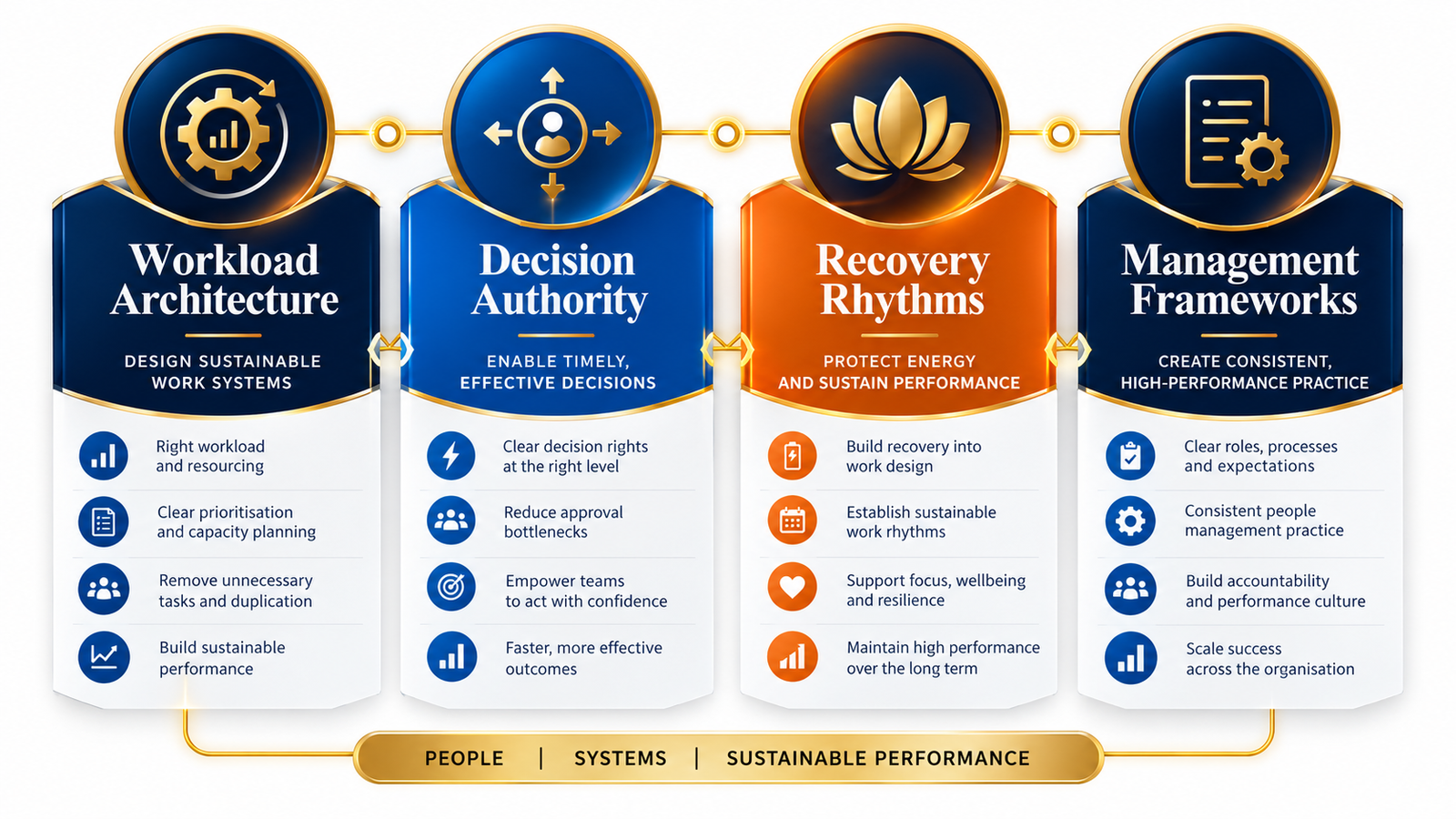
The Burn Bright Not Out Framework™ identifies four connected areas: Workload Architecture™, Decision Authority™, Recovery Rhythms™ and Management Frameworks. Strategic thinking becomes sustainable when all four support it.
Why Do Leaders Lose Strategic Thinking Time?
Strategic thinking rarely disappears because leaders consider it unimportant.
It disappears because the organisation has made immediate responsiveness more visible, more measurable and more socially rewarded than long-term judgement.
Consider a secondary school leader responsible for staffing, safeguarding, performance, budgets and organisational improvement.
Their calendar may contain thirty hours of meetings each week. The remaining time is consumed by urgent conversations, reporting requirements and decisions escalated by colleagues.
- When should that leader examine the school’s future staffing model?
- When should they review the causes of repeated operational failures?
- When should they challenge whether existing processes still serve their intended purpose?
Usually, the answer is: when everything else is finished.
But everything else is never finished.
The Five Structural Causes
Within the Burn Bright Not Out Framework™, five root causes repeatedly undermine sustainable leadership:
These pressures reinforce one another.
Scope creep creates more meetings. Meetings delay decisions. Delayed decisions generate more messages. More messages increase interruptions. Interruptions encourage leaders to complete tasks themselves because delegation appears slower.
What Does the Research Tell Us?
Microsoft’s 2023 Work Trend Index reported that 68% of people surveyed said they lacked sufficient uninterrupted focus time during the working day.
This matters because strategic leadership requires sustained attention, not simply access to information.
Microsoft also found that meetings had increased substantially in its Microsoft 365 workplace data compared with February 2020, illustrating how collaboration demands can expand into available working capacity.
The lesson is not that meetings are inherently damaging. Meetings are necessary for coordination, accountability and collective judgement.
The problem emerges when organisations fail to distinguish between conversations that create value and conversations that merely transfer information.
A leader who spends their week attending every discussion has little capacity left to examine whether those discussions are necessary.
This is why protecting time alone is insufficient.
The workload itself must change.
How Does a Lack of Strategic Thinking Time Cause Burnout?
Leadership burnout develops when sustained workplace demands exceed the resources available to manage them.
The World Health Organization defines burnout as an occupational phenomenon resulting from chronic workplace stress that has not been successfully managed. It identifies three dimensions: exhaustion, increased mental distance or cynicism towards work, and reduced professional efficacy.
Strategic thinking time matters because it influences how those demands are managed. Without it, leaders become trapped in a cycle of reacting to problems they have no opportunity to prevent.
The Reactive Leadership Cycle
- A recurring operational problem appears.
- The leader intervenes because the issue is urgent.
- The immediate situation improves.
- However, the underlying process remains unchanged.
- The same problem returns.
- The leader intervenes again.
Over time, the organisation becomes increasingly dependent on the leader’s personal availability. This creates two failures.
First, the organisation fails to develop reliable systems.
Second, the leader becomes the system.
I have seen this pattern across leadership environments. Capable professionals gradually become the point through which every difficult issue must pass.
Their competence becomes a liability because it encourages everyone else to depend on them.
The Hidden Cost of Constant Reaction
Gallup’s State of the Global Workplace 2024 reported that 41% of employees globally experienced a lot of stress the previous day.
The same report estimated that low employee engagement cost the global economy approximately US$8.9 trillion, equivalent to 9% of global GDP.
These figures do not establish that inadequate strategic thinking directly causes burnout or economic losses. They demonstrate the wider scale of workplace strain and disengagement that organisations must address.
The relationship between strategic capacity and burnout is therefore best understood through organisational design.
When leaders cannot examine root causes, inefficient systems persist.
Those systems create additional demands.
Additional demands consume the capacity needed to improve them.
This is a self-reinforcing problem.
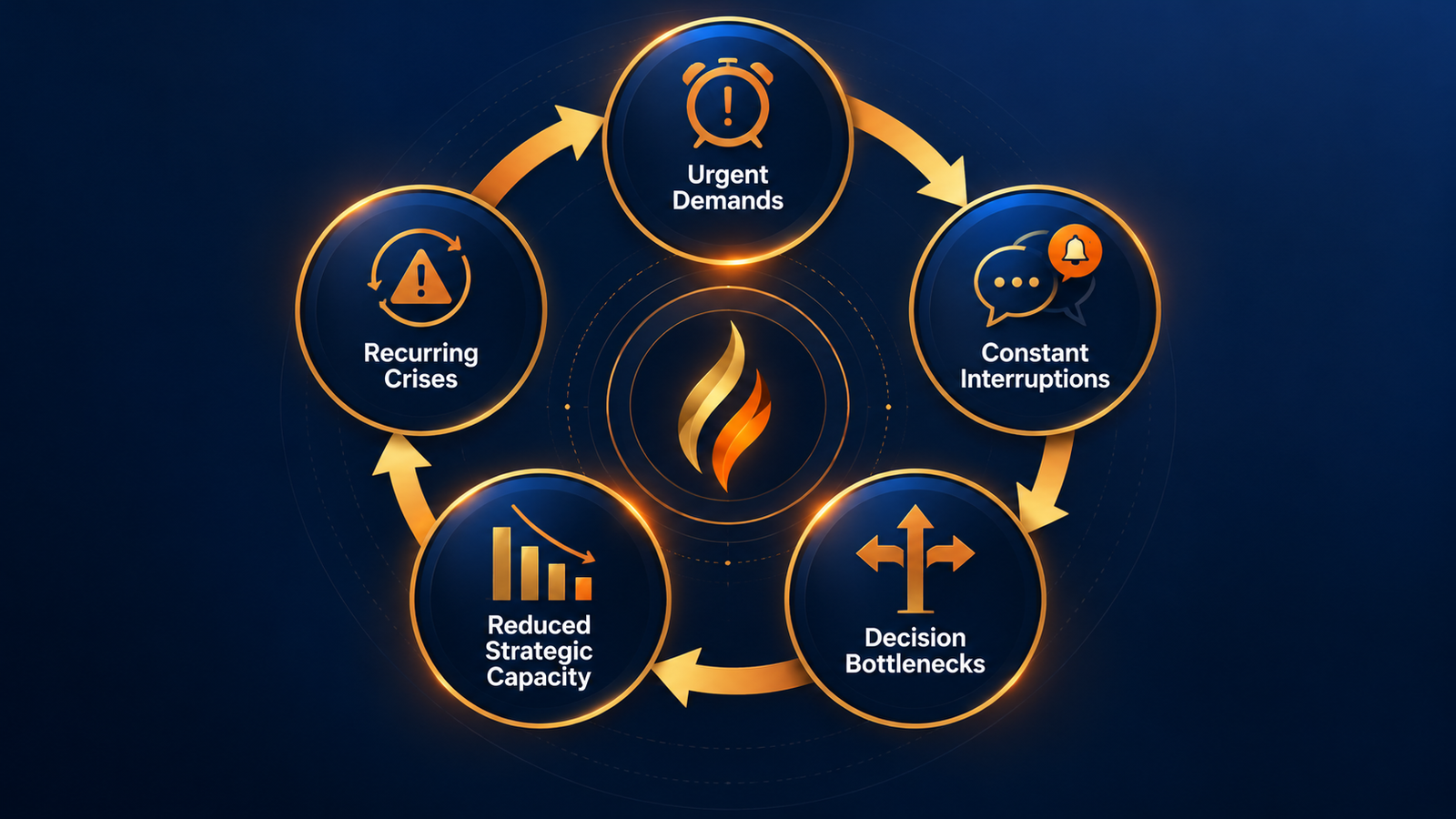
The diagram illustrates a causal mechanism rather than a measured statistical relationship.
The intervention point is structural. Reducing unnecessary meetings, clarifying decision authority and redesigning workload interrupts the cycle.
Leaders can then invest time in preventing problems instead of repeatedly responding to them.
For a broader explanation, see the Burn Bright leadership burnout course.
How Much Strategic Thinking Time Do Leaders Need?
There is no universal number of hours that guarantees effective strategic leadership.
The correct allocation depends on organisational complexity, role responsibilities, decision authority and the maturity of existing systems.
A chief executive overseeing several divisions will have different strategic demands from a newly appointed team manager. Nevertheless, one principle applies to both.
Start With a Capacity Audit
Before blocking additional hours, examine the current working week. Divide your activities into four categories:
- Strategic: future priorities, system improvement, risk analysis and resource planning.
- Operational: delivering existing plans and coordinating routine activity.
- Reactive: responding to unexpected issues and escalations.
- Administrative: reporting, scheduling and information processing.
Then ask three questions.
- What proportion of my week improves future performance?
- Which activities genuinely require my authority?
- Which recurring demands exist because our systems are poorly designed?
The answers often reveal that the problem is not insufficient effort.
It is poor Workload Architecture™.
A Practical Starting Allocation
For a senior leader whose role includes meaningful strategic responsibility, two protected 90-minute sessions per week can provide an initial test.
This is a practical design recommendation, not a scientifically established ideal.
The sessions should have defined purposes. The first might examine emerging risks, priorities and resource constraints. The second might focus on system improvement, leadership development and decisions affecting the next quarter.
Neither session should become another reporting meeting.
Protect the Quality of the Time
Strategic thinking requires more than an empty calendar. It requires reduced interruption.
Notifications should be managed. Routine decisions should follow agreed escalation rules. Colleagues should understand when interruption is justified.
Crucially, the time must not simply create additional work later.
If a leader protects three hours for strategy but compensates by working three hours in the evening, the intervention has failed.
Use Time Architecture™
The Burn Bright Not Out Framework™ includes Time Architecture™ as a specific management discipline.
Time Architecture™ examines how the organisation allocates attention across competing demands. It asks whether the calendar reflects genuine priorities or inherited habits.
For example, a weekly two-hour update meeting might be replaced with a concise written dashboard and a thirty-minute decision session. The recovered capacity can then support strategic work.
The value is not merely the time saved.
It is the improvement in how decisions are made.
Related reading: Burn Bright leadership insights and practical frameworks.
How Can Leaders Redesign Their Calendars for Strategic Work?
The calendar is one of the clearest indicators of an organisation’s leadership priorities.
If every available hour is allocated to operational activity, strategic thinking is being excluded by design.
A sustainable calendar requires deliberate choices about what leaders attend, what they delegate and what they stop doing.
Step 1: Audit recurring commitments
Examine the previous four weeks. Identify every recurring meeting and assess its purpose. Does it produce a decision? Does it resolve an issue that cannot be handled elsewhere? Does your attendance materially improve the outcome? If the answer is consistently no, challenge the commitment. A meeting should not survive simply because it has always existed.
Step 2: Establish decision authority
Many leaders spend excessive time in meetings because colleagues lack clarity about who can make decisions. The RACI Delegation Framework™ provides a practical solution. It distinguishes between those Responsible for delivery, Accountable for the outcome, Consulted for expertise and Informed about progress.
Consider a department purchasing routine equipment within an approved budget. If every purchase requires senior leadership approval, the process creates an unnecessary bottleneck.
Clear spending limits and delegated authority allow appropriate decisions to happen without escalation. Senior leaders retain oversight without becoming involved in every transaction.
Step 3: Introduce protected strategic sessions
A protected strategic session needs a defined purpose and clear operating rules. For example:
| Illustrative Session | Focus |
|---|---|
| Tuesday, 9:00–10:30 | Future priorities, emerging risks and resource planning |
| Thursday, 14:00–15:30 | System improvement, leadership capability and strategic decisions |
| Friday, 15:00–15:20 | Review actions, decisions and next week’s priorities |
These sessions should be protected by agreed interruption rules and supported by a colleague authorised to handle routine issues.
Step 4: Remove equivalent workload
This is the step organisations frequently overlook. You cannot create sustainable capacity by adding another expectation to an already overloaded role. For every strategic session introduced, identify operational work to eliminate, simplify or redistribute. Otherwise, strategic thinking becomes another demand competing for exhausted attention.
Step 5: Review the design monthly
Ask whether the protected time is being used as intended. Identify what repeatedly interrupts it. Determine whether those interruptions indicate genuine emergencies or weak operational systems.
The purpose is not to defend a calendar at all costs. It is to establish a leadership structure that can handle both predictable work and legitimate disruption.
What Does Sustainable Strategic Leadership Look Like?
Sustainable strategic leadership is not characterised by leaders who are permanently unavailable.
It is characterised by organisations that can operate effectively without requiring constant senior intervention.
The difference becomes clear when we compare two approaches.
| Reactive Leadership | Sustainable Strategic Leadership |
|---|---|
| Calendar controlled by incoming demands | Calendar designed around priorities |
| Senior leader approves routine decisions | Decisions made at appropriate levels |
| Repeated problems handled individually | Root causes examined and corrected |
| Meetings used for information sharing | Meetings used for necessary decisions |
| Constant availability rewarded | Clear escalation boundaries respected |
| Success measured by visible busyness | Success measured by outcomes |
| Recovery left to personal time | Recovery built into workload design |
| Performance depends on heroic effort | Performance supported by reliable systems |
The comparison reveals a critical distinction.
Strategic leadership is not simply about thinking differently.
It requires organisations to operate differently.
The Four-Pillar Solution
The Burn Bright Not Out Framework™ provides a practical structure for making that transition.
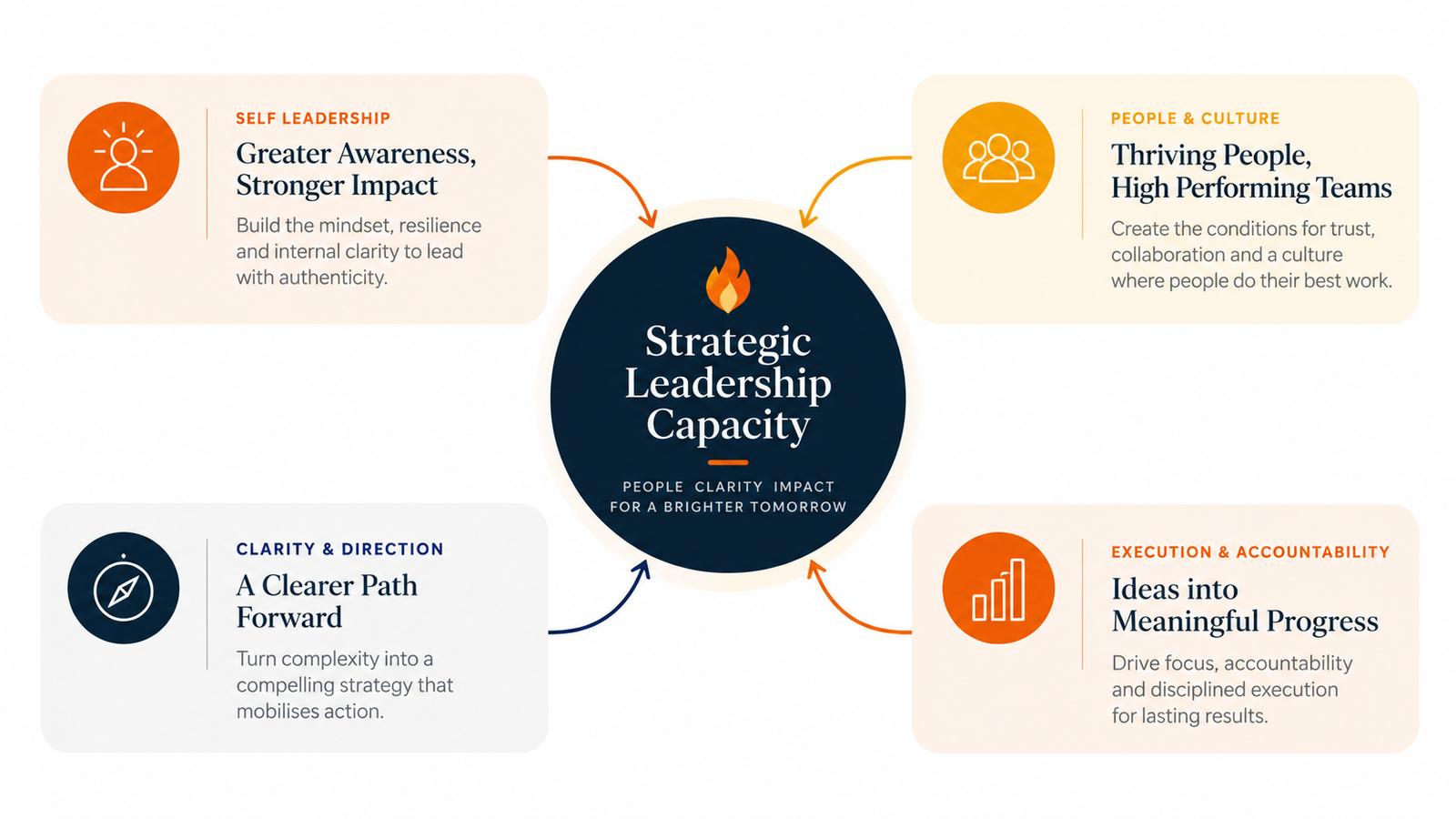
Pillar 1
Workload Architecture™
Define realistic responsibilities, capacity and priorities. Remove work that no longer contributes sufficient value.
Pillar 2
Decision Authority™
Clarify who can decide, who must be consulted and what requires escalation. Reduce unnecessary dependence on senior leaders.
Pillar 3
Recovery Rhythms™
Design working patterns that allow sustained concentration and recovery. Avoid making permanent urgency the normal operating condition.
Pillar 4
Management Frameworks
Introduce repeatable approaches for prioritisation, delegation, communication and review. Reduce the need to reinvent decisions every week.
These pillars work together.
Protected strategic time without decision authority will be interrupted.
Delegation without workload clarity will create confusion.
Recovery without operational redesign will provide temporary relief while leaving the underlying demands unchanged.
The objective is structural alignment.
What Should Leaders Actually Think About?
Strategic sessions should address questions that change future organisational performance. For example:
Leadership Reflection Questions
- Which recurring problems consume disproportionate leadership attention?
- What responsibilities have expanded without corresponding resources?
- Which decisions could be made closer to the work?
- What risks are emerging that current reporting does not capture?
- Which processes would we redesign if we were building the organisation today?
These questions shift attention from managing activity to improving organisational effectiveness.
The value of strategic thinking is demonstrated through the decisions it produces and the problems it prevents.
How Can Leaders Make Strategic Thinking Time Sustainable?
Protecting strategic capacity for one week is relatively straightforward. Maintaining it across several months requires organisational discipline.
This is where leadership intent must become an operating framework.
The 30-60-90 Day Approach
The Burn Bright Not Out Framework™ includes a 30-60-90 Day Plan for implementing structural change. Applied to strategic thinking, the process has three phases.
30 Days Diagnose the problem
Audit the calendar, identify recurring interruptions and record decisions that unnecessarily reach senior leadership. Establish baseline measures.
60 Days Redesign the system
Remove low-value meetings, clarify delegation and introduce protected strategic sessions. Agree on escalation rules.
90 Days Embed and evaluate
Review strategic decisions, repeat escalations, meeting hours and workload sustainability. Adjust structures where needed.
Measure What Changes
A useful measurement system might include:
- Strategic capacity: Hours spent on planned strategic work during normal working time.
- Decision independence: Proportion of routine decisions completed without senior escalation.
- Operational recurrence: Number of repeated problems requiring leadership intervention.
- Meeting efficiency: Hours spent in recurring meetings relative to decisions and outcomes produced.
- Workload sustainability: Whether leaders and teams can maintain performance without routinely extending their working hours.
No single measure tells the whole story. A leader might increase strategic hours while team workload deteriorates. That is not sustainable improvement.
The objective is better organisational performance without transferring excessive demands elsewhere.
Make Strategic Capacity an Organisational Expectation
The most effective intervention is cultural as well as operational.
Senior leaders must demonstrate that thinking, questioning and redesigning systems are legitimate leadership activities. They must also avoid rewarding constant availability while publicly encouraging strategic work.
If leaders are expected to respond instantly to every message, protected time will never be secure. The organisation must decide which behaviours it genuinely values.
McKinsey’s research on organisational health has consistently emphasised the relationship between management practices, organisational effectiveness and long-term performance. The practical implication is that sustained performance depends on the systems through which people work, not only the capability of individual leaders.
Strategic capacity should therefore be reviewed alongside delivery, risk, people and financial performance.
It is part of how the organisation operates.
Not an occasional reward for completing everything else.
Frequently Asked Questions
What is strategic thinking time for leaders?
Strategic thinking time is protected working capacity for examining future priorities, risks, organisational systems and important decisions. It differs from routine management because it focuses on improving future outcomes rather than responding only to immediate demands. Effective leaders use it to identify root causes, allocate resources and strengthen organisational capability.
How many hours should leaders spend on strategic thinking?
There is no universally correct number. The appropriate allocation depends on the role and organisational context. Two 90-minute sessions each week can be a useful starting experiment for senior leaders. The essential requirement is to remove or redistribute other work so the sessions do not create additional working hours.
Why is strategic thinking difficult for busy executives?
Strategic thinking becomes difficult when calendars are dominated by meetings, interruptions, unclear decision authority and competing priorities. Executives may also feel pressure to demonstrate value through immediate responsiveness. Sustainable improvement requires changes to workload and management systems rather than relying exclusively on personal discipline.
Can strategic thinking time help prevent leadership burnout?
It can support burnout prevention when combined with realistic workloads, clear decision authority and effective recovery. Strategic time allows leaders to examine recurring problems before they generate further demands. However, protected thinking sessions alone cannot resolve chronic overload, inadequate staffing or harmful organisational expectations.
How can leaders protect thinking time without neglecting their teams?
Leaders should establish clear escalation criteria, delegate appropriate decisions and ensure colleagues know how genuine emergencies will be handled. Protected time should not mean abandoning responsibilities. It means creating reliable systems that allow teams to operate effectively without requiring continuous senior involvement.
What should a leader do during a strategic thinking session?
Begin with one significant organisational question. Examine relevant evidence, identify underlying causes, consider alternative responses and record decisions or next actions. Avoid using the session to clear email, prepare routine reports or complete postponed administration. The purpose is to improve future decisions and organisational performance.
Conclusion: Strategic Thinking Is a Leadership Responsibility
Strategic thinking time for leaders is not an indulgence. It is a fundamental requirement of effective organisational leadership.
When leaders spend every working hour responding to immediate demands, they lose the capacity to question why those demands exist.
Problems repeat.
Decisions accumulate.
Meetings expand.
And organisations become increasingly dependent on the personal endurance of a small number of capable people.
That is not a sustainable leadership model.
The solution is not simply to work faster, protect a few calendar appointments or become more disciplined. It is to redesign the structures that determine how leadership attention is allocated.
- Workload Architecture™ creates realistic capacity.
- Decision Authority™ reduces unnecessary escalation.
- Recovery Rhythms™ protect sustained effectiveness.
- Management Frameworks make better practices repeatable.
Together, these elements create space for the judgement, foresight and improvement that leadership requires.
After more than thirty years working across leadership environments, I remain convinced that the quality of leadership cannot be separated from the systems in which leaders operate.
See What Is Consuming Your Strategic Capacity
For a fuller structural picture of the pressures shaping your leadership workload, explore the Burn Bright Full Diagnostic™ — £144.
Your Next Step: Diagnose Your Leadership Workload
Before redesigning your calendar, identify the structural pressures consuming your capacity. The Burn Bright Leadership Burnout Self-Assessment provides a starting point for examining workload, decision demands and the conditions affecting sustainable performance.
Free Leadership Intelligence
Get Weekly Leadership Insights
Join thousands of leaders receiving practical strategies on burnout prevention, workload design, and sustainable performance every week.