Quick Answer
Key Takeaways
- Leadership effectiveness comes from an integrated system of capabilities, not personality, charisma or a single leadership style.
- Leadership Performance Intelligence™ combines nine domains: Professionalism, Ethics, Constructivism, Adaptability, Vision, Reflection, Knowledge Development, Emotional Intelligence and Sustainability.
- Competency models describe what leaders should do; Leadership Performance Intelligence™ explains why some leaders consistently make better decisions.
- Burnout is treated as a signal that leadership systems need redesign — not evidence of personal weakness or commitment.
- Sustainable leadership is measured through leading indicators — decision quality, trust, learning agility — rather than lagging outcomes alone.
- The framework applies across business, education, healthcare, public service and entrepreneurial contexts.
Leadership Foundations: Why Leadership Performance Intelligence™ Matters More Than Leadership Style
Many organisations continue searching for the perfect leadership style while overlooking a far more important question: what enables leaders to perform consistently under pressure over many years?
Leadership is not defined by charisma, authority or personality. Nor is it determined by a single leadership model. High-performing leadership emerges from a collection of interconnected capabilities that influence judgement, behaviour, relationships and organisational outcomes.
Burn Bright Advisory™ describes this integrated capability as Leadership Performance Intelligence™. Rather than asking whether someone is transformational, servant, authentic or situational, Leadership Performance Intelligence™ asks deeper questions: can this leader sustain performance, adapt, make ethical decisions, build trust, develop others and continue learning while leading? These questions form the true foundations of effective leadership.
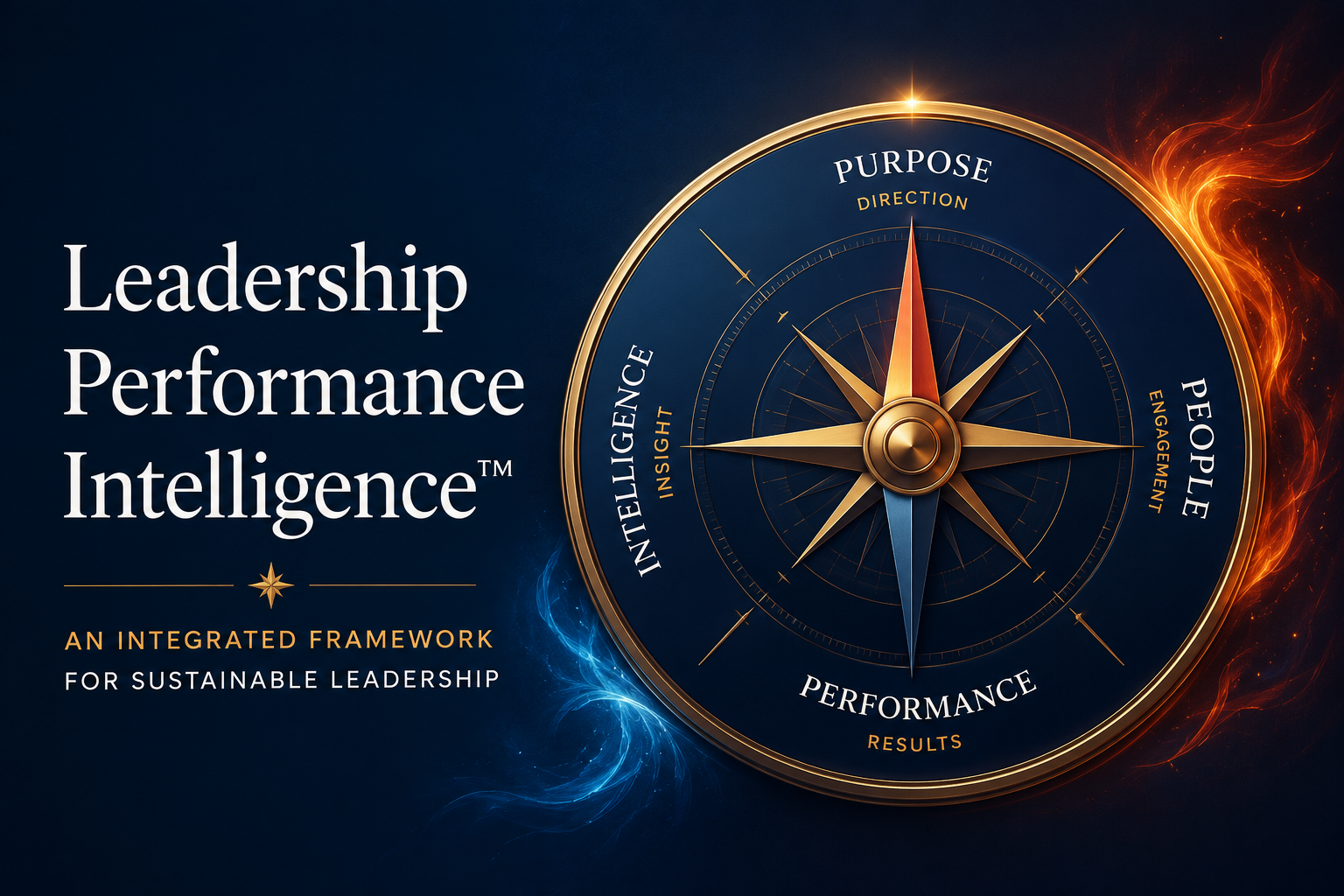
This article introduces Leadership Performance Intelligence™ as the cornerstone of the Burn Bright Leadership Intelligence Compass™ and explains why organisations should invest less in isolated leadership competencies and more in developing complete leadership capability.
Featured Snippet
Leadership Foundations: Building Leadership That Lasts
Leadership has never been more demanding. Across every sector — business, healthcare, education, public service and entrepreneurship — leaders are expected to make faster decisions, inspire diverse teams, navigate uncertainty, adopt emerging technologies and deliver measurable outcomes simultaneously.
Many organisations respond by investing heavily in leadership development. Yet despite unprecedented spending on leadership programmes, executive coaching and management training, burnout continues to rise, employee engagement remains inconsistent and organisations struggle to build sustainable leadership pipelines.
The challenge is not a lack of leadership training. The challenge is that many organisations continue to develop leaders through fragmented competency models rather than integrated leadership capability. Traditional leadership development often focuses on individual skills:
- Communication
- Delegation
- Influencing
- Coaching
- Conflict management
- Strategic planning
Each skill has value. None of them, individually, creates outstanding leadership. Leadership effectiveness emerges from how these capabilities interact under real organisational pressure — the central premise behind Leadership Performance Intelligence™.
Instead of viewing leadership as a collection of disconnected competencies, Leadership Performance Intelligence™ views leadership as an integrated system of thinking, behaviour, judgement and continuous development. This shift fundamentally changes how organisations recruit, develop and evaluate leaders.
Leadership Is More Than Style
For decades, leadership literature has largely revolved around identifying the “best” leadership style: Transformational, Servant, Authentic, Situational, Transactional and Distributed Leadership among them. Each contributes valuable insights. However, none fully explains why two leaders using the same model often produce dramatically different results.
The difference lies beneath leadership style. Style describes behaviour. Performance Intelligence explains capability.
Two leaders may communicate in similar ways.
One builds trust. The other creates dependency.
Two leaders may empower staff.
One develops future leaders. The other creates confusion.
Two leaders may appear highly confident.
One demonstrates sound judgement. The other repeatedly makes poor strategic decisions.
The visible behaviour may appear similar. The invisible leadership intelligence driving those behaviours is fundamentally different. Leadership Performance Intelligence™ seeks to understand and develop these deeper capabilities.
Moving Beyond Competencies
Competency frameworks have dominated leadership development for many years. Most organisations maintain extensive lists of desirable leadership behaviours — communication, innovation, collaboration, resilience, customer focus, accountability. These frameworks provide useful benchmarks. However, they often encourage leaders to demonstrate behaviours without understanding the thinking processes that create those behaviours consistently.
The answer lies in developing integrated leadership intelligence rather than isolated competencies. A leader with strong Leadership Performance Intelligence™ does not simply follow behavioural checklists. They develop the judgement required to adapt those behaviours appropriately across changing environments.
The Shift From Leadership Development to Leadership Performance Intelligence™
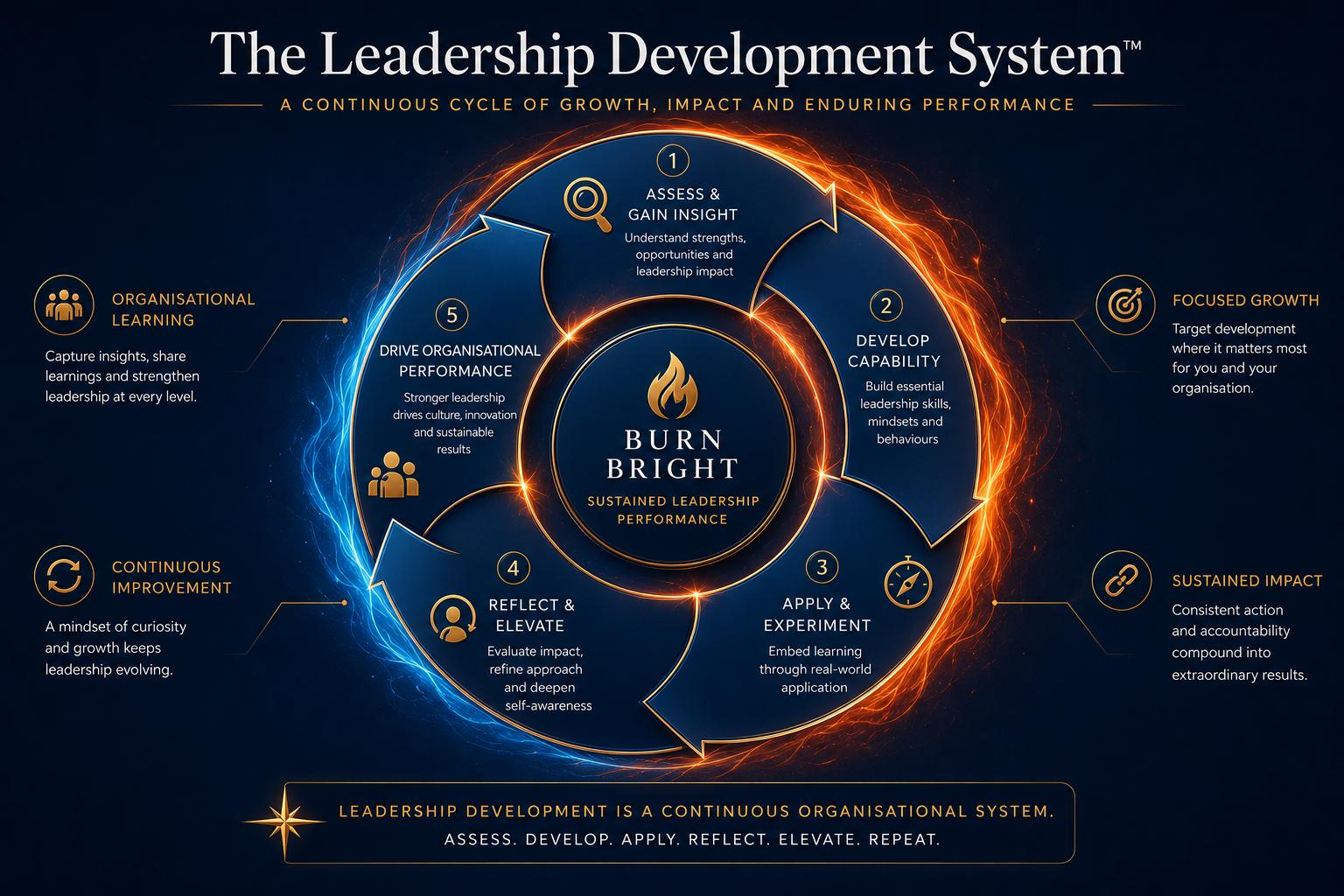
Burn Bright Advisory™ proposes a significant evolution in leadership thinking. Rather than treating leadership development as occasional training events, organisations should build an ongoing Leadership Development System™ that continuously strengthens leadership capability across multiple intelligence domains.
Leadership becomes less about acquiring knowledge.
It becomes the continual development of better judgement.
Better thinking. Better relationships. Better organisational performance.
This is the foundation upon which sustainable leadership is built.
Leadership Intelligence Is Multi-Dimensional
Leadership has traditionally been measured through visible outcomes — revenue growth, performance targets, organisational change, employee engagement, promotion rates and project delivery. These metrics are important. However, they tell us little about how those outcomes were achieved or whether they can be sustained.
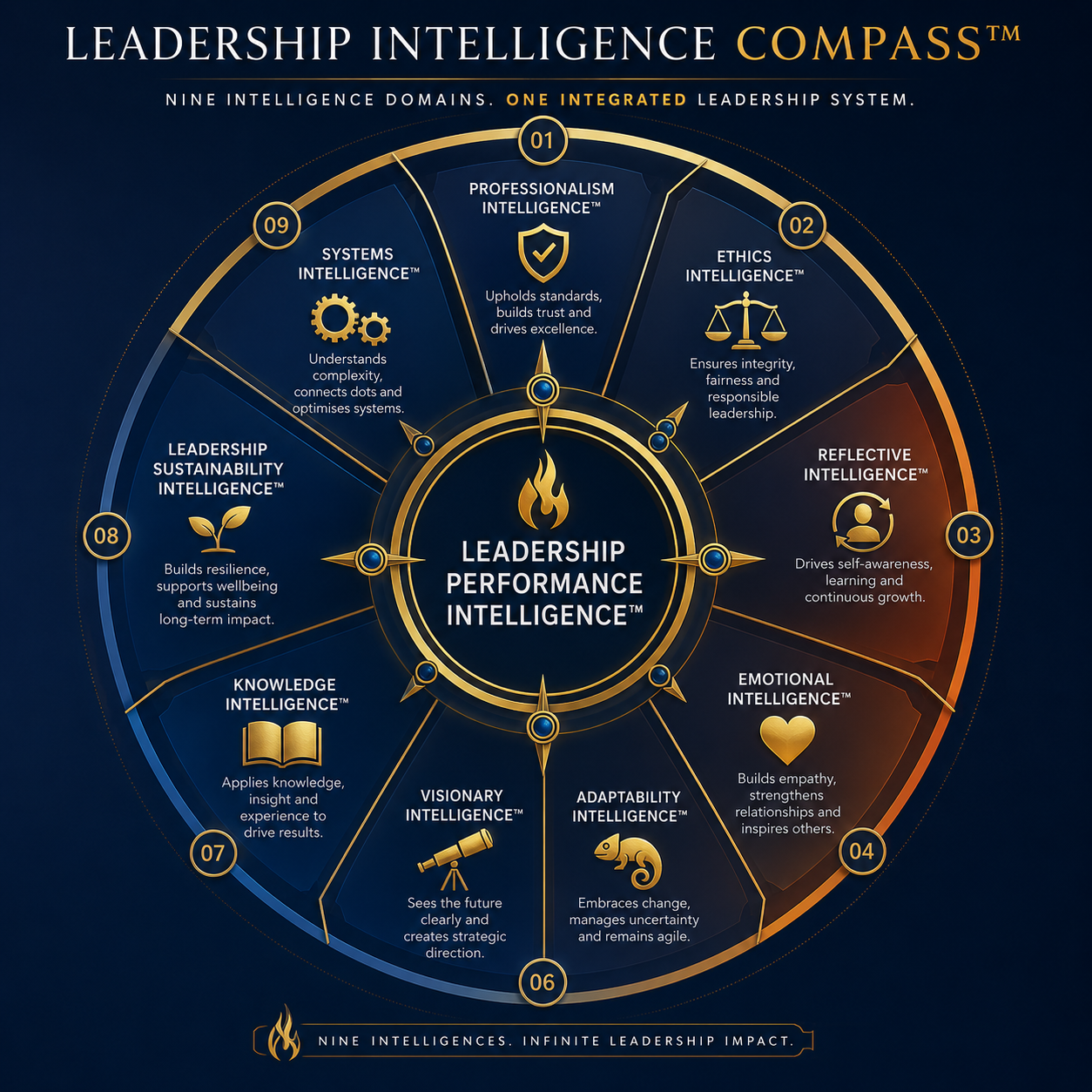
Exceptional leadership rarely depends on a single strength. Instead, it emerges from multiple interconnected capabilities working together. Burn Bright Advisory™ refers to this integrated capability model as the Leadership Intelligence Compass™.
Rather than focusing solely on personality traits or leadership styles, the Compass examines the underlying intelligence domains that influence every leadership decision. These domains interact continuously — weakness in one area inevitably affects performance across the others. Strong leadership is therefore less about perfection in one competency and more about balance across multiple capabilities.
Just as a compass helps travellers maintain direction despite changing conditions, the Leadership Intelligence Compass™ helps leaders navigate complexity without losing their values, judgement or effectiveness.
The Nine Intelligence Domains
Leadership Performance Intelligence™ is strengthened through nine complementary intelligence domains. Together they provide a holistic framework for sustainable leadership.
Domain 1
Professionalism Intelligence™
Professionalism extends beyond etiquette or appearance. It reflects the consistency with which leaders demonstrate integrity, reliability, accountability and high professional standards.
- Honour commitments and prepare thoroughly
- Communicate clearly and maintain professional boundaries
- Build trust through consistency and demonstrate accountability during success and failure
Without professionalism, credibility quickly deteriorates.
Domain 2
Ethics Intelligence™
Every leadership decision contains an ethical dimension. Rather than asking “what can we do?”, ethical leaders ask “what should we do?” — balancing organisational objectives, employee wellbeing, customer interests, legal obligations, public responsibility and long-term reputation.
Organisations rarely fail because of one catastrophic ethical decision. More often they fail because leaders repeatedly justify small compromises. Ethics Intelligence™ prevents these gradual declines.
Domain 3
Constructivism Intelligence™
High-performing leaders do not simply provide answers. They create environments where learning flourishes, recognising that people develop understanding through reflection, collaboration and experience.
- Encourage questioning and facilitate discussion
- Develop critical thinking and empower problem-solving
- Create psychologically safe learning environments
Instead of becoming organisational bottlenecks, these leaders become capability builders.
Domain 4
Adaptability Intelligence™
Modern leadership exists within continual uncertainty — technological disruption, economic volatility, political instability, changing workforce expectations and new legislation. Organisations cannot predict every challenge, but they can develop leaders capable of responding effectively.
Adaptability is not reactive behaviour. It is disciplined responsiveness.
Domain 5
Visionary Leadership Intelligence™
Vision gives organisations direction. Without it, activity becomes disconnected from purpose. Visionary Leadership Intelligence™ enables leaders to anticipate future trends, identify emerging opportunities, communicate compelling purpose and align daily work with long-term strategy.
Vision is not prediction. It is disciplined imagination supported by evidence and strategic thinking.
Domain 6
Reflective Practice Intelligence™
Reflection transforms experience into learning. Many leaders accumulate years of experience — far fewer learn systematically from those experiences. Reflective Practice Intelligence™ encourages leaders to ask what happened, why it happened, what assumptions influenced the decision, and what should change next time.
Reflection improves judgement because it reduces automatic decision-making.
Domain 7
Knowledge Development Intelligence™
Leadership requires continual learning. Knowledge becomes outdated rapidly as industries evolve, technology advances, research develops and social expectations change.
Leaders with strong Knowledge Development Intelligence™ remain intellectually curious, evaluate evidence critically, pursue continuous professional development and share knowledge across teams — turning learning into an organisational capability rather than an individual activity.
Domain 8
Emotional Intelligence™
Perhaps no leadership capability has received more attention in recent decades, yet it remains widely misunderstood. It extends beyond empathy to include self-awareness, emotional regulation, interpersonal understanding, relationship management, influence and resilience.
Emotionally intelligent leaders create trust. Trust improves communication. Improved communication strengthens collaboration. Collaboration enhances organisational performance — the relationship is cumulative.
Domain 9
Leadership Sustainability™
Leadership is not measured by one successful quarter, one promotion, or surviving one crisis. Leadership Sustainability™ asks a more important question: can this leader continue performing effectively five years from now?
Sustainable leaders protect personal wellbeing, organisational capability, decision quality, future leadership capacity and workforce resilience. They understand that burnout is not evidence of commitment — it is evidence that leadership systems require redesign.
Why Integration Matters More Than Individual Strengths
Leadership Intelligence™ does not operate in isolation. Consider a leader with exceptional vision but poor Emotional Intelligence™ — they may inspire ambitious strategic plans but fail to bring people with them. A leader with strong ethics but limited adaptability may struggle during rapid organisational change. Someone with excellent Professionalism Intelligence™ but weak Reflective Practice Intelligence™ may repeatedly make similar mistakes because they never examine their own thinking.
Leadership therefore becomes an interconnected ecosystem rather than a checklist of competencies.
Sector Applications
Although the Leadership Intelligence Compass™ applies universally, its practical application varies across sectors.
Business
Business leaders balance profitability with innovation, customer expectations and workforce wellbeing. Leadership Performance Intelligence™ enables executives to build organisations capable of adapting while maintaining commercial performance.
Education
Educational leaders shape learning cultures rather than simply managing institutions. Professionalism, Reflection and Constructivism Intelligence™ become particularly important when developing teachers, students and future leaders.
Healthcare
Healthcare leadership combines ethical judgement, rapid decision-making and emotional resilience. Leadership Sustainability™ becomes essential because exhausted leaders ultimately compromise patient outcomes.
Public Service
Public leaders operate under constant scrutiny. Ethics Intelligence™, Professionalism Intelligence™ and Visionary Leadership Intelligence™ help maintain public trust while delivering complex services.
Entrepreneur Performance Intelligence™
Entrepreneurs face continual uncertainty. Adaptability, Reflection and Knowledge Development Intelligence™ allow founders to evolve their organisations without becoming trapped by previous success.
Leadership Intelligence Creates Organisational Intelligence
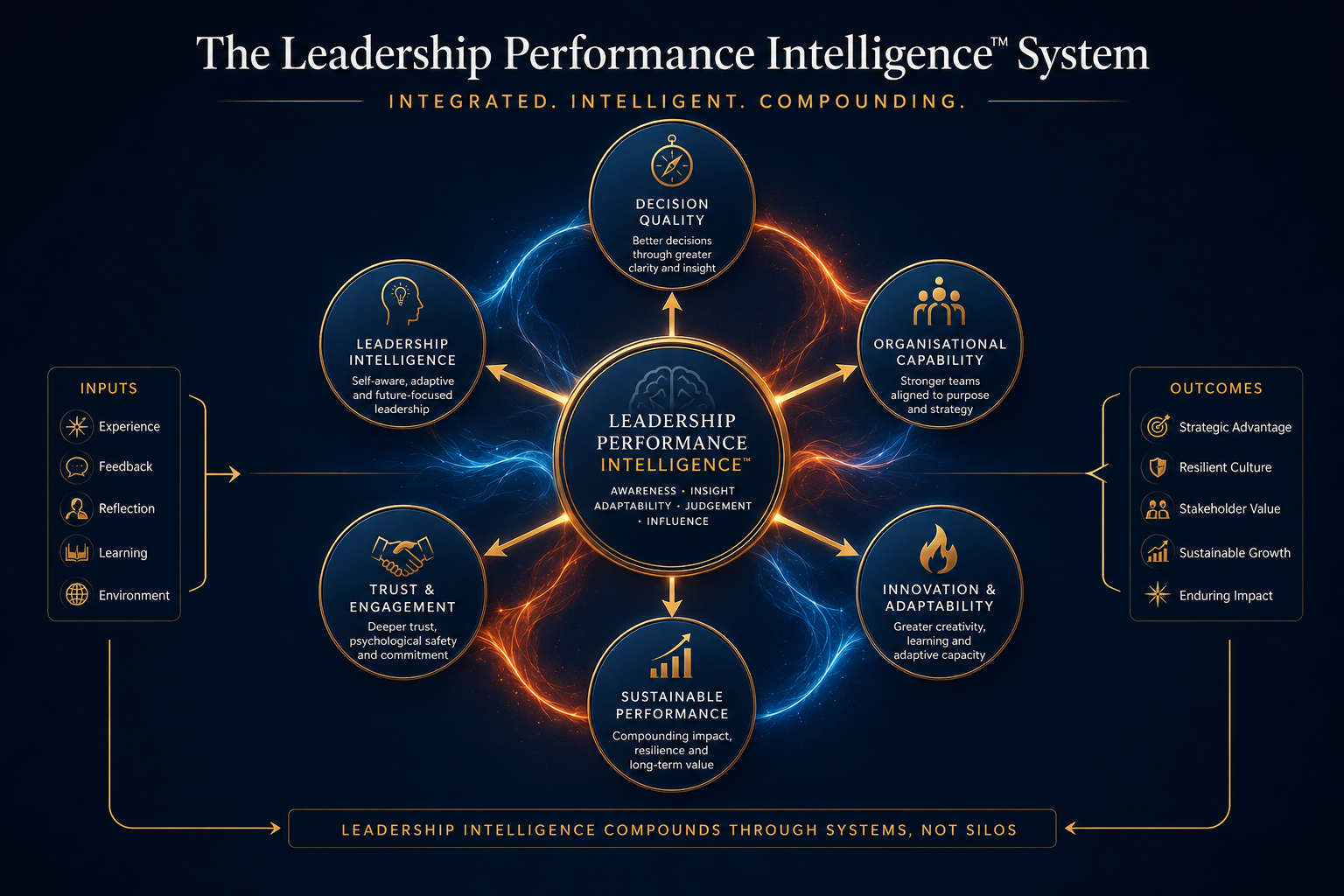
Leadership capability does not remain isolated within individual leaders. It shapes organisational culture — influencing communication patterns, decision-making quality, innovation, learning, trust, wellbeing and accountability.
As leadership improves, organisational capability expands, creating a compounding effect: one stronger leader develops stronger managers, stronger managers develop stronger teams, and stronger teams improve organisational performance. Performance then reinforces learning, creating a sustainable cycle of continuous improvement.
Burn Bright Advisory™ describes this as the transition from individual leadership excellence to organisational Leadership Performance Intelligence™.
From Leadership Potential to Leadership Performance
Most organisations invest heavily in identifying leadership potential — assessing qualifications, experience, technical competence and behavioural characteristics. While these factors remain important, they do not necessarily predict sustained leadership performance.
Many technically excellent managers struggle when faced with prolonged uncertainty, organisational change or competing stakeholder expectations. Likewise, some leaders who initially appear less charismatic consistently outperform their peers because they possess stronger judgement, adaptability and self-awareness.
Leadership Performance Intelligence™ shifts the conversation from identifying potential to measuring sustainable capability. Instead of asking “who demonstrates leadership?”, it asks “who consistently improves people, systems and organisational outcomes over time?” Potential predicts possibility. Performance Intelligence predicts sustainable impact.
Measuring Leadership Performance Intelligence™
Traditional leadership metrics often concentrate on outcomes that are relatively easy to quantify — financial performance, staff turnover, customer satisfaction, project delivery and operational efficiency. These indicators remain valuable, but they are lagging indicators: they measure what has already happened.
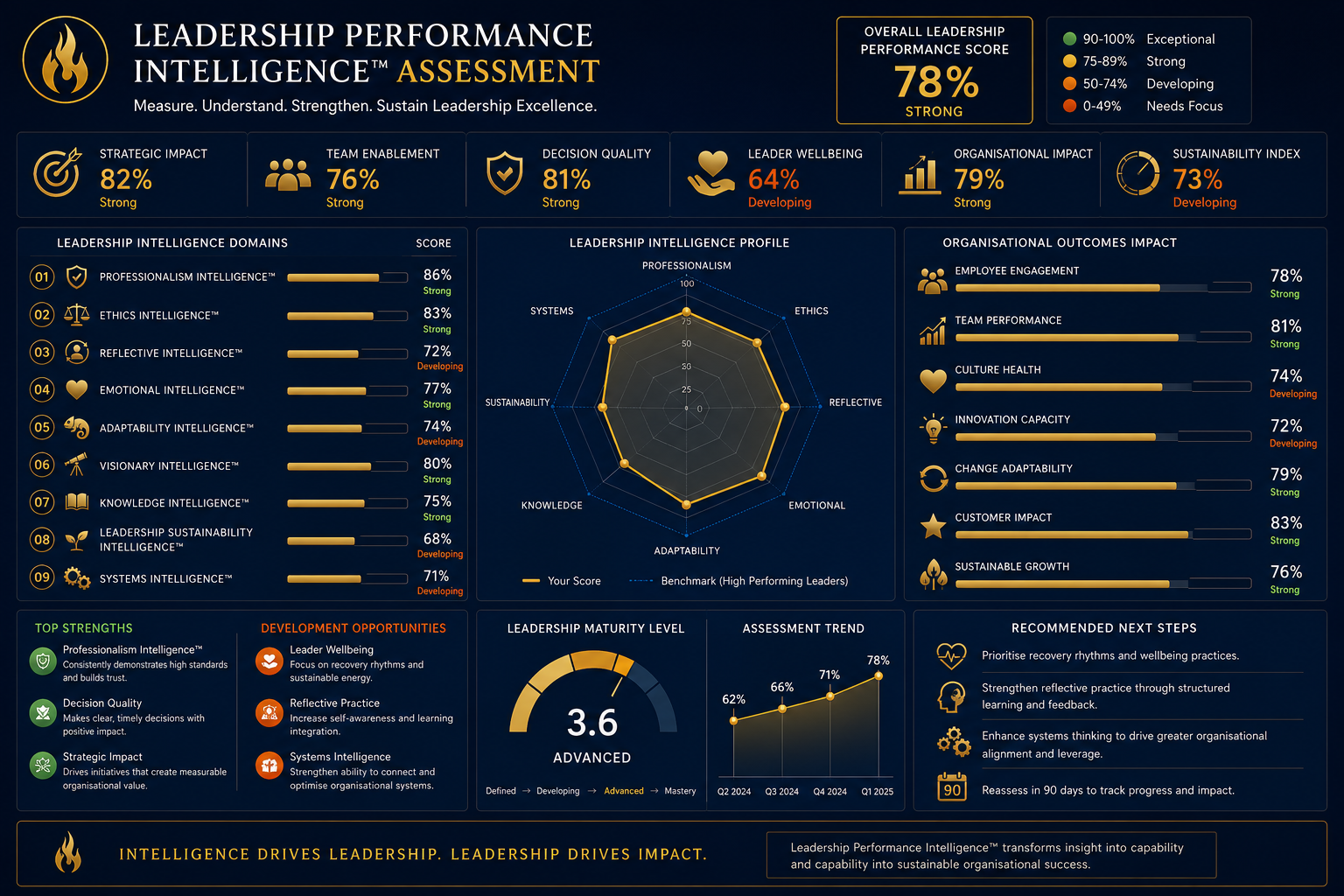
Leadership Performance Intelligence™ introduces leading indicators that reveal the health of leadership capability before organisational problems emerge.
Indicator 1Decision Quality
Does the leader consistently make informed, balanced and ethical decisions?
- Are decisions evidence-informed?
- Are stakeholders appropriately consulted?
- Are risks evaluated objectively, with long-term sustainability considered alongside short-term performance?
Indicator 2Leadership Capacity
Can the leader manage increasing complexity without declining effectiveness? Indicators include delegation quality, strategic thinking, workload management, resilience under pressure and the ability to develop future leaders.
Indicator 3Leadership Sustainability™
High-performing leaders are not those who simply work longer. They maintain effectiveness while protecting physical wellbeing, psychological wellbeing, professional relationships and organisational resilience. Burnout is not a performance metric — it is an organisational warning signal.
Indicator 4Organisational Trust
Trust represents one of the strongest predictors of organisational performance. Leaders build trust by demonstrating consistency, fairness, transparency, accountability, competence and integrity. Without trust, leadership influence rapidly diminishes.
Indicator 5Learning Agility
High-performing organisations continuously learn. Leadership Performance Intelligence™ measures whether leaders seek feedback, reflect regularly, update knowledge, encourage experimentation and learn from mistakes. Learning organisations outperform static organisations because they adapt faster.
| Traditional Lagging Metric | Leadership Performance Intelligence™ Leading Indicator |
|---|---|
| Financial performance after the fact | Decision quality before outcomes materialise |
| Staff turnover reports | Organisational trust and psychological safety |
| Annual engagement surveys | Ongoing leadership capacity and workload sustainability |
| Project delivery post-mortems | Learning agility and reflective practice |
| Crisis response after a failure | Leadership Sustainability™ monitored continuously |
Leadership Performance Intelligence™ Across Different Sectors
Although the Leadership Intelligence Compass™ is universal, practical application differs according to organisational context.
Business Growth Intelligence™
Business leaders face continual pressure to improve profitability while maintaining innovation and employee engagement. Leadership Performance Intelligence™ enables organisations to move beyond short-term financial success by strengthening strategic capability, workforce development, ethical decision-making, customer trust and organisational resilience.
School Leadership Intelligence™
Educational leadership extends far beyond operational management, influencing teaching quality, staff wellbeing, pupil outcomes, community confidence and organisational culture. Reflection, Professionalism Intelligence™ and Constructivism Intelligence™ become particularly significant.
Healthcare Leadership Intelligence™
Healthcare leaders make decisions where consequences extend beyond financial performance. Patient safety depends on effective communication, ethical judgement, multidisciplinary collaboration, resilience and continuous learning. Burned-out healthcare leaders inevitably affect patient care, workforce morale and organisational effectiveness.
Public Service Leadership Intelligence™
Public sector leaders operate within environments characterised by political accountability, limited resources and intense public scrutiny. Leadership Performance Intelligence™ strengthens ethical governance, public trust, transparent decision-making, organisational adaptability and collaborative leadership.
Entrepreneur Performance Intelligence™
Entrepreneurs often begin with exceptional vision but face challenges associated with rapid organisational growth. Leadership Performance Intelligence™ helps founders evolve from technical experts into sustainable organisational leaders — developing others, building systems, delegating effectively, maintaining culture and avoiding founder dependency.
A Practical Leadership Performance Intelligence™ Framework
Burn Bright Advisory™ recommends that organisations evaluate leadership using five interconnected questions.
Question 1Can the leader deliver results?
Performance remains essential. However, performance alone is insufficient.
Question 2Can the leader develop people?
Outstanding leaders multiply leadership capability throughout the organisation. Their success is measured not simply by their own achievements but by the success of others.
Question 3Can the leader sustain performance?
Leadership should remain effective over years rather than months. This requires deliberate attention to workload, wellbeing and continuous development.
Question 4Can the leader improve organisational capability?
Exceptional leaders leave organisations stronger than they found them. They improve systems rather than becoming indispensable themselves.
Question 5Can the leader continue learning?
The strongest predictor of future leadership success is often the willingness to continue learning. Leadership Performance Intelligence™ therefore values curiosity alongside competence.
Practical Action Steps
Over the next thirty days, consider implementing the following actions.
Week One
Conduct an honest assessment of your current Leadership Intelligence™ profile. Identify your strongest and weakest intelligence domains.
Week Two
Seek structured feedback from trusted colleagues regarding your leadership effectiveness. Listen before responding. Look for recurring themes rather than isolated comments.
Week Three
Select one Leadership Intelligence™ domain for focused improvement. Develop one practical behaviour you will consistently practise. Small improvements create long-term capability.
Week Four
Reflect on the organisational impact of your leadership. Ask: what improved because of my leadership, what became more sustainable, and what capability have I developed in others?
Leadership Reflection Questions
- Which Leadership Intelligence™ domain currently represents your greatest strength?
- Which intelligence domain requires the greatest development?
- Do your leadership behaviours consistently reflect your professional values?
- How sustainable is your current leadership approach?
- Are you developing future leaders or simply solving today’s problems?
- What systems would remain effective if you were absent for one month?
- What evidence demonstrates that your leadership is improving organisational capability?
What is Leadership Performance Intelligence™?
Leadership Performance Intelligence™ is Burn Bright Advisory™’s integrated framework for understanding how leaders sustain effective performance through multiple interconnected intelligence domains rather than relying solely on leadership style or technical competence.
How is Leadership Performance Intelligence™ different from leadership competency models?
Competency models focus primarily on observable behaviours. Leadership Performance Intelligence™ examines the deeper judgement, adaptability, ethics, reflection and learning processes that consistently produce effective leadership.
Can Leadership Performance Intelligence™ be developed?
Yes. Like any professional capability, Leadership Intelligence™ improves through deliberate reflection, structured development, practical application and continuous learning.
Is this framework suitable for all sectors?
Yes. Although practical applications vary, the Leadership Intelligence Compass™ has relevance across business, healthcare, education, public service and entrepreneurial environments.
Why is Leadership Sustainability™ included?
Organisations increasingly recognise that leadership effectiveness cannot be separated from wellbeing. Leadership Sustainability™ protects both organisational performance and long-term leadership capacity.
How can organisations begin implementing Leadership Performance Intelligence™?
Organisations should begin by assessing current leadership capability, identifying development priorities, embedding reflective practice and aligning leadership development with organisational strategy rather than isolated training programmes.
Conclusion
Leadership is no longer defined by position, authority or personality. Nor is it adequately explained by leadership style alone. The organisations that will thrive over the coming decade will be those that deliberately develop leaders capable of thinking ethically, adapting intelligently, learning continuously and sustaining high performance without compromising organisational health or personal wellbeing.
Leadership Performance Intelligence™ provides a practical framework for achieving this objective. By integrating the nine Leadership Intelligence Compass™ domains into everyday leadership practice, organisations move beyond fragmented competency models towards a coherent system that strengthens judgement, develops people and builds resilient organisational cultures.
The future of leadership belongs not to those who simply lead more, but to those who lead more intelligently.
“Leadership is becoming less about authority and more about sustainable capability.”
Free Assessment
Where Does Your Leadership Intelligence™ Stand?
Discover your strongest and weakest Leadership Intelligence™ domains and get a clear, practical starting point for building sustainable leadership capability.
Free Leadership Intelligence
Get Weekly Leadership Insights
Join thousands of leaders receiving practical strategies on burnout prevention, workload design, and sustainable performance every week.