Quick Answer
Key Takeaways
- Workload overload develops gradually rather than appearing overnight.
- Constant busyness is often a symptom of poor workload design, not high performance.
- Decision quality usually declines before productivity does.
- Burnout is frequently caused by structural workload failures rather than individual weakness.
- Leaders who redesign workload systems recover performance more effectively than those who simply work harder.
Workload Overload Warning Signs
Workload overload warning signs rarely begin with complete exhaustion. They start quietly. A missed lunch. A growing inbox. A diary with no thinking time. Another evening spent catching up on work that should have been completed during the day.
Most leaders dismiss these moments as temporary pressure. They assume next week will be easier. Unfortunately, next week often looks exactly the same.
This is why so many capable leaders find themselves burned out despite being highly organised, experienced and committed. The issue is rarely motivation. The issue is that the workload has silently exceeded human capacity.
At Burn Bright Advisory, we see this repeatedly across education, healthcare, business and the public sector. Leaders continue adding responsibilities long after their workload has become structurally unsustainable. Eventually the system begins to fail.
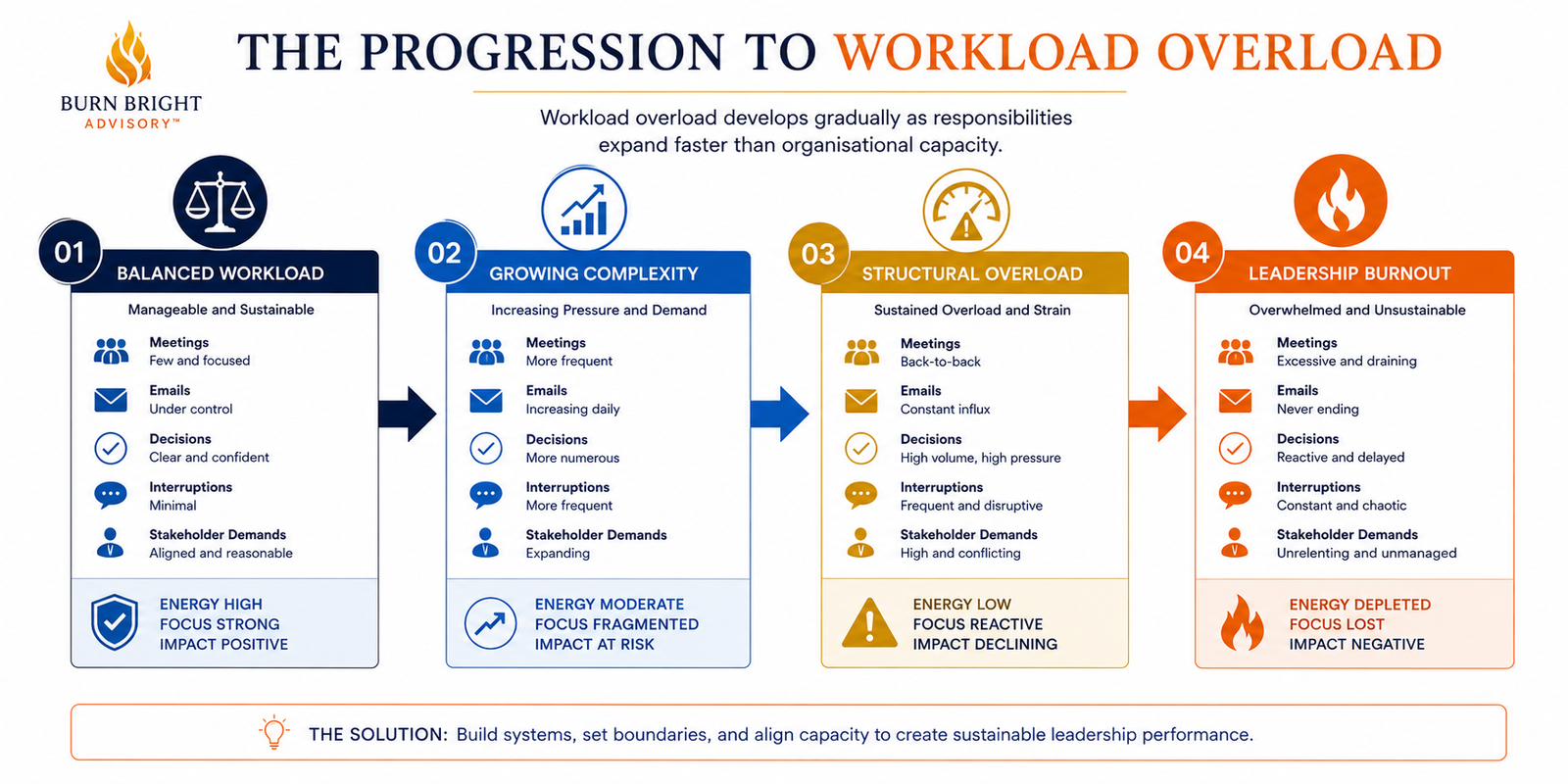
In this article, you’ll learn how to recognise the earliest warning signs of workload overload, understand why they occur, and identify when the problem is no longer your calendar — but the architecture of the work itself. This reflects Burn Bright’s core philosophy: burnout is a system failure, not a personal failure.
Understanding the Structural Warning Signs
The diagram below illustrates how workload expands long before burnout becomes visible.
Featured Snippet
What Are the Earliest Workload Overload Warning Signs?
Most people assume workload overload begins when someone starts working long hours. It doesn’t.
The earliest warning signs are usually changes in how work feels rather than how much work exists. A leader who previously enjoyed solving problems now spends every day reacting to interruptions. Strategic projects remain untouched because operational issues consume every available hour. Meetings multiply. Emails arrive faster than they can be answered. Decision queues continue growing.
Nothing appears dramatic.
Everything simply becomes harder.
Research consistently shows that excessive workload is one of the strongest predictors of occupational burnout. The World Health Organization identifies chronic workplace stress that has not been successfully managed as a defining feature of burnout, while Gallup has repeatedly found workload to be one of the strongest drivers of manager exhaustion and disengagement.
These early indicators typically include:
- Constant context switching
- Loss of uninterrupted thinking time
- Increasing reactive work
- Persistent backlog growth
- Reduced delegation
- Decision fatigue
- Declining recovery between working days
Notice that none of these relate to personal weakness. They all relate to workload architecture. This distinction matters because leaders often respond by trying to become more productive rather than questioning whether the workload itself is realistic. That response usually accelerates burnout instead of preventing it.
Why Do Leaders Often Miss the Warning Signs?
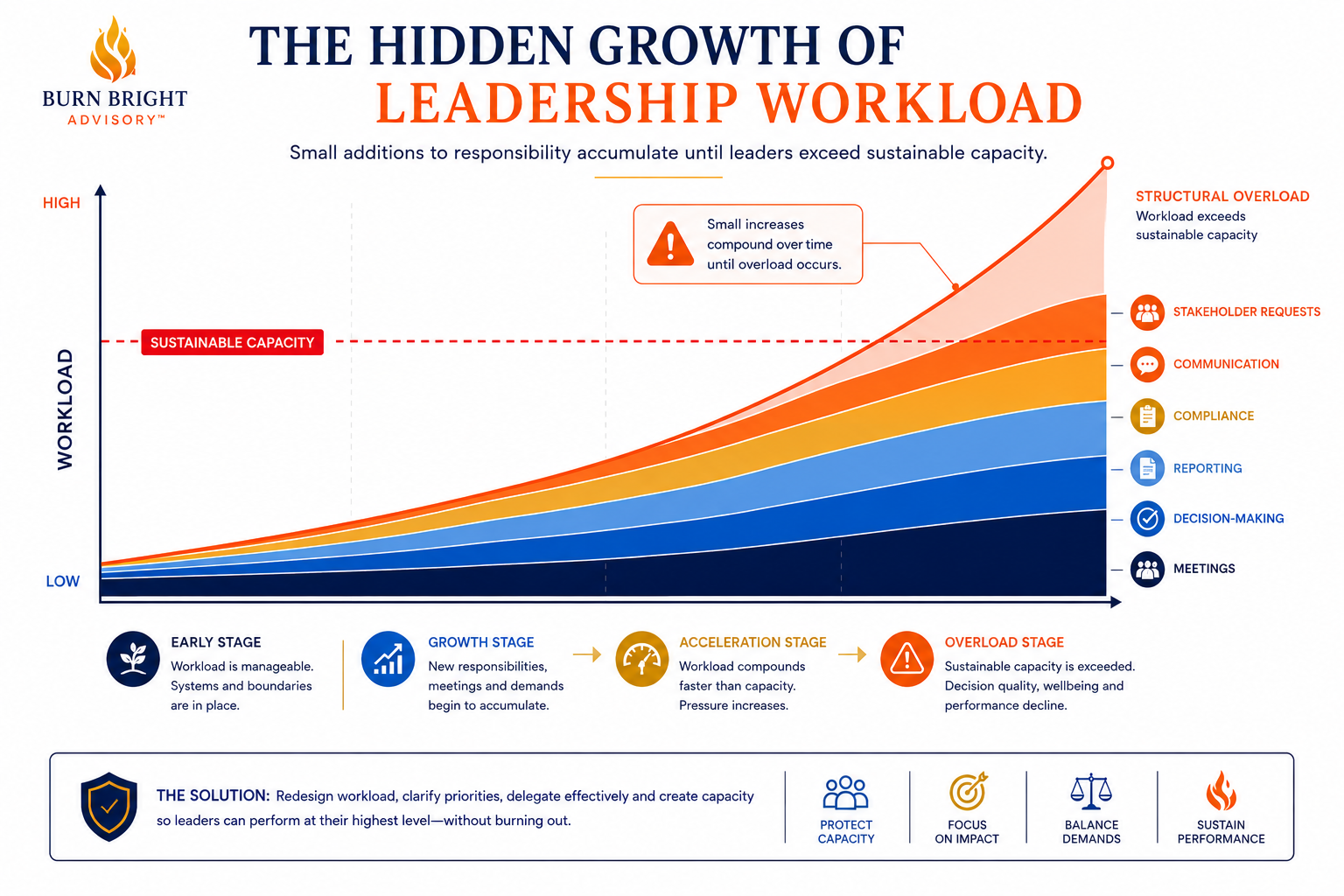
One of the biggest dangers of workload overload is that it rarely feels unusual. Most leaders don’t wake up one morning burned out. Instead, they gradually adapt to increasing demands until unhealthy working patterns become normal. Each new responsibility feels manageable on its own. Over time, however, dozens of small additions create an impossible workload.
This is known as scope creep — one of the five root causes identified in the Burn Bright Not Out Framework. Every extra meeting, project, report or committee appears reasonable in isolation. Collectively, they create structural overload.
Many organisations unintentionally reward this behaviour. The busiest leaders are often viewed as the most committed. Full calendars become status symbols. Saying “yes” is praised, while protecting capacity can be mistaken for a lack of ambition.
The result is predictable. Leaders become trapped in an endless cycle of:
- Accepting additional responsibilities
- Working longer hours
- Reducing recovery time
- Losing strategic thinking
- Becoming increasingly reactive
Because this progression happens slowly, most leaders adjust their expectations instead of questioning the system.
The irony is that workload overload often hides behind apparent success. A leader may still be delivering projects, meeting deadlines and supporting their team. From the outside, everything appears under control.
Internally, however, the cost is accumulating.
Decision quality declines.
Patience shortens.
Creative thinking disappears.
Recovery becomes impossible.
Eventually, performance begins to deteriorate — not because the leader has become less capable, but because the workload has exceeded sustainable human capacity.
Seeing the Hidden Growth in Workload
The graphic below demonstrates how small increases in responsibility combine to create exponential workload growth.
Which Warning Signs Affect Performance First?
Contrary to popular belief, productivity is not usually the first thing to decline. Performance changes begin much earlier.
The first casualty is often decision quality. Modern leaders make hundreds of decisions every day, ranging from strategic planning to routine operational choices. As workload increases, cognitive capacity becomes depleted. Leaders begin postponing decisions, relying on familiar solutions instead of thoughtful analysis, or avoiding difficult conversations altogether.
This phenomenon is known as decision fatigue, and it represents one of the clearest indicators that workload has become unsustainable.
Other early performance warning signs include:
Strategic thinking disappears
Every hour becomes devoted to immediate operational issues. Long-term planning receives whatever time remains — usually none. The leader spends every day managing today’s emergencies instead of preventing tomorrow’s.
Meetings replace leadership
An overloaded calendar leaves no opportunity for reflection. Leaders attend meetings continuously without creating meaningful progress between them. Meeting culture slowly replaces leadership itself.
Delegation decreases
Instead of empowering others, overwhelmed leaders often begin reclaiming work. Explaining tasks feels harder than completing them personally. Ironically, this increases workload even further.
Communication becomes reactive
Emails become shorter. Responses become delayed. Important conversations are postponed. Team members receive less coaching, less recognition and less clarity because the leader simply lacks the capacity.
Recovery disappears
Perhaps the strongest warning sign is that work no longer has a clear endpoint. Evenings become catch-up sessions. Weekends become preparation days. Annual leave becomes an opportunity to answer emails. When recovery disappears, sustainable performance becomes impossible.
Research consistently demonstrates that recovery is not optional for high performance. Sustainable leadership depends on periods of cognitive restoration that allow judgement, creativity and emotional regulation to recover. The Burn Bright framework refers to this as Recovery by Design — creating deliberate organisational systems that protect recovery rather than leaving it to chance.
Healthy Workload vs Workload Overload
| Workload Overload | Healthy Workload |
|---|---|
| Everything feels urgent. | Priorities are clear. |
| Operational tasks consume every available hour. | Strategic work receives protected time. |
| Decision fatigue delays important choices. | Decisions are thoughtful and timely. |
| Meetings dominate the working week. | Meetings support progress. |
| Leaders reclaim work because delegation feels slower. | Delegation increases team capability. |
| Recovery is postponed indefinitely. | Recovery happens daily and weekly. |
| Performance relies on constant overwork. | Performance is sustainable. |
The critical difference is not the amount of effort. It is the design of the workload. Healthy organisations build work around available capacity. Unhealthy organisations continually increase expectations without redesigning roles, systems or resources.
Can Organisations Prevent Workload Overload?
Yes — but only if they stop treating burnout as an individual resilience problem.
Many organisations invest heavily in wellbeing initiatives while leaving the structural causes untouched. Employees are offered mindfulness sessions. Managers attend resilience workshops. Teams complete wellbeing surveys.
Yet nothing changes about workload.
The meetings remain.
The reporting increases.
The inbox continues growing.
The staffing shortages persist.
The system remains exactly the same.
This explains why so many wellbeing initiatives fail to produce lasting improvements. They address symptoms rather than causes.
Burn Bright Advisory advocates a different approach. Instead of asking “How do we make leaders more resilient?”, ask “Why has this workload become impossible in the first place?”
The Burn Bright Not Out Framework identifies five structural causes that repeatedly drive leadership overload:
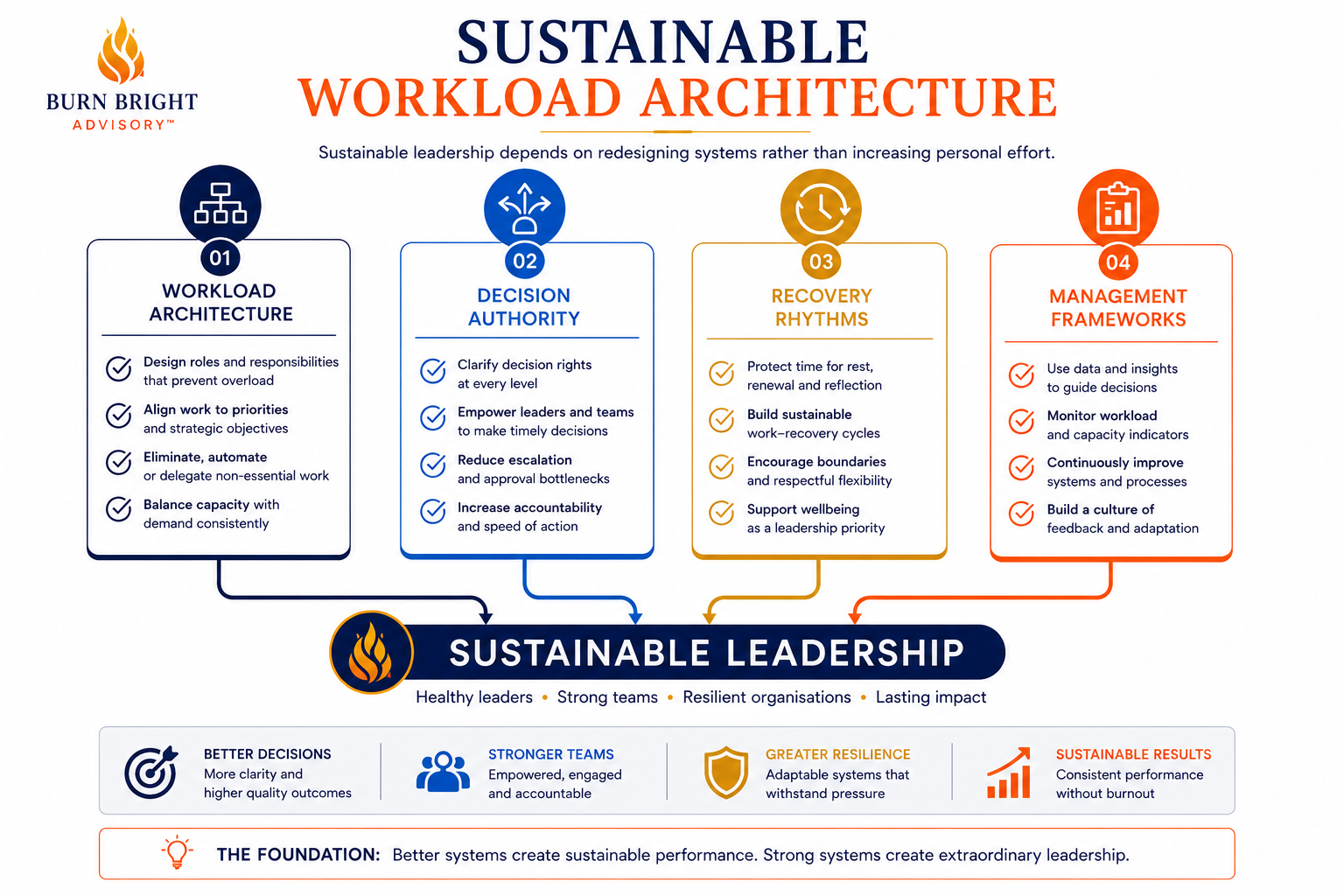
These are organisational design issues rather than personal shortcomings. They require structural solutions, including workload architecture, clearer decision authority, protected recovery rhythms and practical management frameworks that reduce unnecessary complexity.
Organisations that redesign work rather than simply expecting greater effort are more likely to retain experienced leaders, improve engagement and reduce the hidden financial burden of burnout. Burn Bright refers to this hidden organisational cost as the Culture Tax — the annual price organisations pay through turnover, disengagement, reduced productivity and lost leadership capacity when structural problems remain unresolved.
Designing Sustainable Leadership
The framework below shows how organisations move from overload to sustainable performance.
What are the first workload overload warning signs?
The earliest warning signs include constant firefighting, increasing decision fatigue, calendar saturation, declining strategic thinking, reduced delegation and difficulty recovering outside working hours. These usually appear well before complete burnout.
Is workload overload the same as burnout?
No. Workload overload is one of the major contributors to burnout, but burnout develops over time through prolonged exposure to excessive demands without adequate recovery or structural support.
Can highly resilient leaders still experience workload overload?
Absolutely. Resilience can delay burnout, but it cannot overcome permanently unsustainable workload. Even highly capable leaders eventually reach the limits of human cognitive and emotional capacity.
How can organisations identify workload overload?
Warning signs include increased turnover, slower decision-making, declining engagement, excessive meeting hours, growing backlogs, reduced innovation and leaders regularly working beyond contracted hours.
What is the best way to reduce workload overload?
The most effective solution is structural redesign. This includes clarifying priorities, reducing unnecessary meetings, improving delegation, simplifying decision-making processes and protecting time for strategic work and recovery rather than expecting leaders to become more productive.
Conclusion
Recognising workload overload warning signs early allows leaders to intervene before declining performance becomes burnout.
The most important lesson is this: workload overload is rarely caused by poor time management. It is usually created by poor workload design.
When leaders become permanently reactive, struggle to think strategically and lose opportunities for recovery, the answer is not another productivity technique. The answer is redesign.
Organisations that redesign workload architecture, clarify decision authority and protect recovery create leaders who perform better, remain healthier and stay effective for the long term. Sustainable leadership is not about heroic effort. It is about building systems that make sustainable performance possible.
Recognise Any of These Warning Signs?
The Burn Bright Leadership Burnout Self-Assessment provides a structured diagnosis to help you identify the underlying causes before they become burnout.
Free Leadership Intelligence
Get Weekly Leadership Insights
Join thousands of leaders receiving practical strategies on burnout prevention, workload design, and sustainable performance every week.