Quick Answer
Key Takeaways
- Workload overload develops gradually through structural pressures rather than sudden failure.
- Longer working hours rarely solve excessive workload because the underlying system remains unchanged.
- Decision fatigue is often the first measurable sign that workload has exceeded leadership capacity.
- Burnout prevention begins by redesigning workload architecture rather than encouraging individuals to become more resilient.
- Sustainable leadership protects long-term organisational performance by fixing systems instead of relying on personal sacrifice.
Workload Overload Warning Signs
Introduction
Workload overload warning signs rarely appear without warning. Most leaders do not wake up one morning burned out. Instead, overload develops quietly through expanding responsibilities, constant interruptions, growing expectations, and increasingly complex decisions until exhaustion becomes the normal way of working.
This gradual progression explains why so many experienced leaders miss the warning signs. They assume they simply need better time management, greater resilience, or another productivity system. Yet evidence increasingly shows the opposite. Burnout is rarely caused by poor organisation. It is far more often the predictable result of organisations asking human beings to manage workloads that have outgrown the systems supporting them.
Across every sector, leadership roles have expanded dramatically. Managers now coordinate hybrid teams, navigate continuous digital communication, respond to multiple stakeholders, interpret increasing volumes of data, and make more high-stakes decisions than ever before. Technology promised efficiency, but for many leaders it has introduced constant complexity instead.
The challenge is not simply working harder. The challenge is recognising when workload has exceeded sustainable capacity.
This article explores the structural warning signs of workload overload, explains why they occur, and outlines practical ways leaders can redesign work before burnout becomes inevitable.
Understanding the Bigger Picture
The warning signs become much easier to recognise when viewed as part of a wider leadership system rather than isolated personal struggles.
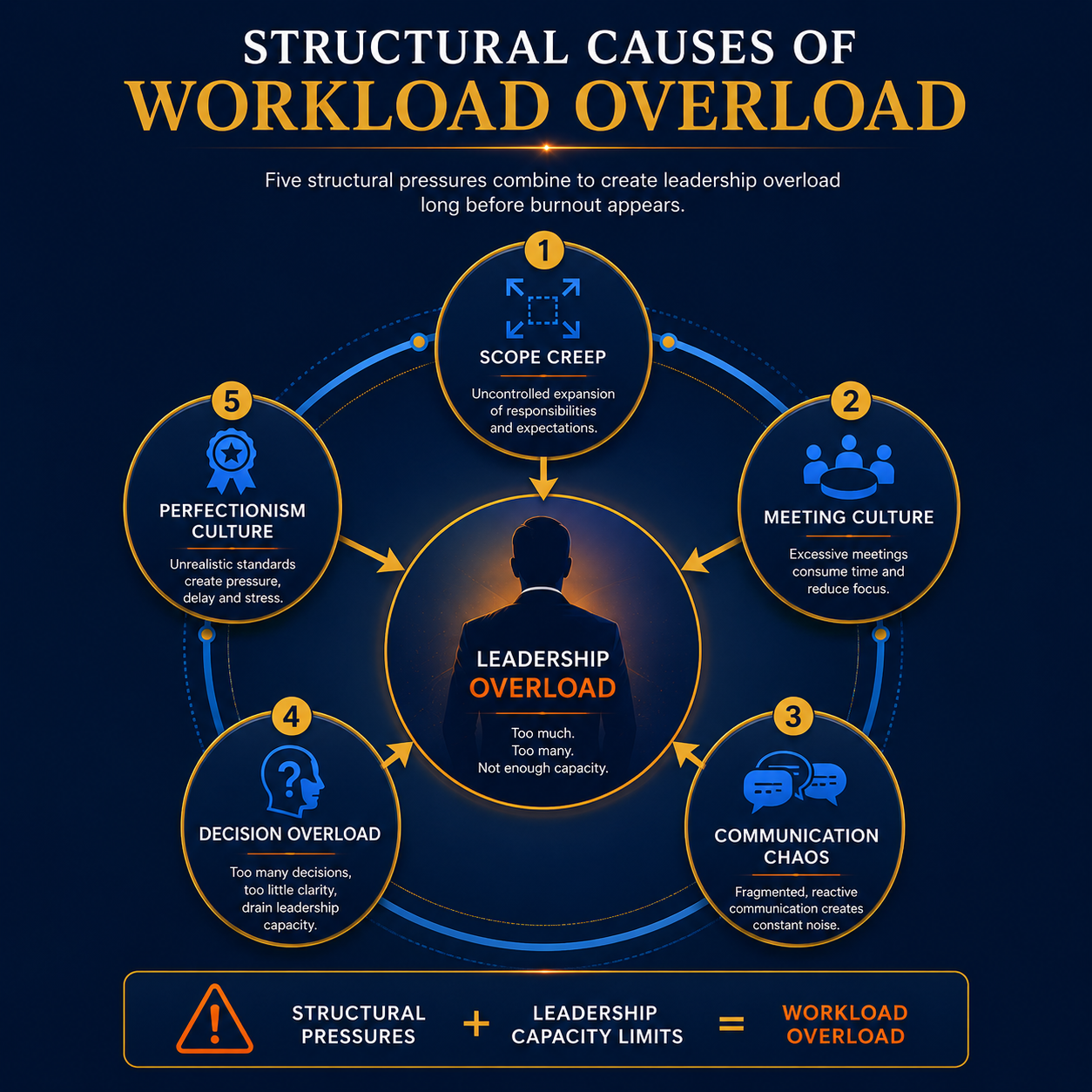
Most leadership overload develops through multiple interacting pressures rather than a single cause. Identifying these pressures early allows organisations to intervene before burnout becomes embedded within the culture.
Featured Snippet
Why Do Leaders Miss Workload Overload Warning Signs?
One of the biggest myths surrounding burnout is that leaders will recognise it before serious damage occurs. The evidence suggests the opposite. Most experienced leaders become progressively better at functioning while exhausted. They continue delivering results long after their capacity has been exceeded, making overload increasingly difficult to detect.
This happens because workload overload rarely arrives dramatically. It grows through small additions.
One extra committee.
Another reporting requirement.
Additional compliance.
A larger team.
New technology.
More stakeholders.
None of these changes appear overwhelming individually. Collectively they create a role that barely resembles the one the leader originally accepted.
Research consistently demonstrates that modern management responsibilities have expanded significantly over the past decade. Leaders now operate across far broader technical, strategic and emotional domains than previous generations while support structures have remained largely unchanged.
Burn Bright describes this progression as scope creep, one of the five structural causes of burnout. Instead of organisations redesigning leadership roles as responsibilities increase, additional work simply accumulates until overload becomes normal.
The problem is reinforced by organisational culture.
High-performing leaders are often rewarded for absorbing additional work. They become known as dependable, resilient and capable. Promotions frequently follow those behaviours. Unfortunately, organisations can unintentionally reward exactly the habits that eventually produce burnout.
By the time obvious symptoms appear, the structural overload has usually existed for months.
This explains why many leaders describe burnout as arriving “unexpectedly”, despite years of steadily increasing workload.
The issue was never resilience.
The workload simply exceeded sustainable capacity.
What Are the Most Common Workload Overload Warning Signs?
The earliest warning signs of workload overload are rarely dramatic. They are subtle shifts in behaviour, thinking and performance that gradually become normal. The danger is that leaders often adapt to these changes instead of questioning why they are happening.
You Spend Every Day Firefighting
One of the clearest indicators is that your calendar becomes entirely reactive.
Your day starts with good intentions, but within an hour priorities have changed. Emails replace strategic planning. Urgent requests replace important work. Meetings multiply. Problems dominate every conversation.
By the end of the day you have worked continuously yet made little progress on the objectives that actually move the organisation forward.
This is not poor discipline.
It is evidence that workload architecture has broken down.
The Burn Bright framework identifies this as a consequence of expanding scope combined with poor decision pathways. When every issue reaches the leader, every day becomes crisis management.
Strategic Thinking Disappears
Leadership is supposed to create direction. Overloaded leaders become trapped in administration instead.
Planning time disappears.
Innovation slows.
Long-term thinking is replaced by immediate survival.
Many leaders mistake this for “being busy”, yet organisations pay a significant price when strategic capacity disappears. Teams continue operating, but improvement stops.
Gallup consistently reports that manager effectiveness strongly influences employee engagement and organisational performance. When leaders lose the capacity to think strategically, the entire organisation becomes less effective.
Being busy should never become the measure of leadership success.
Decision Fatigue Becomes Your Default
Every decision consumes mental energy. The problem is not major strategic decisions. It is the hundreds of small decisions that accumulate throughout the day.
Should I attend this meeting?
Do I approve this request?
Who should respond?
Is this urgent?
Should I intervene?
Research into cognitive performance shows that decision quality declines as decision volume increases. Leaders experiencing workload overload often delay decisions, avoid difficult conversations or default to the safest option simply because mental capacity has been exhausted.
Within the Burn Bright Framework, Decision Overload is recognised as one of the five structural causes of burnout because organisations frequently centralise decisions around a small number of senior leaders.
Instead of distributing authority, they create organisational bottlenecks. Eventually every decision waits for one exhausted person.
Working Longer Produces Less
Many leaders notice a strange contradiction. They are working more hours than ever. Yet they accomplish less.
Tasks that once took thirty minutes now require ninety.
Emails are read repeatedly.
Reports take longer to complete.
Concentration becomes increasingly fragmented.
The instinctive response is usually to work even harder. Unfortunately this creates an even greater workload spiral.
More hours reduce recovery.
Reduced recovery lowers cognitive performance.
Lower performance requires longer hours.
The cycle repeats until exhaustion becomes permanent. This is why productivity alone cannot solve burnout. The system itself requires redesign.
Measuring Workload Before Burnout Occurs
Rather than waiting until leaders become exhausted, organisations should monitor leading indicators that reveal overload much earlier.
Useful indicators include:
- Increasing average meeting hours
- Rising decision queues awaiting approval
- More work completed outside contracted hours
- Declining uninterrupted focus time
- Growing email response expectations
- Reduced annual leave utilisation
- Higher staff turnover within leadership teams
These metrics reveal organisational capacity rather than individual resilience. When monitored consistently they provide an early warning system that allows structural intervention before burnout becomes embedded.
Traditional Thinking vs the Burn Bright View
The following framework summarises the difference between treating overload as an individual issue and recognising it as a structural leadership challenge.
| Traditional View | Burn Bright View |
|---|---|
| Leaders need greater resilience. | Leaders need sustainable workload architecture. |
| Better time management solves overload. | Better system design prevents overload. |
| Burnout reflects personal weakness. | Burnout reflects structural imbalance. |
| More effort creates better performance. | Better systems create sustainable performance. |
| Leaders should absorb complexity. | Organisations should reduce unnecessary complexity. |
This shift is fundamental. If organisations continue diagnosing individual leaders while ignoring structural causes, burnout will continue to return regardless of how much resilience training they provide.
That principle sits at the heart of sustainable leadership.
How Does Workload Overload Affect Leaders Physically and Emotionally?
Workload overload does not begin with collapse. It begins with depletion.
Most leaders continue performing long after their energy reserves have been exhausted. The body adapts. The mind compensates. Performance appears stable from the outside while capacity quietly declines beneath the surface.
This is why burnout is often described as arriving “unexpectedly”. In reality, the warning signs have usually been present for months.
Recovery Stops Working
One of the earliest indicators is that recovery no longer restores energy.
A good night’s sleep leaves you feeling tired.
Weekends disappear into catching up on work.
Annual leave becomes an opportunity to answer emails rather than disconnect.
Monday arrives before genuine recovery has taken place.
Healthy work creates healthy recovery. Overload removes that recovery cycle completely.
Without adequate recovery, the brain never fully resets. Attention declines, creativity narrows and emotional regulation becomes increasingly difficult. Eventually leaders begin every working day already mentally fatigued.
Recovery should never be viewed as a reward after productivity. It is the condition that makes sustainable productivity possible.
Within the Burn Bright Framework this principle forms part of Recovery Rhythms, one of the four structural transformation pillars designed to protect long-term leadership performance.
Emotional Capacity Begins to Shrink
Leadership is emotional work.
Every conversation requires empathy.
Every conflict requires composure.
Every difficult decision requires emotional regulation.
When workload becomes excessive, emotional capacity becomes the first casualty.
Leaders become noticeably less patient.
Minor interruptions feel frustrating.
Constructive feedback feels like criticism.
Colleagues appear demanding rather than collaborative.
This emotional narrowing is frequently misunderstood as poor attitude. More often it reflects depleted cognitive and emotional reserves.
The leader has not become less capable. They simply no longer possess sufficient capacity to manage continuous emotional demands.
Research consistently links emotional exhaustion with reduced leadership effectiveness, lower employee engagement and higher turnover. Organisations often experience declining culture long before recognising leadership overload as the underlying cause.
Physical Symptoms Become Normalised
Many leaders dismiss physical symptoms as part of modern working life.
Persistent headaches.
Poor sleep.
Back and neck tension.
Frequent illness.
Digestive discomfort.
Reliance on caffeine to maintain concentration.
These symptoms are often treated individually while the workload producing them remains unchanged.
Medication replaces redesign.
Temporary relief replaces permanent solutions.
Burn Bright takes a different approach. The symptom is valuable. It tells us something about the system.
Instead of asking, “How can I cope better?” the better question is: “What is this workload trying to tell me?”
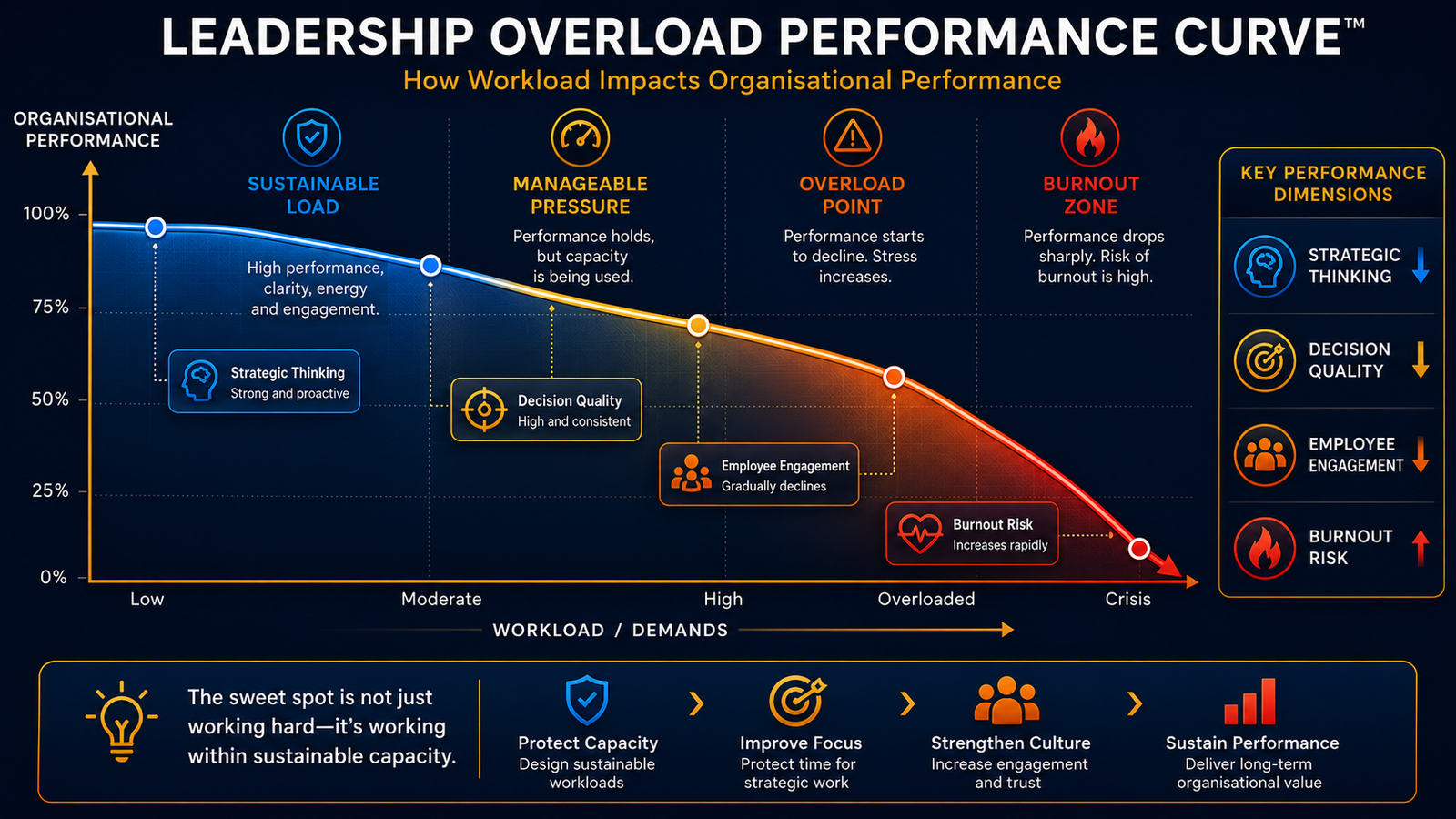
Data Supports What Leaders Already Feel
Across multiple sectors, research continues to demonstrate the growing gap between leadership expectations and organisational capacity.
Gallup has found that managers are significantly more likely than non-managers to report stress and burnout, reflecting the expanding demands placed on leadership roles.
Research published by McKinsey has shown that leaders increasingly operate within environments characterised by constant change, competing priorities and rising organisational complexity.
The World Health Organization recognises burnout as an occupational phenomenon resulting from chronic workplace stress that has not been successfully managed.
Taken together, the evidence supports a simple conclusion. The issue is rarely personal resilience. It is chronic structural overload.
The Financial Cost of Ignoring the Warning Signs
Many organisations still view burnout primarily as a wellbeing issue. The financial evidence suggests otherwise.
Replacing a middle manager can cost approximately £75,000, while replacing a senior executive frequently exceeds £500,000 once recruitment, lost productivity, onboarding and organisational disruption are considered. Leadership transitions can also reduce productivity by more than 30%, creating a hidden financial burden long before recruitment begins.
Burn Bright describes this accumulated organisational loss as the Culture Tax. The Culture Tax includes:
- Higher leadership turnover
- Reduced employee engagement
- Slower decision-making
- Increased sickness absence
- Lower innovation
- Declining organisational trust
- Lost institutional knowledge
Most organisations measure salary costs. Very few measure the cost of depleted leadership.
Understanding these hidden costs changes the conversation completely. Burnout is no longer simply an individual wellbeing issue. It becomes a measurable organisational performance issue. That shift moves the discussion away from resilience training and towards structural redesign.
How Can Leaders Prevent Workload Overload?
Preventing workload overload is not about becoming more efficient. It is about redesigning the way leadership work is organised.
For decades, organisations have responded to overload by encouraging leaders to improve their productivity. Better calendars. Better prioritisation. Better time management.
These tools have value. But they cannot solve structural overload.
If demand continues to exceed capacity, greater efficiency simply delays the point at which burnout occurs. Sustainable leadership requires organisations to redesign the system itself.
The Burn Bright Structural Transformation Framework
At Burn Bright Advisory, preventing workload overload begins with four interconnected structural pillars that create sustainable leadership capacity rather than relying on personal sacrifice.
Pillar 1
Workload Architecture
Every leadership responsibility should have a clear purpose, owner and priority. Leaders should regularly audit:
- Responsibilities that no longer create value.
- Tasks that can be delegated.
- Processes that can be simplified.
- Meetings that can be removed.
- Reports that nobody uses.
Reducing unnecessary work often delivers greater impact than improving productivity.
Pillar 2
Decision Authority
Decision overload is rarely caused by poor judgement. It is usually caused by too many decisions reaching too few people. Organisations should:
- Clarify decision ownership.
- Increase delegated authority.
- Remove unnecessary approvals.
- Create clear escalation pathways.
Better decision architecture reduces cognitive overload while improving organisational speed.
Pillar 3
Recovery Rhythms
Recovery should be designed into leadership roles. Examples include:
- Protected strategic thinking time.
- Meeting-free focus periods.
- Genuine annual leave.
- Clear boundaries around after-hours communication.
- Regular workload reviews.
Recovery protects decision quality. It is an operational requirement rather than an optional wellbeing initiative.
Pillar 4
Management Frameworks
Frameworks reduce uncertainty. Instead of asking leaders to solve every challenge from scratch, organisations should provide consistent models for delegation, prioritisation, workload planning and decision making.
Frameworks reduce cognitive load while improving consistency across teams.
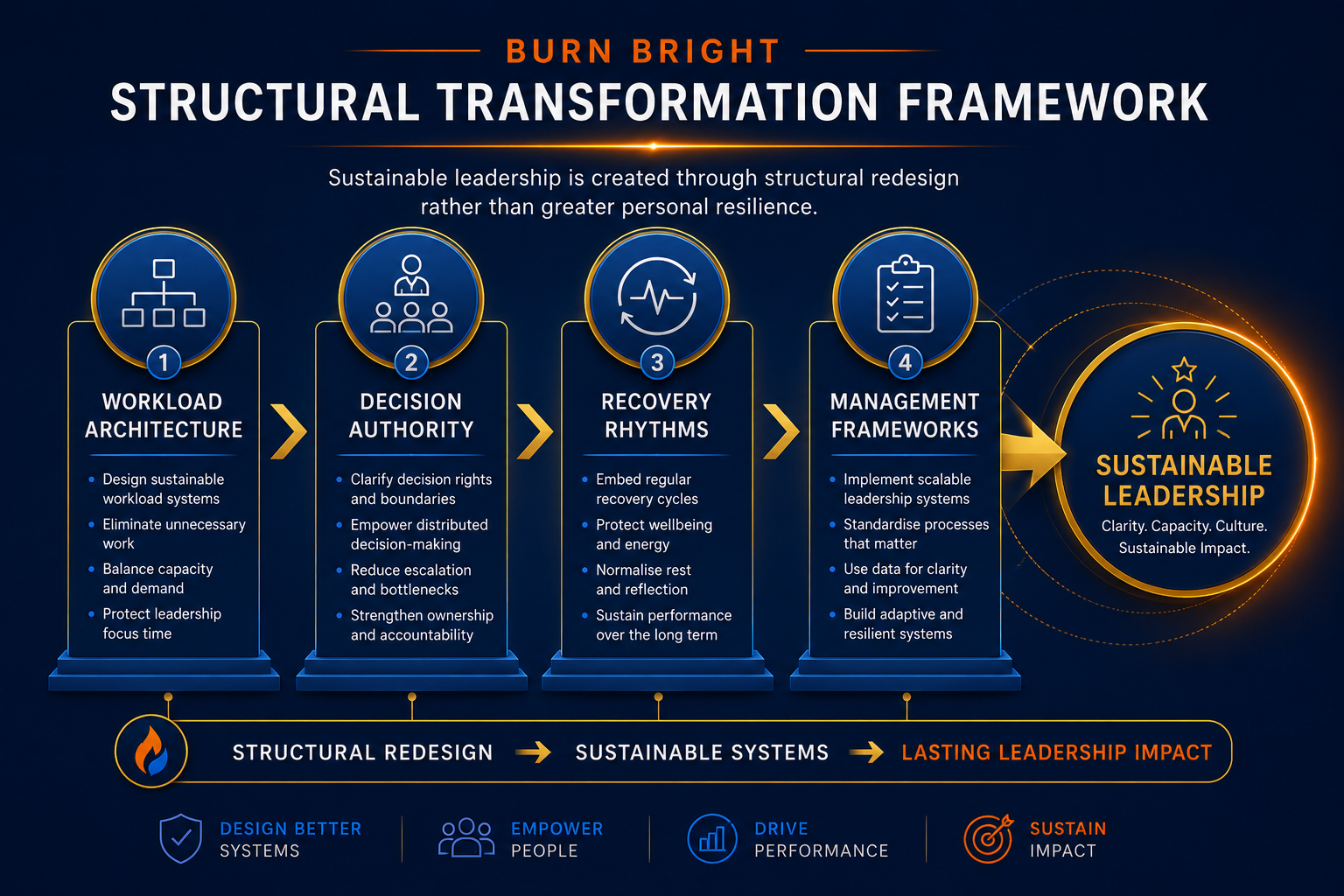
Sustainable leadership is created through better workload architecture, distributed decision-making, intentional recovery and consistent management frameworks. Together these reduce overload before burnout develops.
What are the first workload overload warning signs?
The earliest warning signs usually include constant firefighting, declining strategic thinking, increasing decision fatigue, longer working hours without better results and reduced recovery between working days. These indicators normally appear months before burnout becomes obvious.
Is workload overload the same as burnout?
No. Workload overload is a contributing cause. Burnout is the longer-term outcome of sustained overload that remains unresolved. Recognising overload early allows leaders to intervene before burnout develops.
Can better time management prevent workload overload?
Time management can improve personal organisation, but it cannot compensate for workloads that exceed sustainable human capacity. Structural redesign is usually required alongside individual productivity improvements.
Why do high-performing leaders ignore workload overload?
Many high performers become accustomed to absorbing additional responsibilities because organisations often reward reliability and availability. Over time, this creates unsustainable expectations that gradually normalise overload.
What should organisations measure?
Rather than measuring hours worked alone, organisations should monitor workload indicators such as meeting hours, decision queues, uninterrupted focus time, leadership turnover, annual leave usage and workload distribution. These metrics provide earlier warning signs than wellbeing surveys alone.
Conclusion
Recognising workload overload warning signs is not about encouraging leaders to become more resilient. It is about recognising when leadership systems have become unsustainable.
Every organisation reaches a point where additional effort produces diminishing returns. Beyond that point, longer hours reduce decision quality, strategic thinking disappears and burnout becomes increasingly likely.
The solution is not heroic leadership.
The solution is structural leadership.
By redesigning workload architecture, distributing decision authority, protecting recovery and implementing consistent management frameworks, organisations create environments where leaders can perform at a high level without sacrificing their health or effectiveness.
Burnout is not the inevitable cost of leadership. It is often the predictable outcome of systems that have not evolved alongside modern work.
Fix the system.
Performance follows.
As you look at your own situation today — are you leading from a place of clarity or a place of depletion?
Is Your Workload Approaching Burnout Risk?
Complete the Leadership Burnout Self-Assessment for a practical benchmark of your current leadership capacity and the structural pressures most likely to be driving overload.
Free Leadership Intelligence
Get Weekly Leadership Insights
Join thousands of leaders receiving practical strategies on burnout prevention, workload design, and sustainable performance every week.