Quick Answer
Key Takeaways
- Feeling permanently behind is usually a structural problem rather than a personal productivity problem.
- Leadership roles have expanded dramatically over the last decade without equivalent increases in support.
- Constant communication and fragmented work reduce strategic thinking time.
- Sustainable leaders redesign workload instead of simply working longer hours.
- Better systems outperform greater effort over the long term.
Why Leaders Feel Permanently Behind
Introduction
Why leaders feel permanently behind has become one of the defining leadership challenges of modern organisations. Senior leaders, middle managers and executives frequently describe the same experience: every day begins with good intentions but ends with an even longer list of unfinished work.
The traditional explanation is simple. Work harder. Become more organised. Manage your time better.
Unfortunately, none of these solve the real problem.
Leadership has fundamentally changed. Managers today oversee more people, more technology, more reporting requirements, more communication channels and more competing priorities than at any point in modern organisational history. Yet the number of available hours has not changed.
This creates what Burn Bright Advisory describes as a structural workload gap — a growing mismatch between leadership expectations and human capacity. Burnout is often the predictable consequence of this mismatch rather than evidence of poor resilience or weak leadership.
In this article, you’ll discover why leaders constantly feel behind, why traditional productivity advice often fails, and how sustainable leadership begins by redesigning systems rather than expecting individuals to absorb unlimited workload.
Before exploring the causes, it helps to understand how workload expands faster than organisational systems evolve.
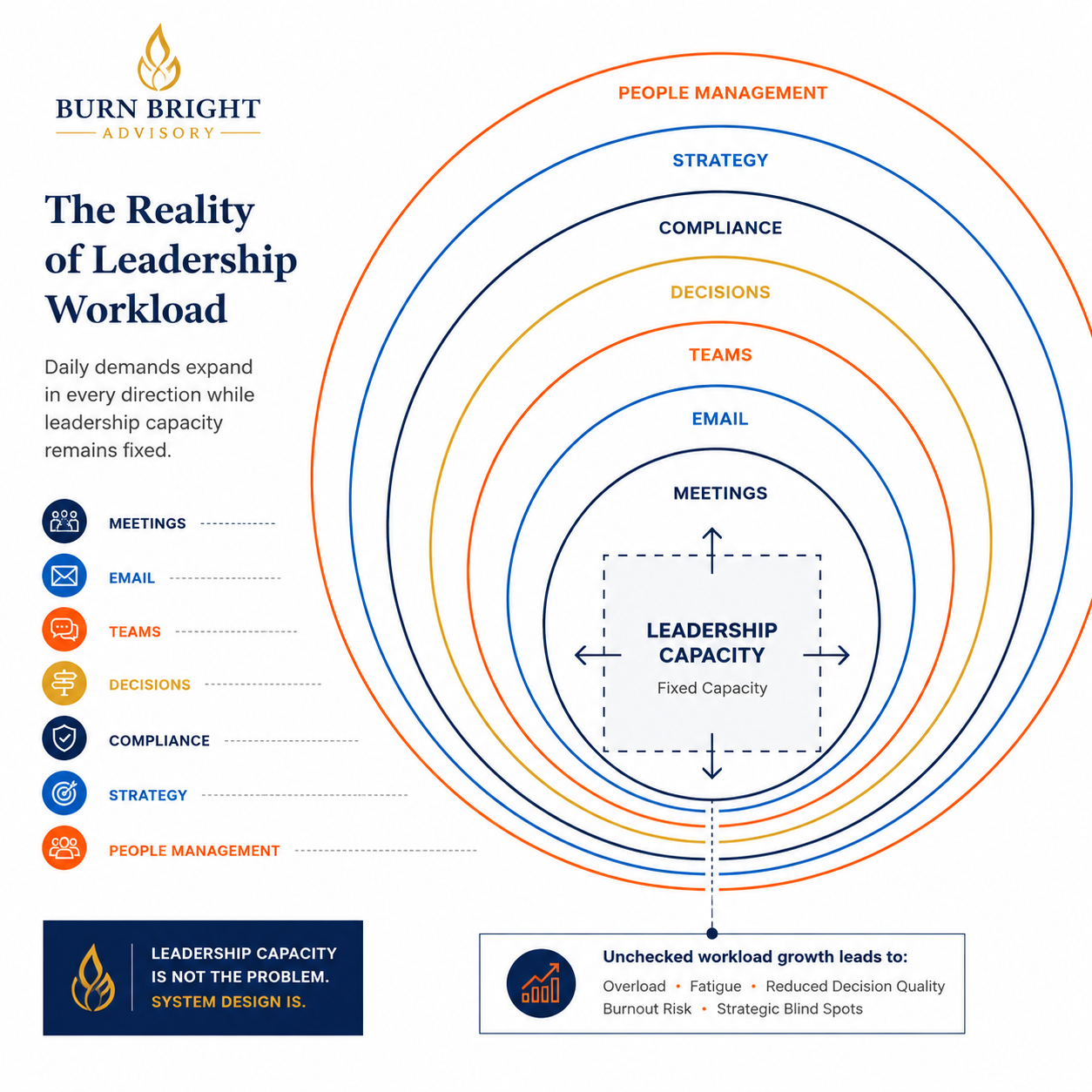
As responsibilities increase while organisational structures remain largely unchanged, leaders become trapped in a cycle of permanent overload. The issue is rarely individual capability — it is structural design.
Featured Snippet
Why Does Leadership Always Feel Like Catching Up?
Most leaders do not arrive at work intending to firefight. Yet many spend the majority of their day reacting rather than leading.
Research consistently shows that modern managers operate inside an environment dominated by interruption. Instead of completing strategic work, they move continuously between emails, meetings, instant messaging, approvals, staffing issues and unexpected operational problems.
The challenge is cumulative.
Every new responsibility seems reasonable in isolation:
- One additional weekly meeting.
- One extra reporting requirement.
- One more digital platform.
- Another compliance process.
- Another stakeholder group.
Individually these appear manageable.
Collectively they transform leadership into continuous reactive work.
The opening chapter of Burn Bright Not Out describes this perfectly. Leadership roles have expanded dramatically while support structures have remained largely unchanged. Managers have become strategists, coaches, analysts, communicators, crisis managers, wellbeing champions and technology specialists simultaneously.
Gallup has reported that over half of managers experience burnout, while organisations continue asking leaders to deliver more with fewer resources.
This is not because leaders have become less capable. It is because leadership architecture has not evolved alongside organisational complexity.
Why Isn’t Better Time Management Solving the Problem?
For decades, leadership development has focused on one solution above all others: improve personal productivity.
Use a better diary.
Block your calendar.
Prioritise more effectively.
Answer emails faster.
Delegate more.
These are valuable skills. They are simply no longer sufficient.
The difficulty is that traditional time management assumes you control your workload. Modern leaders rarely do.
Your calendar is shaped by dozens of competing stakeholders. A strategic planning session disappears because a critical employee resigns. A quiet afternoon becomes filled with emergency meetings after a customer complaint. A day reserved for thinking becomes consumed by instant messages and urgent approvals.
The reality is that leadership work has shifted from planned execution to continuous interruption.
Research discussed throughout Burn Bright Not Out argues that today’s managers are expected to operate within organisational systems designed for a much simpler workplace. Technology has increased communication rather than reducing it. Digital collaboration has created constant availability rather than greater flexibility. Leaders now manage simultaneous conversations across Teams, Slack, email, WhatsApp, project platforms and video meetings, often while trying to complete the work they were originally employed to do.
This explains why many leaders feel busy all day yet finish with little meaningful progress.
The issue is not poor organisation.
It is fragmented attention.
Each interruption may only take a few minutes, but the cognitive cost of switching between tasks is significant. Strategic thinking requires uninterrupted concentration, yet many leaders rarely experience more than fifteen or twenty consecutive minutes without disruption.
Eventually, leaders begin measuring success differently. Instead of asking, “Did I move the organisation forward today?” they ask, “Did I survive today?”
That shift represents the beginning of chronic leadership overload. Burn Bright describes this as moving from leadership by design to leadership by reaction. Once every day becomes reactive, permanent backlog becomes inevitable because important work is continually displaced by urgent work.
Before examining the structural causes, it helps to visualise how workload expands while productive capacity remains fixed.
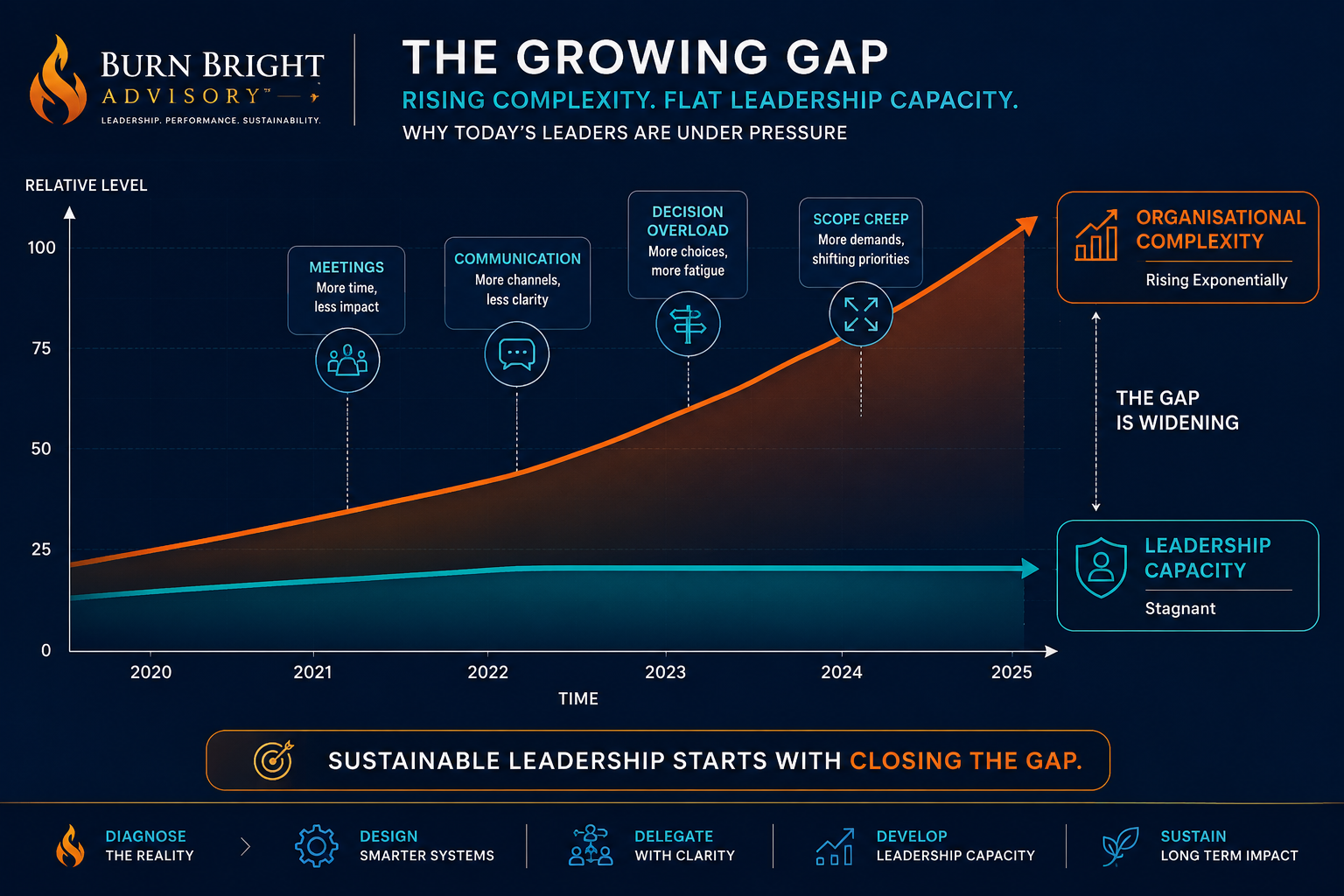
As communication, meetings and decision demands increase, strategic capacity steadily declines unless organisations deliberately redesign workload.
Which Organisational Systems Keep Leaders Permanently Behind?
Most organisations unintentionally create conditions where falling behind becomes unavoidable.
Not because people are lazy.
Not because leaders lack resilience.
Because the systems themselves generate more work than they remove.
Burn Bright identifies five structural causes of burnout that repeatedly appear across sectors.
Instead, they quietly increase what Burn Bright calls the Culture Tax — the hidden financial cost organisations pay through turnover, disengagement, reduced innovation and burnout.
When these five structural pressures combine, leaders begin experiencing a permanent sense of unfinished work.
| Traditional Productivity | Sustainable Leadership |
|---|---|
| Work harder | Redesign workload |
| Improve personal efficiency | Improve organisational systems |
| Manage every task | Remove unnecessary work |
| Increase individual resilience | Build structural resilience |
| Prioritise more activities | Eliminate competing priorities |
| Stay constantly available | Protect strategic thinking time |
| Measure busyness | Measure organisational outcomes |
The difference is significant. Traditional productivity asks leaders to adapt to broken systems. Sustainable leadership asks organisations to redesign those systems so leaders can perform consistently without sacrificing their health.
How Can Leaders Stop Feeling Permanently Behind?
The first step is recognising that the backlog is not the problem. The system creating the backlog is.
Many leaders believe the answer lies in becoming faster. They download another productivity app, colour-code their diary, or wake up an hour earlier. These tactics might create temporary improvements, but they rarely solve the underlying issue because they leave the structure of work untouched.
Burn Bright takes a different approach. Instead of asking, “How can I fit more work into my day?” ask, “Why is this work entering my day in the first place?”
That question shifts the conversation from personal productivity to organisational design. The Burn Bright Not Out Framework identifies four structural pillars that transform sustainable leadership.
Pillar 1 Workload Architecture
Every leader should understand exactly where their workload originates. Conduct a workload audit by categorising every recurring responsibility:
- Strategic leadership
- Operational management
- Administration
- Meetings
- Communication
- Compliance
- Crisis response
Many leaders discover that less than 20% of their week is spent on the work only they can perform. Everything else represents an opportunity to redesign, automate, simplify or delegate.
Pillar 2 Decision Authority
One of the greatest hidden drains on leadership capacity is unnecessary decision-making. When every decision flows upwards, organisations become slower while leaders become exhausted.
High-performing organisations deliberately define decision ownership. Questions that teams can answer should stay with teams. Managers should coach decision-making rather than becoming permanent decision-makers. Reducing unnecessary approvals creates two benefits:
- Leaders recover strategic capacity.
- Teams become more confident and accountable.
Pillar 3 Recovery Rhythms
Recovery is not the opposite of productivity. Recovery enables productivity. Elite performers in sport understand that performance depends upon structured recovery. Leadership is no different. Recovery rhythms include:
- Protected thinking time
- Meeting-free blocks
- Defined communication boundaries
- Recovery between major projects
- Holidays that genuinely disconnect leaders from operational decisions
Recovery should be designed into organisational systems rather than left to chance.
Pillar 4 Management Frameworks
Frameworks reduce decision fatigue. Instead of reinventing every response, leaders develop consistent ways of handling recurring challenges. Examples include:
- Delegation frameworks
- Meeting rules
- Communication standards
- Priority matrices
- Escalation protocols
Every framework removes unnecessary cognitive effort. Over time, this creates significant capacity for strategic leadership instead of constant firefighting.
Before implementing change, it helps to see how sustainable leadership systems work together.
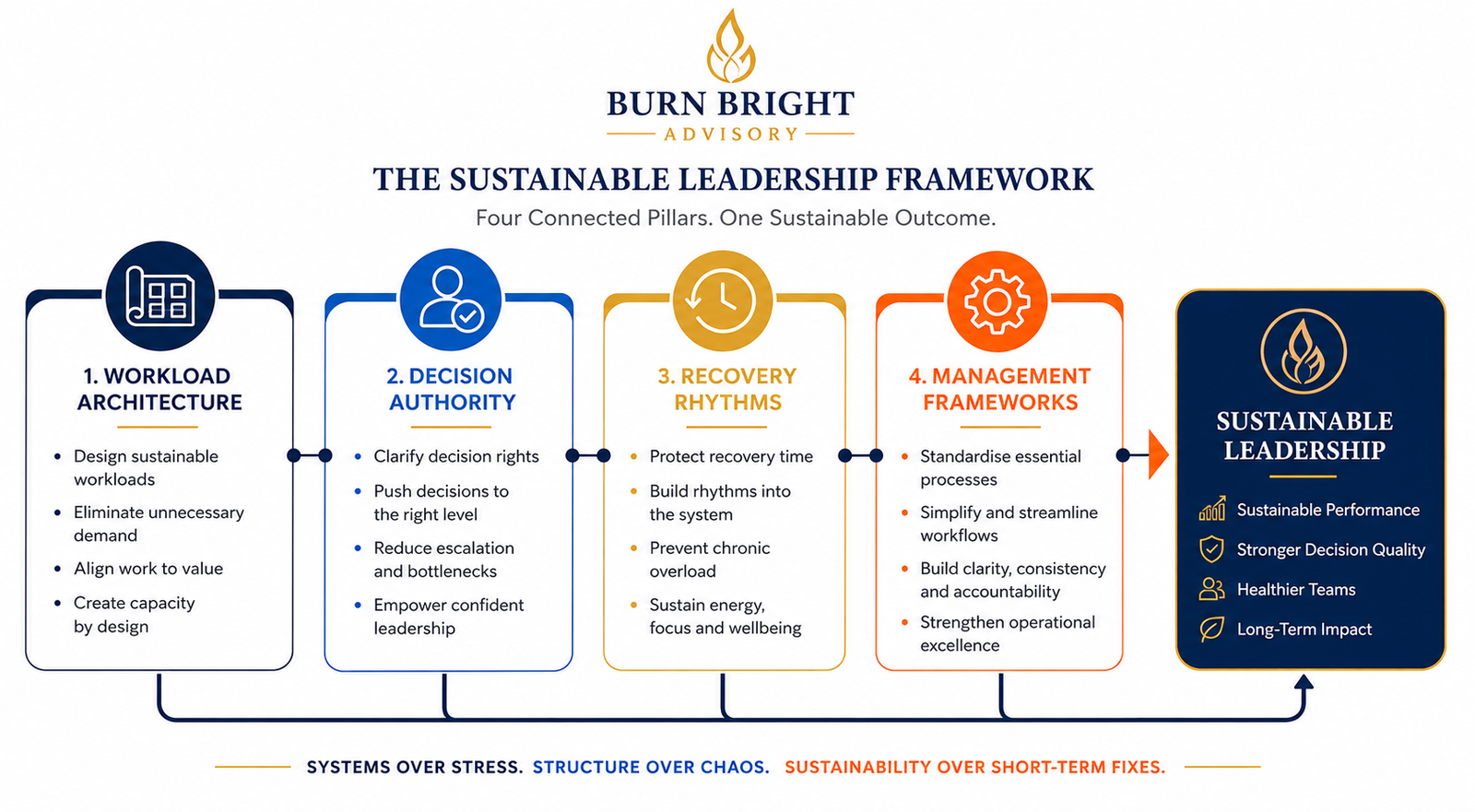
Sustainable leadership is built through better workload architecture, decision authority, recovery rhythms and management frameworks — not longer working hours.
Why Sustainable Leadership Outperforms Heroic Leadership
Many organisations continue rewarding heroic leadership.
The leader who answers emails at midnight.
The executive who never takes annual leave.
The manager who solves every problem personally.
These behaviours often receive praise because they appear committed. In reality, they create fragile organisations.
When leaders become indispensable, organisations become vulnerable. Every absence creates disruption. Every holiday delays decisions. Every resignation creates instability.
Sustainable leaders think differently. They ask:
- How can this process work without me?
- Which decisions should my team own?
- What work should stop altogether?
- Which systems repeatedly create unnecessary demand?
These questions shift leadership away from individual effort and towards organisational resilience.
Research consistently shows that organisations with healthier leadership cultures experience lower turnover, higher engagement and stronger long-term performance. Burn Bright’s own framework highlights the financial implications of ignoring structural burnout, including replacement costs exceeding £500,000 for senior leaders, approximately £75,000 for middle managers, and significant productivity losses during leadership transitions.
This reinforces one of Burn Bright Advisory’s central beliefs: leaders cannot outwork broken systems. They can only redesign them.
Why do leaders always feel like they have too much to do?
Because leadership responsibilities have expanded faster than organisations have redesigned leadership roles. Most leaders are managing more communication, meetings, compliance and decision-making than previous generations while operating with similar time and resources.
Is feeling permanently behind a sign of burnout?
Not always, but it is often an early warning sign. Persistent backlog, constant urgency and the inability to complete important work can indicate that workload has become structurally unsustainable rather than temporarily busy.
Does better time management solve leadership overload?
Better time management helps organise work but cannot remove unnecessary work. Sustainable improvement requires redesigning workload, improving delegation, clarifying decision ownership and reducing organisational complexity.
Why do high-performing leaders burn out?
High performers often compensate for broken systems by increasing personal effort. Over time this creates chronic overload, emotional exhaustion and declining effectiveness because the underlying organisational problems remain unresolved.
What is the first step towards sustainable leadership?
Begin with a workload diagnosis rather than a productivity solution. Understand where work originates, which activities create value and which tasks exist simply because of outdated organisational processes.
Conclusion
Understanding why leaders feel permanently behind changes the conversation about burnout.
The issue is rarely poor organisation or insufficient resilience. It is usually the predictable outcome of leadership roles that have expanded without corresponding changes in organisational design.
Modern leaders are expected to manage increasing complexity, constant communication and growing accountability while protecting performance, supporting wellbeing and driving innovation. No amount of personal productivity can permanently solve a structural problem.
The answer lies in redesigning leadership itself. When organisations improve workload architecture, clarify decision authority, protect recovery and simplify management systems, leaders regain the capacity to think strategically rather than react continuously.
Is Your Workload Structurally Sustainable?
Take the Leadership Burnout Self-Assessment to identify the hidden organisational factors contributing to overload and discover practical strategies for redesigning your leadership approach.
Free Leadership Intelligence
Get Weekly Leadership Insights
Join thousands of leaders receiving practical strategies on burnout prevention, workload design, and sustainable performance every week.