Quick Answer
Key Takeaways
- Exceptional leadership rarely begins with advanced strategy — it begins with strong foundations.
- Leadership Performance Intelligence™ treats leadership as an interconnected system, not a collection of isolated competencies.
- Technical competence may open the door to leadership, but it does not automatically prepare someone to lead.
- Leadership capacity limits organisational capacity — when leaders become overwhelmed, performance declines across the whole organisation.
- Sustainable leadership is built through continual learning, reflection, ethical decision-making and professionalism, not isolated moments of brilliance.
Leadership Foundations: Why Leadership Performance Intelligence™ Is the Starting Point for Sustainable Leadership
Executive Summary
Exceptional leadership rarely begins with advanced strategy. It begins with strong foundations.
Many organisations invest heavily in leadership development while overlooking the capabilities that determine whether leaders can consistently perform under pressure, adapt to complexity and maintain long-term effectiveness. Technical expertise alone is no longer enough. Sustainable leadership requires an integrated approach that combines capability, judgement, reflection, ethical practice and continuous learning.
Leadership Performance Intelligence™ provides this foundation. Rather than viewing leadership as a collection of isolated competencies, it recognises leadership as a dynamic system of interconnected intelligences that influence decision-making, culture, resilience and organisational performance.
This article introduces the principles that underpin Leadership Performance Intelligence™ and explains why strong foundations are essential before organisations invest in advanced leadership programmes, exploring the relationship between leadership capacity, professionalism, ethical judgement, reflective practice and sustainability, with practical insights applicable across business, education, healthcare and public service.
Introduction
Leadership has never been more demanding. Across business, education, healthcare, government and the not-for-profit sector, leaders are expected to navigate uncertainty, manage increasing complexity, inspire diverse teams, embrace rapid technological change and deliver sustainable results — all while maintaining trust, integrity and resilience. Yet despite unprecedented investment in leadership development, many organisations continue to experience declining engagement, increasing burnout, inconsistent decision-making and fragile organisational cultures.
The challenge is not simply a shortage of leadership programmes.
It is a shortage of strong leadership foundations.
Too often, leadership development begins with advanced competencies — strategic planning, innovation, digital transformation or executive influence — before leaders have established the fundamental capabilities required to sustain high performance. Without solid foundations, even highly talented leaders can become overwhelmed by competing priorities, ethical dilemmas and organisational pressures.
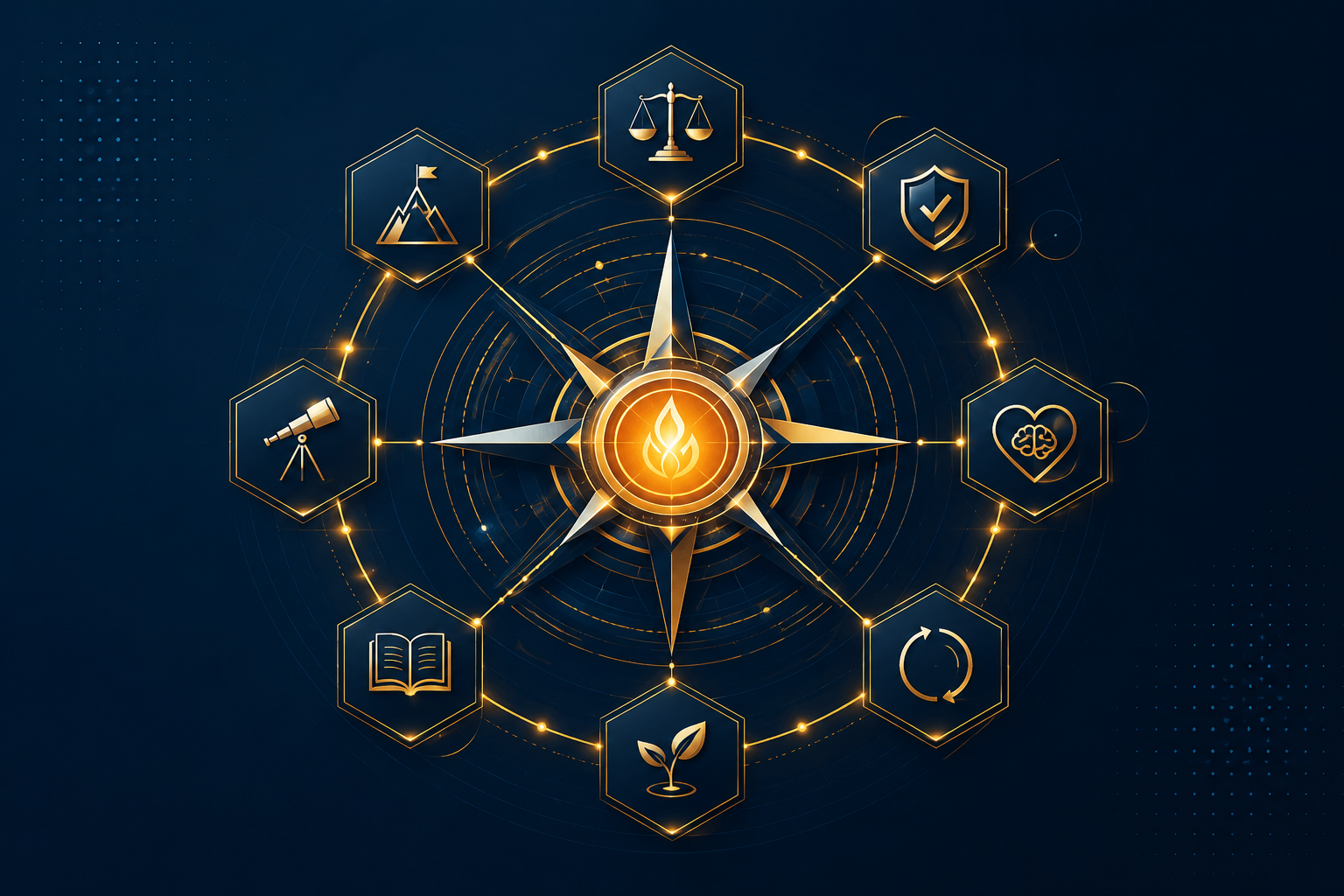
This is where Leadership Performance Intelligence™ offers a different perspective. Rather than viewing leadership as a collection of isolated skills, it recognises leadership as an integrated system of knowledge, judgement, behaviour and continual growth. Effective leadership is not determined by position, personality or technical expertise alone. It emerges from the interaction of multiple intelligences that shape how leaders think, decide, communicate, adapt and influence others over time.
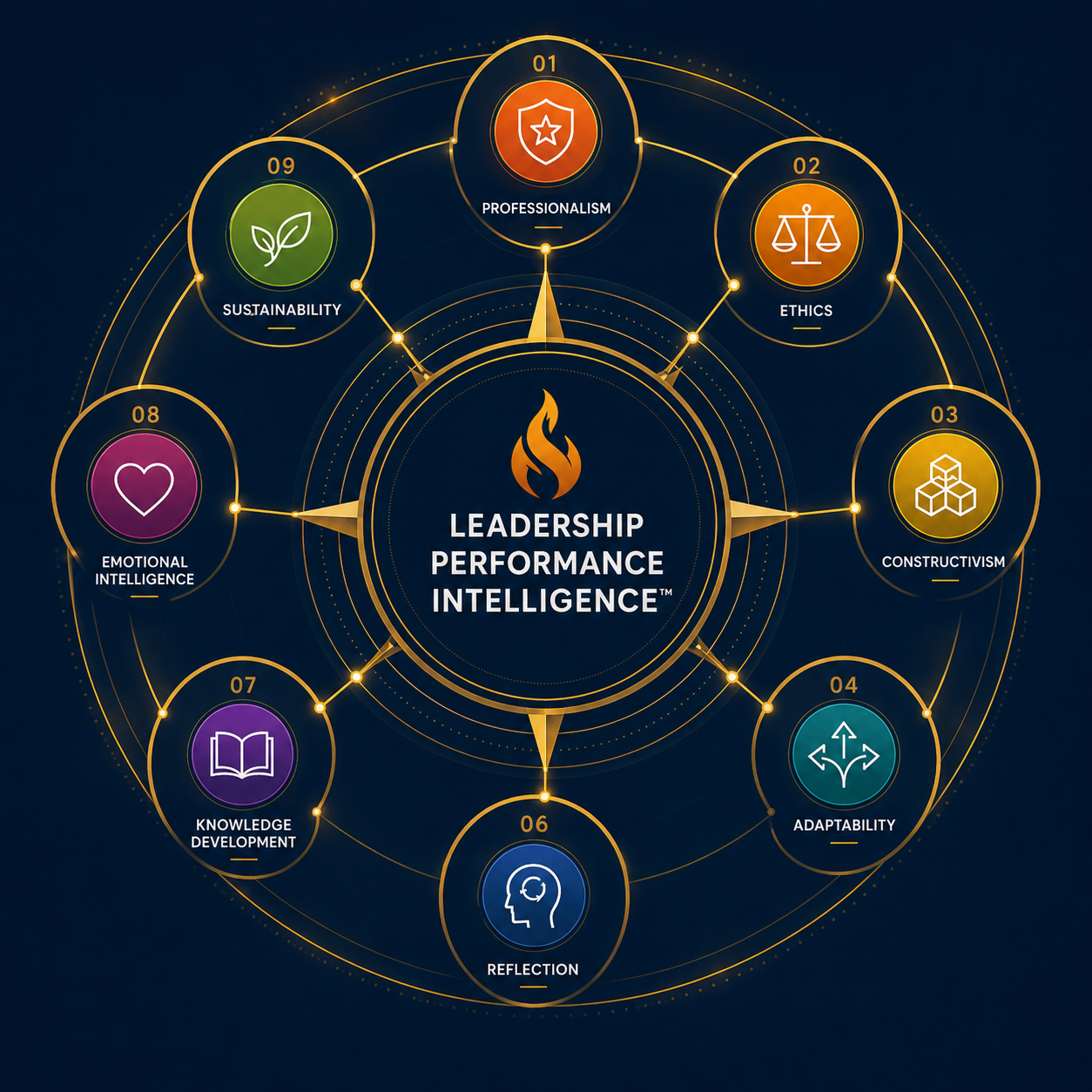
At the centre of this philosophy is the Leadership Intelligence Compass™, a framework that connects the core domains of leadership capability, including Professionalism Intelligence™, Ethics Intelligence™, Constructivism Intelligence™, Adaptability Intelligence™, Visionary Leadership Intelligence™, Reflective Practice Intelligence™, Knowledge Development Intelligence™, Emotional Intelligence™ and Leadership Sustainability™. Each domain strengthens the others, creating a leadership system that is both resilient and adaptable in increasingly complex environments.
Strong foundations also recognise that leadership is contextual. A school principal, hospital executive, public sector director and business owner may work in different environments, yet they face remarkably similar leadership challenges: balancing competing priorities, making decisions with incomplete information, maintaining professional standards, developing people and creating cultures that enable long-term success. Leadership Performance Intelligence™ provides a common framework that can be adapted across sectors while remaining grounded in universal leadership principles.
Importantly, leadership foundations are not static. They develop through deliberate reflection, continuous learning and practical application. Leaders who regularly evaluate their assumptions, seek feedback and invest in their own development are better equipped to navigate change than those who rely solely on past experience or positional authority.
What Are Leadership Foundations?
Leadership is often misunderstood as a position, a personality trait or the ability to influence others. In reality, effective leadership begins much earlier. Before leaders can inspire transformation, implement strategy or navigate complexity, they require a solid foundation that enables consistent, ethical and sustainable performance.
Leadership foundations are the underlying capabilities, values, behaviours and thinking patterns that shape every leadership decision. They determine how leaders respond under pressure, build trust, learn from experience and create environments where individuals and organisations can perform at their best.
Rather than asking, “What skills does a leader need?”, Leadership Performance Intelligence™ asks a more important question: “What enables leaders to perform consistently and sustainably over time?”
The answer lies in developing the right foundations before pursuing advanced leadership capabilities.
Leadership Is Built, Not Bestowed
Many organisations still promote individuals primarily because of technical expertise or professional achievement. Outstanding teachers become school leaders. Exceptional clinicians become healthcare managers. High-performing engineers become department directors. Successful sales professionals become business executives.
Technical competence may open the door to leadership.
It does not automatically prepare someone to lead.
Leadership requires an entirely different set of capabilities, including judgement under uncertainty, ethical decision-making, emotional awareness, reflective practice, communication, adaptability, strategic thinking, capacity management, and professional integrity.
Without these foundations, leaders often rely on experience alone. While experience is valuable, it can also reinforce ineffective habits if it is not accompanied by reflection and continuous learning. Leadership therefore becomes a developmental journey rather than a destination.
The Difference Between Competence and Leadership Performance
Competence describes what someone can do. Leadership Performance Intelligence™ focuses on how consistently and sustainably they can do it.
Two leaders may possess identical qualifications, experience and technical knowledge, yet achieve vastly different outcomes. Why? Because performance is influenced by far more than knowledge alone.
High-performing leaders consistently demonstrate sound judgement, emotional regulation, professionalism, resilience, ethical reasoning, learning agility, reflective thinking, and adaptability. As organisational complexity increases, technical expertise gradually becomes less important than the leader’s ability to think, learn, collaborate and adapt.
Leadership Performance Intelligence™ as the Foundation
Rather than viewing leadership through isolated competency models, Leadership Performance Intelligence™ recognises that leadership effectiveness emerges from the interaction of multiple forms of intelligence.
Foundation How Each Domain Contributes to Leadership
- Professionalism Intelligence™ — builds credibility, accountability and trust
- Ethics Intelligence™ — supports principled and transparent decision-making
- Reflective Practice Intelligence™ — encourages continual learning and self-improvement
- Adaptability Intelligence™ — enables leaders to respond effectively to uncertainty and change
- Emotional Intelligence™ — strengthens relationships, communication and influence
- Knowledge Development Intelligence™ — promotes evidence-informed leadership and lifelong learning
- Visionary Leadership Intelligence™ — provides strategic direction and organisational purpose
- Leadership Sustainability™ — protects long-term effectiveness while preventing burnout and capability decline
None of these capabilities operate independently. Weakness in one area inevitably affects performance elsewhere. Leaders with excellent strategic thinking but poor reflective practice may repeat ineffective decisions. Leaders with strong emotional intelligence but limited ethical judgement may build positive relationships while making inconsistent decisions. Leaders with exceptional professionalism but low adaptability may struggle during periods of organisational change.
Leadership foundations therefore function as an interconnected system rather than individual competencies.
Why Strong Foundations Matter More Than Ever
Modern leadership operates within an environment of unprecedented complexity. Leaders must balance competing priorities while responding to rapid technological change, artificial intelligence, workforce shortages, hybrid working, increased stakeholder expectations, regulatory complexity, organisational transformation, and economic uncertainty.
These challenges cannot be solved through technical expertise alone. Instead, they require leaders capable of thinking critically, reflecting objectively, making ethical decisions, adapting continuously, managing competing demands, and sustaining both personal and organisational performance.
Leadership Foundations Across Every Sector
Although leadership contexts differ, foundational principles remain remarkably consistent.
Business
Business leaders require strong foundations to balance commercial performance with innovation, employee wellbeing and sustainable growth. Leadership Performance Intelligence™ enables executives to make better strategic decisions while maintaining organisational resilience.
Education
School leaders influence far more than academic outcomes. Their foundations determine organisational culture, staff wellbeing, student achievement and community confidence. Reflective leadership, professionalism and ethical decision-making become essential components of effective educational leadership.
Healthcare
Healthcare leadership combines operational complexity with significant ethical responsibility. Strong leadership foundations improve collaboration, patient safety, workforce wellbeing and organisational learning. Leadership Sustainability™ becomes particularly important within high-pressure clinical environments.
Public Service
Public sector leaders operate under intense public scrutiny while balancing competing stakeholder expectations. Professionalism, transparency, ethical reasoning and reflective practice provide the foundations required to maintain public trust.
Foundations Support Sustainable Leadership
Leadership success should not be measured solely by short-term results. True leadership excellence is demonstrated through sustained performance over months, years and entire careers. This requires leaders to continually invest in their own development.
Leadership Sustainability™ recognises that sustainable performance depends upon maintaining leadership capacity, personal wellbeing, reflective habits, professional standards, ethical integrity, and continuous learning. Without these foundations, even highly capable leaders eventually experience declining effectiveness, decision fatigue and reduced organisational impact.
The Leadership Intelligence Compass™ — A Framework for Sustainable Leadership
Leadership is rarely strengthened by developing a single skill in isolation. Many leadership programmes focus on communication, strategic planning or emotional intelligence as independent competencies. While each is valuable, leadership rarely succeeds or fails because of one capability alone. Instead, leadership performance emerges from the interaction of multiple forms of intelligence that continually influence one another.
Rather than treating leadership as a checklist of competencies, the Leadership Intelligence Compass™ recognises that effective leadership is dynamic, interconnected and continuously evolving. Every decision a leader makes is influenced by multiple dimensions of intelligence operating simultaneously.
Leadership as an Integrated System
Imagine leadership as the navigation system of a modern aircraft. The aircraft does not rely on a single instrument to reach its destination. Instead, pilots integrate information from navigation systems, weather data, fuel levels, communications and performance indicators before making decisions.
Leadership works in much the same way. A leader making a strategic decision is simultaneously drawing upon professional judgement, ethical reasoning, emotional awareness, organisational knowledge, adaptability, reflective learning, and long-term sustainability.
Weakness in any one area increases the likelihood of poor decisions, regardless of strengths elsewhere.
The Nine Domains of the Leadership Intelligence Compass™
Domain 1
Professionalism Intelligence™
Forms the visible foundation of leadership credibility. It shapes how leaders conduct themselves, communicate with others, maintain accountability and demonstrate consistency between words and actions.
- Builds trust quickly
- Demonstrates reliability
- Models organisational values
Professionalism is not about perfection. It is about creating confidence through integrity, consistency and accountability.
Domain 2
Ethics Intelligence™
Every leadership decision carries ethical consequences. Leaders demonstrate this intelligence by asking: is this decision fair, who benefits, who may be disadvantaged, does this align with our values, and would I be comfortable explaining this decision publicly?
Ethical leadership builds trust because it creates consistency between organisational values and leadership behaviour.
Domain 3
Constructivism Intelligence™
Recognises that people interpret situations differently based on their experiences, beliefs and organisational context. Rather than assuming there is only one correct perspective, effective leaders actively explore multiple viewpoints before making decisions — becoming facilitators of understanding rather than simply providers of answers.
Domain 4
Adaptability Intelligence™
Change is no longer an occasional organisational event — it is the operating environment. Adaptable leaders learn continuously, adjust strategies quickly, embrace innovation, respond calmly to uncertainty, and encourage experimentation without losing strategic direction.
Domain 5
Visionary Leadership Intelligence™
Leadership requires more than solving today’s problems — it requires creating tomorrow’s opportunities. Leaders with strong visionary capability communicate compelling direction, align teams around shared purpose, and anticipate future challenges.
Vision provides stability during uncertainty because people understand not only what they are doing but why it matters.
Domain 6
Reflective Practice Intelligence™
Experience alone does not create expertise — reflection transforms experience into learning. Reflective leaders continually ask: what worked, what did not, why, what have I learned, and what should I do differently next time?
Domain 7
Knowledge Development Intelligence™
Leadership capability expands through evidence-informed practice, curiosity and lifelong professional development. Knowledge becomes valuable only when translated into improved leadership practice.
Domain 8
Emotional Intelligence™
Leadership is deeply relational. This domain enables leaders to understand both their own emotions and those of others, strengthening communication, trust, conflict resolution, coaching, motivation, and collaboration.
Domain 9
Leadership Sustainability™
Perhaps the defining feature of the Compass. Leadership should enhance organisational performance without exhausting the people responsible for delivering it — balancing leadership capacity, workload, wellbeing, resilience, organisational systems, and continuous improvement.
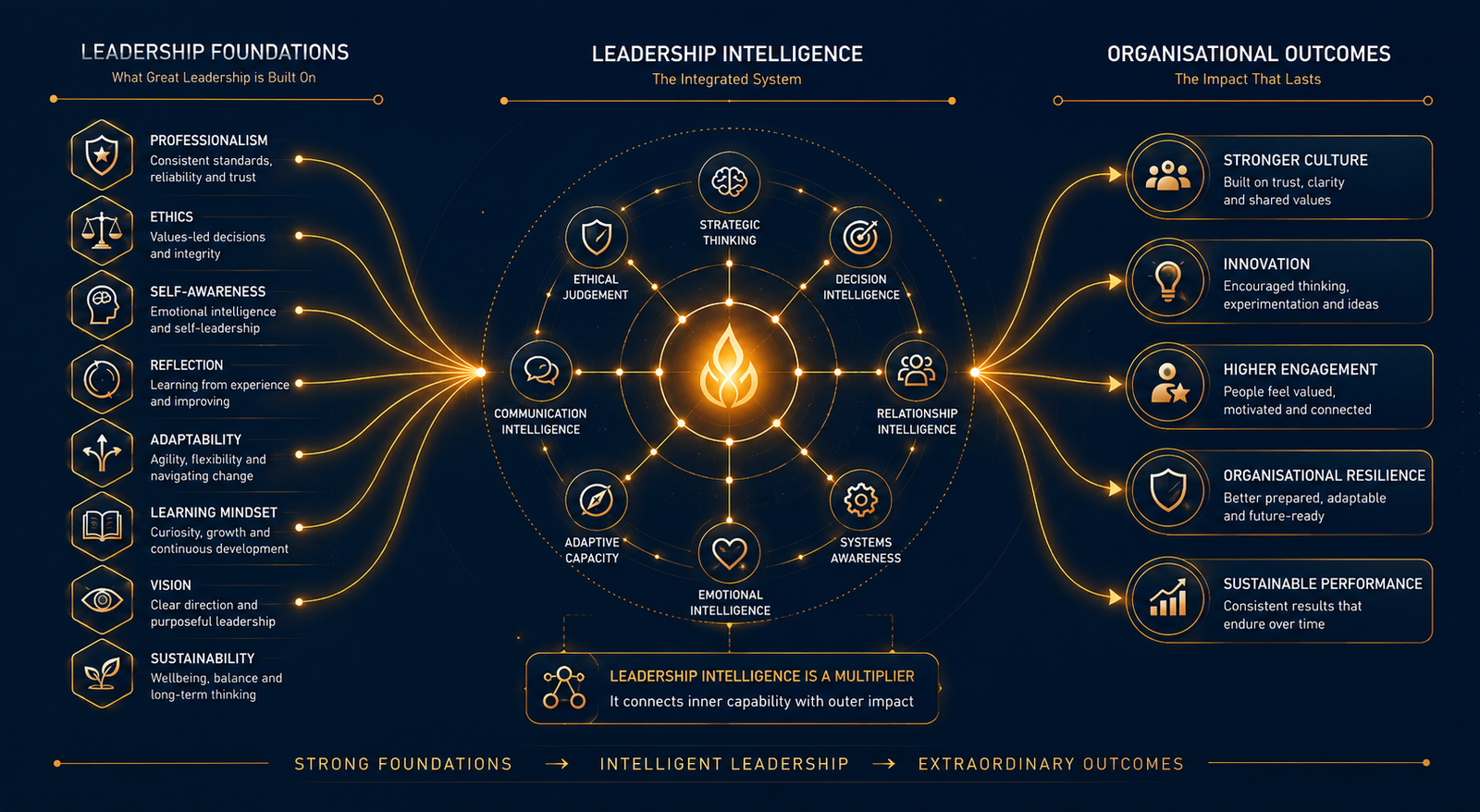
The Compass Works as a Whole
Although each domain has distinct characteristics, they operate as an integrated leadership ecosystem. A leader implementing organisational change draws simultaneously upon Visionary Leadership Intelligence™ to communicate purpose, Emotional Intelligence™ to understand employee concerns, Ethics Intelligence™ to ensure fairness, Adaptability Intelligence™ to respond to changing circumstances, Reflective Practice Intelligence™ to evaluate progress, and Professionalism Intelligence™ to maintain trust throughout implementation.
The strongest leaders develop balance across the entire Compass rather than pursuing isolated excellence.
Developing Leadership Performance Intelligence™
Leadership development should move beyond competency checklists. Instead, leaders should regularly assess which intelligence is currently their greatest strength, which domain most limits their effectiveness, how these domains interact, and which capability will have the greatest impact if strengthened next.
Why the Leadership Intelligence Compass™ Matters
Organisations increasingly operate in environments characterised by complexity, ambiguity and constant change. Technical expertise alone cannot navigate these realities. The Leadership Intelligence Compass™ equips leaders with a comprehensive framework for developing the judgement, adaptability, professionalism and sustainability required to lead effectively across every sector.
How Leadership Performance Intelligence™ Drives Organisational Success
Leadership is often evaluated through visible outcomes — financial performance, productivity, employee engagement, innovation or customer satisfaction. While these indicators are important, they are ultimately lagging measures. They tell us what has happened, but they rarely explain why it happened.
Organisations rarely outperform the quality of their leadership for long. Likewise, sustained organisational underperformance is often less a consequence of poor strategy than of leadership systems that lack the capacity, adaptability and judgement to execute that strategy effectively.
Leadership Is an Organisational Performance System
Every organisation is a network of interconnected decisions that determine culture, employee engagement, innovation, customer experience, operational performance, ethical standards, and financial sustainability.
When leaders make consistently high-quality decisions, organisations become more adaptive, resilient and productive. Conversely, when leadership capability is inconsistent, the effects quickly cascade — declining trust, inconsistent communication, increased conflict, slower decision-making, reduced innovation, employee disengagement, higher turnover, and reputational risk.
Leadership Performance Extends Beyond Individual Capability
Traditional leadership models often concentrate on developing individual leaders. Leadership Performance Intelligence™ recognises that leadership also exists within organisational systems. Strong organisations invest in shared leadership language, reflective cultures, ethical governance, evidence-informed decision-making, leadership development pathways, continuous feedback systems, succession planning, and organisational learning.
Leadership becomes a collective capability rather than an individual characteristic.
The Relationship Between Leadership and Organisational Culture
Culture reflects the cumulative effect of thousands of leadership decisions made over time. Leaders shape culture through the behaviours they reward, the standards they uphold, the conversations they encourage, and the accountability they demonstrate.
A stated commitment to collaboration means little if leaders consistently discourage differing opinions. Similarly, organisations cannot claim to value wellbeing if leadership behaviour rewards chronic overwork and constant availability.
Consistency builds trust.
Trust strengthens culture.
Strong culture improves performance.
Leadership Capacity Determines Organisational Capacity
When leaders become overwhelmed by excessive workload, poor delegation or reactive decision-making, organisational performance begins to decline — resulting in delayed decisions, reduced innovation, slower organisational learning, increased operational bottlenecks, lower employee confidence, and diminished strategic focus.
Leadership Capacity™ is not simply about personal productivity. It represents the organisation’s ability to think strategically, solve problems effectively and maintain sustainable performance over time.
Sustainable Leadership Creates Sustainable Organisations
Many organisations achieve short-term success through extraordinary individual effort. Unfortunately, these gains are often followed by burnout, high turnover and declining performance.
Sustainable organisations deliberately design systems that support long-term performance by distributing leadership responsibility, encouraging collaboration, preventing unnecessary workload duplication, strengthening decision-making processes, investing in continual capability development, and protecting leadership capacity.
Measuring What Matters
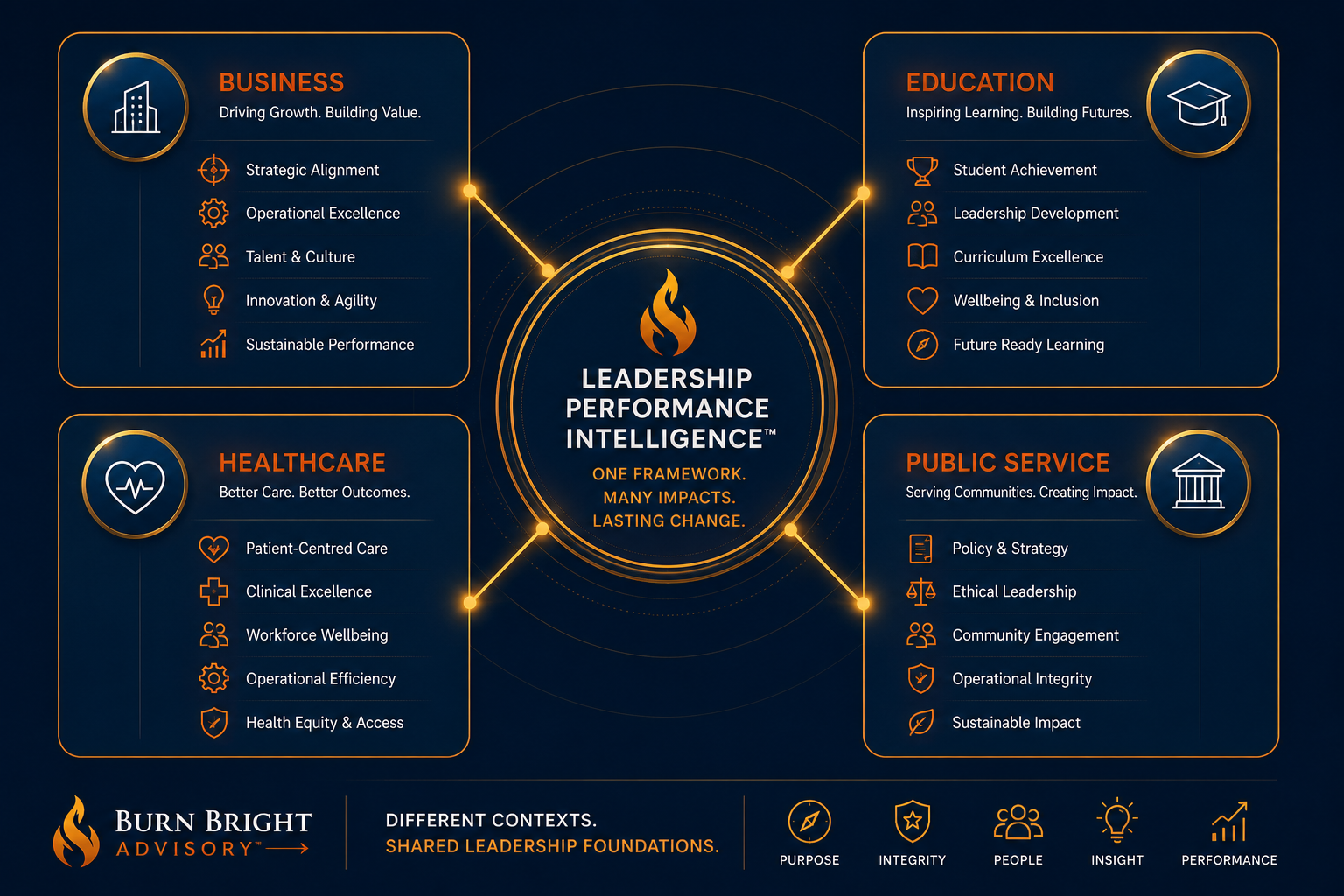
Many leadership programmes evaluate success by attendance, satisfaction surveys or competency checklists. Leadership Performance Intelligence™ encourages organisations to measure leadership through broader indicators.
Indicators Leadership Intelligence and Organisational Outcome
- Leadership Capacity™ → improved strategic execution
- Leadership Sustainability™ → reduced burnout and turnover
- Reflective Practice Intelligence™ → continuous organisational learning
- Professionalism Intelligence™ → increased trust and accountability
- Ethics Intelligence™ → stronger governance and reputation
- Emotional Intelligence™ → higher employee engagement
- Adaptability Intelligence™ → greater organisational resilience
- Visionary Leadership Intelligence™ → improved long-term strategy execution
These indicators move leadership measurement beyond activity towards meaningful organisational impact.
Leadership Excellence Is Never Accidental
High-performing organisations rarely emerge through chance. They are built by leaders who continually invest in their own development while creating systems that enable others to succeed.
Leadership Performance Intelligence™ demonstrates that sustainable organisational success is not driven by charismatic individuals or isolated leadership competencies. It is created through interconnected leadership foundations that strengthen judgement, adaptability, professionalism, ethics, reflection and sustainability over time.
A Practical Roadmap for Developing Leadership Performance Intelligence™
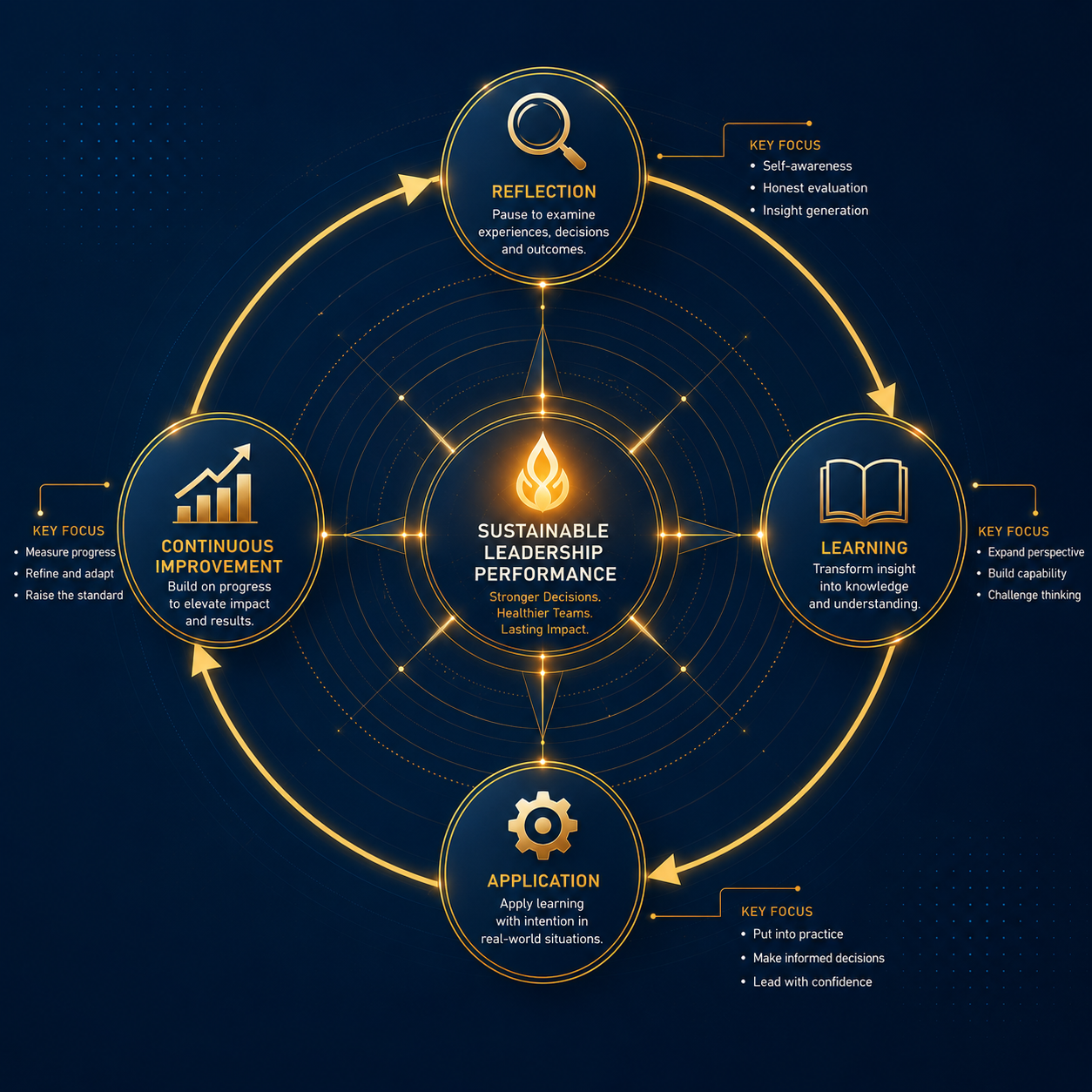
Leadership is not developed through a single workshop, qualification or promotion. It evolves through deliberate practice, reflective learning and continual adaptation. The roadmap presented here is not linear — leaders may revisit each stage many times throughout their careers as responsibilities change, organisations evolve and new challenges emerge.
Stage 1 Build Self-Awareness
Without self-awareness, leaders often overestimate their strengths, underestimate their blind spots and repeat behaviours that limit performance. Self-awareness involves understanding:
- Personal values and leadership beliefs
- Behavioural preferences and communication style
- Emotional responses and decision-making patterns
- Leadership strengths and development needs
Developing self-awareness creates the foundation for every other leadership capability.
Stage 2 Strengthen Professionalism and Ethical Judgement
Professionalism Intelligence™ and Ethics Intelligence™ work together to establish trust throughout an organisation. Professional leaders honour commitments, communicate transparently, accept accountability, model respectful behaviour, and remain consistent under pressure.
Ethical leadership builds cultures where trust becomes a competitive advantage rather than a compliance requirement.
Stage 3 Develop Reflective Practice
Experience alone does not improve leadership — reflection transforms experience into wisdom. Effective reflection considers what happened, why it happened, what assumptions influenced the decision, and what should be repeated or changed.
Many successful leaders schedule dedicated reflection time every week to review decisions, conversations and organisational progress.
Stage 4 Expand Knowledge Continuously
Rapid technological change, evolving workforce expectations and complex organisational challenges require continual learning. This includes reading current leadership research, analysing organisational data, seeking diverse viewpoints, and participating in professional networks.
The most effective leaders remain intellectually curious regardless of seniority.
Stage 5 Strengthen Emotional and Relational Capability
Even the best strategies fail if leaders cannot build trust, communicate effectively and create psychologically safe environments. Emotional Intelligence™ enables leaders to recognise emotional cues, manage conflict constructively, coach others effectively, and communicate with empathy.
Stage 6 Develop Adaptability
Economic uncertainty, artificial intelligence, changing workforce expectations and global disruption require continual adaptation. Adaptable leaders remain open to new ideas, adjust strategies when evidence changes, encourage experimentation, and learn quickly from setbacks.
Adaptability does not mean abandoning principles — it means applying enduring principles within changing environments.
Stage 7 Lead with Vision
Operational excellence keeps organisations functioning. Vision creates momentum. Effective leaders consistently communicate why the organisation exists, where it is heading, and why change is necessary.
Vision creates meaning.
Meaning strengthens engagement.
Engagement improves performance.
Stage 8 Protect Leadership Sustainability™
Leadership is not a sprint. It is a professional lifetime. This stage involves managing workload, decision fatigue, energy, wellbeing, recovery, resilience, and professional boundaries.
Sustainable leaders recognise that exhaustion is not evidence of commitment.
Leadership Development Is Continuous
The Leadership Intelligence Compass™ should not be viewed as a checklist to complete. Instead, it represents an ongoing cycle of development:
- Reflect on performance.
- Assess current capabilities.
- Identify development priorities.
- Learn new knowledge.
- Apply improvements.
- Evaluate outcomes.
- Begin the cycle again.
The Role of the Leadership Intelligence Assessment™
Development begins with accurate diagnosis. Without understanding current strengths and capability gaps, leadership development often becomes generic and ineffective. The Leadership Intelligence Assessment™ provides leaders with evidence-informed insight into each domain of the Leadership Intelligence Compass™, identifying leadership strengths, development priorities, behavioural patterns, sustainability risks, leadership capacity, and opportunities for growth.
From Development to Transformation
Instead of asking, “How can we create better managers?”, organisations begin asking how they build sustainable leadership capability, improve leadership judgement, create healthier organisational cultures, strengthen leadership across every level, and ensure today’s leaders remain effective tomorrow.
Reflection Questions
Sustainable leadership begins with thoughtful reflection rather than immediate action. These questions are designed to help leaders evaluate the strength of their own leadership foundations and identify opportunities for continual growth through the Leadership Intelligence Compass™.
Self-Awareness
- What values consistently guide my leadership decisions?
- Which leadership behaviours do I demonstrate consistently under pressure?
- Where might my leadership blind spots be limiting my effectiveness?
- How do others experience my leadership?
Professionalism Intelligence™
- Do my actions consistently reflect my stated values?
- How effectively do I model professionalism for others?
- What leadership behaviours build the greatest trust within my organisation?
Ethics Intelligence™
- How often do I consciously consider the ethical implications of my decisions?
- How transparent is my decision-making process?
- Would I be comfortable explaining every major decision publicly?
Reflective Practice Intelligence™
- How regularly do I evaluate my leadership performance?
- What leadership mistake has taught me the most during the past year?
- What assumptions do I rarely challenge?
Adaptability Intelligence™
- How comfortable am I leading during uncertainty?
- How quickly do I adjust when evidence changes?
- Do I encourage innovation or unintentionally resist it?
Leadership Sustainability™
- Is my current leadership approach sustainable over the next five years?
- Am I developing future leaders or becoming indispensable?
- How effectively do I protect my own leadership capacity?
Practical Action Steps
Developing Leadership Performance Intelligence™ is a continuous process rather than a single initiative. The following actions provide practical starting points for leaders across every sector.
Immediate Actions (This Week)
- Schedule one hour of uninterrupted leadership reflection.
- Identify one Leadership Intelligence Compass™ domain that requires the greatest improvement.
- Ask three trusted colleagues what you do consistently well and what you could improve.
- Review your current workload and identify activities that could be delegated or discontinued.
- Write a short personal leadership purpose statement.
Short-Term Actions (Next 30 Days)
- Complete a structured Leadership Intelligence Assessment™.
- Establish a weekly leadership reflection routine.
- Read one evidence-based leadership publication each week.
- Hold purposeful development conversations with every direct report.
- Review recent leadership decisions through an ethical lens.
- Create measurable leadership development goals.
Long-Term Actions (Next 6–12 Months)
Develop a personal leadership development plan that includes measurable objectives across every Leadership Intelligence Compass™ domain. Invest in professional development, executive coaching or mentoring, leadership benchmarking, organisational learning, succession planning, and leadership sustainability practices. Review progress quarterly and adjust development priorities as organisational needs evolve.
What are leadership foundations?
Leadership foundations are the core capabilities, behaviours and values that enable leaders to make sound decisions, build trust, adapt to change and sustain high performance over time. They form the basis upon which advanced leadership skills are developed.
What is Leadership Performance Intelligence™?
Leadership Performance Intelligence™ is Burn Bright Advisory’s integrated framework for developing sustainable leadership capability. It combines multiple leadership intelligences — including professionalism, ethics, adaptability, emotional intelligence and reflective practice — to improve long-term leadership performance.
How is Leadership Performance Intelligence™ different from traditional leadership competency models?
Traditional competency models often assess individual skills in isolation. Leadership Performance Intelligence™ views leadership as an interconnected system where multiple intelligences interact to influence judgement, behaviour, organisational culture and sustainable performance.
Why is reflective practice important for leaders?
Reflection transforms experience into learning. Leaders who regularly evaluate their decisions, assumptions and behaviours develop stronger judgement, avoid repeating mistakes and continually improve their effectiveness.
Can Leadership Performance Intelligence™ be applied across different sectors?
Yes. The framework has been designed to support leaders across business, education, healthcare, public service, non-profit organisations and entrepreneurship. While leadership contexts differ, the foundational principles remain consistent.
What is the Leadership Intelligence Compass™?
The Leadership Intelligence Compass™ is Burn Bright Advisory’s leadership framework that integrates nine interconnected domains — Professionalism, Ethics, Constructivism, Adaptability, Visionary Leadership, Reflective Practice, Knowledge Development, Emotional Intelligence, and Leadership Sustainability — providing a comprehensive roadmap for leadership development.
Why is Leadership Sustainability™ so important?
Many organisations unintentionally reward unsustainable leadership practices such as excessive workloads, continual availability and reactive decision-making. Leadership Sustainability™ focuses on protecting leadership capacity, promoting wellbeing and creating systems that enable long-term organisational success without burnout.
How can organisations measure leadership capability more effectively?
Organisations should move beyond competency checklists and incorporate broader indicators such as Leadership Capacity™, Leadership Sustainability™, ethical decision-making, professionalism, reflective practice, employee trust, organisational learning, and leadership adaptability.
How often should leaders review their development?
Leadership development should be continuous. A formal review every quarter, supported by regular weekly reflection and annual Leadership Intelligence Assessments™, helps ensure leaders continue adapting as organisational demands evolve.
Where should leaders begin?
The most effective starting point is self-awareness. Understanding current leadership strengths, capability gaps and development priorities enables leaders to build personalised development plans aligned with the Leadership Intelligence Compass™.
Conclusion
The future of leadership will not be defined solely by technical expertise, positional authority or charismatic influence. It will belong to leaders who possess the judgement, adaptability and resilience to navigate complexity while remaining grounded in strong professional and ethical foundations.
Leadership Performance Intelligence™ offers a comprehensive framework for developing these capabilities. By integrating the interconnected domains of the Leadership Intelligence Compass™, leaders can move beyond fragmented competency models towards a more holistic, sustainable approach to leadership development.
Whether leading a business, school, healthcare organisation or public institution, the principles remain the same: sustainable leadership is built through continual learning, reflective practice, ethical decision-making, professionalism and the deliberate cultivation of leadership capacity.
Explore How Leadership Performance Intelligence™ Can Strengthen Your Organisation
Complete the Leadership Burnout Self-Assessment to identify your leadership strengths, capability gaps and development priorities across the Leadership Intelligence Compass™.
Free Leadership Intelligence
Get Weekly Leadership Insights
Join thousands of leaders receiving practical strategies on burnout prevention, workload design, and sustainable performance every week.