Quick Answer
Key Takeaways
- Leadership begins with self-leadership — managing thinking, behaviour, decisions and wellbeing before influencing others.
- Leadership Performance Intelligence™ treats leadership as an interconnected system, not a set of isolated skills.
- Five foundational elements — capacity, reflection, sustainability, workload and benchmarking — determine whether leadership capability can be expressed.
- The Leadership Intelligence Compass™ brings together nine domains that together define sustainable leadership capability.
- Techniques such as delegation or communication training only succeed consistently when the underlying foundations are strong.
Leadership Foundations: Why Sustainable Leadership Begins with Self-Leadership
Leadership is often misunderstood as something people receive through promotion.
A new title.
A larger office.
A bigger budget.
More responsibility.
Yet organisations continue to discover that authority does not automatically create effective leadership.
Many technically excellent professionals struggle after promotion because leadership requires a fundamentally different capability. Success is no longer measured solely by individual expertise but by the ability to create conditions in which other people perform at their best.
The difference lies in foundations.
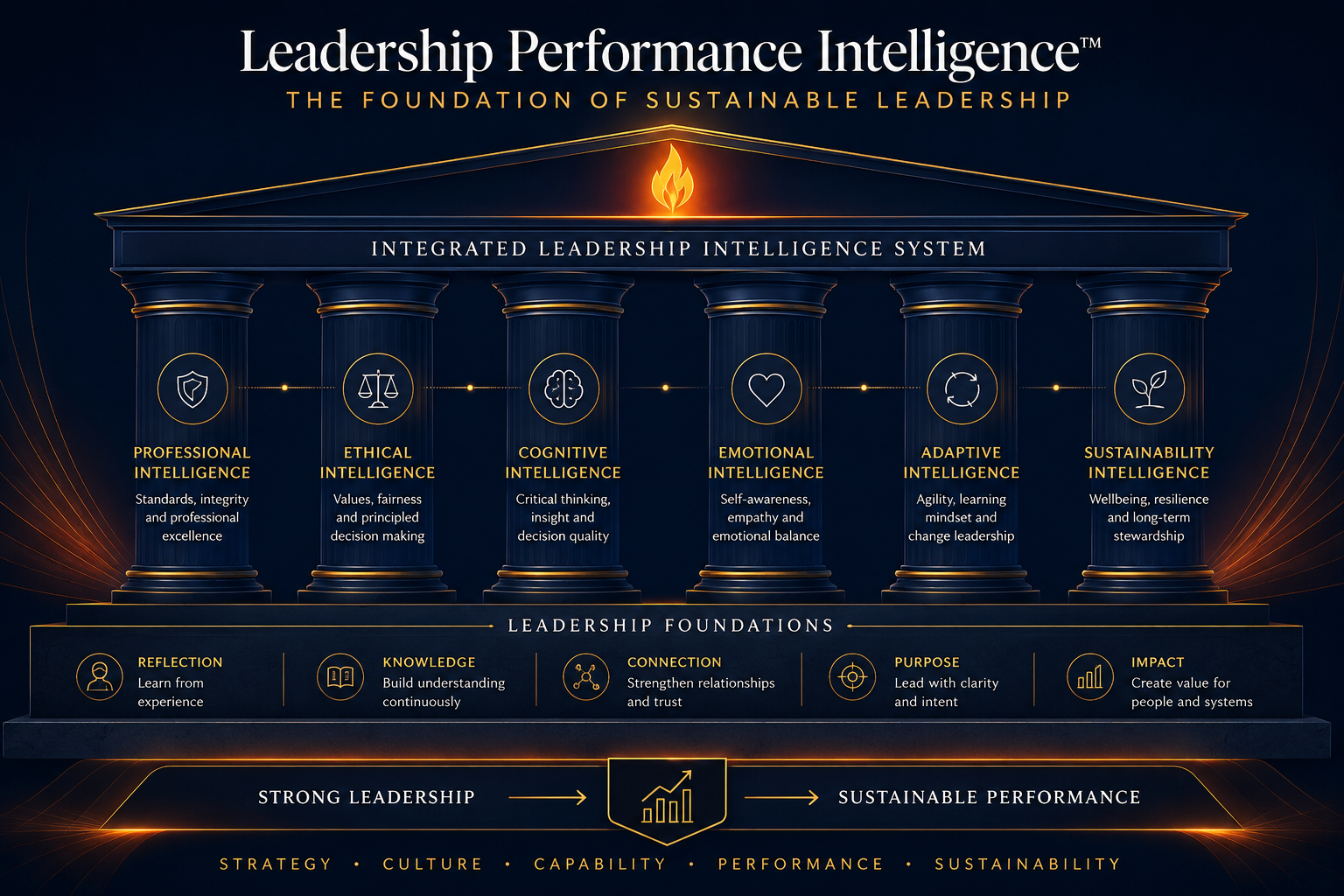
Buildings rise only because their foundations remain hidden beneath the surface. Likewise, sustainable leadership rests upon capabilities that are rarely visible but determine everything that follows.
Burn Bright Advisory describes these capabilities collectively as Leadership Performance Intelligence™ — the integrated ability to sustain personal effectiveness while enabling high organisational performance.
Rather than treating leadership as a collection of disconnected competencies, Leadership Performance Intelligence™ recognises leadership as an interconnected system where every decision, behaviour and relationship influences long-term organisational outcomes.
Featured Snippet
The journey begins with one principle:
Leadership Is More Than Management
Many organisations continue to reward management behaviours while expecting leadership outcomes.
Management focuses on:
- Processes
- Systems
- Compliance
- Consistency
- Coordination
Leadership focuses on:
- Direction
- Purpose
- Judgement
- Adaptation
- Influence
- Culture
Neither is superior. Healthy organisations require both.
Problems emerge when leaders rely exclusively upon management behaviours while operating in increasingly uncertain environments. Complex challenges rarely have procedural solutions.
They require thoughtful judgement.
Reflection.
Adaptability.
Ethical reasoning.
Continuous learning.
These capabilities emerge through self-leadership rather than positional authority.
Self-Leadership Is the First Leadership Responsibility
Leadership begins long before anyone else chooses to follow. It begins with managing:
- Personal thinking
- Emotional responses
- Decision quality
- Learning habits
- Behavioural consistency
- Wellbeing
- Professional standards
This internal leadership determines external effectiveness. Without self-leadership, technical expertise often becomes reactive management. With self-leadership, ordinary decisions become opportunities to strengthen trust, culture and organisational performance.
The most respected leaders rarely possess all the answers. Instead, they possess the discipline to ask better questions.
Leadership Performance Intelligence™: A Systems Perspective
Traditional leadership models frequently separate competencies into isolated categories — communication, decision making, innovation, emotional intelligence, strategy.
Leadership Performance Intelligence™ integrates these capabilities into a single adaptive system. Every leadership decision influences multiple organisational outcomes simultaneously.
For example: a leader experiencing chronic overload may unintentionally reduce strategic thinking, increase emotional reactivity, delay important decisions and weaken team confidence. The issue is not simply workload — it is reduced leadership capacity.
Similarly, ethical decision-making is influenced not only by organisational values but also by fatigue, stress, cognitive overload and psychological safety. Leadership therefore becomes the management of interconnected systems rather than isolated behaviours.
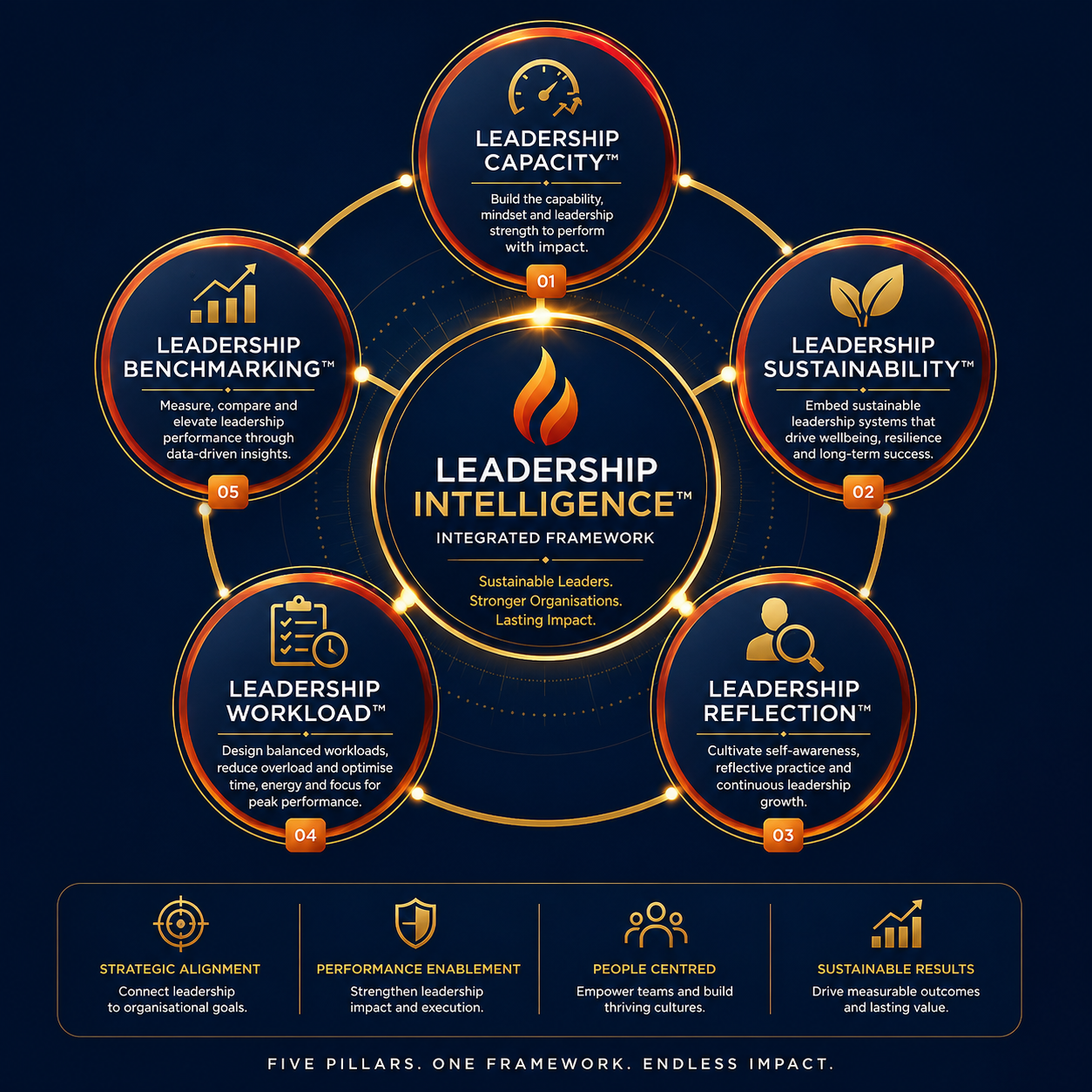
The Five Foundational Elements of Sustainable Leadership
Many leaders focus exclusively on increasing capability while neglecting the foundational elements that allow capability to be expressed consistently.
Pillar 1
Leadership Capacity
Capacity refers to how much leadership energy is available, including cognitive capacity, emotional capacity, physical wellbeing, decision-making bandwidth and resilience. The most skilled leader cannot consistently perform without sufficient personal resources — capacity determines whether capability can actually be expressed.
Pillar 2
Leadership Reflection
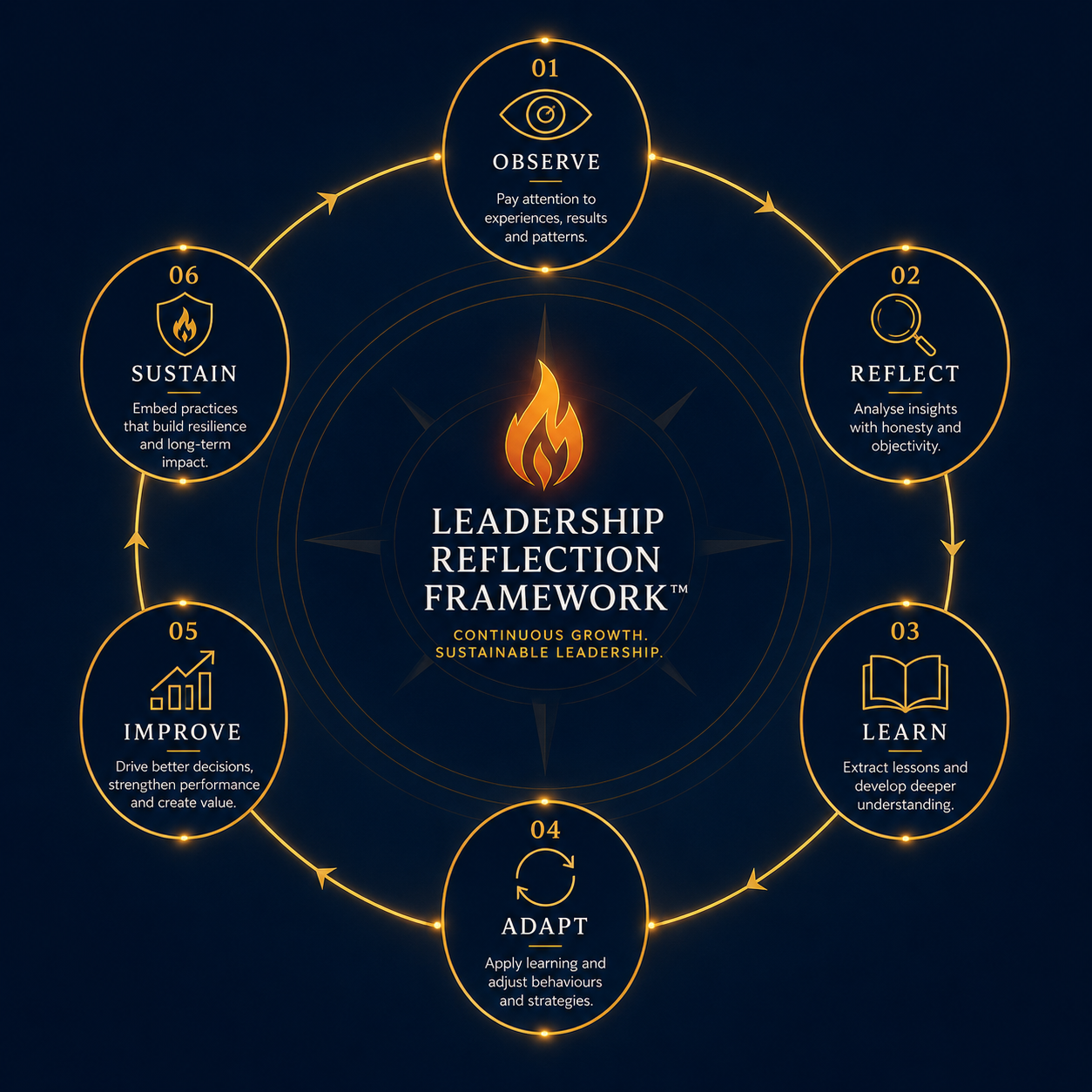
Reflection transforms experience into learning. Without reflection, experience becomes repetition; with reflection, experience becomes wisdom. Reflective leaders routinely examine assumptions, decisions, behaviours, outcomes and unintended consequences — reducing cognitive bias before important decisions are made.
Pillar 3
Leadership Sustainability™
Many leadership cultures unintentionally reward exhaustion, where long hours become symbols of commitment and busyness becomes status. Leadership Sustainability™ recognises that organisations depend upon leaders who remain effective over decades, protecting wellbeing, recovery, strategic thinking and long-term decision quality.
Pillar 4
Leadership Workload
Leadership workload extends beyond visible tasks to include emotional labour, conflict resolution, difficult conversations, stakeholder management, uncertainty and decision fatigue. When invisible workload exceeds available capacity, performance declines even when calendars appear manageable.
Pillar 5
Leadership Benchmarking™
Improvement requires measurement. Leadership Benchmarking™ examines broader indicators including organisational trust, decision quality, psychological safety, adaptability, ethical consistency and learning culture — providing earlier warnings than traditional performance measures.
Why Foundations Matter More Than Techniques
Leadership development often focuses on techniques — how to coach, how to communicate, how to delegate, how to negotiate. These skills are valuable. However, techniques become inconsistent when underlying foundations remain weak.
A leader may attend communication training yet still struggle with difficult conversations because stress narrows attention and increases emotional defensiveness. Another leader may understand delegation but continue micromanaging because psychological safety remains underdeveloped.
The issue is not knowledge. The issue is foundational leadership capability.
Leadership Across Every Sector
Although industries differ considerably, foundational leadership remains remarkably consistent.
Business
Business leaders balance innovation, financial performance, customer expectations and workforce wellbeing. Leadership foundations improve strategic decision-making while reducing reactive management.
Education
School leaders create environments where both educators and students thrive. Reflection, ethical judgement and emotional intelligence strengthen educational cultures far more effectively than compliance alone.
Healthcare
Healthcare leaders make high-stakes decisions under continuous pressure. Leadership sustainability protects both clinical performance and patient outcomes by preserving decision quality during prolonged complexity.
Public Service
Public leaders operate within competing political, financial and community expectations. Foundational leadership supports transparency, trust and ethical governance despite constant external scrutiny.
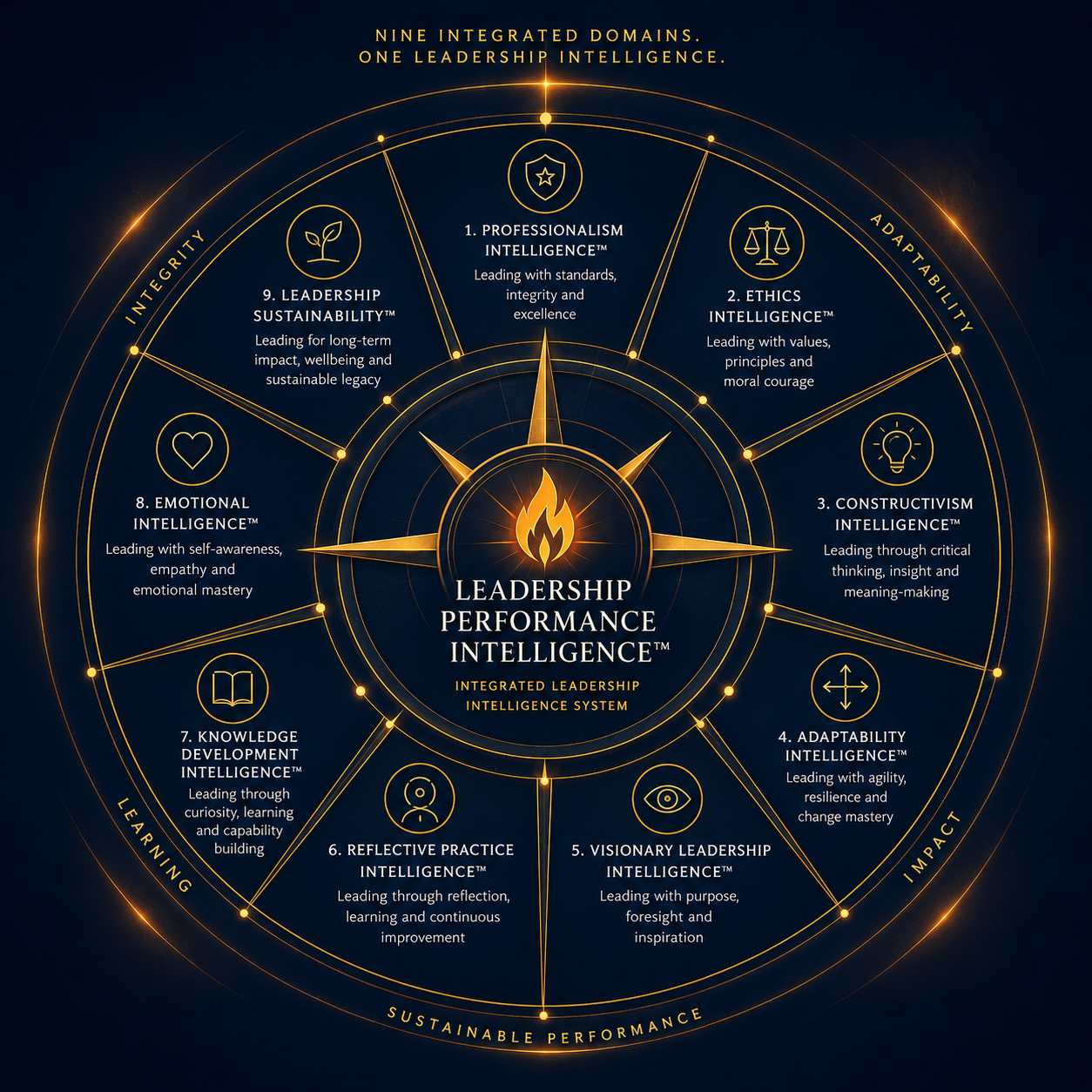
The Leadership Intelligence Compass™: An Integrated Model
Leadership Performance Intelligence™ is strengthened through the interconnected domains of the Leadership Intelligence Compass™. Each domain contributes a distinct capability, but together they form a comprehensive framework for sustainable leadership.
Domain 1 Professionalism Intelligence™
Professionalism is more than competence. It reflects consistency, accountability, reliability and credibility. Leaders with strong Professionalism Intelligence™ create trust because their behaviours align with their commitments.
Domain 2 Ethics Intelligence™
Ethical leadership is not reserved for major organisational crises. It is demonstrated through everyday decisions involving fairness, transparency, confidentiality and responsible judgement.
Domain 3 Constructivism Intelligence™
Modern leaders rarely possess every answer. Constructivism Intelligence™ encourages collaborative learning, shared problem-solving and continuous improvement rather than protecting expertise.
Domain 4 Adaptability Intelligence™
Rapid technological, economic and societal change requires leaders who can adjust without abandoning purpose. Adaptability Intelligence™ balances stability with flexibility.
Domain 5 Visionary Leadership Intelligence™
Vision provides meaning beyond operational targets. Leaders who communicate a compelling future help teams understand why their work matters.
Domain 6 Reflective Practice Intelligence™
Reflection transforms activity into development. Leaders who intentionally examine their decisions become more self-aware and reduce repeated mistakes.
Domain 7 Knowledge Development Intelligence™
Leadership requires continuous learning. Curiosity, evidence-based thinking and professional development ensure leaders remain relevant in increasingly complex environments.
Domain 8 Emotional Intelligence™
Leadership relationships depend upon emotional awareness, empathy and interpersonal effectiveness, strengthening collaboration and trust.
Domain 9 Leadership Sustainability™
The final domain integrates every other element by ensuring leaders maintain the physical, emotional and cognitive resources necessary for long-term effectiveness.
Case Study: Two Leaders, Two Different Futures
Consider two department directors appointed at the same time. Both possess excellent technical expertise. Both inherit capable teams. Both receive similar organisational resources.
Leader A
Leader A believes success depends upon working harder than everyone else. They answer emails late into the evening, attend every meeting, approve every decision and solve every problem personally.
Initially, performance improves. After twelve months, decision quality declines, innovation slows, the team becomes increasingly dependent upon the leader, staff engagement decreases, and the leader experiences chronic exhaustion.
Leader B
Leader B adopts a Leadership Performance Intelligence™ approach. They establish clear priorities, delegate appropriately, develop team capability, protect strategic thinking time, reflect weekly, invest in learning, encourage ethical discussion and model sustainable working practices.
Two years later, the organisation demonstrates higher engagement, stronger innovation, improved succession planning, greater adaptability and a healthier organisational culture.
Common Leadership Myths That Undermine Performance
Many leadership assumptions unintentionally reduce organisational effectiveness.
| Myth | Reality |
|---|---|
| Great leaders always know the answer | Great leaders ask better questions and create environments where collective intelligence emerges |
| Hard work always produces better leadership | Sustainable performance depends upon managing capacity rather than continually increasing effort |
| Leadership is a position | Leadership is a pattern of influence demonstrated through everyday behaviours |
| Confidence means certainty | Confident leaders acknowledge uncertainty while maintaining clarity of purpose |
| Leadership development ends after promotion | Promotion marks the beginning — not the completion — of leadership development |
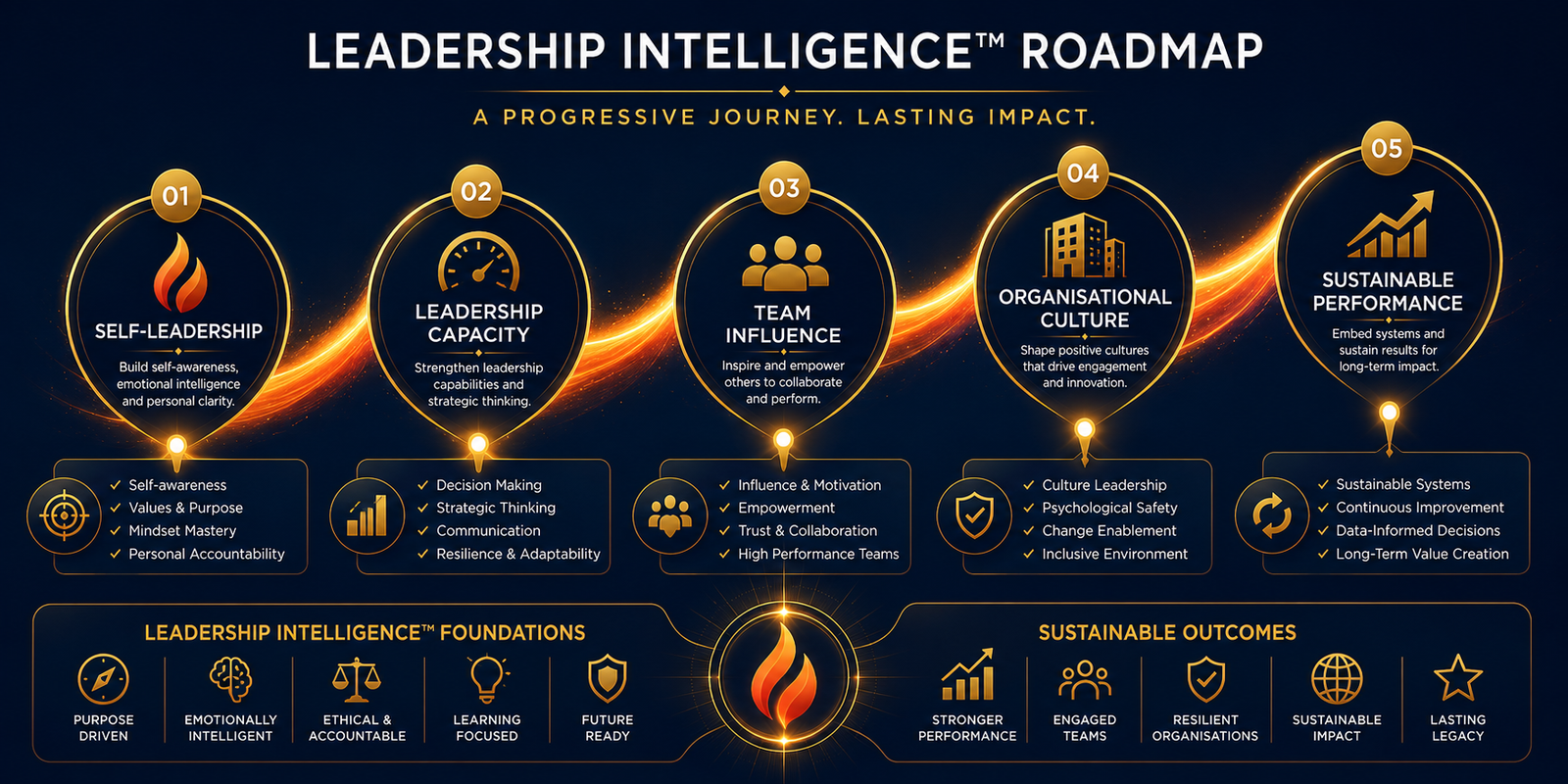
Practical Framework: Building Strong Leadership Foundations
Leaders can strengthen their foundations by consistently asking five reflective questions.
1. Am I increasing my capacity or merely increasing my workload?
Growth requires protecting the energy necessary for effective leadership.
2. What assumptions am I making?
Reflection exposes hidden biases before they influence decisions.
3. Am I developing people or solving problems for them?
Effective leaders create capability rather than dependency.
4. What behaviours am I modelling?
Culture reflects what leaders consistently demonstrate rather than what they occasionally communicate.
5. Will today’s decisions remain effective in five years?
Leadership Sustainability™ requires balancing immediate performance with long-term organisational health.
Leadership Reflection Questions
- Which leadership behaviours currently consume the greatest amount of your personal capacity?
- How regularly do you intentionally reflect on important leadership decisions?
- What assumptions most influence your leadership style?
- Which area of the Leadership Intelligence Compass™ requires the greatest development?
- How effectively does your current leadership approach support long-term sustainability?
- Where might your organisation be rewarding busyness rather than effectiveness?
- How could greater self-leadership improve your team’s performance?
- What leadership habit would create the greatest positive impact if consistently practised over the next six months?
Action Steps
Over the coming month:
- Conduct a personal Leadership Capacity review.
- Schedule a weekly thirty-minute reflection session.
- Identify one workload that could be redesigned rather than personally absorbed.
- Seek structured feedback from trusted colleagues regarding your leadership behaviours.
- Develop one capability within the Leadership Intelligence Compass™ each quarter.
- Introduce discussions about leadership sustainability within your team.
- Review organisational measures of leadership success beyond operational performance.
- Commit to continuous professional learning as a leadership responsibility rather than an optional activity.
What are leadership foundations?
Leadership foundations are the underlying capabilities that support effective leadership, including self-awareness, ethical judgement, reflection, emotional intelligence, resilience and sustainable decision-making.
Why is self-leadership important?
Leaders influence others most effectively when they first manage their own behaviours, thinking and wellbeing. Self-leadership creates consistency, trust and credibility.
What is Leadership Performance Intelligence™?
Leadership Performance Intelligence™ is Burn Bright Advisory’s integrated framework for developing sustainable leadership capability through interconnected systems of leadership thinking, behaviour and organisational performance.
How does Leadership Sustainability™ improve organisational performance?
Sustainable leaders maintain the capacity to make high-quality decisions over time, reducing burnout, improving engagement and strengthening long-term organisational outcomes.
Can leadership foundations be developed?
Yes. Leadership capability is not fixed. Through reflection, deliberate practice, continuous learning and evidence-informed development, leaders can strengthen every foundational capability.
Which organisations benefit most from Leadership Performance Intelligence™?
The framework applies across business, healthcare, education, government, public services and not-for-profit organisations because foundational leadership principles remain consistent despite sector-specific challenges.
What is the difference between management and leadership?
Management focuses on systems, processes and operational consistency, while leadership focuses on direction, influence, adaptability and creating conditions in which people can perform at their best.
Why does Burn Bright Advisory emphasise systems thinking?
Leadership challenges rarely occur in isolation. Systems thinking recognises the interconnected relationships between wellbeing, decision-making, culture, ethics and organisational performance, enabling leaders to create sustainable rather than temporary improvements.
Conclusion
Leadership is not built upon authority alone. It is built upon the invisible foundations that shape every decision, conversation and relationship.
Organisations often invest heavily in leadership techniques while overlooking the deeper capabilities that determine whether those techniques succeed. Sustainable leadership requires more than communication skills or strategic knowledge — it requires leaders who understand themselves, manage their capacity, reflect on their practice and continuously develop their capability.
Leadership Performance Intelligence™ provides a framework for this deeper development. By integrating self-leadership, ethical judgement, reflection, sustainability and continuous learning, leaders create resilient organisations capable of thriving amid complexity and change.
The strongest organisations are not those with the busiest leaders, but those with leaders who have built strong foundations. When leaders invest in their own development first, they create the conditions for others to succeed, strengthening performance, culture and long-term organisational impact.
Where Do Your Leadership Foundations Stand?
Discover which foundational capabilities are strengthening your leadership — and which need attention — with the free Leadership Burnout Self-Assessment.
Free Leadership Intelligence
Get Weekly Leadership Insights
Join thousands of leaders receiving practical strategies on burnout prevention, workload design, and sustainable performance every week.