Quick Answer
Key Takeaways
- A workload triage framework reduces reactive leadership.
- Not every urgent request deserves immediate attention.
- Strategic leaders manage organisational capacity, not just personal productivity.
- Burnout is often caused by poor workload design rather than poor time management.
- Better systems consistently outperform greater personal effort.
Workload Triage Framework: Stop Leading in Constant Crisis
A workload triage framework has become essential for modern leaders because today’s workload is no longer simply larger — it is structurally different. Leaders are expected to manage increasing complexity while operating with the same number of hours, limited resources and growing organisational expectations.
The result is predictable. Calendars become saturated, strategic thinking disappears and leaders spend their days responding instead of leading. Many attempt to solve this with better productivity tools or stricter time management. Unfortunately, these approaches rarely address the underlying problem.
Burnout is rarely created by a single busy week. It develops when every decision competes for attention, every meeting appears urgent and every stakeholder believes their request deserves priority. The issue is not effort. It is architecture.
At Burn Bright Advisory, we view burnout as a system failure rather than a personal weakness. Sustainable leadership begins by redesigning how work enters, moves through and exits the organisation. A workload triage framework provides that structure by replacing reactive decision-making with deliberate prioritisation.
Featured Snippet
Why Do Leaders Need a Workload Triage Framework?
Leadership has fundamentally changed. Ten years ago, managers largely controlled the flow of work. Today, work arrives continuously through email, Microsoft Teams, Slack, mobile devices, project management platforms and countless digital notifications. Technology has increased communication speed, but it has also increased complexity, creating an environment of constant interruption and fragmented attention.
Research consistently demonstrates the scale of the problem. Gallup has reported that more than half of managers experience burnout, while organisations continue to expand managerial responsibilities without increasing resources. The Burn Bright framework identifies this as a structural mismatch rather than an individual failing, reinforcing the principle that leaders cannot outwork broken systems.
This creates four predictable consequences.
Everything becomes urgent.
Strategic work disappears.
Decision quality declines.
Burnout becomes inevitable.
Burnout is not created because leaders are incapable. It develops because the volume and structure of work exceed sustainable human capacity. The Burn Bright methodology identifies scope creep, communication overload and decision fatigue as three major structural drivers of leadership burnout.
Why Traditional Prioritisation Methods No Longer Work
Many leaders still rely on simple priority lists — urgent, important, high, medium, low. Although these systems appear logical, they fail because modern leadership work rarely fits into neat categories.
Consider a school principal. A safeguarding concern, an inspection request, a staffing issue, a parent complaint and next year’s strategic improvement plan may all require attention on the same day. Every issue is important, but not every issue requires the principal’s personal involvement.
The same pattern exists across healthcare, government, business and the voluntary sector. Modern leaders operate inside complex systems where work must constantly be redistributed rather than simply prioritised.
Traditional time management assumes leaders control their time. Modern leadership demands control over workload architecture instead. Rather than asking “What should I do next?”, a workload triage framework asks:
- Should this task exist?
- Should I own it?
- Can it be delegated?
- Can it wait?
- Can it be eliminated completely?
The Burn Bright philosophy calls this structural leadership. Instead of relying on personal resilience, leaders redesign the flow of work so that organisational systems absorb complexity before individuals do.
How Does a Workload Triage Framework Work?
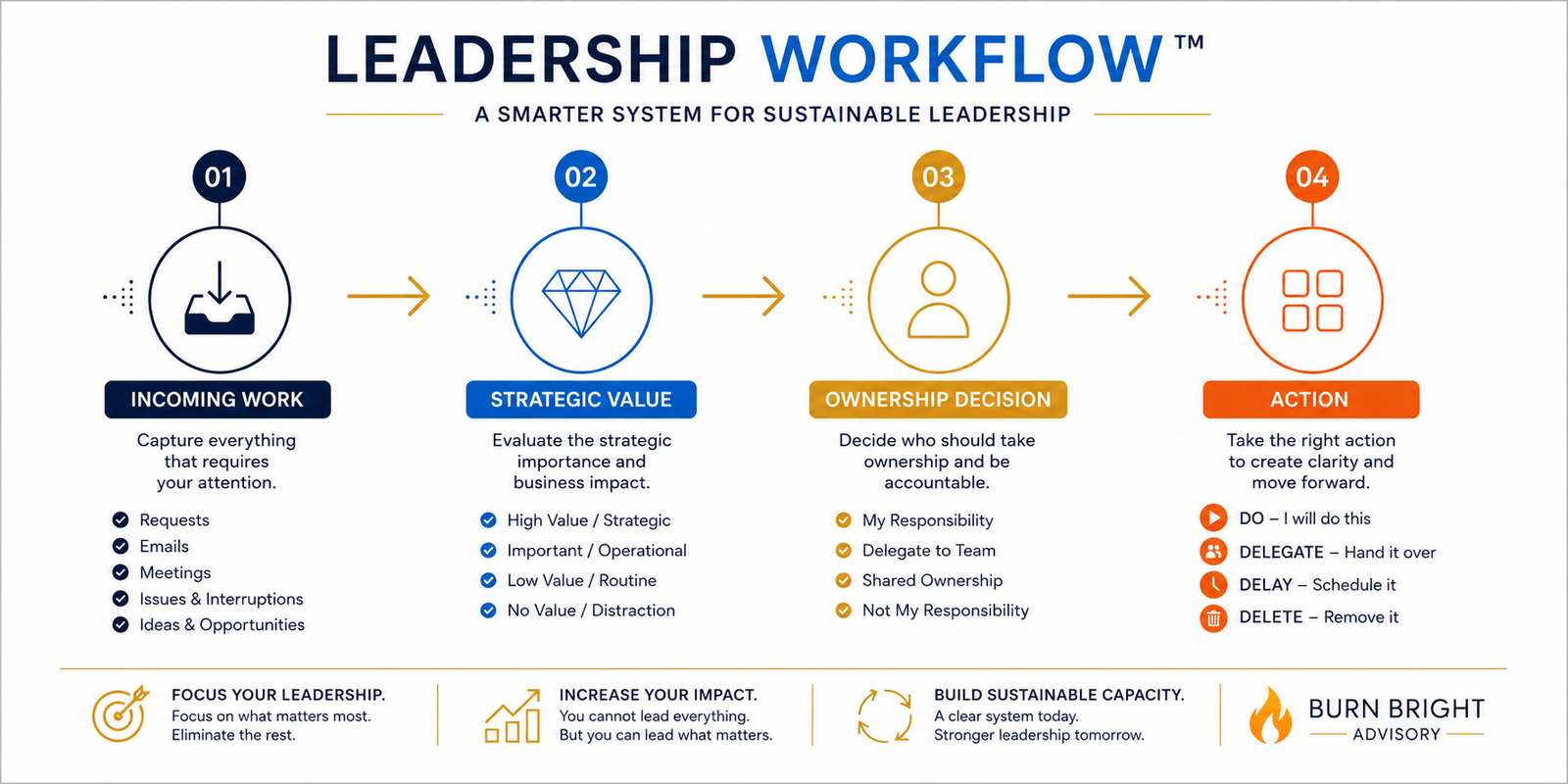
A workload triage framework is not another productivity technique. It is a leadership operating system. At Burn Bright Advisory, workload triage is built around three core questions.
Step 1: Does This Work Support Strategic Objectives?
Before accepting any new work, ask whether it directly supports organisational objectives, who benefits, and what happens if you choose not to do it. High-performing organisations routinely stop doing low-value work; burnt-out organisations simply continue adding more.
Step 2: Who Should Own the Work?
Assuming personal responsibility for every important decision creates bottlenecks and accelerates burnout. The Burn Bright Framework recommends structured delegation using its RACI Delegation Framework to distinguish between work you are responsible for, accountable for, consulted on, or simply informed about.
Step 3: When Does This Need to Be Done?
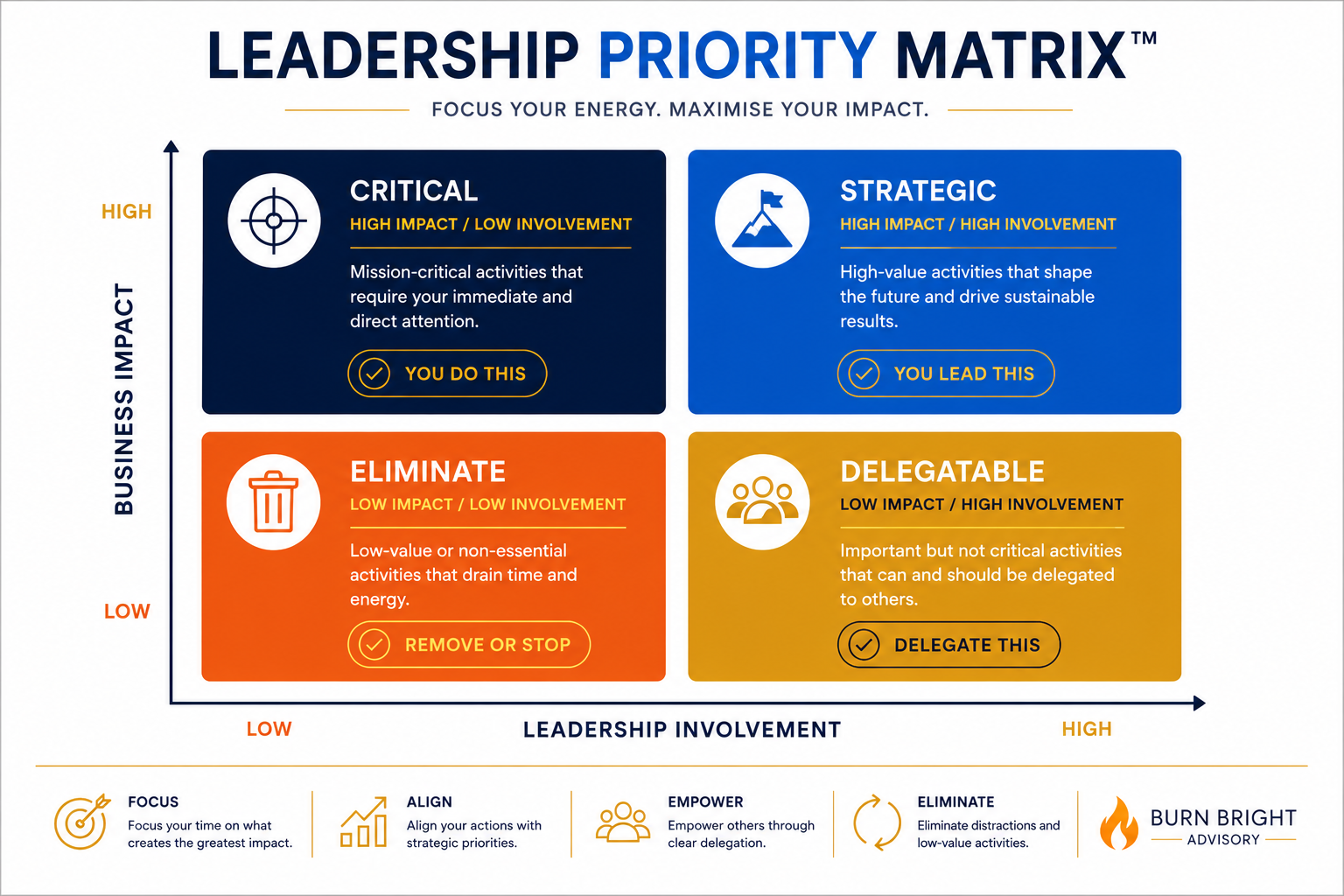
Urgency is one of the greatest misconceptions in leadership. A workload triage framework separates perceived urgency from actual organisational risk by classifying work into four categories — only one of which requires immediate attention.
Critical
Immediate action required to reduce organisational risk.
Important
Schedule dedicated time for strategic completion.
Delegatable
Assign clear ownership with agreed outcomes.
Eliminate
Remove entirely because it creates little organisational value.
Leaders often discover that more than one-third of their workload falls into the final two categories — that represents significant recoverable capacity.
What Prevents Leaders From Using Workload Triage?
If workload triage is so effective, why do so few leaders consistently apply it? The answer has little to do with capability. It has everything to do with organisational culture.
Many workplaces unintentionally reward availability instead of effectiveness. Leaders become recognised for solving every problem personally, responding instantly to messages and attending every meeting. Over time, these behaviours become embedded expectations rather than conscious choices.
The Burn Bright Framework identifies five structural causes of burnout that reinforce this behaviour. Each one increases workload without increasing organisational capacity.
How Can Leaders Implement a Workload Triage Framework?
The most effective workload triage frameworks are simple enough to use every day. They are not annual planning exercises — they are leadership habits.
Begin With a Workload Audit
You cannot redesign a workload you have never measured. Start by recording every activity you complete over two working weeks, including meetings, email management, decision approvals, staff conversations, crisis management, administrative work, strategic planning, reporting and project work.
Most leaders are surprised by the results. The issue is rarely the number of hours worked — it is the distribution of those hours. Many discover that strategic leadership occupies less than 20% of their working week, while reactive operational work consumes the remaining capacity.
Apply the Four-Part Triage Test
Every incoming request should pass through four questions.
1. Does it create strategic value?
If not, challenge whether the work should exist.
2. Am I the right person?
If someone else can achieve the same outcome, delegate with clear accountability.
3. What happens if it waits?
Many tasks feel urgent simply because they arrive unexpectedly. Separate genuine organisational risk from perceived urgency.
4. Can we remove it altogether?
Elimination is often the highest form of productivity. Every unnecessary report, duplicated meeting or redundant approval permanently increases organisational capacity.
Protect Strategic Capacity
High-performing leaders deliberately reserve thinking time — not because they have spare capacity, but because they understand that strategic thinking creates future capacity. Without protected time, improvement work stops, innovation slows, problems repeat, and leaders become permanent firefighters.
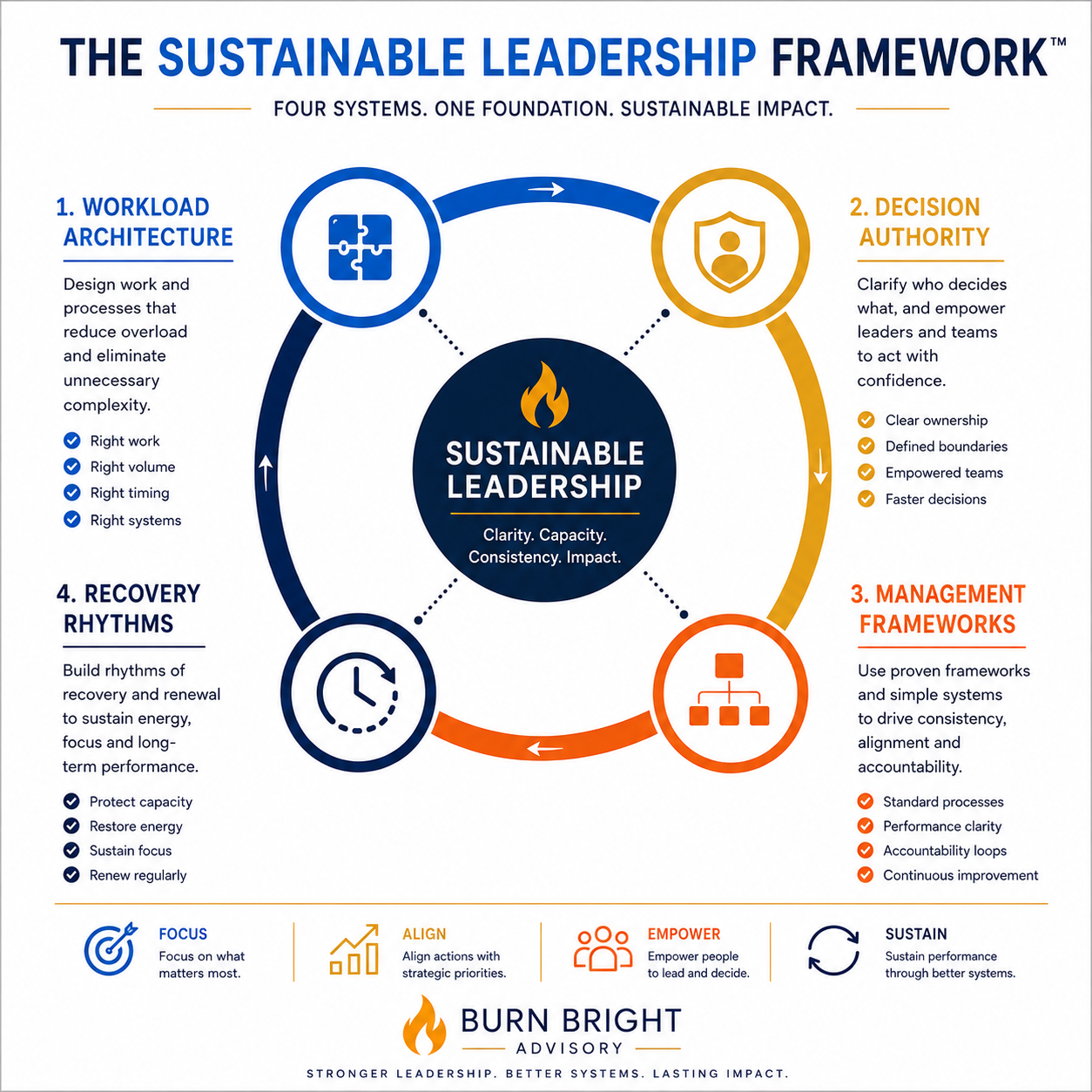
The Burn Bright Framework calls this Workload Architecture — designing leadership roles around sustainable performance rather than constant availability. It sits alongside Decision Authority, Recovery Rhythms and Management Frameworks as one of the four pillars of structural transformation.
Traditional Leadership vs Sustainable Leadership
| Traditional Leadership | Sustainable Leadership |
|---|---|
| Reacts to every request | Filters work through structured triage |
| Measures effort | Measures organisational impact |
| Keeps every decision | Distributes decision authority |
| Solves every problem personally | Builds systems that solve problems consistently |
| Prioritises urgency | Prioritises strategic value |
| Rewards availability | Protects capacity for high-value work |
| Depends on individual resilience | Depends on organisational design |
Traditional leadership assumes better people create better organisations. Sustainable leadership recognises that better systems create better performance. That philosophy underpins every Burn Bright framework.
What is a workload triage framework?
A workload triage framework is a structured decision-making process that helps leaders assess incoming work according to strategic value, urgency, ownership and organisational impact. Rather than reacting to every request, leaders deliberately decide what should be completed, delegated, delayed or removed.
How is workload triage different from time management?
Time management focuses on organising available hours. Workload triage focuses on deciding which work deserves those hours in the first place — one manages time, the other manages organisational capacity.
Can workload triage reduce burnout?
Yes. Many leadership burnout problems develop because workload continually expands without corresponding changes to resources or decision authority. A structured triage process reduces unnecessary work, protects strategic capacity and lowers decision fatigue.
What is the biggest mistake leaders make?
Assuming every important task requires their personal involvement. Effective leaders create capable teams; overwhelmed leaders create organisational bottlenecks. Delegation strengthens organisational performance rather than avoiding responsibility.
How often should leaders review workload?
Weekly operational reviews help maintain control of short-term priorities. Monthly workload audits identify recurring patterns. Quarterly structural reviews ensure leadership roles remain aligned with organisational strategy rather than gradually expanding through scope creep.
Conclusion
A workload triage framework is far more than another productivity technique. It is a leadership discipline.
Modern organisations generate more work than any individual leader can sustainably absorb. Attempting to solve this through longer hours or greater personal resilience only accelerates exhaustion. The solution is structural.
Leaders who consistently evaluate work before accepting it make better decisions, protect cognitive capacity and create stronger organisations. They understand that leadership is not measured by how many problems they personally solve, but by how effectively they design systems that prevent unnecessary problems from occurring.
Burnout is not evidence of weak leadership. It is often evidence of poor organisational architecture. When leaders redesign workload instead of simply enduring it, they create healthier teams, better decisions and more sustainable performance.
Is Your Workload Structurally Unsustainable?
If you’re constantly firefighting, making endless decisions and struggling to create time for strategic leadership, take the free Leadership Burnout Self-Assessment to identify the hidden organisational patterns driving overload.
Free Leadership Intelligence
Get Weekly Leadership Insights
Join thousands of leaders receiving practical strategies on burnout prevention, workload design, and sustainable performance every week.