Quick Answer
Key Takeaways
- Professionalism has evolved from a behavioural expectation into a strategic leadership capability.
- Professionalism Intelligence™ is built on five interconnected dimensions: competence, ethical judgement, accountability, respectful influence and continuous growth.
- Professionalism strengthens every other domain within the Leadership Intelligence Compass™, including Ethics Intelligence™, Emotional Intelligence™ and Reflective Practice Intelligence™.
- Organisations that embed professionalism systemically build stronger trust, better decisions and greater Leadership Sustainability™.
- Professionalism is not innate—it is developed through reflection, evidence-informed practice and disciplined habits.
Professionalism Leadership: The Leadership Capability That Determines Long-Term Organisational Success
Professionalism has traditionally been associated with appearance, etiquette and workplace conduct. While these elements remain important, they represent only the visible surface of what effective leadership demands in increasingly complex organisations.
Today’s leaders operate in environments characterised by rapid technological change, heightened stakeholder expectations, hybrid workforces, regulatory complexity and constant public scrutiny. In this context, professionalism is no longer a behavioural checklist—it is a strategic leadership capability that directly influences organisational performance, trust and long-term sustainability.
Burn Bright Advisory™ defines Professionalism Leadership as the disciplined integration of competence, ethical judgement, accountability, credibility and reflective practice. Through the Leadership Performance Intelligence™ framework, professionalism becomes a measurable leadership capability that strengthens decision quality, enhances organisational culture and increases leadership sustainability.
This article explores why professionalism should be viewed as a core domain within the Leadership Intelligence Compass™, demonstrating how Professionalism Intelligence™ connects with Emotional Intelligence™, Ethics Intelligence™, Reflective Practice Intelligence™ and Leadership Sustainability™ to create leaders capable of delivering consistent performance under pressure.
Drawing on examples from business, healthcare, education and public service, the article shows that professionalism is not about perfection or authority. Rather, it is about creating confidence through consistency, building credibility through accountability and enabling organisations to perform effectively in environments of uncertainty.
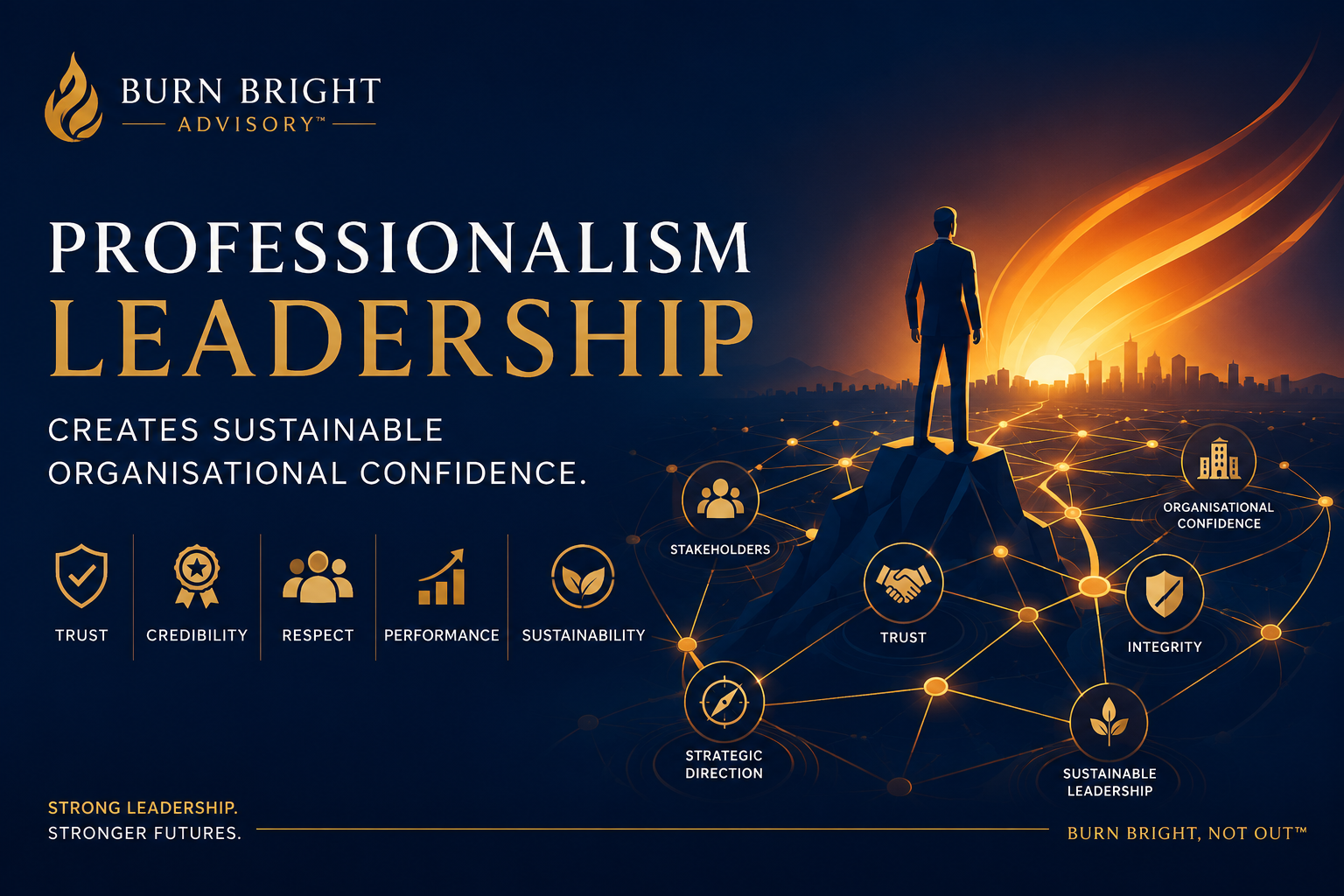
Featured Snippet
Introduction
Professionalism has long been viewed as one of leadership’s most desirable characteristics. Yet it is also one of the least understood. For decades, organisations have associated professionalism with punctuality, appearance, etiquette, qualifications, or compliance with organisational policies. While these behaviours contribute to credibility, they represent only the visible expression of something much deeper.
In today’s increasingly volatile, interconnected and technology-driven world, professionalism has become a strategic leadership capability rather than a behavioural expectation. It shapes how leaders think, make decisions, respond to uncertainty, build trust and sustain performance over time.
This distinction matters.
Organisations rarely fail because leaders dress inappropriately or neglect professional etiquette. They fail because professionalism breaks down where it matters most—in ethical judgement, accountability, communication, evidence-informed decision-making, emotional regulation and the ability to act consistently under pressure.
The consequences are visible across every sector. Businesses lose customer confidence after leaders prioritise short-term financial gains over long-term credibility. Healthcare organisations experience declining staff engagement when professional standards become inconsistent across leadership teams. Educational institutions struggle to maintain trust when leadership decisions appear reactive rather than principled. Public sector organisations face increasing public scrutiny when professionalism is replaced by political expediency or organisational self-interest.
In every case, professionalism influences far more than individual behaviour. It determines whether people believe leadership can be trusted.
Burn Bright Advisory™ argues that this represents one of the most significant shifts in modern leadership thinking. Professionalism should no longer be viewed as an isolated competency. It should be recognised as one of the foundational domains within Leadership Performance Intelligence™. Professionalism provides the stability upon which every other leadership capability depends.
Vision without professionalism becomes unrealistic.
Innovation without professionalism becomes reckless.
Authority without professionalism becomes coercive.
Emotional intelligence without professionalism lacks consistency.
Even exceptional technical expertise becomes ineffective if stakeholders lose confidence in the leader demonstrating it. This is why Burn Bright positions Professionalism Intelligence™ as a core domain within the Leadership Intelligence Compass™. Rather than focusing solely on behaviours, Professionalism Intelligence™ examines the thinking, judgement and decision-making processes that consistently produce credible leadership.
Why Professionalism Has Become a Leadership Imperative
Leadership has changed more during the past decade than perhaps any comparable period in modern organisational history. Hybrid working, artificial intelligence, continuous organisational change, economic uncertainty, social media transparency, increased stakeholder expectations, multi-generational workforces and growing ethical scrutiny have dramatically increased leadership complexity.
Leaders now make decisions that are examined almost instantly by employees, customers, regulators and the public. The speed of judgement has accelerated. So has the cost of poor professionalism.
A single poorly communicated decision can undermine months of relationship building. One inconsistent leadership response can weaken organisational trust. A failure to acknowledge mistakes can rapidly erode credibility across an entire workforce.
Professionalism therefore acts as an organisational stabiliser. When uncertainty increases, professionalism becomes more—not less—important. Professionally intelligent leaders create consistency during volatility. They establish behavioural standards that remain stable despite changing circumstances, and their communication remains measured rather than reactive.
This consistency becomes psychologically reassuring for employees. Research across organisational psychology consistently demonstrates that trust develops through predictable behaviour rather than occasional excellence. People rarely expect perfection from leaders. They expect consistency. Professionalism provides that consistency.
Beyond Competence: The Evolution of Professional Leadership
Traditional leadership development often assumes that technical expertise naturally produces effective leadership. Experience demonstrates otherwise. Many organisations promote outstanding specialists into leadership positions only to discover that expertise alone rarely builds influence.
The most technically capable manager may struggle to communicate difficult decisions. A highly qualified clinician may find it difficult to lead multidisciplinary teams. An exceptional teacher may struggle to develop future leaders. An accomplished entrepreneur may unintentionally create cultures of dependency rather than empowerment.
The missing capability is frequently professionalism. Professional leadership combines technical competence with behavioural consistency, ethical judgement and relational credibility. It transforms expertise into influence.
Professionalism answers questions that employees continuously ask—often subconsciously:
- Can I trust this leader?
- Will decisions remain consistent?
- Does this leader behave fairly?
- Will they acknowledge mistakes?
- Are organisational values reflected in daily actions?
- Can I rely upon their judgement during uncertainty?
When these questions receive consistent positive answers, trust strengthens. When they do not, organisational performance gradually deteriorates regardless of technical competence. Professionalism therefore serves as the bridge between leadership capability and organisational confidence.
Professionalism Through the Lens of Leadership Performance Intelligence™
Within Burn Bright Advisory™’s Leadership Performance Intelligence™ framework, professionalism is not viewed as a standalone characteristic. Instead, it functions as an integrating capability that strengthens every other leadership domain.
Framework Professionalism Intelligence™ Supports
- Ethics Intelligence™ by ensuring values influence decisions consistently rather than selectively.
- Emotional Intelligence™ by encouraging emotional regulation under pressure.
- Reflective Practice Intelligence™ through continuous learning and self-evaluation.
- Constructivism Intelligence™ by enabling leaders to build knowledge collaboratively rather than relying solely on authority.
- Adaptability Intelligence™ by balancing flexibility with principled decision-making.
- Leadership Sustainability™ by replacing reactive leadership with disciplined, repeatable practice.
Viewed together, these domains create leaders who are not only capable of achieving results but of sustaining those results ethically, consistently and credibly over time.
Professionalism is therefore less about projecting authority and more about earning confidence. That confidence becomes one of the most valuable forms of organisational capital available to any leader. As organisations continue to navigate increasing uncertainty, the leaders who consistently demonstrate Professionalism Intelligence™ will be those most capable of maintaining trust, strengthening culture and delivering sustainable performance. Their influence will not be built upon position alone. It will be built upon credibility—and credibility remains one of leadership’s most enduring competitive advantages.
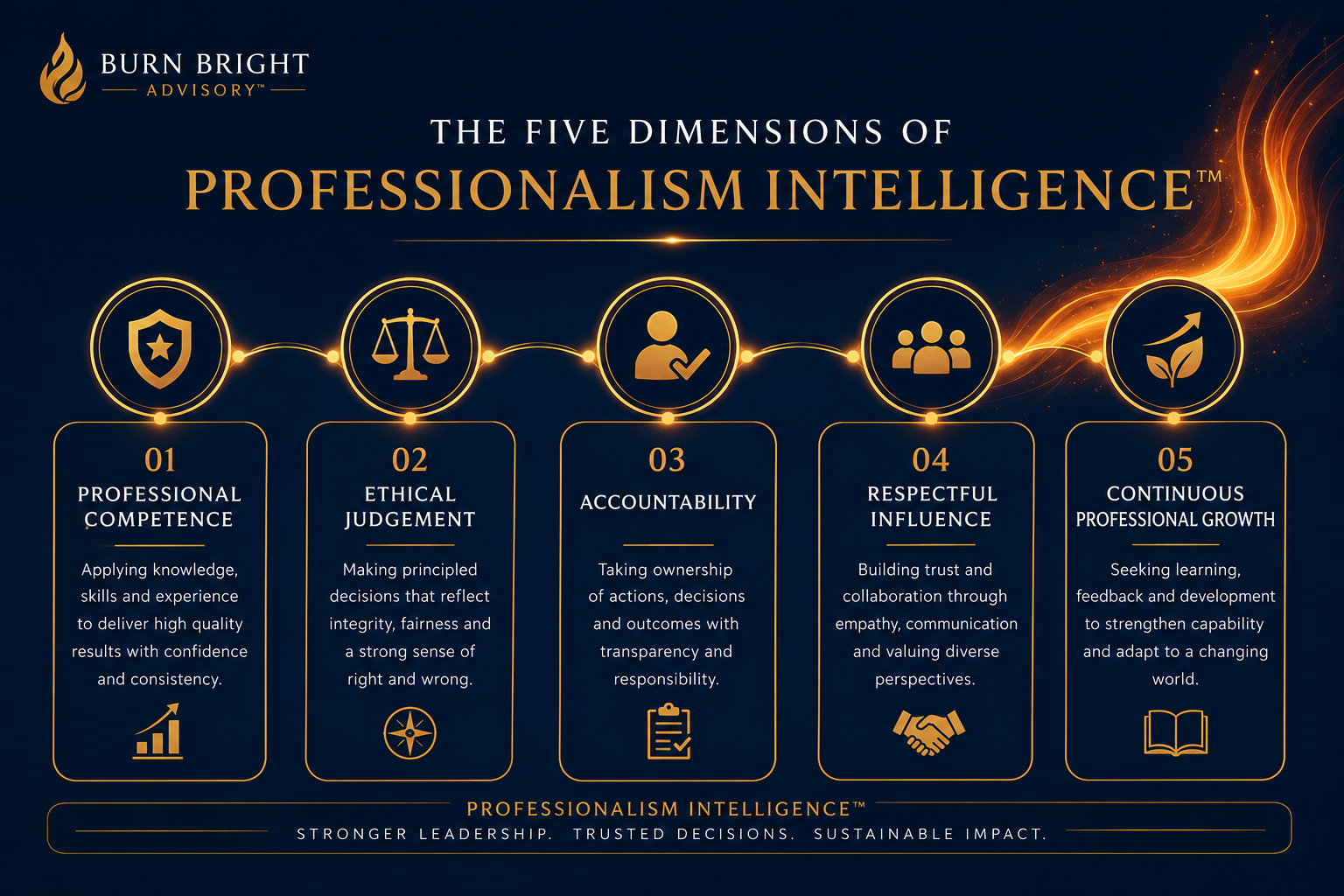
The Five Dimensions of Professionalism Leadership
Professionalism is often misunderstood because it is usually observed only through behaviour. People notice whether a leader is punctual, respectful, well prepared or communicates effectively. While these behaviours matter, they are merely the visible outcomes of deeper leadership capabilities.
Burn Bright Advisory™ defines Professionalism Intelligence™ as the leadership capability that integrates competence, ethical judgement, accountability, credibility and continuous development into consistent leadership performance.
Rather than asking, “Does this leader behave professionally?” a more valuable question is: “What enables this leader to behave professionally under pressure, uncertainty and complexity?”
The answer lies within five interconnected dimensions that together form the foundation of Professionalism Leadership.
Dimension One: Professional Competence
Professionalism begins with competence. Trust is impossible without confidence that leaders possess the knowledge, judgement and capability required to fulfil their responsibilities.
Competence extends beyond qualifications or experience. It reflects a commitment to continual learning, evidence-informed decision-making and the willingness to challenge outdated assumptions.
Professional leaders recognise that expertise has a shelf life. Industries evolve. Technology changes. Legislation develops. Stakeholder expectations shift. Consequently, Professionalism Intelligence™ requires leaders to remain active learners rather than relying solely on past success.
Competence Is Dynamic
Leadership competence develops through:
- Continuous professional learning
- Reflection on experience
- Evidence-informed practice
- Cross-sector learning
- Constructive feedback
- Intellectual curiosity
Leaders who stop learning eventually begin leading organisations that stop improving.
Business Example
A manufacturing director implementing artificial intelligence into operational planning does not rely exclusively on technical consultants. Instead, they invest time understanding both the opportunities and limitations of AI before making strategic decisions. Their credibility comes not from pretending to know everything but from demonstrating informed judgement.
Healthcare Example
A clinical director introduces new patient safety protocols after reviewing current research, consulting multidisciplinary teams and evaluating implementation risks. Professional competence is demonstrated through thoughtful evidence rather than authority alone.
Dimension Two: Ethical Judgement
Competence enables leaders to make decisions. Professionalism determines how those decisions are made. Ethical judgement is the ability to balance competing priorities while maintaining integrity, fairness and long-term organisational trust.
Professional leaders recognise that not every decision presents a clear right or wrong answer. Many involve competing obligations: financial sustainability versus employee wellbeing, innovation versus risk, efficiency versus quality, growth versus organisational values. Professionalism requires disciplined judgement rather than convenient decision-making.
Ethics Builds Predictability
Employees rarely expect leaders to satisfy everyone. They do expect consistency. Professional leaders develop decision-making frameworks that remain stable regardless of external pressure. This consistency strengthens organisational trust because stakeholders understand not only what decisions are made but why they are made.
Public Service Example
A local authority leader faces budget reductions while protecting essential community services. Rather than making arbitrary cuts, the leadership team establishes transparent principles that guide every decision. Even unpopular decisions become easier to understand because the decision-making process remains consistent. Professionalism therefore protects organisational legitimacy.
Educational Example
A school leader allocates limited resources using published criteria aligned with student outcomes rather than personal preference. Transparency reduces perceptions of favouritism while increasing confidence across staff and parents.
Dimension Three: Accountability and Reliability
Professional leaders understand that credibility is earned through consistency rather than intention. Everyone makes mistakes. Professionalism is demonstrated by how leaders respond when mistakes occur.
Accountability requires leaders to acknowledge errors promptly, communicate honestly, accept responsibility, implement corrective action and learn publicly. Organisations with high levels of professionalism rarely become crisis-free. Instead, they become highly effective at responding to challenges without damaging trust.
Accountability Creates Psychological Safety
When leaders model accountability, employees become more willing to acknowledge their own mistakes. Learning accelerates, innovation increases, risk reporting improves and continuous improvement becomes part of organisational culture. Conversely, cultures where leaders avoid accountability inevitably become cultures where employees hide problems. Hidden problems eventually become organisational crises.
Healthcare Example
Following a medication error, a hospital leadership team focuses on improving systems rather than assigning blame. Staff confidence increases because transparency replaces fear. Patient safety improves because learning becomes more important than reputation management. Professionalism therefore protects both people and organisational performance.
Dimension Four: Respectful Influence
Professionalism is demonstrated most clearly through everyday interactions. Respect is not simply politeness. It reflects how leaders value people, ideas and relationships.
Respectful influence includes active listening, constructive feedback, inclusive decision-making, emotional regulation, empathy and psychological safety. Professional leaders recognise that influence cannot be demanded. It must be earned. Respect therefore becomes a strategic capability rather than merely a social behaviour.
Respect Encourages Better Thinking
Leaders often underestimate how quickly employees adapt to leadership behaviour. Where respect is consistently demonstrated, employees contribute ideas more freely, innovation increases, conflict becomes constructive, trust develops naturally and collaboration strengthens. Conversely, environments characterised by dismissiveness or inconsistency often produce silence rather than commitment. People protect themselves by withholding ideas. Professionalism prevents this organisational withdrawal.
Business Example
A CEO deliberately invites disagreement during executive meetings. Alternative viewpoints are explored respectfully before strategic decisions are finalised. The result is stronger decision quality because professionalism creates intellectual diversity rather than forced consensus.
Dimension Five: Continuous Professional Growth
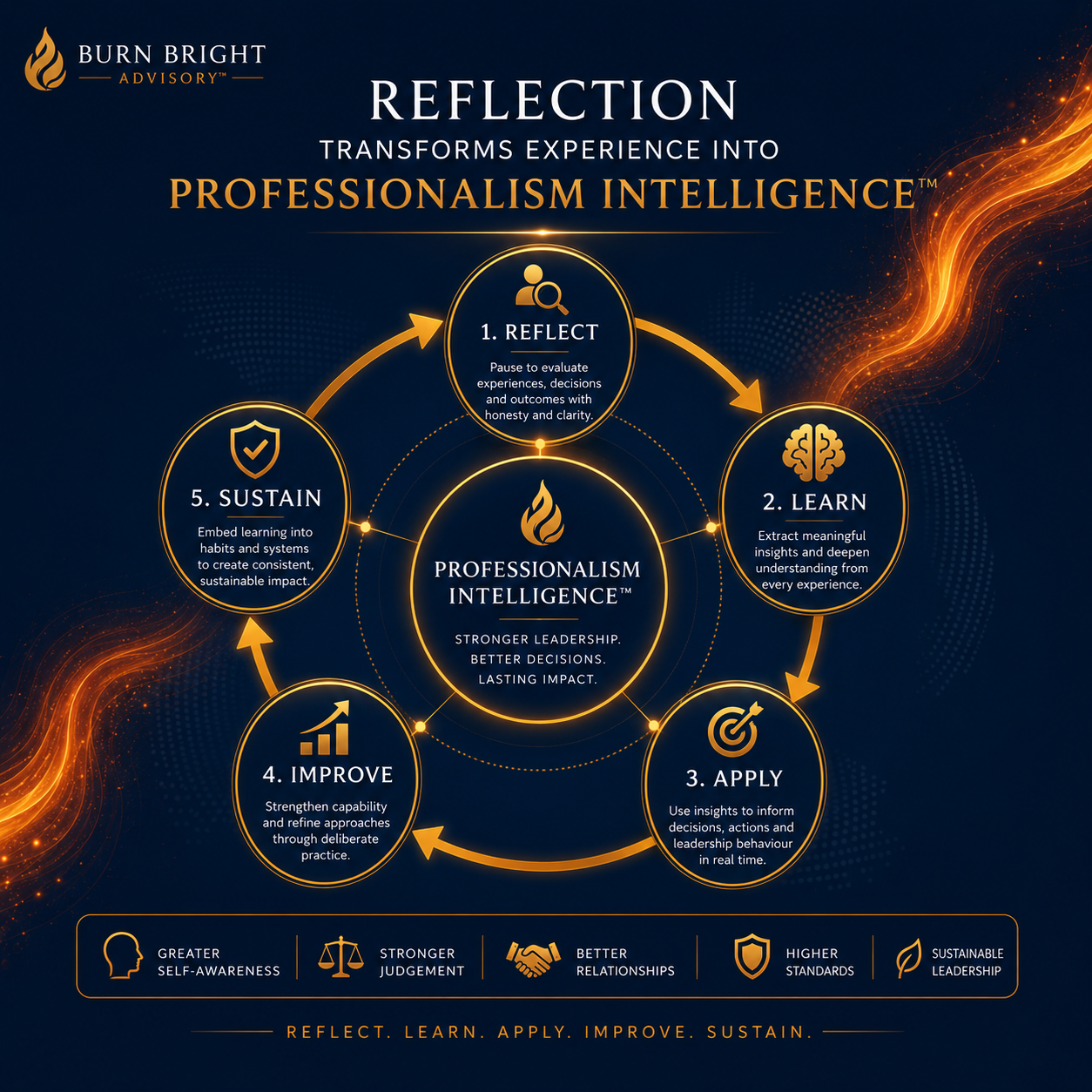
Professional leaders never assume they have arrived. Leadership is developmental rather than static. Professionalism therefore includes an ongoing commitment to reflection, learning and adaptation. Burn Bright Advisory™ refers to this capability as Leadership Reflection™.
Without reflection, experience simply becomes repetition.
With reflection, experience becomes leadership intelligence.
Professional leaders regularly ask themselves what worked well, what assumptions influenced a decision, what feedback they might be avoiding, what they learned, and what they should improve next time. These questions create continuous leadership development.
The Professionalism Leadership Cycle
The five dimensions do not operate independently. They reinforce one another in a continuous cycle of improvement.
| Leadership Dimension | Primary Outcome |
|---|---|
| Professional Competence | Better decisions |
| Ethical Judgement | Greater trust |
| Accountability | Stronger credibility |
| Respectful Influence | Higher engagement |
| Continuous Growth | Sustainable leadership performance |
Together they create what Burn Bright Advisory™ describes as Professionalism Intelligence™—the capability to consistently demonstrate leadership that others can trust, respect and confidently follow.
Professionalism therefore becomes much more than personal behaviour. It becomes an organisational asset. Leaders who strengthen these five dimensions improve not only their own effectiveness but also the capability of the systems, teams and cultures they influence.
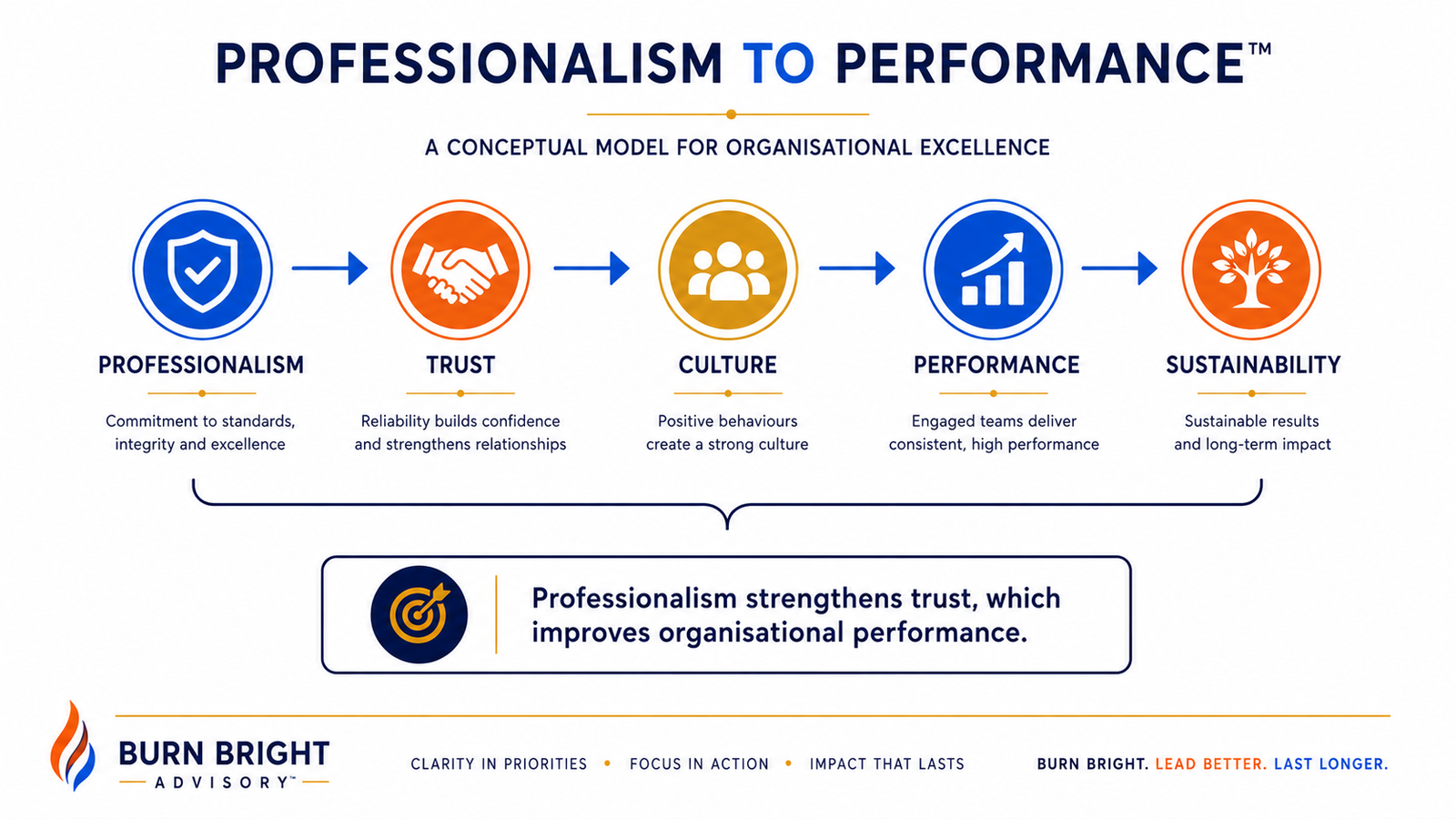
How Professionalism Intelligence™ Drives Organisational Performance
Professionalism is frequently discussed as though it were a personal virtue. Organisations celebrate professionalism during induction programmes, performance reviews and leadership development initiatives. Yet they rarely measure its contribution to organisational outcomes. This is a significant oversight.
Professionalism is not merely an individual characteristic. It is an organisational performance driver. Every leadership decision influences culture. Every interaction reinforces behavioural expectations. Every response to pressure communicates what the organisation truly values.
Burn Bright Advisory™ argues that Professionalism Intelligence™ should therefore be viewed as strategic infrastructure rather than interpersonal etiquette. Like financial governance, risk management or operational excellence, professionalism provides a foundation upon which sustainable organisational performance depends.
Professionalism Creates Organisational Trust
Trust is often described as the currency of leadership. Without it, organisations become slower, less innovative and increasingly bureaucratic. When employees lose confidence in leadership, they begin protecting themselves rather than contributing fully—information is withheld, initiative declines, decision-making slows, collaboration weakens and innovation becomes riskier because psychological safety disappears.
Professionalism interrupts this cycle. Professionally intelligent leaders create predictable environments where people understand expectations, believe commitments will be honoured and trust that decisions will be made consistently. Trust therefore reduces organisational friction, allowing organisations to spend less time managing internal uncertainty and more time pursuing external opportunities.
The Trust Multiplier Effect
Professionalism generates a multiplier effect across every level of an organisation. When senior leaders consistently model accountability, middle managers adopt similar behaviours. When managers demonstrate respect, teams collaborate more openly. When teams experience psychological safety, customers receive better service. When customers trust organisations, loyalty increases.
Burn Bright describes this as the Leadership Trust Cascade™: leadership behaviour influences organisational culture, culture influences employee behaviour, employee behaviour influences stakeholder experience, and stakeholder experience ultimately influences organisational reputation and performance. Professionalism sits at the beginning of that chain.
Professionalism Improves Decision Quality
Many leadership failures are not caused by a lack of intelligence. They arise because decision-making becomes distorted by pressure, bias or short-term thinking. Professionalism provides decision discipline. Rather than reacting emotionally, professionally intelligent leaders ask what evidence supports a decision, which stakeholders will be affected, whether it aligns with organisational values, what the long-term consequences are, and what assumptions might be influencing their thinking.
These questions slow impulsive decisions while improving judgement. Professionalism therefore becomes a decision-making framework rather than a behavioural standard.
Framework Three Considerations
- Performance – Will this improve organisational outcomes?
- People – How will this affect those involved?
- Principles – Does this align with our values and responsibilities?
Leaders capable of balancing these three perspectives consistently outperform those focused exclusively on immediate performance metrics.
Business Example
A technology company faces increasing pressure from investors to accelerate product release. Senior leadership identifies unresolved cybersecurity vulnerabilities. A purely commercial decision would prioritise speed. Professionalism Intelligence™ encourages leaders to evaluate customer trust, long-term reputation and ethical responsibility before proceeding. Although release is delayed, customer confidence increases because leadership demonstrates responsible governance. Short-term pressure is exchanged for long-term credibility.
Professionalism Strengthens Organisational Culture
Culture is frequently described as “how things are done around here.” Professionalism determines why they are done that way.
Leaders often attempt to improve organisational culture through values statements, engagement initiatives or communication campaigns. While these initiatives have value, culture changes primarily through observed behaviour. Employees pay closer attention to leadership actions than organisational slogans. If leaders promote collaboration while rewarding individual competition, employees quickly recognise the inconsistency. If integrity is promoted publicly but ignored during difficult decisions, credibility disappears.
Professionalism closes this gap. It aligns stated values with daily leadership behaviour. Consistency gradually becomes culture. Culture becomes expectation. Expectation becomes organisational identity. Professionalism therefore transforms values from words into observable practice.
Professionalism Enhances Leadership Sustainability™
Leadership effectiveness cannot be measured solely by today’s results. It must also consider whether those results remain achievable over time. Many organisations achieve exceptional short-term performance while simultaneously exhausting their leaders, damaging trust and weakening organisational resilience.
Professionalism Intelligence™ challenges this pattern. Sustainable leaders understand that high performance should not require continuous crisis management. Instead, professionalism encourages proactive planning, effective delegation, healthy boundaries, evidence-informed prioritisation, reflective learning and ethical workload management. These practices preserve leadership capacity.
Burn Bright refers to this capability as Leadership Sustainability™. Sustainable leadership protects organisational performance because leaders remain capable of making high-quality decisions over extended periods. Professionalism therefore contributes directly to leadership longevity.
Healthcare Example
A hospital executive recognises increasing levels of clinical fatigue among department managers. Rather than simply encouraging resilience, leadership redesigns reporting systems, reduces unnecessary administrative workload and strengthens decision authority closer to frontline teams. Professionalism is demonstrated through responsible stewardship of both organisational performance and human capacity. Patient care improves because leadership sustainability improves.
Professionalism Encourages Continuous Improvement
One of the defining characteristics of Professionalism Intelligence™ is intellectual humility. Professional leaders do not assume existing practices are automatically effective. Instead, they consistently ask: “What can we improve?”
Continuous improvement requires organisations to accept that learning never ends. Professionalism therefore encourages reflective practice, constructive feedback, performance benchmarking, organisational learning and evidence-based innovation. Rather than protecting established processes, professional leaders remain committed to improving them. This mindset enables organisations to adapt without abandoning their values.
Education Example
A school leadership team reviews student outcomes alongside staff wellbeing data. Although examination results remain positive, teacher workload has increased significantly. Rather than celebrating academic success alone, leaders redesign planning processes to improve both educational quality and professional sustainability. Professionalism balances performance with people, and this distinction strengthens long-term organisational effectiveness.
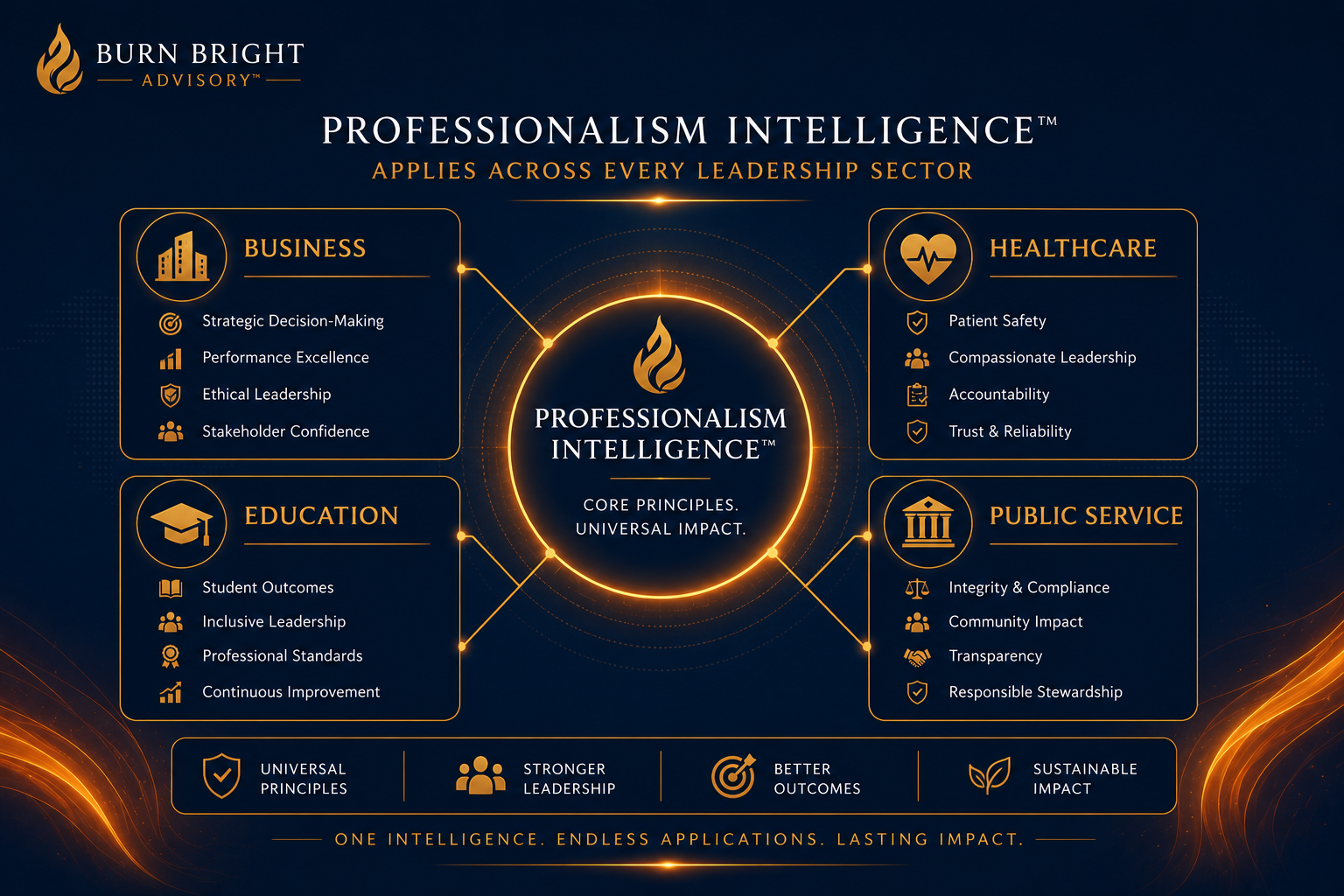
Professionalism Across Every Sector
While every industry operates differently, Professionalism Intelligence™ consistently produces similar organisational benefits.
| Sector | Professionalism Leadership Creates |
|---|---|
| Business | Customer confidence, innovation, ethical growth and strategic consistency |
| Healthcare | Patient safety, multidisciplinary collaboration and clinical trust |
| Education | Credibility, reflective practice and sustainable school improvement |
| Public Service | Transparency, public confidence and responsible governance |
| Nonprofit | Stakeholder trust, mission alignment and ethical stewardship |
Although operational priorities differ, professionalism consistently strengthens trust, decision quality and organisational resilience. This demonstrates that Professionalism Intelligence™ is not industry specific. It is leadership specific.
Professionalism as a Competitive Advantage
Increasingly, organisations compete not only through products or services but through credibility. Customers have more information. Employees have greater employment choice. Stakeholders demand transparency. Investors examine governance. Communities expect accountability.
Professionalism therefore becomes a competitive differentiator. Organisations known for principled leadership attract stronger talent, retain employees longer, build more loyal customer relationships and recover more effectively from crises because trust already exists. In contrast, organisations that neglect professionalism often discover that repairing damaged credibility requires significantly more effort than protecting it in the first place.
The Burn Bright Perspective
Within Leadership Performance Intelligence™, professionalism is not the outcome of successful leadership. It is one of its primary causes. Professionalism creates the conditions in which trust develops, ethical decisions become consistent, learning accelerates and sustainable performance becomes possible.
Leaders frequently ask how they can become more influential.
The answer is rarely charisma. It is rarely authority. It is almost never position.
Influence grows from credibility. Credibility grows from professionalism. Professionalism grows from disciplined leadership practice.
That progression explains why Professionalism Intelligence™ occupies such a central position within the Leadership Intelligence Compass™. It strengthens every other leadership capability because it provides the stability upon which effective leadership depends.
In uncertain environments, organisations do not simply need leaders who can deliver results. They need leaders whose professionalism ensures those results remain trusted, repeatable and sustainable for years to come.
Conclusion
Professionalism has always mattered. What has changed is its strategic importance. In increasingly complex organisations, professionalism is no longer defined by appearance, protocol or organisational etiquette. It is demonstrated through the consistency of leadership judgement, the quality of decision-making and the ability to sustain trust during periods of uncertainty.
Every organisation depends upon confidence. Employees need confidence that leaders will make fair decisions. Customers need confidence that promises will be honoured. Communities need confidence that organisations will act responsibly. Investors require confidence that governance is both ethical and sustainable. Professionalism creates that confidence.
Throughout this article we have explored Professionalism Leadership through the lens of Burn Bright Advisory™’s Leadership Performance Intelligence™ framework, built upon five interconnected dimensions: professional competence, ethical judgement, accountability, respectful influence and continuous professional growth.
Together these capabilities transform professionalism from an individual characteristic into an organisational capability. When embedded consistently, professionalism improves trust, strengthens organisational culture, enhances decision quality and increases Leadership Sustainability™.
Perhaps the greatest misconception surrounding professionalism is that it develops naturally with experience. It does not. Experience alone does not create professionalism. Reflection does. Intentional development does. Evidence-informed practice does. Professionalism is cultivated through disciplined habits repeated consistently over time.
This is why Burn Bright Advisory™ places Professionalism Intelligence™ at the heart of the Leadership Intelligence Compass™. Without professionalism, other leadership capabilities become inconsistent. With professionalism, they become sustainable.
Ultimately, leadership is remembered less for isolated achievements than for the confidence leaders leave behind. Professionalism is how that confidence is built. And in an increasingly uncertain world, confidence may be the most valuable leadership asset of all.
Leadership Reflection Questions
Use the following questions individually, within leadership teams or during executive coaching conversations.
Personal Reflection
- Which of the five dimensions of Professionalism Intelligence™ represents my greatest leadership strength?
- Which dimension requires the greatest development over the next twelve months?
- How consistently do my daily behaviours reflect the professional standards I expect from others?
- What leadership habits strengthen trust?
- Which habits unintentionally weaken my credibility?
Team Reflection
- How consistently do our leadership team members model professionalism?
- Where do employees experience inconsistency between organisational values and leadership behaviour?
- Which leadership behaviours generate the highest levels of trust?
- How effectively do we learn from mistakes?
- Do our systems encourage accountability or blame?
Organisational Reflection
- Is professionalism measured or merely assumed?
- How is professionalism recognised during recruitment and promotion?
- Does our leadership development strategy include Professionalism Intelligence™?
- How do we benchmark leadership credibility?
- Are professional standards consistently demonstrated across all leadership levels?
Practical Action Steps
Professionalism develops through deliberate practice rather than occasional effort. The following actions can be implemented immediately.
Week One
Conduct a personal Professionalism Intelligence™ self-assessment. Identify three behaviours that consistently strengthen credibility. Request confidential feedback from trusted colleagues.
Month One
Introduce structured reflection after significant leadership decisions. Review communication consistency across your leadership team. Audit organisational decision-making against stated values.
Quarter One
Develop professionalism benchmarks for leadership roles. Embed accountability conversations into performance reviews. Create opportunities for cross-sector learning and professional development. Review leadership workload to strengthen Leadership Sustainability™.
Long-Term
Embed professionalism into organisational infrastructure through leadership recruitment, induction, coaching, succession planning, performance management, executive development and organisational culture reviews. When professionalism becomes systemic rather than individual, organisations become significantly more resilient.
What is Professionalism Leadership?
Professionalism Leadership is the disciplined practice of leading with competence, integrity, accountability, respect and ethical judgement to create trust, credibility and sustainable organisational performance.
Why is professionalism important for leaders?
Professionalism creates consistency. Consistent leadership behaviour strengthens trust, improves decision quality and increases organisational confidence during periods of uncertainty.
How is Professionalism Intelligence™ different from professionalism?
Traditional professionalism focuses primarily on behaviour. Professionalism Intelligence™ expands this concept by integrating competence, ethics, reflective practice, accountability and sustainable leadership into a measurable leadership capability.
Can professionalism be developed?
Yes. Professionalism is not an innate personality trait. It develops through continuous learning, reflective practice, constructive feedback and disciplined leadership habits.
How does professionalism improve organisational performance?
Professionalism improves organisational performance by strengthening trust, reducing unnecessary conflict, improving collaboration, enhancing decision quality and supporting sustainable leadership.
Which sectors benefit most from Professionalism Leadership?
Every sector benefits. Business, healthcare, education, public service and nonprofit organisations all rely upon leadership credibility to maintain trust and achieve long-term performance.
How does Professionalism Intelligence™ connect with the Leadership Intelligence Compass™?
Professionalism Intelligence™ strengthens every other domain within the Leadership Intelligence Compass™ by providing the behavioural consistency, ethical discipline and credibility required for effective leadership.
What is the relationship between Professionalism Intelligence™ and Leadership Sustainability™?
Professionalism supports sustainable leadership by encouraging evidence-informed decisions, healthy accountability, reflective practice and responsible workload management, enabling leaders to perform consistently over the long term.
Professionalism is not a finishing point. It is a leadership discipline. Every decision, every conversation and every action either strengthens or weakens the confidence others place in leadership. If organisations are serious about improving performance, developing future leaders and creating sustainable cultures, professionalism must become measurable, teachable and embedded within every stage of leadership development.
How Strong Is Your Professionalism Intelligence™?
Burn Bright Advisory™’s Leadership Performance Intelligence™ framework gives leaders the practical tools and evidence-informed models required to develop Professionalism Intelligence™ and build organisations defined by enduring trust and credibility. Start with the free self-assessment.
Free Leadership Intelligence
Get Weekly Leadership Insights
Join thousands of leaders receiving practical strategies on burnout prevention, workload design, and sustainable performance every week.
Related Articles
→ Early Signs of Leadership Burnout
→ Why High Performers Burn Out
→ How Burnout Affects Decision Making
→ Take the Leadership Intelligence Compass™ Assessment
→ Take the Free Leadership Burnout Self-Assessment
→ Leadership Diagnostic Platform
→ Leadership Advisory & Consulting