Quick Answer
Key Takeaways
- Workload grows naturally unless leaders actively create boundaries.
- Sustainable leadership depends on protecting capacity rather than simply increasing effort.
- Most burnout begins with small compromises that gradually become permanent expectations.
- Clear workload boundaries improve decision quality, delegation and organisational performance.
- The strongest leaders redesign systems instead of relying on personal sacrifice.
Workload Boundary Setting: Protect Your Capacity Before It Disappears
Workload boundary setting has become one of the most important leadership skills of the modern workplace. Leaders today face more meetings, more communication channels, more reporting requirements and more competing priorities than ever before. Yet most organisations continue expecting managers to operate with the same time, energy and resources they had years ago.
That mismatch creates a dangerous pattern. Leaders begin accepting extra responsibilities to help their teams. Temporary requests become permanent expectations. New projects are added without removing existing ones. Eventually the role itself becomes impossible to perform sustainably.
This is where many burnout conversations go wrong.
Burnout is not simply the result of working too hard. It is often the result of working inside a system where nobody has defined what enough actually looks like. As the Burn Bright philosophy explains, burnout is a system failure, not a personal failure. Effective leadership requires structural solutions that protect long-term performance rather than rewarding constant availability.
In this article, you’ll learn why workload boundaries matter, why leaders struggle to establish them, and how practical frameworks can help protect both performance and wellbeing.
Featured Snippet
Why Has Workload Boundary Setting Become Essential?
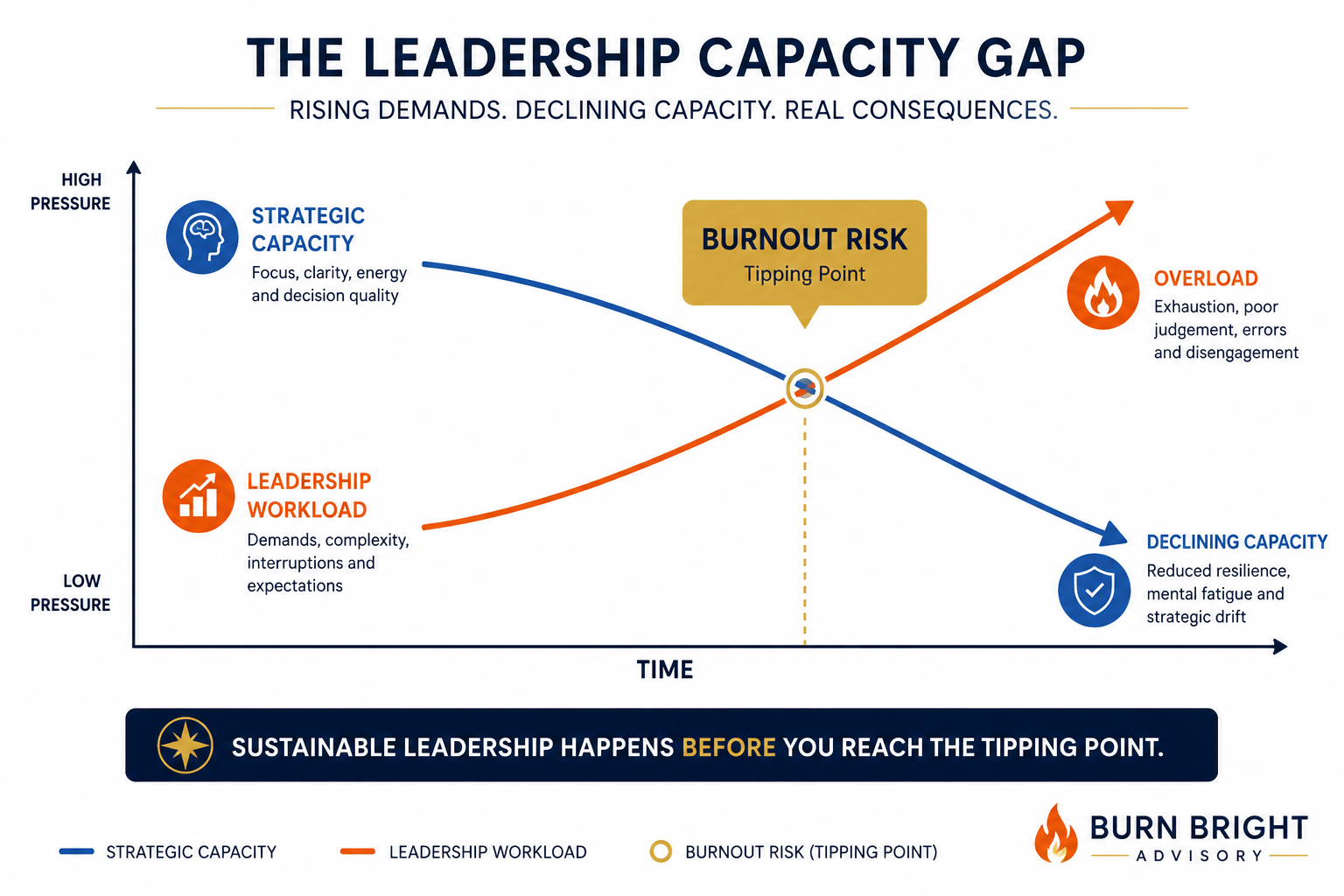
Modern leadership has changed dramatically over the past decade. Technology promised greater efficiency. Instead, many leaders now manage dozens of communication streams while still completing the same operational responsibilities. Email, Teams, Slack, project management platforms, instant messaging and hybrid working have created continuous interruptions that rarely existed previously. Rather than simplifying work, digital tools have often multiplied complexity.
At the same time, leadership roles have expanded significantly. Managers are expected to deliver strategy, manage wellbeing, support hybrid teams, oversee technology adoption, analyse data, maintain compliance and respond immediately to emerging issues. Responsibilities increase, yet very few organisations redesign the role itself. The result is predictable: leaders continue absorbing more work until capacity eventually breaks down.
The Burn Bright framework identifies Scope Creep as the first structural driver of burnout. Additional responsibilities rarely arrive as one dramatic event. They accumulate quietly over months or years until the original role has fundamentally changed. Most leaders can identify dozens of responsibilities they perform today that were never included in their original job description.
Gallup research has consistently shown high levels of manager burnout, while leadership turnover continues to rise across sectors. These trends suggest that the problem is not individual resilience but organisational design.
Without boundaries, leaders eventually experience three predictable consequences:
- Decision quality declines because cognitive capacity becomes exhausted.
- Strategic thinking disappears as operational work dominates every day.
- Teams become increasingly dependent on already overwhelmed managers.
This creates a cycle where leaders work harder but achieve less.
The natural response is often to improve productivity through better calendars, new software or additional time management techniques. Although these tools can be useful, they cannot solve structural overload.
That is why workload boundary setting is fundamentally different from time management. Time management asks how to fit more into the day. Boundary setting asks whether the work should belong to you at all. The most effective leaders understand that protecting capacity is not avoiding responsibility. It is protecting the quality of leadership itself.
Why Do Leaders Struggle to Set Workload Boundaries?
If workload boundary setting is so valuable, why do so many experienced leaders find it difficult?
The answer is rarely poor discipline. More often, it is the result of organisational culture reinforcing behaviours that slowly erode healthy boundaries. Leaders are rewarded for responsiveness, availability and taking on additional work. Over time, saying “yes” becomes part of their professional identity.
The Burn Bright Framework identifies five structural causes of burnout, with Scope Creep, Meeting Culture, Communication Chaos, Decision Overload and Perfectionism Culture acting together to gradually remove workload boundaries. Rather than one dramatic event, leaders experience hundreds of small decisions that steadily expand their workload.
Scope Creep Happens Quietly
Few leaders receive an email saying their workload will now become permanently unsustainable. Instead, additional responsibilities arrive one request at a time — a working group to chair, a new manager to mentor, cover during someone’s leave, “this will only take a few minutes.” Each request appears reasonable. Collectively, they redefine the role.
Many leadership positions today bear little resemblance to the jobs they accepted several years ago. Responsibilities accumulate, yet very few are deliberately removed. The result is continual expansion without corresponding increases in time, resources or authority. This pattern mirrors the Burn Bright principle that burnout develops because organisations continually add work without redesigning the system supporting that work.
Leaders Often Mistake Availability for Leadership
Modern leadership has unintentionally equated visibility with value. Many managers believe they must always be available because they want to be supportive. This creates behaviours such as responding immediately to every email, accepting every meeting invitation, solving every operational problem personally, becoming the default decision-maker and answering messages outside working hours.
Initially these actions appear helpful.
Eventually they become expected.
Instead of empowering teams, constant availability often creates greater dependency. Team members naturally return to the leader because experience tells them the leader will always provide the answer.
Healthy organisations create capability.
Unhealthy organisations create dependence.
The Fear of Disappointing Others
Many senior leaders carry an internal belief that good leadership means saying yes. They worry that declining requests will damage relationships, reduce credibility or appear uncooperative.
Ironically, the opposite is often true. Leaders without boundaries frequently become overwhelmed, delay decisions, miss deadlines and provide inconsistent support. Teams experience unpredictability rather than reliability.
Clear boundaries build trust because expectations become transparent. People know what the leader will prioritise, when decisions will be made, where responsibilities sit and who owns particular outcomes. Boundary setting therefore improves organisational clarity rather than reducing commitment.
Personal Boundaries vs Structural Boundaries
One of the biggest misconceptions about workload boundary setting is believing it is purely a personal discipline. It is not. Personal habits matter, but sustainable leadership depends far more on structural boundaries than individual willpower.
| Traditional Approach | Sustainable Leadership Approach |
|---|---|
| Work harder | Redesign workload |
| Improve time management | Improve workload architecture |
| Protect yourself | Protect the system |
| Individual responsibility | Shared organisational responsibility |
| React to workload | Design workload intentionally |
This distinction is central to Burn Bright’s philosophy. Burnout is not solved by asking individuals to become more resilient while leaving the workload unchanged. Instead, leaders need systems that support sustainable performance over time.
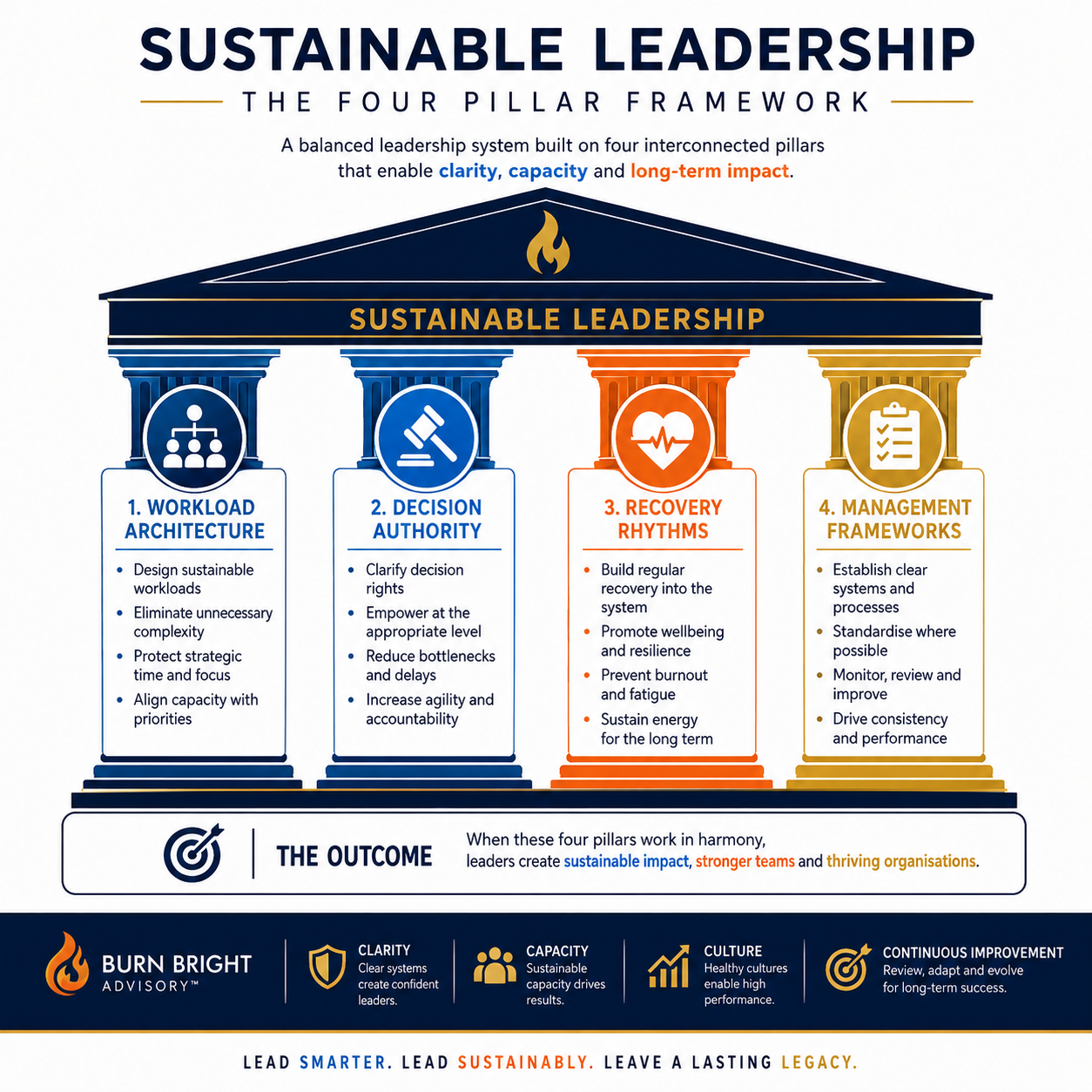
The Burn Bright Structural Transformation Framework identifies four organisational pillars:
Pillar 1
Workload Architecture
Designing work that matches available capacity.
Pillar 2
Decision Authority
Ensuring decisions are made at the correct organisational level.
Pillar 3
Recovery Rhythms
Embedding recovery into leadership rather than treating it as optional.
Pillar 4
Management Frameworks
Replacing reactive leadership with repeatable systems.
These pillars move the conversation away from individual coping strategies and towards organisational redesign.
The Cost of Ignoring Boundaries
Many organisations underestimate the financial consequences of overloaded leaders. Burn Bright describes this as the Culture Tax — the hidden organisational cost created by burnout, disengagement and unnecessary turnover when structural problems remain unresolved.
The figures are significant. Replacing a middle manager can cost around £75,000, while replacing a senior leader can exceed £500,000, before accounting for lost knowledge, disrupted teams and reduced productivity during transition.
These costs highlight an important reality. Boundary setting is not simply about protecting leaders. It protects organisational performance. When leaders maintain the capacity to think strategically, make sound decisions and develop their teams, everyone benefits.
Sustainable leadership is not achieved by expecting extraordinary endurance. It is achieved by building ordinary systems that consistently protect capacity.
How Can Leaders Create Better Workload Boundaries?
Workload boundary setting is not about saying “no” more often. It is about creating clear rules for how work enters, moves through and leaves your leadership role. Without those rules, every request feels urgent, every interruption feels unavoidable and every responsibility eventually lands with the leader.
Sustainable leaders think differently. Rather than asking, “Can I fit this in?” they ask:
- Should this work exist?
- Am I the right person to do it?
- Does this support our strategic priorities?
- What should stop if this begins?
These questions shift leadership from reaction to intentional design.
1. Audit Your Current Workload
Record every activity for one week across categories such as strategic planning, operational management, meetings, email and messaging, decision making, people management, crisis response and administrative work. Many leaders discover they spend less than 20% of their week on genuinely strategic leadership. Awareness creates the evidence needed for meaningful redesign.
2. Define Non-Negotiable Leadership Work
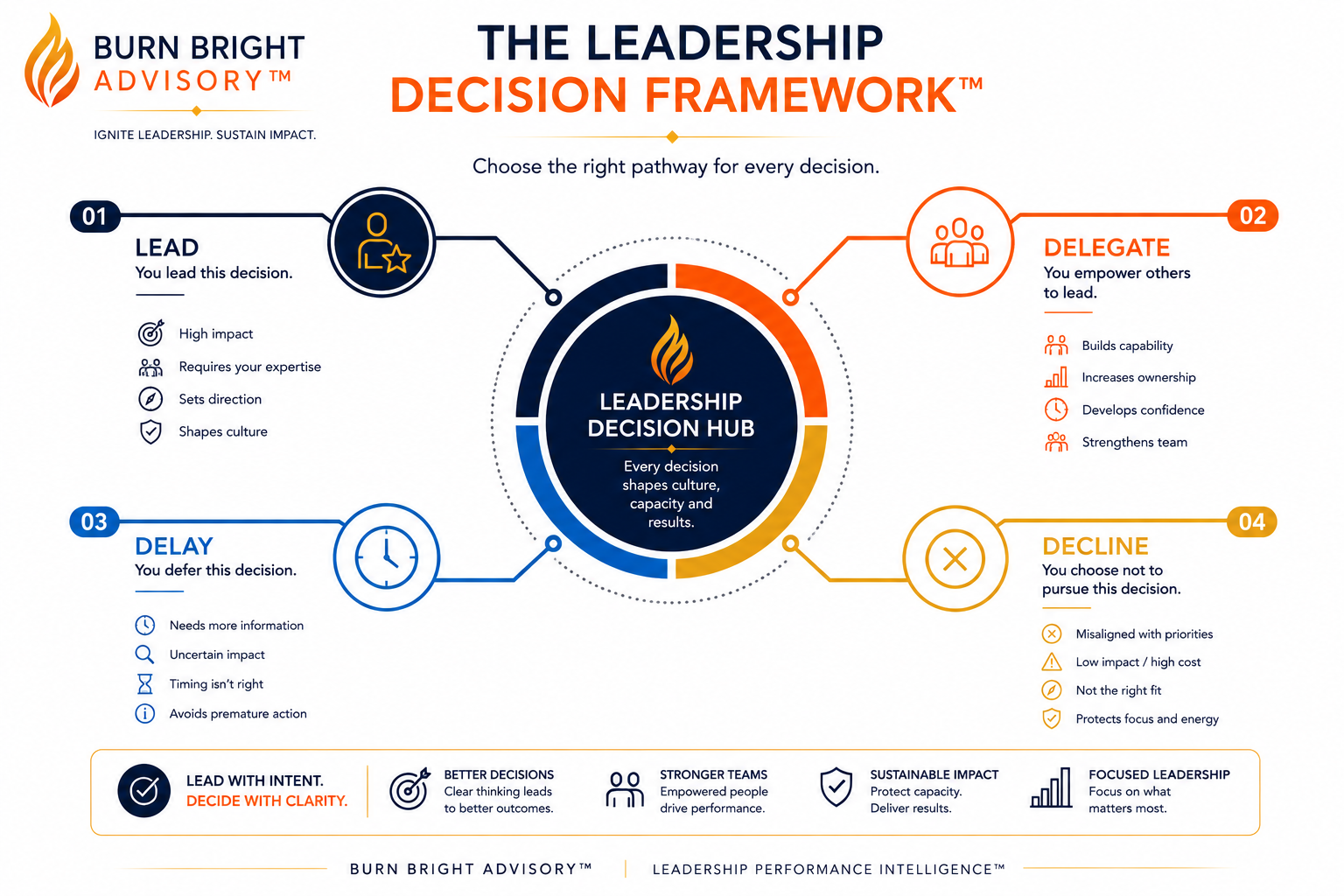
Not every responsibility carries equal value. Divide responsibilities into four groups to see clearly what belongs on your desk and what doesn’t.
Group 1 Lead Personally
Responsibilities that genuinely require your experience, judgement or authority — strategic decisions, performance conversations, organisational priorities, stakeholder relationships.
Group 2 Delegate
Activities that develop others while reducing unnecessary dependence. Delegation is not losing control — it is distributing capability.
Group 3 Delay
Some work feels urgent simply because it arrives today. Often it can wait until existing priorities are complete.
Group 4 Delete
The category most organisations ignore. Some meetings should disappear, some reports are never read, some approval processes no longer add value. Eliminating unnecessary work often creates more capacity than improving efficiency.
3. Create Decision Boundaries
Decision overload has become one of the fastest-growing contributors to leadership fatigue. Many leaders unknowingly become approval bottlenecks, until one individual becomes responsible for everything. Instead of centralising every decision, define clear decision rights: which decisions belong with you, which belong with your team, what level of financial authority managers should have, and which decisions require consultation rather than approval. Reducing unnecessary escalation protects cognitive capacity while increasing organisational agility.
4. Protect Strategic Time
The modern calendar naturally fills itself. If leaders fail to protect thinking time, operational work will consume every available hour. Protected strategic time should be treated like any other critical organisational commitment — scheduling uninterrupted planning blocks, declining unnecessary meetings, grouping operational tasks together, reducing context switching and turning notifications off during deep work. Protecting thinking time is not a luxury. It is an operational requirement.
Reactive Leadership vs Sustainable Workload Boundary Setting
| Reactive Leadership | Sustainable Workload Boundary Setting |
|---|---|
| Accepts every request | Evaluates every request against priorities |
| Measures commitment through availability | Measures commitment through impact |
| Responds immediately | Responds intentionally |
| Solves every problem personally | Builds capability across the team |
| Protects relationships by saying yes | Protects performance through clear expectations |
| Works longer hours | Designs better systems |
| Individual effort drives results | Organisational architecture drives results |
The difference is significant. Reactive leaders eventually become exhausted because every solution depends on them. Sustainable leaders create systems where success no longer relies on individual heroics. Their teams become more capable. Their decisions become stronger. Their organisations become more resilient. Most importantly, they remain effective over the long term.
What is workload boundary setting?
Workload boundary setting is the process of defining clear limits around responsibilities, time and decision-making so leadership remains sustainable. Rather than accepting every new request, leaders deliberately decide what they will lead, delegate, delay or decline. This protects long-term effectiveness instead of relying on continuous personal sacrifice.
Isn’t setting boundaries the same as saying no?
No. Effective workload boundary setting is about making intentional decisions, not refusing work. Sometimes the right answer is delegation, sometimes postponement, sometimes redesigning a process altogether. The goal is ensuring workload aligns with organisational priorities rather than allowing responsibilities to accumulate unchecked.
How do workload boundaries prevent burnout?
Burnout develops when demands consistently exceed capacity. Boundaries prevent this by protecting time for strategic thinking, reducing unnecessary decision-making and stopping scope creep before it becomes permanent. As the Burn Bright framework explains, burnout is primarily a structural problem rather than an individual weakness.
How can leaders introduce boundaries without damaging relationships?
Clear communication is essential. Explain the reasoning behind decisions using organisational priorities rather than personal preference — for example, framing the conversation around protecting time for agreed strategic priorities and identifying the best owner for a piece of work. This creates clarity instead of conflict.
What is the biggest mistake leaders make with workload boundaries?
The most common mistake is waiting until they are already overwhelmed. By that stage, workload has often become normalised, making it harder to redesign expectations. Sustainable leaders establish boundaries before capacity is exhausted, creating systems that prevent overload rather than recovering from it afterwards.
Conclusion
Workload boundary setting is not about limiting ambition. It is about protecting the leadership capacity needed to deliver sustained results.
The modern workplace encourages leaders to equate commitment with constant availability. Yet the evidence tells a different story. As responsibilities continue to expand without corresponding structural redesign, even the most capable leaders eventually reach a point where effort alone is no longer enough. The answer is not working harder — it is working differently.
Burn Bright Advisory’s philosophy is simple: burnout is a system failure, not a personal failure. Leaders cannot outwork broken systems. Sustainable organisations are built through better workload architecture, clear decision authority, intentional recovery rhythms and practical management frameworks that protect both people and performance.
The strongest leaders do not carry every responsibility themselves. They create environments where work is shared intelligently, decisions are made at the right level and strategic thinking is protected. That is how sustainable leadership is built.
As you look at your own situation today — are you leading from a place of clarity or a place of depletion?
Protect Your Leadership Before Burnout Takes Hold
If your workload has gradually expanded beyond what one person can realistically sustain, the first step is understanding where the pressure is coming from. Take the Leadership Burnout Self-Assessment to identify the structural factors increasing your workload and receive practical guidance on building a more sustainable leadership approach.
Free Leadership Intelligence
Get Weekly Leadership Insights
Join thousands of leaders receiving practical strategies on burnout prevention, workload design, and sustainable performance every week.