Quick Answer
Key Takeaways
- Professionalism in leadership goes beyond etiquette — it is reliability under responsibility.
- Professionalism Intelligence™ has five interconnected dimensions: Standards, Judgement, Consistency, Accountability and Stewardship.
- Leadership behaviour sets the standard for what is acceptable throughout an organisation.
- Accountability must apply upward as well as downward, or credibility deteriorates.
- Stewardship extends leadership performance beyond the immediate term to what is left behind.
- Unresolved exceptions to standards accumulate as organisational “professionalism debt.”
- Professionalism Intelligence™ connects directly to Ethics, Reflective Practice, Emotional, Adaptability and Knowledge Development Intelligence™ within the Leadership Intelligence Compass™.
Professionalism in Leadership: Why Standards, Judgement and Consistency Build Trust
Leadership is often discussed through highly visible concepts. Vision. Influence. Innovation. Strategy. Transformation. Culture. These dimensions deserve attention. Yet underneath all of them sits a less glamorous capability that determines whether people ultimately trust the person exercising leadership: professionalism.
A leader can communicate an inspiring vision and still behave inconsistently. A leader can possess considerable expertise and still avoid accountability. A leader can deliver impressive short-term results while damaging relationships, ignoring boundaries or weakening institutional standards. A leader can talk extensively about organisational values while making exceptions whenever those values become inconvenient.
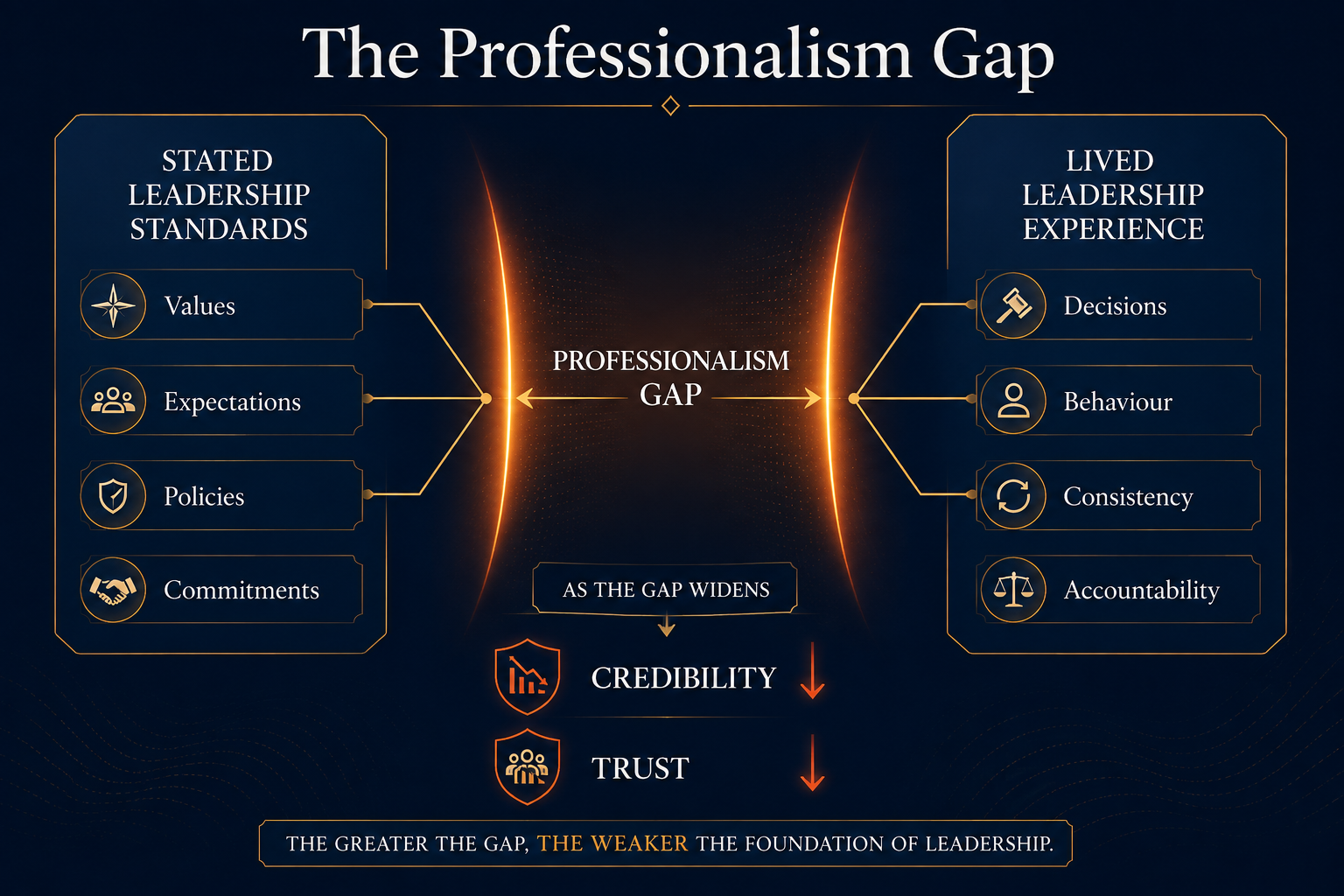
In each case, the leadership problem is deeper than communication or competence. There is a professionalism gap.
That gap matters because people rarely evaluate leadership only by what leaders say. They evaluate leaders by patterns. What happens when pressure rises? How are difficult decisions made? Are expectations applied consistently? Do senior people follow the standards expected of everyone else? What happens when the leader makes a mistake? Are commitments honoured? Are people treated respectfully when disagreement occurs? Does the leader protect the institution, or primarily protect themselves?
Over time, the answers to these questions become the leader’s reputation. And reputation becomes either an asset or a constraint on leadership.
Featured Snippet
Professionalism Is More Than Professional Behaviour
Traditional descriptions of professionalism frequently focus on behaviour. Appropriate communication. Reliability. Competence. Respect. Integrity. These remain important, but leadership introduces an additional layer of complexity. A leader is not simply responsible for behaving professionally. A leader helps determine what professional behaviour means within the system they lead.
If senior leaders regularly arrive unprepared for meetings, preparation gradually becomes optional. If leaders tolerate disrespect from high performers, respect becomes conditional. If leaders ignore policies when those policies become inconvenient, policy becomes negotiable. If leaders blame others when decisions fail, accountability becomes dangerous. If leaders repeatedly cancel development conversations because operational matters are considered more important, people learn where development really sits in the organisational hierarchy.
Culture absorbs these signals.
Leadership behaviour establishes permission.
What leaders repeatedly do communicates what the organisation genuinely accepts.
Professionalism is therefore both personal and systemic. The individual leader demonstrates professional standards. The leadership system reinforces them.
What Is Professionalism Intelligence™?
Within Burn Bright Advisory’s Leadership Performance Intelligence™ architecture, Professionalism Intelligence™ provides a way of examining professionalism as an applied leadership capability rather than a static behavioural checklist.
It asks a more useful question than “does this person appear professional?” Instead, it asks: “can this leader consistently interpret and apply appropriate professional standards when exercising responsibility, judgement and authority?”
That distinction matters. Professionalism Intelligence™ is not simply knowing the rules. It involves understanding which standards matter, why those standards exist, how they should be interpreted, when judgement is required, how competing responsibilities should be balanced, how decisions affect others, when boundaries must be maintained, when accountability must be accepted, and how today’s actions affect tomorrow’s trust.
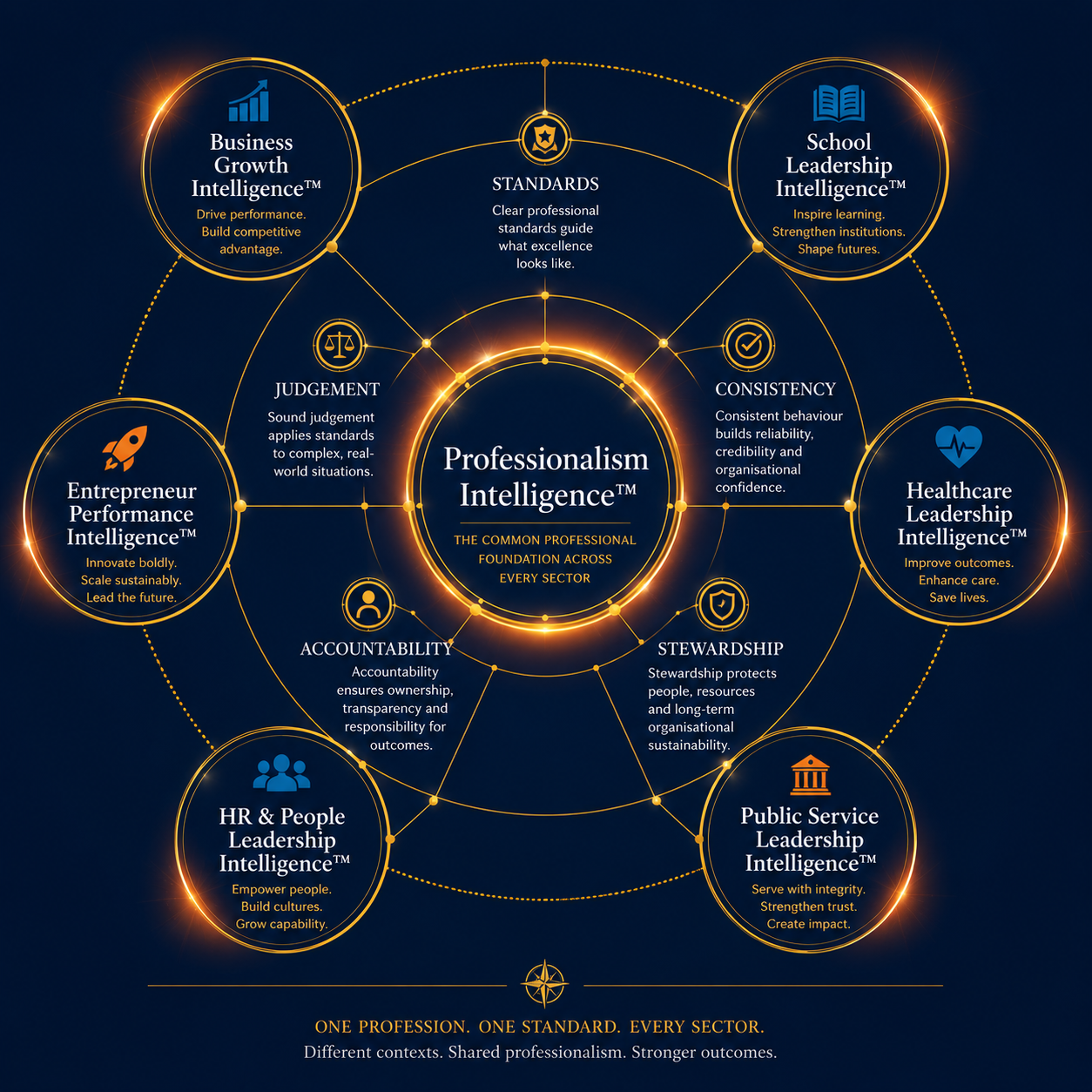
The Five Dimensions of Professionalism Intelligence™
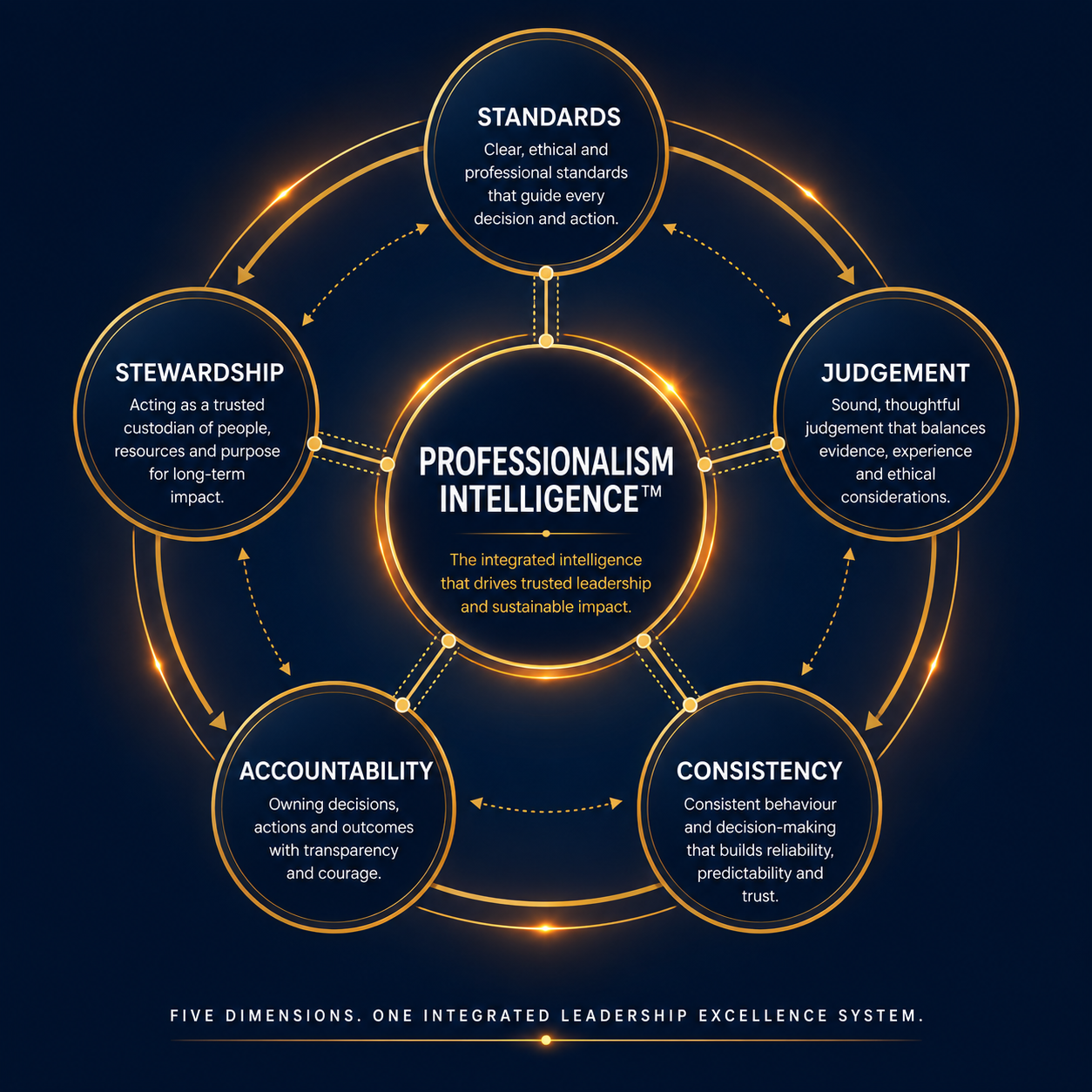
Burn Bright Advisory™ conceptualises Professionalism Intelligence™ through five interconnected leadership dimensions:
| Dimension | Leadership Question | Organisational Effect |
|---|---|---|
| Standards | What level of conduct and performance should govern this situation? | Creates clarity |
| Judgement | What is the most appropriate decision in this context? | Improves decision quality |
| Consistency | Are our actions aligned with our stated expectations and values? | Builds reliability |
| Accountability | Who owns the decision, commitment and resulting impact? | Strengthens responsibility |
| Stewardship | What must be protected or strengthened for the future? | Supports sustainable value |
None operates effectively in isolation. Standards without judgement can become rigid bureaucracy. Judgement without standards can become personal preference. Consistency without reflection can preserve poor practice. Accountability without psychological safety can become blame. Stewardship without operational discipline can remain an aspiration. Professionalism Intelligence™ emerges from their integration.
1. Standards: Making Excellence Explicit
Every organisation operates according to standards. Some are formal — policies, professional codes, regulatory obligations, clinical protocols, safeguarding requirements, governance frameworks and performance expectations all make standards visible. Others are informal: how quickly people respond, how disagreements are handled, how thoroughly meetings are prepared, whether difficult issues are raised, whether poor behaviour from influential people is challenged, whether commitments actually mean something. These unwritten standards can shape organisational culture as powerfully as formal policies.
Leadership professionalism begins by making expectations clear. A leader cannot reasonably demand consistency around standards that nobody understands. Professional leaders ask: what does good look like here? Not vaguely — behaviourally, operationally, ethically, relationally.
“We value respect” is an aspiration. A professional standard explains what respect looks like when people disagree. “We value accountability” is similarly broad. A professional standard explains what leaders do when deadlines are missed, decisions fail or commitments cannot be honoured. Clarity converts values into practice. Without that translation, organisations can possess sophisticated value statements while tolerating behaviour that directly contradicts them.
Leadership standards create predictability
Predictability is one of professionalism’s underestimated contributions to leadership. People do not need leaders to be robotic. They do need reasonable confidence about how important situations will be handled. Will concerns be heard? Will confidentiality be respected? Will poor performance be addressed fairly? Will the same expectations apply to senior people? Will decisions have a rationale? Will the leader do what they said they would do?
Repeated positive answers create confidence. Repeated uncertainty creates vigilance. And organisational energy spent managing uncertainty is energy unavailable for performance.
2. Judgement: Professionalism When the Rulebook Runs Out
Leadership would be relatively simple if every significant problem had an obvious answer. It does not. Many important leadership decisions involve competing legitimate interests: speed versus consultation, individual circumstances versus organisational consistency, commercial opportunity versus reputational exposure, performance versus wellbeing, transparency versus confidentiality, immediate operational requirements versus long-term capability, innovation versus control.
Professional judgement becomes essential precisely because the correct response cannot always be found in a policy manual. Good judgement requires leaders to combine evidence, experience, ethical consideration, contextual awareness, stakeholder impact, risk, organisational purpose and longer-term consequences.
This is one reason Professionalism Intelligence™ connects naturally with Ethics Intelligence™. Professional judgement asks what should be done within the circumstances. Ethical intelligence asks what principles, obligations and consequences should inform that decision. The two reinforce one another.
Judgement is not instinct alone
Experienced leaders sometimes describe judgement as something developed through years of practice. Experience certainly matters. But experience without reflection can simply reinforce existing assumptions. Professional judgement therefore requires the ability to challenge one’s first interpretation: What evidence am I using? What might I be missing? Whose perspective has not been considered? What assumption am I making? Would I consider this decision appropriate if it were publicly scrutinised? Would I apply the same reasoning if a different person were involved?
These questions introduce intellectual discipline into leadership decisions. They transform judgement from personal preference into professional reasoning.
3. Consistency: The Bridge Between Values and Trust
Few things weaken leadership credibility faster than inconsistency. One employee is challenged for missing a deadline while another is excused because they are considered indispensable. One department must follow a process while another receives informal exemptions. Leaders ask employees to protect their wellbeing while sending messages throughout the weekend. An organisation publicly champions inclusion while important decisions remain concentrated among the same small group.
Each contradiction creates a gap between the organisation’s stated standards and lived experience. That is the professionalism gap. The wider that gap becomes, the more trust is placed under pressure. Consistency closes it.
This does not mean leaders must make identical decisions in every circumstance. Context matters. It means differences should have a defensible professional rationale rather than being driven by convenience, favouritism, mood or status. People can often accept a decision they dislike when they understand why it was made. What is much harder to accept is arbitrariness.
Consistency reduces organisational friction
When leadership standards are consistently applied, employees spend less time interpreting hidden rules. They understand how decisions are likely to be made, what behaviour is acceptable, what accountability looks like, where boundaries exist, and what the organisation genuinely prioritises. This reduces ambiguity, and reduced ambiguity supports faster coordination. Professionalism therefore contributes to performance partly by lowering the amount of unnecessary cognitive and relational friction inside the organisation.
From Professionalism to Trust
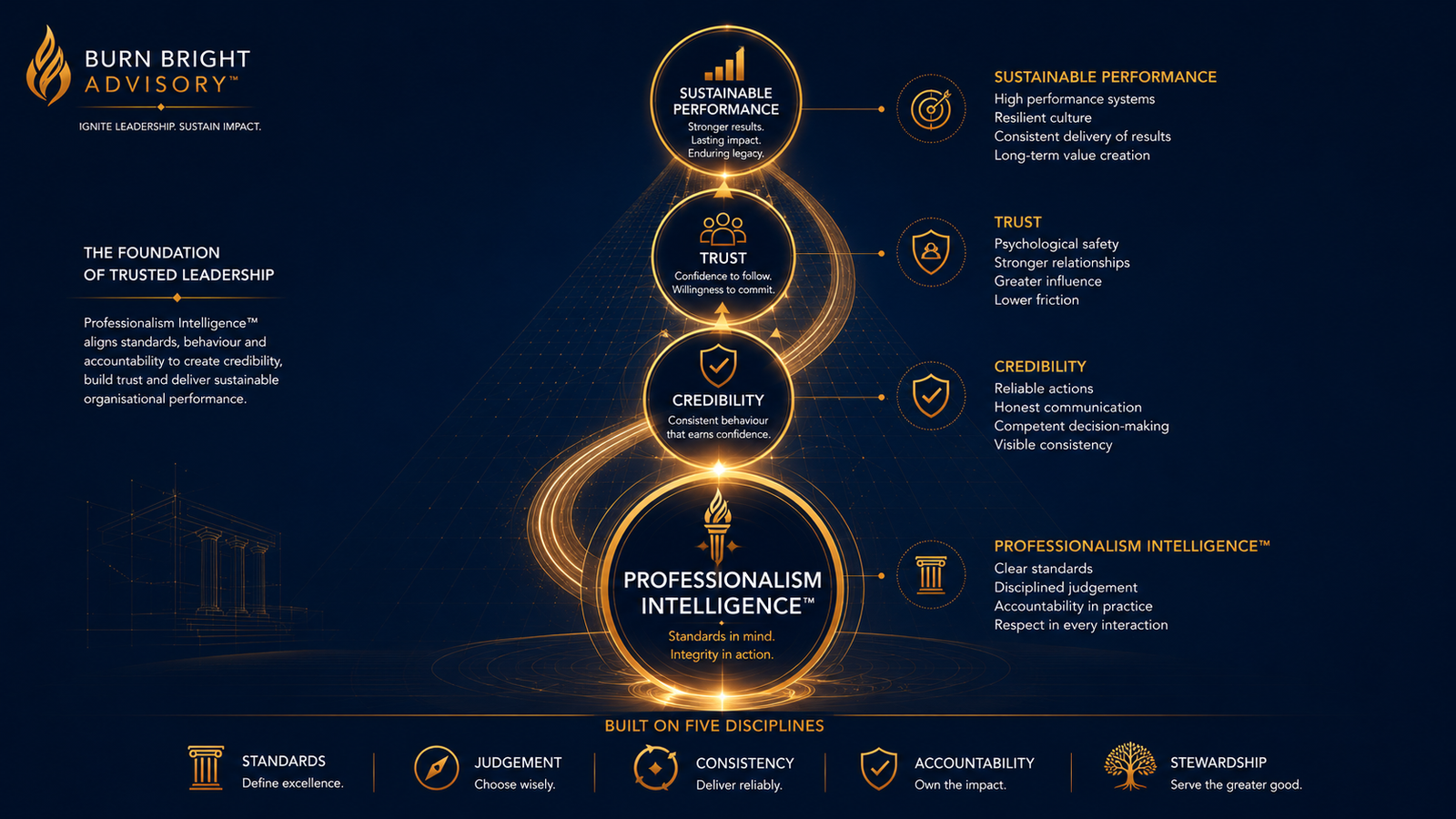
Professional Standards → Consistent Behaviour → Credibility → Trust → Leadership Capacity → Sustainable Performance
This does not imply that professionalism alone guarantees organisational performance. It does mean that sustained performance becomes harder when leadership credibility deteriorates. Trust affects how quickly people communicate. It affects whether problems are raised early. It influences willingness to delegate and willingness to accept delegation. It affects challenge, collaboration, discretionary effort and the speed with which organisations can respond to uncertainty.
Trust is not something leaders should simply request from employees. Trust is an outcome produced through repeated experience. A leader who wants greater trust should therefore examine the conditions from which trust emerges: are standards clear, is judgement defensible, is behaviour consistent, is accountability visible, is authority exercised responsibly? Professionalism Intelligence™ turns these questions into a leadership-development agenda.
Professionalism as Leadership Infrastructure
Organisations frequently invest heavily in strategy while treating professionalism as an assumed capability. That assumption can be costly. Strategy depends on decisions. Decisions depend on judgement. Execution depends on accountability. Collaboration depends on trust. Trust depends partly on consistency. Consistency depends on standards.
Seen this way, professionalism is not peripheral to strategy. It helps create the behavioural infrastructure through which strategy becomes executable.
The same principle applies to transformation. Change programmes frequently concentrate on structures, technology and processes while underestimating the professional credibility required from leaders asking others to navigate uncertainty. Employees watch closely: are leaders transparent about what they know and do not know, are difficult decisions explained, are commitments maintained, are affected employees treated respectfully, are senior leaders subject to the same behavioural expectations?
Professionalism becomes especially visible when circumstances become difficult. Anyone can appear consistent when there is little pressure. Leadership standards become meaningful when maintaining them carries a cost. That is where credibility is built — and where Professionalism Intelligence™ becomes a critical component of Leadership Performance Intelligence™.
4. Accountability: Owning Decisions and Impact
Accountability is frequently discussed as something leaders create for other people. Employees are held accountable for targets, managers for budgets, teams for delivery, functions for performance. Yet Professionalism Intelligence™ begins with a more demanding proposition: before leaders can create credible accountability around them, they must demonstrate accountability themselves.
This means taking responsibility not only for intentions, but also for decisions, commitments, behaviour and impact. A leader can have good intentions and still create poor outcomes. A decision can have been reasonable at the time and still require correction. A communication can have been intended as clear and still have created confusion. A leader can believe they have delegated effectively while the team experiences ambiguity.
Professional accountability requires the capacity to examine that gap without immediately becoming defensive. The question shifts from “was I right?” to “what responsibility do I hold for what happened next?” — a considerably more mature leadership question.
Accountability is not blame
Organisations sometimes confuse accountability with fault. They are not the same. Blame looks backwards in search of someone to carry the discomfort of failure. Professional accountability looks backwards sufficiently to understand what happened, then turns forward towards learning, correction and responsibility.
A professionally intelligent leader can acknowledge that a decision was theirs, that the assumptions behind it were incomplete, that they should have consulted earlier, that a change was not communicated clearly enough, that the outcome differed from what was intended, and that there is something to learn and change. None of those statements diminishes leadership authority. When used appropriately, they strengthen it.
This connects closely with the wider Burn Bright emphasis on unguarded leadership: effective leadership does not require pretending to possess every answer. Curiosity, reflection and the willingness to acknowledge uncertainty can strengthen rather than weaken leadership relationships.
The accountability asymmetry problem
The message is unmistakable: accountability is not really an organisational principle, it is a hierarchical requirement. That damages credibility because people evaluate organisational values partly through how power behaves. Professional leaders understand that greater authority should not produce less accountability — in many respects, it should produce more. The more influence a decision carries, the greater the obligation to exercise that influence responsibly.
Accountability creates learning capacity
Organisations cannot learn effectively when people must protect themselves from failure. If every mistake triggers blame, people learn to conceal problems. If leaders defend every decision, teams learn that challenge is unsafe. If poor outcomes are continually reframed as somebody else’s responsibility, organisational learning becomes distorted.
Accountability creates the possibility of reflection. Reflection creates learning. Learning improves future judgement. This is where Professionalism Intelligence™ connects with Reflective Practice Intelligence™ and Knowledge Development Intelligence™ within the Leadership Intelligence Compass™. Professional leadership is not simply about maintaining standards — it is also about improving the quality with which those standards are understood and applied.
5. Stewardship: Leadership Beyond Self-Interest
The fifth dimension of Professionalism Intelligence™ is perhaps the least discussed and the most consequential: stewardship.
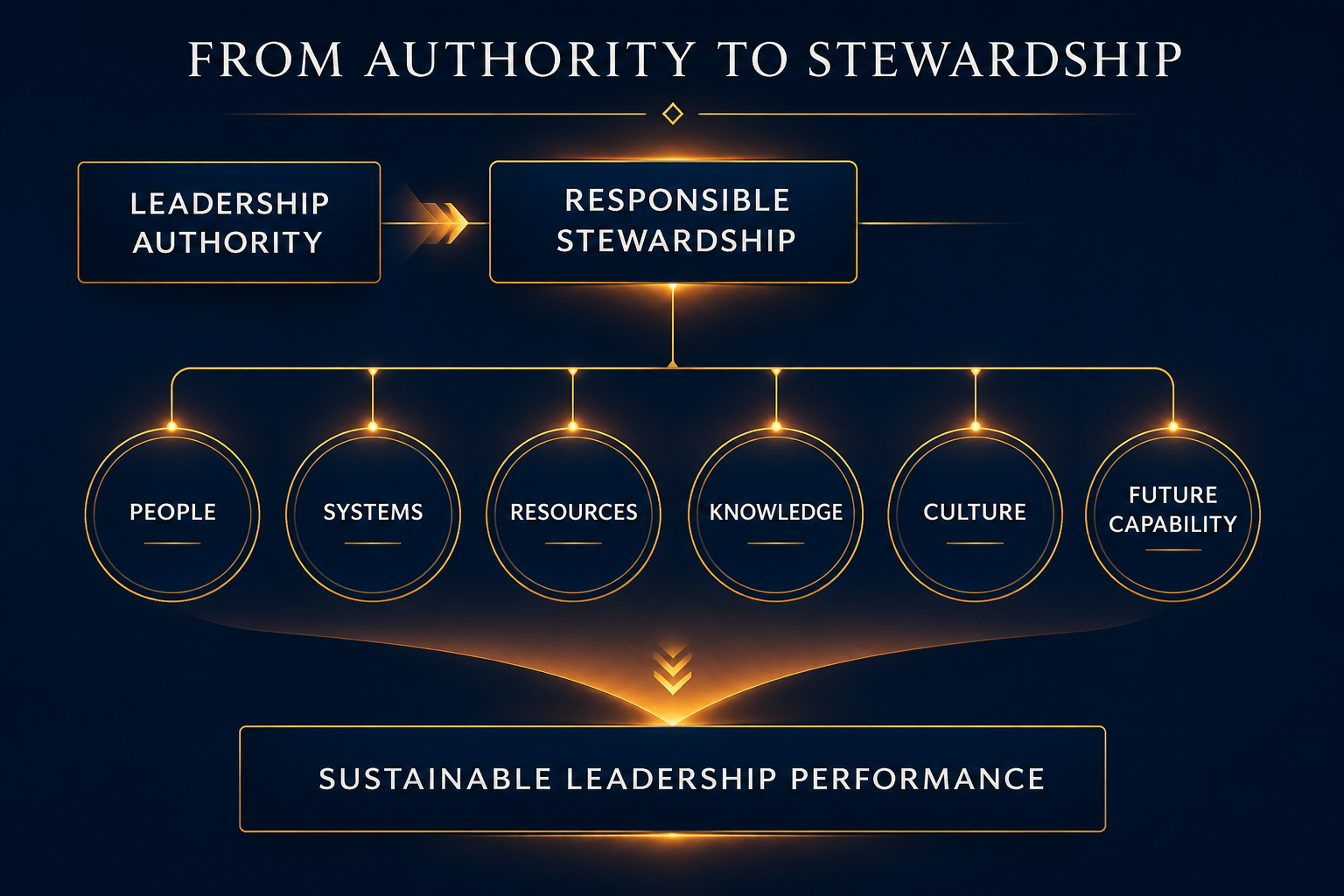
Leadership authority gives people access to resources they do not personally own — budgets, information, talent, institutional reputation, decision rights, relationships, opportunities, time and organisational capability. In public services, healthcare and education, leaders may also carry responsibility for public resources, patient outcomes, safeguarding, community confidence or educational opportunity.
Professional leadership therefore requires more than asking “what can I achieve with this authority?” It asks: “what am I responsible for protecting, developing and passing forward?” That is stewardship.
Leadership is temporary; consequences are not
Titles encourage an illusion of permanence. Yet every leadership role is temporary. Eventually, somebody else will occupy the position. The more useful measure of leadership is therefore not simply what happened while a leader held authority, but what condition the organisation, team or system was left in afterwards. Did capability increase? Did trust strengthen? Did people develop? Did decision-making improve? Were resources used responsibly? Did the culture become healthier? Were systems strengthened? Or did performance depend so heavily on one individual that the organisation became weaker when they left?
Stewardship introduces a longer time horizon into professionalism. It asks leaders to consider consequences beyond the next deadline, quarter, inspection, election, funding cycle or performance review. That makes stewardship particularly important to Leadership Sustainability™.
A leadership approach that generates strong short-term results while exhausting people, weakening systems or concentrating unsustainable dependency is not necessarily strong leadership performance. It may simply be borrowing performance from the future. Burn Bright’s existing work on leadership burnout makes this distinction especially important: sustainable leadership requires systems, workload management and collective wellbeing rather than continual dependence on individual heroics.
Stewardship changes decision-making
Consider two leaders facing the same staffing problem. The first asks: how do we maintain this quarter’s output? The second asks: how do we maintain necessary output while protecting the capability required to perform six months from now? Both care about performance. The difference is time horizon.
Stewardship does not excuse weak performance — it expands the definition of performance. A leader focused primarily on personal achievement may retain their strongest people close to them; a steward develops those people so they can contribute more broadly, even when that development eventually takes them elsewhere. A leader focused on control may centralise decisions; a steward asks which decisions should remain central and which capabilities should be distributed. A leader focused on reputation may conceal weaknesses; a steward identifies weaknesses before they become institutional liabilities.
Stewardship converts leadership from possession into responsibility.
The Professionalism → Trust → Performance Chain
The five dimensions can now be brought together. Professionalism Intelligence™ operates as a system: Standards → Judgement → Consistency → Accountability → Stewardship. These dimensions influence how leadership is experienced. When leaders demonstrate them repeatedly, several organisational effects become possible.
Standards create clarity
People understand what is expected and what acceptable leadership and professional behaviour look like.
Judgement creates confidence
People can see that decisions are being interpreted thoughtfully rather than mechanically or impulsively.
Consistency creates reliability
Employees are less dependent on guessing how the leader will behave from one situation to another.
Accountability creates credibility
People see that responsibility applies upward as well as downward.
Stewardship creates confidence in the future
People recognise that leadership decisions consider organisational capability beyond immediate personal or operational interests.
Together, these conditions strengthen trust. And trust changes what organisations are capable of doing.
Trust is a performance condition
Trust is sometimes categorised as a cultural or relational issue. That understates its operational significance. In a low-trust environment, people double-check decisions, information is withheld, meetings become political, employees document conversations defensively, problems are escalated later, delegation becomes harder, managers increase oversight, employees become reluctant to take sensible risks, feedback becomes filtered, and decision-making slows because people anticipate hidden consequences. Each behaviour consumes capacity.
In the opposite environment, people understand expectations, believe commitments generally mean something, can raise concerns without unnecessary political calculation, know mistakes will be examined rather than automatically weaponised, understand where decision authority sits, and can challenge appropriately. Delegation requires less defensive monitoring. That does not mean conflict disappears — it means less organisational energy is consumed by uncertainty about how people in authority will behave.
Professionalism therefore helps create usable organisational capacity. Leadership performance cannot be assessed only through the leader’s individual output. It must also consider the conditions the leader creates for other people to perform.
The Professionalism–Trust–Performance Model
Layer One
Professionalism Intelligence™
The leader demonstrates Standards, Judgement, Consistency, Accountability and Stewardship.
Layer Two
Leadership Trust
These behaviours create greater clarity, reliability, credibility, fairness and confidence.
Layer Three
Performance Capacity
These conditions support decision quality, collaboration, delegation, learning, adaptability and sustainable performance.
This model highlights an important point: professionalism is not the final outcome. It is an enabling capability. Its value lies partly in what it makes possible.
When Professionalism Intelligence™ Is Weak
Weak professionalism does not always appear as dramatic misconduct. Often, the warning signs are much quieter. A leader repeatedly arrives unprepared. Commitments gradually stop being trusted. Difficult conversations are avoided. Standards vary depending on status. Confidential information is discussed too casually. Decisions are poorly explained. Credit travels upwards while accountability travels downwards. Urgency repeatedly overrides process. People begin saying one thing in meetings and another afterwards. High performers receive behavioural exemptions. The organisation’s stated values and leadership practices drift apart.
Individually, some of these behaviours may appear minor. Collectively, they create a pattern. Patterns create culture. This principle is particularly important when considering toxic leadership. Burn Bright’s work on small teams highlights how problematic leadership patterns can begin subtly and become progressively normalised, with small inconsistencies and dysfunctional behaviours eventually damaging trust, psychological safety and collaboration.
Professionalism Intelligence™ therefore has preventative value. It gives organisations a language for identifying deterioration before behaviour reaches the threshold of obvious dysfunction.
The Cost of Professionalism Debt
Organisations can accumulate what might be called professionalism debt. Professionalism debt develops when short-term exceptions to standards repeatedly remain unresolved: a difficult high performer is tolerated, a weak manager is not challenged, an executive repeatedly bypasses governance, an unresolved conflict becomes normal, a temporary workload expectation becomes permanent, an inappropriate communication style becomes “just how they are,” a leader’s inconsistent behaviour is excused because results remain strong.
Each exception may initially appear manageable. But the organisation pays interest. Other people notice. Standards become harder to enforce elsewhere. Managers lose credibility when challenging behaviour that senior leaders themselves demonstrate. Employees become more cynical about organisational values. Eventually, leadership must spend considerably more effort repairing culture than would have been required to maintain professional standards in the first place.
This is why professionalism should not be viewed primarily as a corrective function. It is a form of organisational risk management.
Professionalism Intelligence™ Across Sectors
Professionalism is universal. Its expression is contextual. A professional standard appropriate to a healthcare environment may differ from one required in a technology startup, school, government department or entrepreneurial business. The underlying intelligence, however, remains relevant: leaders must understand standards, exercise judgement, behave consistently, accept accountability and act as stewards of the responsibilities entrusted to them.
Business Growth Intelligence™
In commercial environments, professionalism supports confidence between employees, customers, investors, partners and boards. A growing business frequently experiences pressure to move faster; processes that worked with 20 employees become inadequate with 100. Professionalism Intelligence™ helps prevent growth from becoming organisational inconsistency, ensuring growth does not outpace leadership maturity.
School Leadership Intelligence™
School leaders operate within unusually complex professional relationships — to students, staff, families, governing bodies, regulators and communities. Professional judgement is central to balancing confidentiality with communication, staff support with accountability, and individual circumstances with consistency. Schools depend heavily on relational trust, so a technically correct decision handled without professional judgement can still damage confidence.
Healthcare Leadership Intelligence™
Healthcare demonstrates particularly clearly why professionalism is more than etiquette — professional standards can directly affect safety. If professional hierarchy prevents people from speaking up, leadership professionalism has failed even when technical competence remains high. Healthcare leaders need to create conditions in which standards and accountability coexist with appropriate challenge.
Public Service Leadership Intelligence™
Public-service leadership carries a distinct stewardship obligation because authority is exercised within systems accountable to citizens, communities and public institutions. Professionalism requires procedural integrity, responsible use of resources, appropriate transparency, impartiality and long-term institutional thinking — standards that matter most precisely when short-term pressure makes them difficult to maintain.
HR & People Leadership Intelligence™
People leaders occupy an unusual position: they frequently help define standards for everyone else while also advising leaders who may themselves fall short of those standards. Confidentiality, consistency, fair process, evidence, boundaries and judgement are operating requirements, not abstract principles. When people processes are not applied consistently across seniority, trust in the wider people system can deteriorate quickly.
Entrepreneur Performance Intelligence™
Entrepreneurs often begin in environments where speed, improvisation and personal authority are advantages — but what helps create a business can eventually constrain its development. Professionalism Intelligence™ helps entrepreneurs make the transition from “this is my business” towards “I am stewarding an organisation that increasingly depends on systems beyond me,” a significant marker of leadership maturity.
Developing Professionalism Intelligence™
Professionalism cannot be strengthened through a policy document alone. It develops through repeated leadership practice. A useful development process begins with five questions: what expectations govern my leadership and are they sufficiently clear (Standards); how do I make decisions when legitimate priorities conflict (Judgement); where might people experience a gap between what I say and what I do (Consistency); how visibly do I take responsibility for my decisions and impact (Accountability); and am I strengthening the people, systems and capability that will remain after my immediate involvement (Stewardship)?
These questions can be used within leadership reflection, supervision, executive coaching, performance conversations, leadership-team reviews, governance discussions, professional development, succession planning and organisational diagnostics. But reflection alone is insufficient — the purpose is behavioural improvement.
From reflection to evidence
Leaders should identify evidence rather than relying on self-perception. Instead of asking “am I consistent?”, ask what evidence your team would use to decide whether you are consistent. Instead of “am I accountable?”, ask what happens publicly when one of your decisions does not work. Instead of “do I maintain high standards?”, ask which behaviours you have tolerated that contradict the standards you say matter. Instead of “am I a good steward?”, ask what capability would disappear tomorrow if you left.
Those questions are more uncomfortable. They are also more useful. Professionalism Intelligence™ grows when leaders become capable of examining the difference between self-perception and experienced leadership.
Connecting Professionalism Intelligence™ to the Leadership Intelligence Compass™
Professionalism Intelligence™ should not operate independently from other leadership capabilities. Professional judgement connects with Ethics Intelligence™. Responding appropriately to changing professional expectations requires Adaptability Intelligence™. Examining one’s impact requires Reflective Practice Intelligence™. Developing better practice requires Knowledge Development Intelligence™. Navigating relationships and disagreement draws upon Emotional Intelligence™. Protecting long-term leadership capacity connects directly with Leadership Sustainability™. And creating shared understanding rather than simply imposing answers connects with Constructivism Intelligence™.
The Leadership Intelligence Compass™ therefore treats leadership as an interconnected system of intelligences rather than a collection of isolated traits. Professionalism provides part of the foundation. The other domains increase the leader’s capacity to apply it intelligently. This is the distinction between merely knowing professional standards and possessing Professionalism Intelligence™: one knows what the standards say, the other can interpret, apply, reflect upon and sustain them in the complexity of real leadership.
The Leadership Question That Matters
Professionalism is sometimes treated as the minimum expected of a leader. That framing misses its strategic importance. The deeper question is not “does this leader behave professionally?” It is “does this leader create confidence that authority will be exercised professionally when circumstances become difficult?” That is a much higher standard. It moves the conversation from appearance to reliability, from etiquette to judgement, from compliance to accountability, from individual behaviour to organisational trust, and from occupying a leadership role to stewarding it responsibly.
When leaders consistently demonstrate standards, judgement, accountability and stewardship, professionalism becomes more than a personal quality. It becomes part of the organisation’s leadership infrastructure. And when that infrastructure is strong, people can spend less energy protecting themselves from leadership uncertainty and more energy contributing to the work leadership exists to enable.
Leadership Reflection Questions
Leadership Reflection Questions
Standards
- What professional standards do I consider non-negotiable in my leadership?
- Are those standards explicit enough for other people to understand them?
- Which behaviours have I tolerated that may unintentionally contradict those standards?
- Do expectations change according to someone’s seniority, influence or performance?
- What does my behaviour communicate about the standards that really matter here?
Judgement
- How do I respond when two legitimate priorities conflict?
- What evidence informs my important decisions?
- Which assumptions am I most likely to make without testing?
- Whose perspective is least likely to be represented when I make decisions?
- Can I explain the professional reasoning behind difficult decisions without relying solely on authority?
Consistency
- Where might employees see a difference between what I say and what I repeatedly do?
- Would people describe my leadership as reasonably predictable under pressure?
- Do I apply principles consistently while still considering individual circumstances?
- Which commitments have I made but not yet completed?
- What leadership inconsistency would my team identify before I did?
Accountability
- What happens when one of my decisions produces an unintended outcome?
- How comfortable am I acknowledging publicly that I was wrong?
- Do I expect behaviours from others that I sometimes excuse in myself?
- When problems occur, do people experience investigation and learning — or blame?
- What evidence shows that accountability applies upwards as well as downwards?
Stewardship
- What am I responsible for leaving stronger than I found it?
- Which people are more capable because of my leadership?
- Which systems depend too heavily on me personally?
- Am I achieving current performance by consuming future leadership capacity?
- If I left my position tomorrow, what capability would disappear with me?
The purpose is not to achieve a perfect score. It is to identify the professionalism gap between intended leadership and experienced leadership.
Action Steps: Strengthening Professionalism Intelligence™
Professionalism Intelligence™ develops through deliberate practice rather than declaration.
1. Define five leadership standards
Identify five standards that should characterise leadership within your context and make them observable. Instead of “act with integrity,” define what integrity requires when information is uncomfortable, competing interests exist, or a senior colleague behaves poorly.
2. Audit the say–do gap
Review the messages leadership sends against actual practice across workload, wellbeing, communication, decision-making, development, inclusion, accountability, meetings, performance and professional boundaries. Identify where leadership behaviour contradicts leadership language, and choose one gap to close immediately.
3. Introduce a professional judgement pause
For consequential decisions, ask what you know, what you are assuming, who will be affected, which professional or ethical standards apply, what alternatives have been considered, and whether you could explain the decision appropriately to those affected.
4. Make leadership accountability visible
Do not limit accountability to private reflection. Where appropriate, communicate what was decided, what happened, what was learned, what responsibility leadership accepts, and what will change.
5. Conduct a stewardship review
Once each quarter, examine more than immediate performance: is leadership capability growing, are processes becoming more resilient, is important knowledge distributed or concentrated, are professional standards strengthening, can current performance be sustained, and could others carry critical responsibilities?
Professionalism Intelligence™ Five-Dimension Self-Review
Rate each statement from 1 (rarely demonstrated) to 5 (consistently demonstrated):
| Dimension | Leadership Statement |
|---|---|
| Standards | I make professional expectations clear through both words and behaviour. |
| Standards | I challenge significant breaches even when the individual involved is influential. |
| Judgement | I examine evidence, context and consequences before consequential decisions. |
| Judgement | I can reconsider my interpretation when credible new information emerges. |
| Consistency | My behaviour broadly aligns with the standards I expect from others. |
| Consistency | Differences in treatment have a defensible professional rationale. |
| Accountability | I take visible responsibility for my decisions and their impact. |
| Accountability | I can acknowledge mistakes without immediately becoming defensive. |
| Stewardship | I consider long-term organisational capability alongside immediate performance. |
| Stewardship | I actively reduce unnecessary dependence on my individual leadership. |
A low score should not automatically be interpreted as a personal deficit. It is a prompt for investigation. Leadership behaviour is influenced by workload, systems, organisational expectations, authority, culture and capacity. Burn Bright’s wider leadership work emphasises precisely this need to examine systems rather than reducing leadership sustainability to individual effort alone.
What is professionalism in leadership?
Professionalism in leadership is the consistent application of appropriate standards, judgement, behaviour, accountability and stewardship when exercising leadership responsibility. It extends beyond appearance, etiquette or technical competence.
What is Professionalism Intelligence™?
Professionalism Intelligence™ is a Burn Bright Advisory™ Leadership Intelligence Compass™ domain concerned with a leader’s capacity to understand, interpret and consistently apply professional standards, judgement, behaviour, accountability and stewardship.
Why is professionalism important in leadership?
Professionalism helps create leadership credibility. When standards are clear, judgement is thoughtful, behaviour is consistent and accountability is visible, people gain greater confidence in how leadership authority will be exercised — supporting trust, delegation, collaboration and performance.
What are the five dimensions of Professionalism Intelligence™?
Standards, Judgement, Consistency, Accountability and Stewardship. They operate as an interconnected system: standards establish expectations, judgement interprets context, consistency builds reliability, accountability creates responsibility, and stewardship protects long-term capability.
How does professionalism build trust?
Through repeated evidence. People observe whether leaders keep commitments, apply standards fairly, explain difficult decisions, accept responsibility and behave consistently under pressure. Trust is something leadership practice continually earns, not something simply requested.
What is the difference between professionalism and ethics in leadership?
Professionalism Intelligence™ concerns the standards, judgement, consistency, accountability and stewardship through which leadership responsibilities are exercised. Ethics Intelligence™ concerns the principles, obligations, competing interests and consequences that inform what should be done. Professional judgement is stronger when ethical reasoning informs it.
Can a high-performing leader still lack professionalism?
Yes. A leader may produce strong short-term results while behaving inconsistently, avoiding accountability, damaging relationships or creating excessive dependence on themselves. Leadership Performance Intelligence™ requires a wider understanding of performance than results alone.
How can organisations improve leadership professionalism?
By making standards explicit, assessing the gap between stated expectations and actual behaviour, developing professional judgement, creating accountability at every level, strengthening reflective practice, and treating stewardship as part of leadership performance.
Perhaps the most useful question for leaders is therefore not “do I consider myself professional?” It is “what evidence would the people I lead use to reach that conclusion?” That question takes us from self-perception to Leadership Performance Intelligence™.
Where Does Your Leadership Stand?
Use the Leadership Burnout Self-Assessment to understand how your standards, judgement, consistency, accountability and stewardship are showing up under pressure — and where the gap between intended and experienced leadership may need attention.
Free Leadership Intelligence
Get Weekly Leadership Insights
Join thousands of leaders receiving practical strategies on burnout prevention, workload design, and sustainable performance every week.