Quick Answer
Key Takeaways
- Calendar overload is usually a work-design problem, not a personal time-management failure.
- A full diary can create the appearance of productivity while reducing the time available for leadership.
- Meetings should compete for leadership capacity rather than automatically receiving it.
- Strategic thinking, decision-making and recovery require protected space, not whatever time remains.
- Sustainable leaders design their calendars around value, capacity and role responsibility, rather than availability.
Managing Calendar Overload: A Leader’s Guide
Managing calendar overload has become one of the defining challenges of modern leadership. Look at the diary of an overloaded senior leader and the problem becomes visible immediately.
Back-to-back meetings. Fifteen-minute gaps consumed by messages. Calls added over lunch. An operational issue inserted into the one remaining strategic block. A meeting that could have been an email sitting next to another meeting whose purpose nobody can clearly explain.
By Friday, the calendar shows 40 or 50 hours of activity. What it does not show is leadership capacity. This distinction matters.
The World Health Organization defines burnout as an occupational phenomenon resulting from chronic workplace stress that has not been successfully managed, identifying exhaustion, increased mental distance or cynicism towards work, and reduced professional efficacy as its three dimensions.
That definition should change how we think about an overloaded calendar. The problem is not simply that you need to become better at organising your diary. Your calendar may be showing you something more significant: the operating system around your leadership role is consuming more capacity than the role can sustainably provide.
Burnout is a system failure.
And sometimes the clearest picture of that system is sitting inside your calendar.
To understand calendar overload, it helps to see leadership time as an architecture rather than an endless series of available slots.
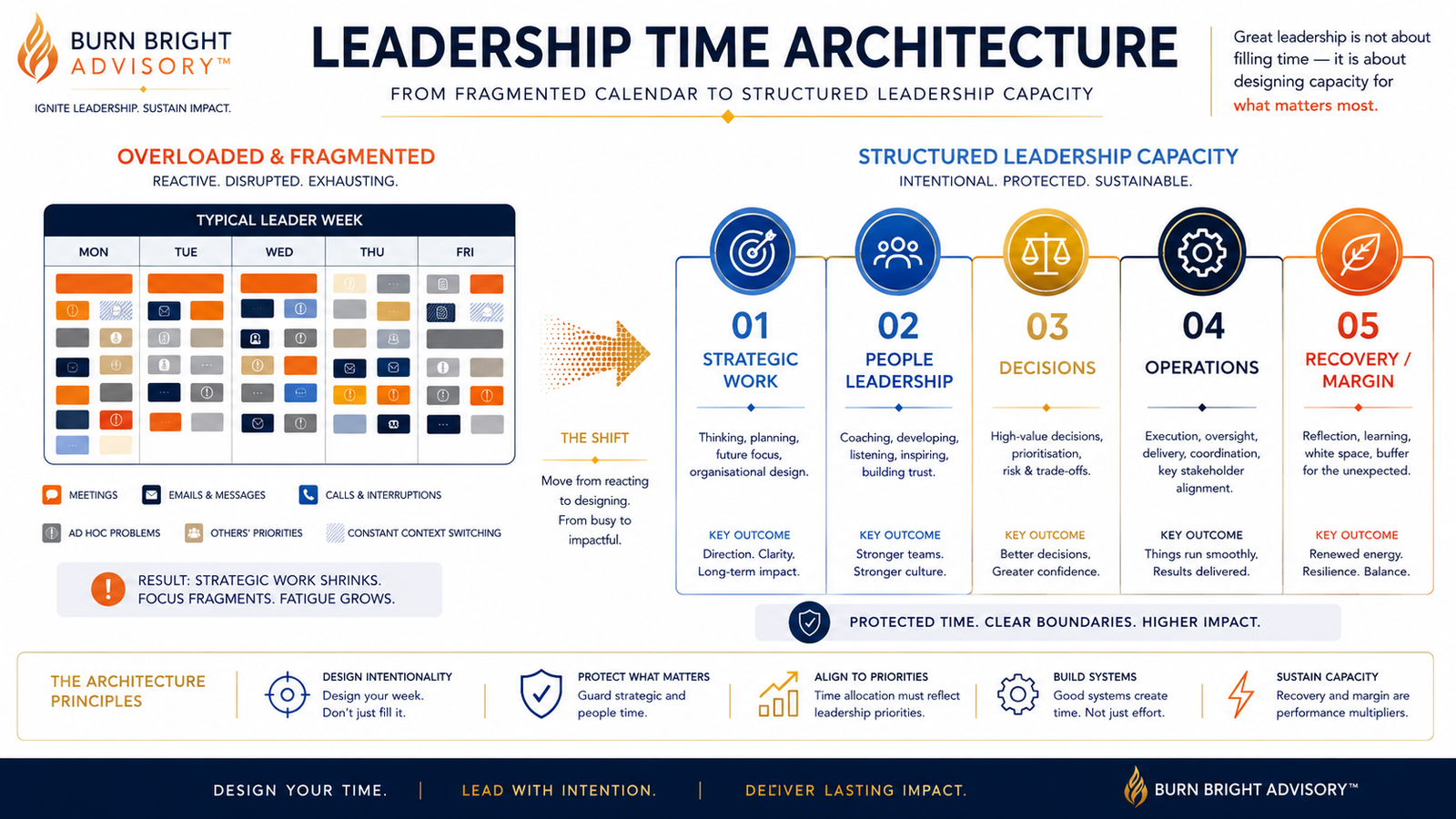
The point of this model is simple: not every empty hour is available capacity, and not every occupied hour represents valuable work. Sustainable leadership requires deliberate allocation between strategic work, decisions, people leadership, operations and recovery.
Featured Snippet
Why Does Calendar Overload Become a Leadership Problem?
Calendar overload rarely announces itself as a crisis. It accumulates. A weekly project meeting is added because a programme needs closer oversight. A recurring one-to-one appears because a new direct report joins. Another committee requires representation. A senior stakeholder asks for a regular update. A temporary working group forms around an urgent problem.
Each individual commitment looks reasonable.
The system becomes unreasonable.
This is one of the patterns described as scope creep: responsibilities accumulate incrementally without a corresponding review of what should stop. Scope creep is one of the five root causes within the Burn Bright Not Out framework, alongside meeting culture, communication chaos, decision overload and perfectionism culture. The calendar becomes the place where all five can collide.
A leader moves from meeting to meeting while Teams, Slack or email continue generating additional demands. Decisions are deferred because there is no thinking space. Preparation happens after hours. Strategic work moves to evenings because operational commitments have colonised the working day.
Eventually, the leader concludes: “I need to manage my time better.” That diagnosis is often wrong. You cannot time-manage your way out of a calendar containing more demand than your available capacity.
Recent workplace data makes the scale of the capacity problem difficult to ignore. Microsoft’s 2025 Work Trend Index reported that 80% of the global workforce said they lacked the time or energy needed to do their work, while 53% of leaders said productivity needed to increase. Its telemetry also found workers could be interrupted by meetings, emails or pings every two minutes during core working hours.
Earlier Microsoft research found employees were spending 57% of their time communicating through meetings, email and chat, compared with 43% creating in documents and other applications. Some 68% said they lacked enough uninterrupted focus time.
This is bigger than diary administration. It is a capacity problem. And the consequences are particularly serious for leaders because leadership requires forms of work that cannot always be compressed into a 20-minute gap.
Judgement requires space.
Complex decisions require space.
Difficult conversations require preparation.
Strategic thinking requires uninterrupted attention.
Recovery requires boundaries.
If every available space is converted into another meeting, leadership gradually becomes reactive. You remain busy. You may even become extraordinarily efficient at being busy. But your ability to lead begins to deteriorate.
How Do You Know When Your Calendar Is Genuinely Overloaded?
A busy calendar is not automatically an overloaded calendar. Some leadership roles naturally contain periods of intense activity. A major change programme, inspection, product launch, restructuring exercise or organisational crisis may temporarily increase meetings and decision demands.
The problem begins when temporary intensity becomes the permanent operating model. Calendar overload exists when scheduled commitments consistently consume the capacity required to perform the rest of your role effectively.
There are several warning signs:
- You finish your meetings and then start your “real work”.
- You regularly prepare for meetings outside normal working hours.
- Strategic tasks move from one week to the next because operational meetings always win.
- You accept invitations without being clear why you are required.
- Your one-to-ones become rushed because another meeting is waiting.
- You use lunch breaks to catch up with email.
- Important decisions are made between meetings rather than after proper consideration.
- You arrive at Friday exhausted but struggle to identify what meaningful work actually moved forward.
Perhaps the clearest warning sign is this: your calendar contains no margin. Every hour has been allocated. That creates fragility. One unexpected problem — an employee issue, customer escalation, operational failure or urgent request from above — does not simply add one more task. It displaces work that was already competing for insufficient capacity.
Work moves into evenings.
Preparation moves into weekends.
Recovery disappears.
This is how a calendar problem becomes a burnout problem. The Burn Bright Not Out framework identifies meeting culture, scope creep, communication chaos and decision overload among the structural root causes of burnout. These pressures rarely operate independently. An overloaded calendar becomes the point where they converge.
Run a Calendar Capacity Test
Instead of asking whether your diary feels busy, examine the evidence. Review the previous four working weeks and divide your scheduled time into five categories:
| Calendar Category | What It Includes | Diagnostic Question |
|---|---|---|
| Strategic | Planning, analysis, future priorities | Am I spending enough time thinking beyond this week? |
| People | Coaching, one-to-ones, difficult conversations | Am I leading people or merely responding to them? |
| Operational | Updates, delivery meetings, problem-solving | Which of these genuinely requires me? |
| Administrative | Reporting, routine approvals, coordination | Could this be delegated, automated or redesigned? |
| Recovery / Margin | Breaks, transition space, thinking time | Does my calendar contain usable capacity for the unexpected? |
Do not judge the calendar yet. Diagnose it. You are looking for the architecture beneath the activity.
If 70% of your scheduled week is operational but your role requires significant strategic leadership, the issue is not whether you can become 10% more efficient. Your time architecture is misaligned with your role.
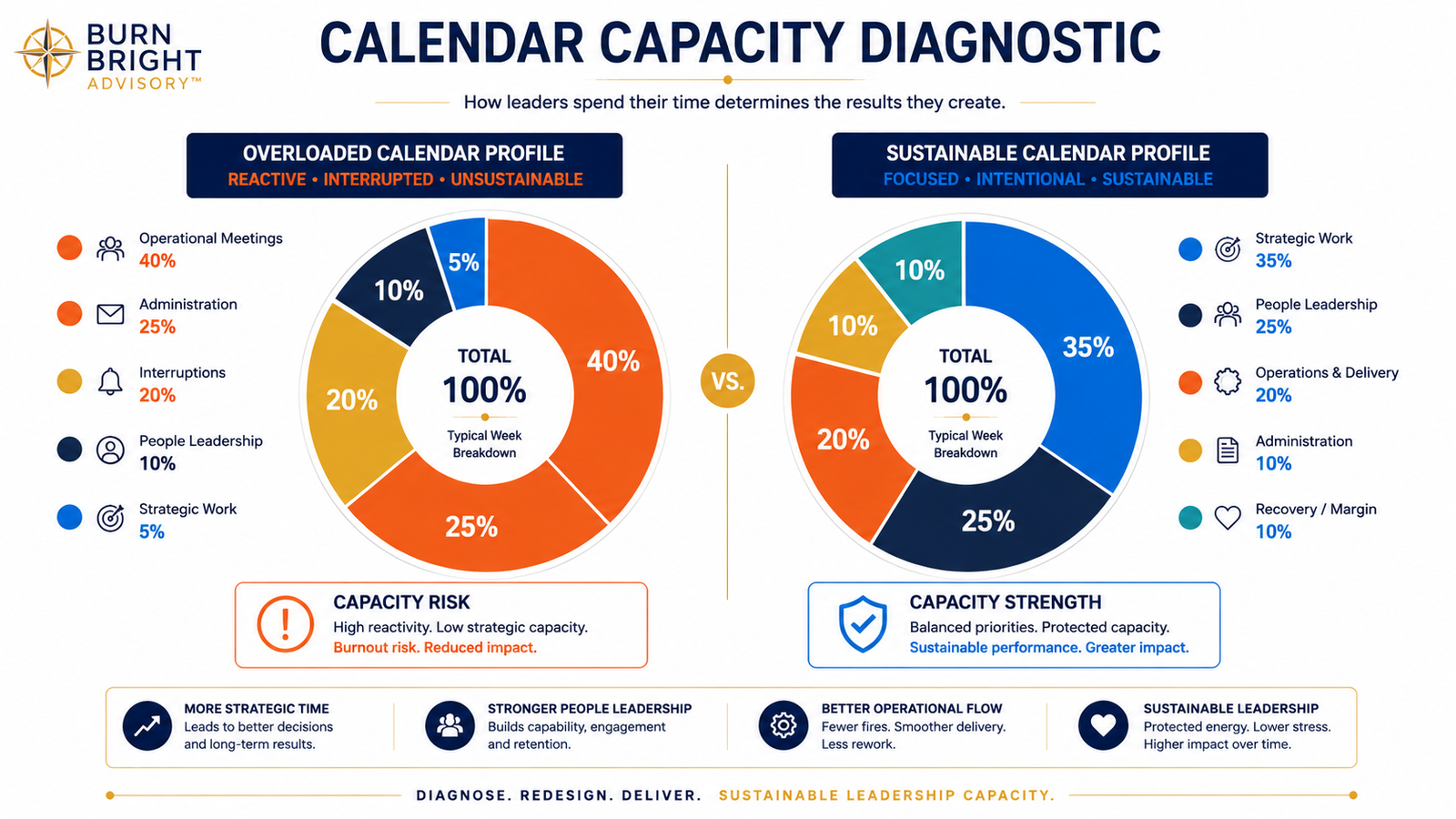
The value of this visual is the gap. Leaders often know they are busy without seeing precisely what is consuming their capacity. Once calendar demand is categorised, overload becomes measurable rather than emotional.
Why Doesn’t Traditional Time Management Fix Calendar Overload?
Most time-management advice begins with the individual: prioritise better, use time blocking, wake earlier, batch similar tasks, improve your morning routine, become more disciplined about your inbox. These techniques can be useful. But they cannot solve a structural capacity deficit.
If you have 55 hours of legitimate demand competing for 40 hours of sustainable capacity, becoming more efficient does not resolve the underlying equation. It simply helps you process overload faster.
This distinction sits at the centre of the Burn Bright approach. Better systems outperform more effort.
Traditional time management often assumes that the leader controls the calendar. Modern leadership frequently works differently. Stakeholders request access. Recurring meetings accumulate. Senior colleagues create urgent demands. Direct reports escalate decisions. Cross-functional projects require representation. Communication platforms generate continuous interruption. Over time, the leader’s diary becomes shared organisational property.
That is particularly dangerous because the visible meeting is only part of its true cost. A 60-minute meeting may require 20 minutes of preparation, 15 minutes of follow-up and several decisions. It may also fragment a larger block of focused work. The real capacity cost can therefore be considerably greater than the scheduled hour.
Research on workplace collaboration reinforces the problem. Microsoft has reported that workers can face a continuous stream of meetings, messages and email throughout the working day, while substantial amounts of working time are consumed by communication rather than creation.
The Burn Bright podcast describes the same structural shift: professional work has moved from more contained, project-based activity towards fragmented work spread across multiple communication channels, resulting in a movement away from deep work towards what the material describes as “perpetually available shallow work.”
Calendar overload therefore cannot be separated from communication architecture. You can cancel three meetings and still remain overloaded if Slack, Teams, WhatsApp and email immediately consume the recovered capacity.
This is why protecting strategic time requires more than putting a coloured block into Outlook. The surrounding system must respect it. Otherwise, “focus time” simply becomes another appointment that gets sacrificed when something apparently urgent appears.
Efficiency vs Architecture
| Traditional Calendar Management | Sustainable Time Architecture |
|---|---|
| Fit more into the week | Decide what deserves capacity |
| Optimise every available hour | Preserve deliberate margin |
| Accept meetings, then organise them | Challenge the need for attendance |
| Protect time when possible | Establish protected capacity by design |
| Measure activity | Measure leadership value |
| Treat interruptions individually | Redesign interruption pathways |
| Catch up outside working hours | Reduce demand to sustainable capacity |
| Leader absorbs excess demand | System redistributes demand |
This is the difference between managing symptoms and redesigning the system.
How Can Leaders Use Time Architecture to Regain Control?
The Burn Bright framework includes Time Architecture™ because time should not simply be managed after demands arrive. It should be designed around the work leadership actually requires. Start with four questions.
1. What work genuinely requires your attention?
Leadership creates a dangerous assumption: if I am responsible for the outcome, I must personally participate in the activity. That is false. Accountability and attendance are not the same thing.
You may be accountable for a project without attending every project meeting. You may need visibility of a decision without making the decision yourself. You may need assurance that work is progressing without receiving a 60-minute verbal update.
For every recurring calendar commitment, ask: what specifically happens because I am in this meeting that could not happen without me? If nobody can answer clearly, your attendance should be challenged.
2. Which decisions have become unnecessarily centralised?
Calendar overload is often decision overload in disguise. A leader attends meeting after meeting because the organisation has learned that decisions require their presence. That creates a bottleneck. The team waits. The leader attends. The calendar fills. More decisions accumulate. The leader then concludes that delegation has failed.
Often, delegation has not failed because people are incapable. It has failed because decision authority was never transferred with the task. This is why Decision Authority™ sits alongside Workload Architecture™ and Recovery Rhythms™ in the wider Burn Bright structural transformation framework.
Ask: which decisions am I still making that someone closer to the work could safely make? Every appropriate decision moved closer to the work potentially removes future meetings, messages and escalations.
3. Where is your strategic capacity?
Strategic thinking cannot depend on cancellation. If your current method is “I will work on strategy when I get a gap,” you do not have a strategy allocation. You have a hope.
Protected strategic capacity should appear in the calendar before routine demand consumes it. The exact amount will depend on the role. The principle does not: strategic work receives capacity first rather than inheriting whatever remains.
That may mean protecting two substantial blocks each week. It may mean designated meeting-free mornings. It may require agreements with your team about what qualifies as an interruption. The objective is not isolation. It is ensuring that the organisation receives the thinking capacity it is paying its leaders to provide.
4. Where is the margin?
This is the element many leaders remove first. They schedule meetings back-to-back because gaps appear inefficient. But a calendar without gaps assumes that nothing unexpected will happen. That is unrealistic leadership design.
Margin allows you to process the previous conversation, make notes, make a difficult decision, prepare for the next meeting, respond to something genuinely urgent or simply reset your attention. Without margin, one meeting running 15 minutes late can destabilise the next three hours.
The Burn Bright Calendar Redesign
The solution to managing calendar overload is not calendar minimalism. You do not need a beautifully empty diary. You need a diary that accurately reflects the work only you can do.
Use this four-stage test against every significant recurring commitment: Eliminate → Delegate → Redesign → Protect.
Stage 1 Eliminate
Does this activity still need to exist? Recurring meetings are particularly vulnerable to organisational inertia. They were created for a reason six months ago, but nobody has checked whether that reason still exists. If the purpose has disappeared, stop the meeting.
Stage 2 Delegate
Does this require your involvement, or merely organisational representation? Another capable team member may be able to attend, decide or report back. Delegation is not dumping work — done properly, it moves responsibility and appropriate authority to the correct level.
Stage 3 Redesign
If the activity must remain, does it need its current format? A 60-minute weekly update could become a 30-minute fortnightly decision meeting supported by an asynchronous written update. Eight attendees may become four. A general agenda may become three explicit decisions. Calendar redesign is not simply cancellation — it is changing the architecture of collaboration.
Stage 4 Protect
Finally, protect the capacity required for the work that remains uniquely yours: strategic thinking, high-consequence decisions, critical people conversations, future planning and recovery. Recovery is easily dismissed because it does not always produce an immediate output — but sustainable leadership depends on the ability to remain effective tomorrow, not merely extract maximum output today.
The Burn Bright Not Out material makes this distinction explicit: sustainable leadership prioritises long-term effectiveness over short-term achievement and replaces dependence on individual heroics with systems that can sustain performance.
Your diary should not prove how hard you work.
It should protect your capacity to lead.
How Do You Redesign an Overloaded Leadership Week?
Once you have diagnosed the problem, the next step is structural. Do not start by moving meetings around. Start by deciding what your leadership week needs to accomplish.
This matters because an overloaded calendar creates a predictable temptation: rearrange the existing commitments until they fit more neatly. That produces a tidier version of the same problem.
Instead, rebuild the week around capacity before commitments. The Burn Bright approach treats this as Time Architecture™: intentionally designing where leadership attention, decision-making and recovery capacity are allocated rather than allowing accumulated demand to determine the shape of the week.
Step 1: Establish Your Leadership Capacity
Begin with your real sustainable working capacity — not the number of hours you could work in an emergency, not the 55-hour week you have normalised. Then recognise that 100% of those hours cannot be scheduled. A motorway running at 60% capacity can absorb an increase in traffic; at 100%, one small disruption creates a queue. Leadership calendars behave similarly. The objective is sustainable utilisation with sufficient margin for uncertainty.
Step 2: Allocate Strategic Capacity First
Identify the work that creates disproportionate leadership value but is most easily displaced — strategic thinking and planning, preparation for high-consequence decisions, analysis of organisational performance, development of key people, difficult conversations, and improvement of systems and processes. Schedule meaningful blocks for this work before filling the calendar with routine commitments.
Step 3: Create Meeting Zones
Scattered meetings fragment attention. Where possible, group meetings into defined zones — certain afternoons may carry the majority of internal meetings while selected mornings remain protected for concentrated leadership work. This will not work perfectly every week. It does not need to. The objective is to reduce unnecessary switching between reactive and reflective modes.
Step 4: Build Transition Space
A meeting ending at 11:00 followed by another beginning at 11:00 assumes something unrealistic — that your brain changes context instantly. Important conversations create follow-up actions, decisions and emotional residue. Ten or fifteen minutes between significant meetings can provide enough capacity to record decisions, assign actions and mentally close one conversation before entering another.
Step 5: Set a Calendar Capacity Ceiling
Establish a limit beyond which additional meeting demand triggers a trade-off. Without a ceiling, every new commitment simply becomes additional work. With a ceiling, a new meeting creates a question: what will this replace? That question introduces scarcity into calendar decisions, and scarcity forces prioritisation.
ROLE PRIORITIES → CAPACITY → STRATEGIC BLOCKS → MEETING ZONES → MARGIN → RECOVERY
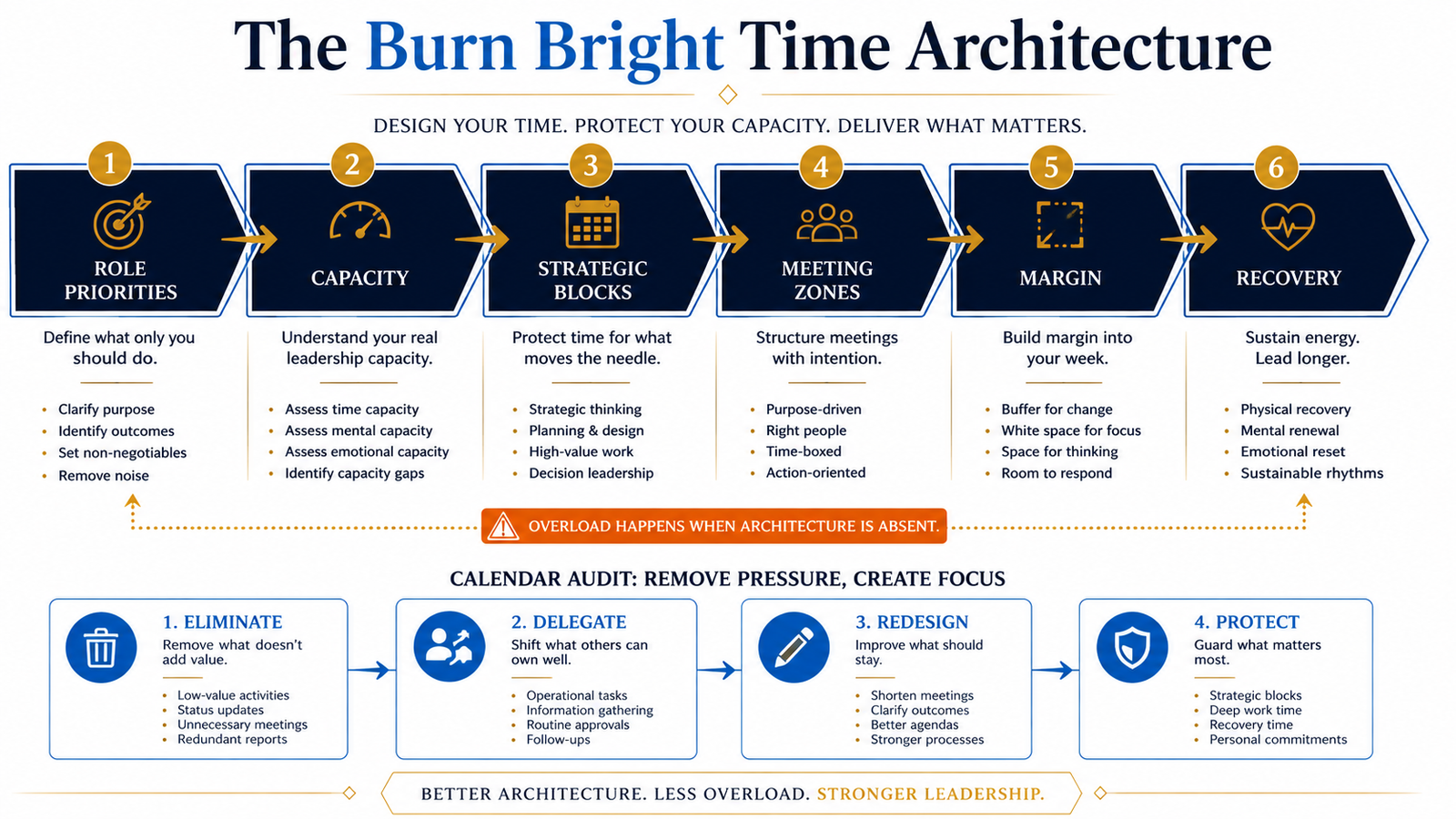
The framework changes the central question from “where can I fit this?” to “does this deserve leadership capacity?” That is a far more useful question.
What Does Managing Calendar Overload Look Like in Practice?
Consider a senior leader whose week contains 28 hours of scheduled meetings. On paper, 12 hours remain inside a conventional 40-hour week. In practice, those 12 hours are fragmented across small gaps. Email, preparation, follow-up actions, unexpected issues and routine administration consume most of them. Strategic work therefore happens in the evening.
The leader believes the problem is personal productivity. So they try harder. They answer email faster. They shorten lunch. They prepare for meetings earlier in the morning. They work later. Nothing fundamental changes.
Now apply the structural approach. The leader audits every recurring meeting. Four status meetings are replaced by written updates. Two meetings are delegated because attendance was required for representation rather than leadership judgement. A weekly 60-minute meeting becomes a 30-minute decision meeting. Another recurring meeting is removed because its original purpose no longer exists.
Meeting demand falls. But the leader does not immediately fill the recovered space. Two strategic blocks are protected. Transition periods are introduced around high-consequence meetings. Routine meetings are concentrated into defined zones. Clearer decision authority reduces the number of issues escalating upwards.
The leader has not become more productive through greater personal effort. The system has become less demanding of unnecessary leadership attention.
What Should You Do When Other People Control Your Calendar?
This is where calendar advice often becomes unrealistic. Many leaders cannot simply reject every meeting. There are organisational expectations, senior stakeholders, clients, boards, governance requirements and genuine operational responsibilities.
Structural calendar management does not require complete control. It requires greater intentionality over the control you do have.
Start by distinguishing between fixed and negotiable commitments. Some obligations genuinely are fixed. Others merely appear fixed because nobody has challenged them.
Then use evidence. Instead of saying “I have too many meetings,” say: “Recurring meetings are currently consuming 26 hours of my working week. That is leaving insufficient capacity for the strategic priorities I am accountable for. I want to review which meetings require my direct involvement and which can be delegated or redesigned.”
The second statement changes the conversation. It is not a complaint. It is a workload diagnosis. This aligns with the Upward Advocacy Framework within Burn Bright Not Out: sustainable workload conversations need to make capacity, competing demands and organisational consequences visible.
The same principle applies when someone requests another commitment. Do not automatically say yes and absorb the cost privately. Clarify the trade-off. You might ask: “which existing priority should move to create capacity for this?” That is not resistance. It is responsible leadership.
Organisations get into difficulty when leaders repeatedly conceal capacity problems through personal sacrifice. The work still gets done, so the system receives no signal that demand has exceeded capacity. Evenings become the invisible overflow mechanism. Eventually, the leader pays for a structural problem personally. That is precisely the pattern Burn Bright is designed to challenge.
What is the fastest way to start managing calendar overload?
Audit your recurring meetings before reorganising your diary. Identify which commitments can be eliminated, delegated or redesigned. Then protect strategic capacity before allowing routine meetings to refill the available space. The fastest improvement usually comes from reducing unnecessary demand, not improving scheduling technique.
How many meetings are too many for a leader?
There is no universal number. The better question is whether meetings leave enough capacity to perform the thinking, decision-making, people leadership and strategic work your role requires. If essential work repeatedly moves into evenings because meetings consume the working day, your meeting load has exceeded sustainable capacity.
Should leaders block focus time in their calendars?
Yes, but a calendar block alone is insufficient. Protected focus time needs organisational rules around interruption. Teams should understand when interruption is appropriate, which communication channels should be used and which decisions can proceed without the leader. Otherwise, focus blocks become placeholders that disappear whenever pressure rises.
Why do I feel exhausted after a day of meetings?
Meetings require sustained attention, context switching, information processing, decision-making and often emotional regulation. Back-to-back meetings also remove opportunities to process one conversation before beginning another, which can produce significant cognitive depletion even when spent mostly sitting down.
Can calendar overload contribute to leadership burnout?
Yes. Persistent calendar overload can contribute to chronic workplace stress by reducing control, increasing workload and removing opportunities for recovery. The Burn Bright framework treats meeting culture and decision overload as structural burnout risks rather than simply individual productivity problems.
What should I do if my organisation expects constant availability?
Make the operational cost visible. Track interruptions, meeting hours and work displaced outside normal hours, then discuss the impact in terms of organisational priorities and capacity. The aim is not to withdraw from leadership responsibilities but to establish clearer rules about availability, escalation and decision authority.
Conclusion: Managing Calendar Overload Requires Redesign
Managing calendar overload starts with recognising that your diary is not merely a scheduling tool. It is a record of how your organisation consumes your leadership capacity.
If every available hour is occupied, strategic work happens after hours, decisions are constantly escalated and recovery depends on finding an accidental gap, another productivity technique will not solve the problem. Redesign the architecture.
Audit recurring demand.
Eliminate work that no longer creates value.
Delegate attendance and decisions that do not require you.
Redesign meetings that consume more capacity than they justify.
Protect strategic work.
Build margin.
Protect recovery.
The objective is not an empty calendar. It is a calendar that allows you to perform the leadership role sustainably.
Burnout is a system failure. When the calendar repeatedly demands more capacity than a human being can sustainably provide, fix the system rather than asking the leader to absorb more.
Better systems outperform more effort.
And sustainable leadership beats heroic leadership.
Take the Leadership Burnout Self-Assessment
If calendar overload has become your normal operating model, diagnose the wider pattern before simply reorganising another week. Identify where workload, decision pressure and structural demands may be creating unsustainable leadership conditions.
Free Leadership Intelligence
Get Weekly Leadership Insights
Join thousands of leaders receiving practical strategies on burnout prevention, workload design, and sustainable performance every week.