Quick Answer
Key Takeaways
- Professionalism is not etiquette or appearance — it is a leadership intelligence that becomes visible through judgement under pressure.
- Burn Bright Advisory™ defines this capability as Professionalism Intelligence™, a domain of the Leadership Intelligence Compass™.
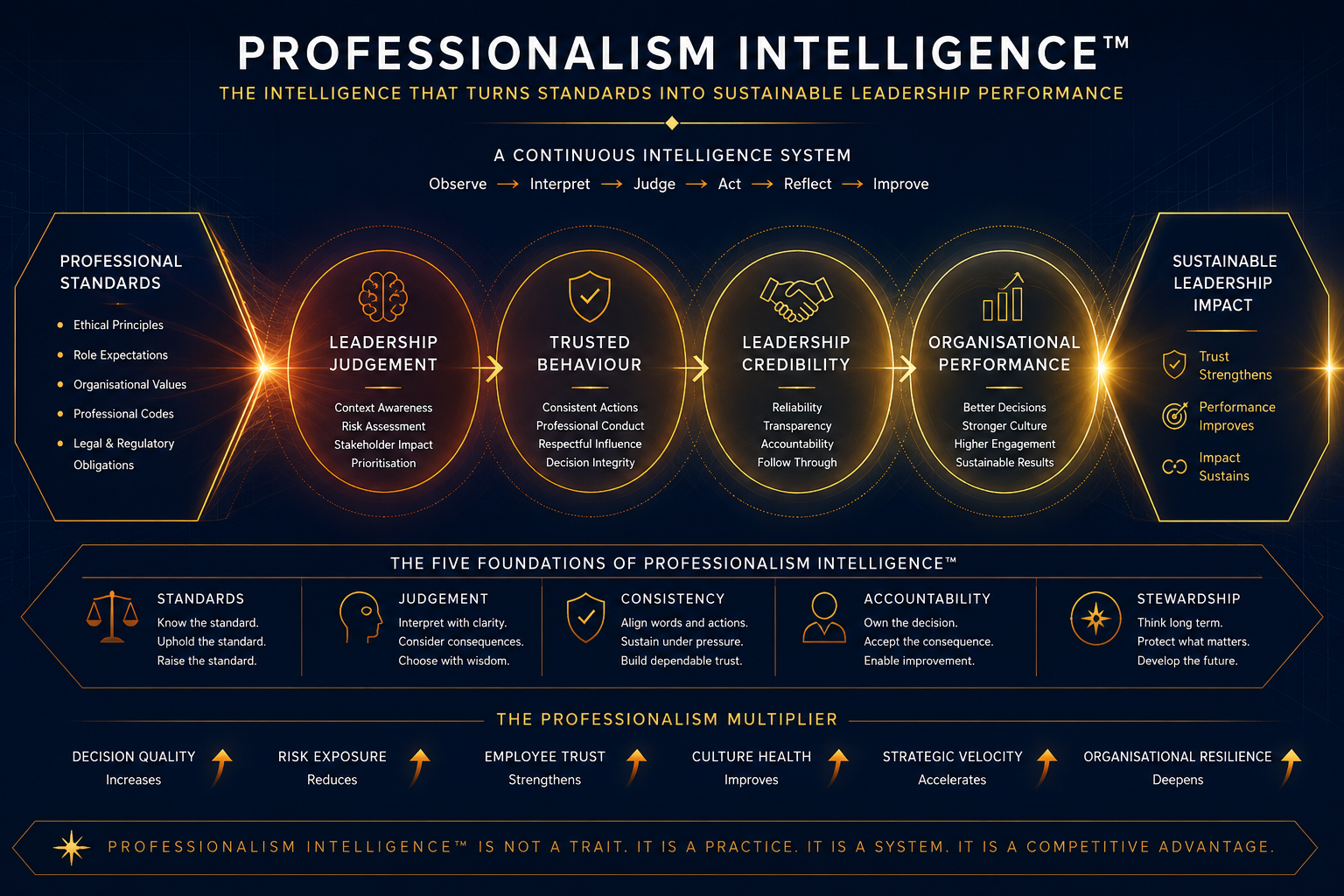
- The Professionalism Intelligence™ Chain links standards, judgement, behaviour, impact, trust and performance.
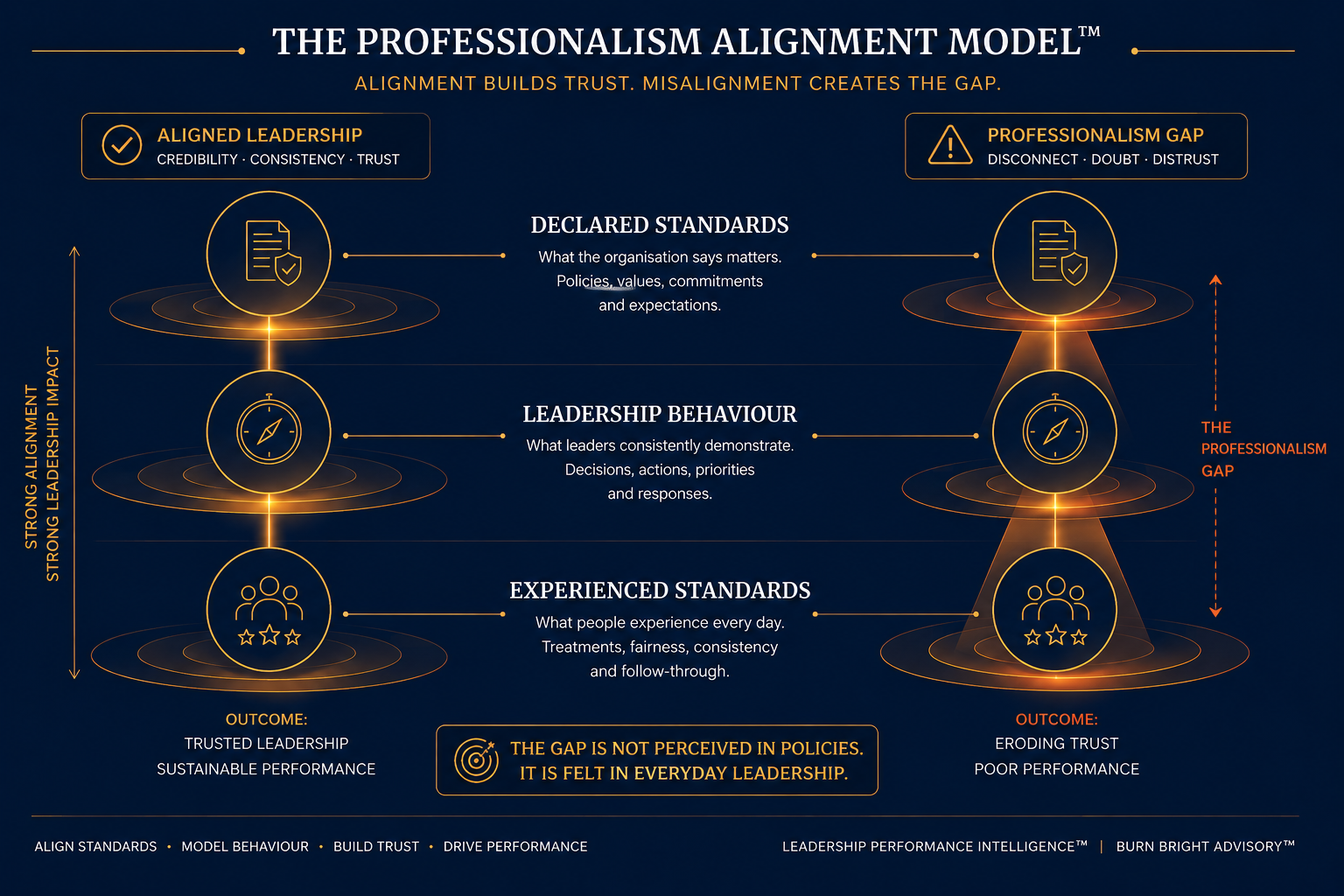
- A “Professionalism Gap” opens when declared standards and lived leadership behaviour diverge — and employees learn the experienced standard, not the written one.
- Professionalism requires sustainable Leadership Capacity™; chronic overload erodes consistency even when intentions remain good.
- Professionalism Intelligence™ develops through a five-part operating system: Pause, Interpret, Choose, Act, Review.
Professionalism in Leadership: Why Standards of Conduct Shape Trust, Performance and Organisational Culture
Leadership is watched. Not necessarily because employees are consciously evaluating every decision a leader makes, but because authority changes the significance of behaviour.
A comment made by a colleague may be forgotten. The same comment made by a senior leader can alter someone’s perception of what is acceptable. A missed deadline by an employee may create inconvenience. Repeated missed commitments by a leader can change how seriously the team treats future commitments. An emotional reaction between colleagues may damage one relationship. An uncontrolled reaction from a leader can change the psychological climate of an entire meeting.
This is one reason professionalism deserves considerably more attention within leadership development. It is frequently treated as an entry-level expectation — something people should already understand before entering leadership. Yet increasing authority makes professional judgement more important, not less. The greater a leader’s influence, the greater the potential consequences of inconsistency between stated standards and actual behaviour.
Professionalism in leadership is therefore not primarily about looking professional.
It is about becoming professionally dependable.
People need reasonable confidence about how a leader will use authority, exercise judgement, manage information, treat others and respond when circumstances become difficult. That dependability is a foundation of leadership credibility — and credibility is one of the currencies through which leadership operates.
Featured Snippet
Professionalism Is More Than Professional Appearance
Traditional interpretations of professionalism have often concentrated on presentation: professional dress, professional language, punctuality, meeting etiquette and appropriate workplace behaviour. These remain relevant, but they are insufficient for understanding professional leadership.
A leader can be impeccably presented and profoundly unprofessional. A polished executive can still humiliate employees. A technically competent manager can still breach confidentiality. A charismatic founder can still create inconsistent rules. A respected school leader can still avoid difficult accountability conversations. A clinically exceptional healthcare leader can still create an environment in which colleagues are afraid to question decisions.
What Is Professionalism Intelligence™?
Within the Burn Bright Leadership Intelligence Compass™, Professionalism Intelligence™ is the capacity to recognise, interpret, maintain and model appropriate professional standards while navigating the complexity of leadership responsibility. It combines several capabilities:
- Understanding the expectations attached to a leadership role
- Exercising appropriate judgement when rules do not provide an obvious answer
- Maintaining boundaries without becoming inaccessible
- Communicating respectfully without avoiding difficult conversations
- Using authority proportionately
- Demonstrating competence while remaining open to learning
- Taking responsibility for decisions and their consequences
- Maintaining consistency between stated standards and personal behaviour
- Protecting confidentiality and organisational trust
- Adapting behaviour appropriately across different professional contexts
Professional environments contain ambiguity, and leaders routinely encounter situations for which there is no perfectly written procedure. A professional leader does not simply know the rules — they develop the judgement required to interpret responsibility when the rules are incomplete.
The Professionalism Intelligence™ Chain
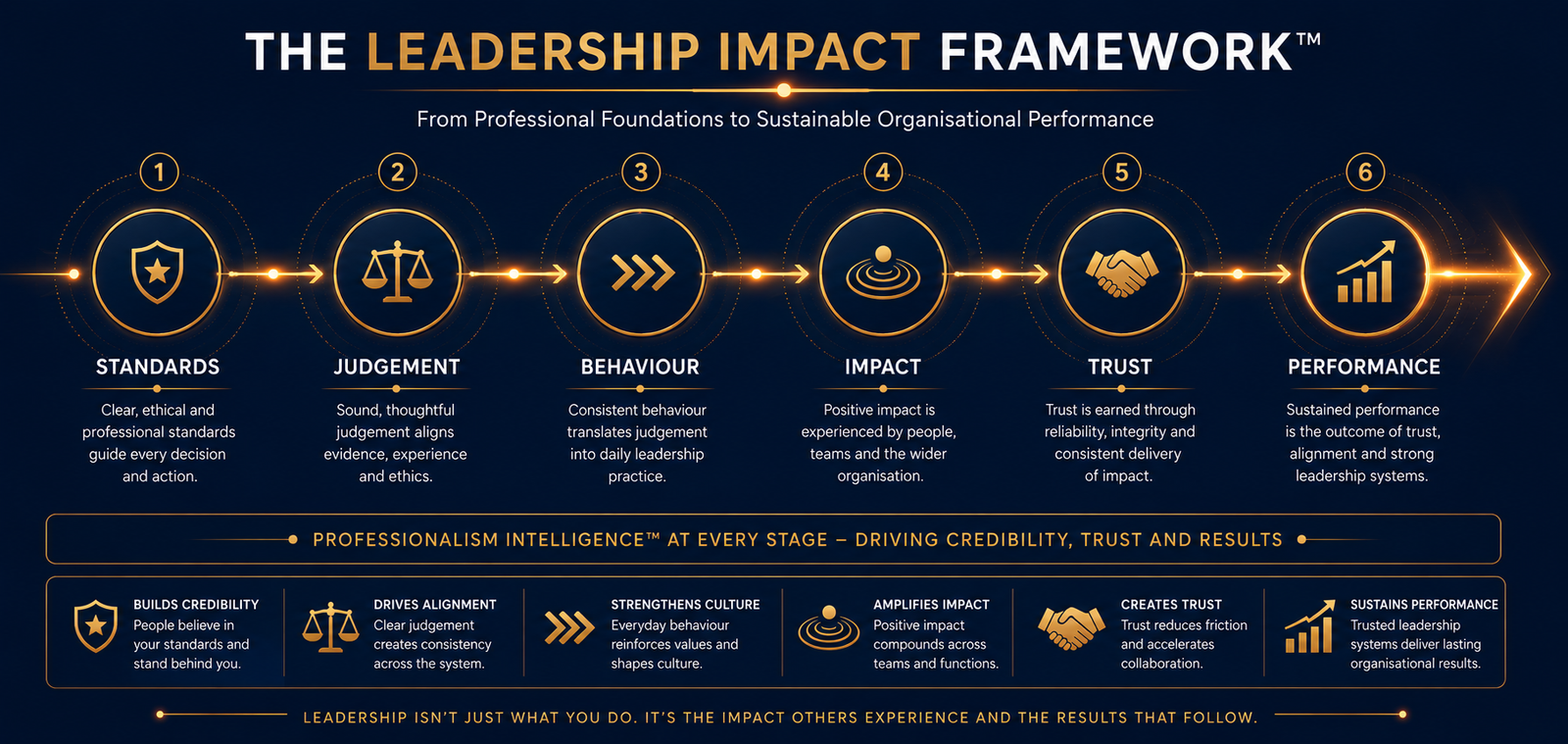
A useful way to understand professional leadership is through the Professionalism Intelligence™ Chain: Standards → Judgement → Behaviour → Impact → Trust → Performance.
Stage 1
Standards
Professional behaviour begins with standards originating from legislation, professional codes, organisational policy, sector expectations, ethics or the responsibilities inherent in the role. Knowing standards exist does not guarantee they influence behaviour.
Stage 2
Judgement
Leaders must interpret standards within real situations. Context, power, risk, relationships and consequences all matter — this is where professionalism becomes intelligent rather than procedural.
Stage 3
Behaviour
Judgement eventually becomes observable. Leaders communicate, decide, respond, delegate, challenge, disclose, intervene or remain silent — and these behaviours are where standards become visible to others.
Stage 4
Impact
Intent and impact are not always the same. Professionalism requires leaders to evaluate not only what they intended, but what their behaviour actually produced.
Stage 5
Trust
Repeated professional behaviour creates predictability, and predictability supports trust. Trust does not require agreement with every decision — it requires confidence in the integrity of the process.
Stage 6
Performance
Trust influences whether people speak honestly, raise risks, contribute ideas, challenge assumptions, admit mistakes and take responsibility. Professionalism therefore ultimately affects performance.
Professionalism Is What Happens When Nobody Can Easily Challenge You
The most revealing test of professionalism is often not how leaders behave toward people with greater authority. It is how they behave toward people with less. Most leaders understand the importance of managing upward — preparing carefully for board meetings, moderating language with executives, managing impressions when visibility is high.
Professionalism Intelligence™ asks a harder question: do the same standards survive changes in power? How does the executive speak to the administrative assistant? How does the principal respond to the newly qualified teacher who disagrees? How does the physician respond when a junior colleague questions a clinical assumption?
Authority creates discretion. Discretion reveals standards. The professionally intelligent leader recognises when organisational convention is insufficient and ethical judgement must become the stronger guide — connecting Professionalism Intelligence™ directly with Ethics Intelligence™.
The Professionalism Gap: When Stated Standards and Lived Behaviour Diverge
Many organisations do not suffer from an absence of standards. They suffer from an absence of alignment. The organisation says respect matters, and employees watch a senior leader interrupt colleagues repeatedly. The organisation says wellbeing matters, and managers learn that late-night replies are informally rewarded.
The distance between the declared standard and the experienced standard creates what Burn Bright Advisory™ calls the Professionalism Gap:
| Stage | What It Represents |
|---|---|
| Declared Standard | What the organisation says should happen |
| Leadership Behaviour | What people actually observe leaders doing |
| Reinforced Behaviour | What receives reward, tolerance or consequence |
| Experienced Standard | What employees conclude is really expected |
Culture is shaped less by the standards written on a wall than by the standards people learn through repeated experience. When leaders consistently model the declared standard, organisational credibility strengthens. When behaviour contradicts it, employees learn that the written rules are not the real rules.
Why Professionalism Matters for Leadership Trust
Employees continually make small assessments of leaders: will this person do what they said, keep confidences appropriately, treat me fairly if I disagree, manage their emotional response under pressure, admit an error, make the difficult decision when necessary?
Each experience adds evidence, and over time that evidence becomes a judgement about leadership credibility. This is why trust can be lost through apparently small incidents — one broken confidence, one unexplained exception, one public humiliation. Individually manageable; collectively, they teach people how leadership actually operates. Professionalism is cumulative. So is unprofessionalism.
Professionalism Under Pressure
Leadership development frequently examines behaviour in controlled conditions. Real leadership occurs under considerably less controlled circumstances — deadlines shorten, budgets tighten, mistakes happen, personal energy declines.
This connects Professionalism Intelligence™ with Leadership Sustainability™. An overloaded leader may know precisely how they should behave while having diminishing capacity to behave that way consistently. Organisations that demand consistently professional leadership while systematically exhausting their leaders create a contradiction: professional standards require sustainable capacity.
The Five Dimensions of Professionalism Intelligence™
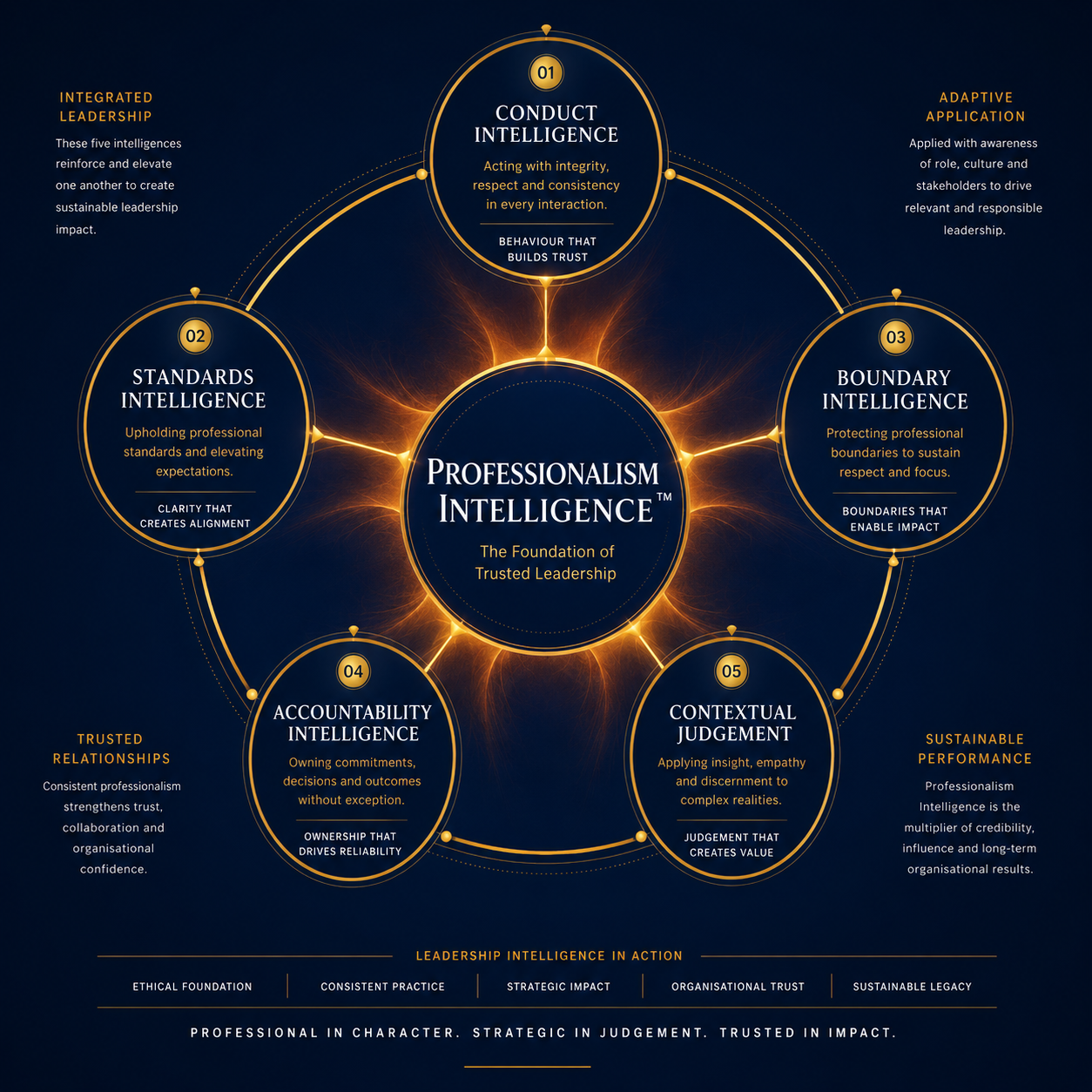
Burn Bright Advisory™ organises professional leadership around five interconnected dimensions.
Dimension 1 Conduct Intelligence
The ability to regulate personal behaviour according to role, context and responsibility — including communication, emotional regulation, respect, discretion and the appropriate use of authority.
Dimension 2 Standards Intelligence
The ability to understand the formal and informal expectations governing professional responsibility, including codes, policies, regulatory requirements and role-specific expectations.
Dimension 3 Boundary Intelligence
The ability to establish and maintain appropriate boundaries around relationships, information, workload, availability and decision-making — preventing both excessive distance and inappropriate familiarity.
Dimension 4 Accountability Intelligence
The willingness to take responsibility for commitments, decisions, mistakes and consequences. Professional leaders do not demand standards from others that they repeatedly excuse in themselves.
Dimension 5 Contextual Judgement
The ability to adapt behaviour without abandoning principles. A hospital, school, startup and government agency may require different communication norms — the intelligent leader adapts to context while preserving underlying standards.
Professionalism Is Not Perfection
Professionalism expects responsibility. Perfectionism frequently expects impossibility. Professional leaders make mistakes, misjudge situations and overlook information. The professional question is not whether mistakes occur — it is what happens next.
This is where Reflective Practice Intelligence™ becomes essential. Professionalism without reflection can become rigid compliance. Reflection without professional standards can become endless introspection without behavioural change. Together they create a stronger cycle: Act → Observe → Reflect → Learn → Adjust → Recommit. The objective is not flawless leadership. It is increasingly intelligent leadership.
The Leadership Performance Intelligence™ Perspective
Professional leadership cannot be understood as a single competency operating in isolation. Professionalism Intelligence™ establishes dependable standards of conduct. Ethics Intelligence™ strengthens moral judgement when interests and obligations conflict. Emotional Intelligence™ supports appropriate regulation and interpersonal awareness. Reflective Practice Intelligence™ enables leaders to examine impact and adjust behaviour. Adaptability Intelligence™ helps leaders respond appropriately when contexts change. Knowledge Development Intelligence™ prevents professional competence from becoming static. Leadership Sustainability™ protects the capacity required to maintain these behaviours over time.
That system is what transforms leadership development from a collection of disconnected skills into Leadership Performance Intelligence™.
From Professional Standards to Professional Maturity
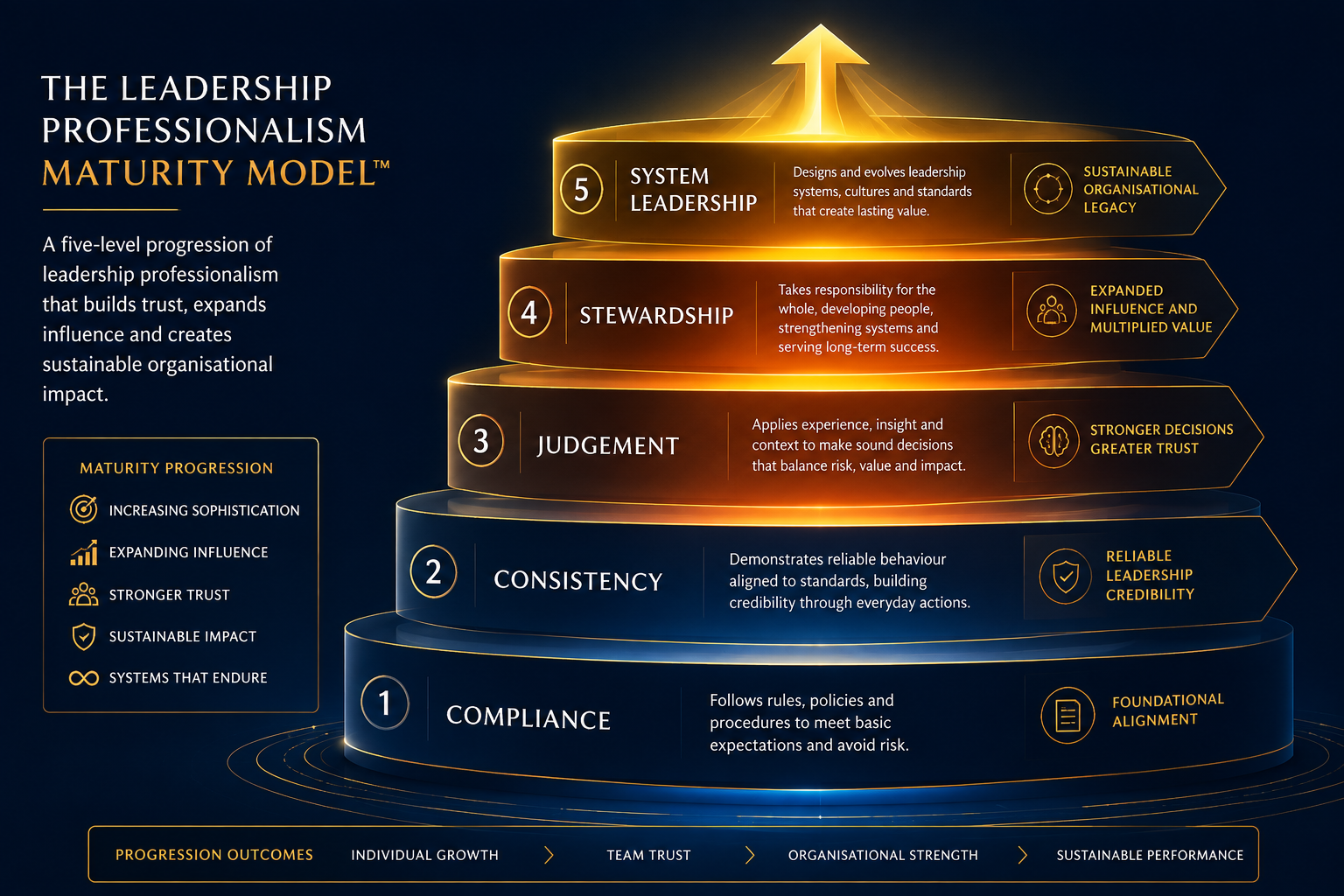
Professionalism is not a fixed trait — it develops. Burn Bright Advisory™ frames this through a five-level maturity model.
Level 1
Compliance
Professionalism is primarily understood through rules. The leader asks: what am I required to do? Compliance is necessary but not sufficient — the challenge begins where the procedure ends.
Level 2
Consistency
The leader begins translating formal expectations into dependable behaviour, asking: do I apply appropriate standards consistently? Professionalism becomes observable rather than merely procedural.
Level 3
Judgement
Leaders become increasingly capable of navigating ambiguity, asking: what is the professionally appropriate response in this situation? Professionalism becomes contextual.
Level 4
Stewardship
Professional maturity expands beyond personal behaviour. The leader asks: what standards am I creating for others through my leadership? Professionalism becomes part of leadership stewardship.
Level 5
System Leadership
Leaders recognise professionalism as organisational infrastructure, embedded into recruitment, induction, development, supervision and succession — part of the Leadership Development System™.
Professionalism Across Sectors
Professionalism has universal foundations — responsibility, respect, competence, integrity, accountability, appropriate boundaries and sound judgement — but its expression changes with context.
Business Growth Intelligence™
Commercial leadership creates tensions between speed and standards. Clear professional standards can increase organisational speed because people spend less time interpreting inconsistent leadership behaviour. Growth magnifies leadership behaviour — an eccentricity at five people can become a cultural liability at fifty.
School Leadership Intelligence™
School leaders operate within a highly visible network of teachers, students, parents, governors and regulators. Professionalism cannot be reduced to kindness or procedural compliance — it requires protecting dignity while exercising legitimate accountability.
Healthcare Leadership Intelligence™
Professional relationships influence whether people challenge decisions. Professional authority means taking responsibility for a decision while also creating conditions in which relevant information can reach the leader.
Public Service Leadership Intelligence™
Public-service leadership requires stewardship of public trust and the capacity to distinguish personal preference from institutional responsibility, even under intense scrutiny.
HR & People Leadership Intelligence™
People leaders occupy a complex position as advisers, representatives, investigators and process guardians simultaneously, requiring sophisticated Boundary Intelligence.
Entrepreneur Performance Intelligence™
Founders often hold overlapping roles — CEO, manager, culture carrier, friend. Professionalism Intelligence™ does not require imitating large corporations; it requires recognising when informal relationships intersect with formal authority.
Case Study: The High Performer Nobody Challenged
Consider a composite example. A senior director has built an exceptional performance record — revenue has increased, clients trust her, executives value her judgement. Yet she interrupts colleagues frequently, junior employees receive abrupt responses when challenging her assumptions, and team members are contacted outside working hours for issues that could wait.
None of these behaviours appears catastrophic in isolation, so senior leaders hesitate to intervene — she is, after all, delivering. Over time, employees prepare excessively before approaching her, difficult information reaches her later, and several capable colleagues leave. Performance remains strong until the organisation encounters a problem she cannot personally solve. The hidden cost becomes visible: current results do not necessarily reveal the health of the system producing them.
Professional Boundaries Are Leadership Infrastructure
Healthy boundaries create clarity: what information is confidential, where decision authority sits, when availability can reasonably be expected, how disagreement will be managed. Boundaries reduce uncertainty.
A manager who prides themselves on permanent accessibility may initially be appreciated, but permanent availability can create unintended consequences — the leader becomes a decision bottleneck, the team develops less independent judgement, and late-night messages become normalised. This is where Leadership Workload™, Leadership Capacity™ and Leadership Sustainability™ intersect with professionalism.
Professionalism in Hybrid and Digital Leadership
Digital communication can remove contextual signals that normally help people interpret intent. A short message from a senior executive may be read as anger; a late-night email may unintentionally establish an availability expectation. Before communicating, useful questions include: does this need to be sent now, is this the appropriate channel, and could my positional authority change how this message is interpreted?
The Risk of Over-Professionalisation
Professionalism has a shadow side. Interpreted badly, “be professional” can mean: do not challenge authority, do not show emotion, hide uncertainty, suppress personality. That is not the model being proposed here.
The Professionalism Intelligence™ Operating System
Burn Bright Advisory™ frames practical professional leadership through a five-part operating system: Pause → Interpret → Choose → Act → Review.
1. Pause
Professional judgement deteriorates when reaction becomes automatic. A brief pause interrupts reflexive behaviour and creates cognitive space that protects professional judgement.
2. Interpret
Consider what standards apply, what responsibilities and authority are relevant, who may be affected, and what assumptions are being made. Interpretation converts reaction into reasoning.
3. Choose
Determine which response best reflects your responsibility — not always the easiest option, but the one that can be responsibly defended.
4. Act
Professionalism becomes visible through behaviour. A fair decision delivered disrespectfully can still damage trust — content and conduct both matter.
5. Review
After significant situations, revisit what worked, what did not, and what evidence should shape the next response. Without review, leaders accumulate experience without accumulating intelligence.
Professionalism Risk Indicators
Professional decline is often visible before a major incident occurs. Leaders and organisations should watch for patterns such as:
- Employees becoming increasingly cautious around a particular leader
- Informal exceptions multiplying
- Confidentiality becoming casual
- Missed commitments becoming normal
- High performers being protected from behavioural accountability
- Employees hesitating to raise mistakes or risks
None of these automatically proves serious leadership dysfunction — but patterns, frequency, impact and context all matter. The objective is early intelligence, not premature judgement.
Leadership Reflection Questions
- What does professionalism mean within my leadership role beyond appearance and etiquette?
- Which of my professional standards remain strongest under pressure, and which become less consistent?
- Would people with less organisational power describe my behaviour in the same way as senior colleagues?
- Where might there be a gap between my intentions and the impact others experience?
- Are my professional boundaries clear enough to create healthy expectations?
- Do I apply standards consistently when high performers, friends or influential stakeholders are involved?
- What happens to my professionalism when my Leadership Workload™ exceeds my Leadership Capacity™?
- What evidence would demonstrate that my Professionalism Intelligence™ is improving?
Frequently Asked Questions
What is professionalism in leadership?
Professionalism in leadership is the consistent exercise of appropriate conduct, judgement, competence, boundaries and accountability when carrying leadership responsibility, including how leaders use authority, communicate, make decisions and respond under pressure.
Why is professionalism important for leaders?
Leadership behaviour carries additional weight because leaders influence expectations, culture and trust. Consistent professional conduct helps employees understand how authority will be exercised and supports organisational credibility.
What is Professionalism Intelligence™?
Professionalism Intelligence™ is a Burn Bright Advisory™ Leadership Intelligence Compass™ domain describing the capacity to recognise, interpret, maintain and model professional standards across complex leadership situations.
Is professionalism the same as ethics?
No. Professionalism concerns standards of appropriate conduct and responsibility, while Ethics Intelligence™ examines questions of right, fairness, competing interests and moral responsibility. Complex leadership decisions often require both.
Can a leader be too professional?
Professionalism can become dysfunctional when interpreted as emotional suppression, excessive formality or unquestioning conformity. Professionalism Intelligence™ preserves humanity, curiosity and appropriate vulnerability while maintaining responsibility and boundaries.
How does professionalism affect organisational culture?
Employees observe what leaders model, tolerate, reward and challenge. Repeated leadership behaviour helps employees determine the organisation’s experienced standards, which may differ from its written values.
How can organisations improve professionalism in leadership?
Professionalism should be integrated across recruitment, induction, leadership assessment, development, reflection, performance management, benchmarking and succession rather than addressed only after misconduct occurs.
Conclusion: Professionalism Is a Performance Capability
Professionalism is easy to underestimate because much of it appears ordinary: keeping a commitment, listening before responding, protecting a confidence, admitting a mistake, treating a junior colleague with the same fundamental respect afforded to a senior executive. None of this appears revolutionary. Yet organisations are built through repeated behaviour, and leadership culture emerges through thousands of moments in which people discover what authority means in practice.
The central question for leaders is not “do I know how a professional leader should behave?” It is: can people depend on me to exercise professional judgement when leadership becomes difficult? That is the standard that matters — and it is a standard worth developing deliberately.
Where Does Your Professionalism Intelligence™ Stand?
Take the free Leadership Burnout Self-Assessment to understand how workload, boundaries and pressure are shaping your professional standards.
Free Leadership Intelligence
Get Weekly Leadership Insights
Join thousands of leaders receiving practical strategies on burnout prevention, workload design, and sustainable performance every week.