Quick Answer
Key Takeaways
- Ethics leadership goes beyond compliance — a decision can be technically permitted and still be ethically weak.
- Ethics Intelligence™ is a developed leadership capability, not a fixed personal trait.
- A six-question decision framework helps leaders examine evidence, stakeholders, principles, power, consequences and defensibility.
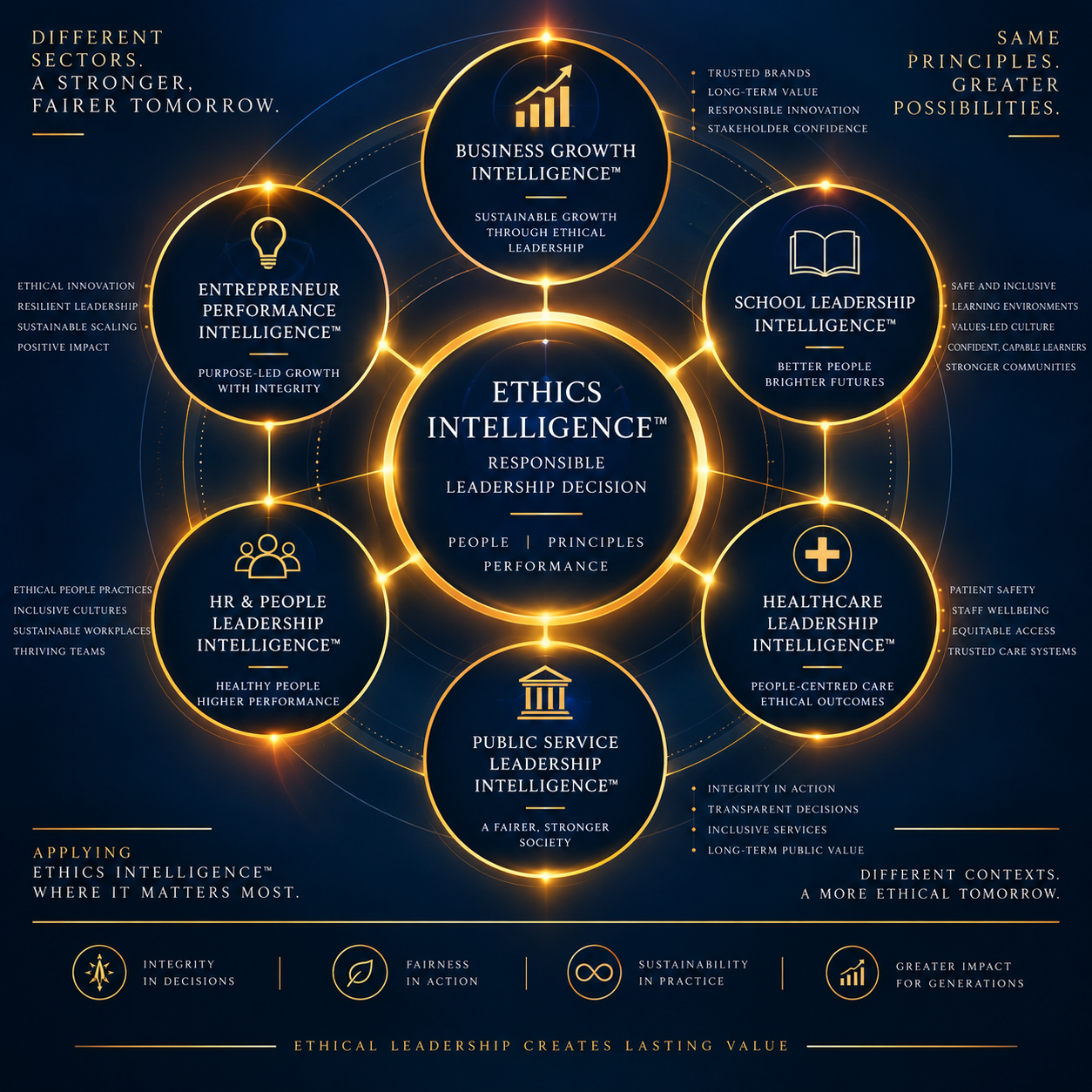
- Ethical leadership expression changes by sector, but its underlying principles remain universal.
- Standards rarely collapse suddenly — they erode through “ethical drift”: small, repeated exceptions.
- Psychological safety and accountability are both required — neither replaces the other.
What Is Ethics Leadership? Understanding Ethics Intelligence™ in Leadership Performance
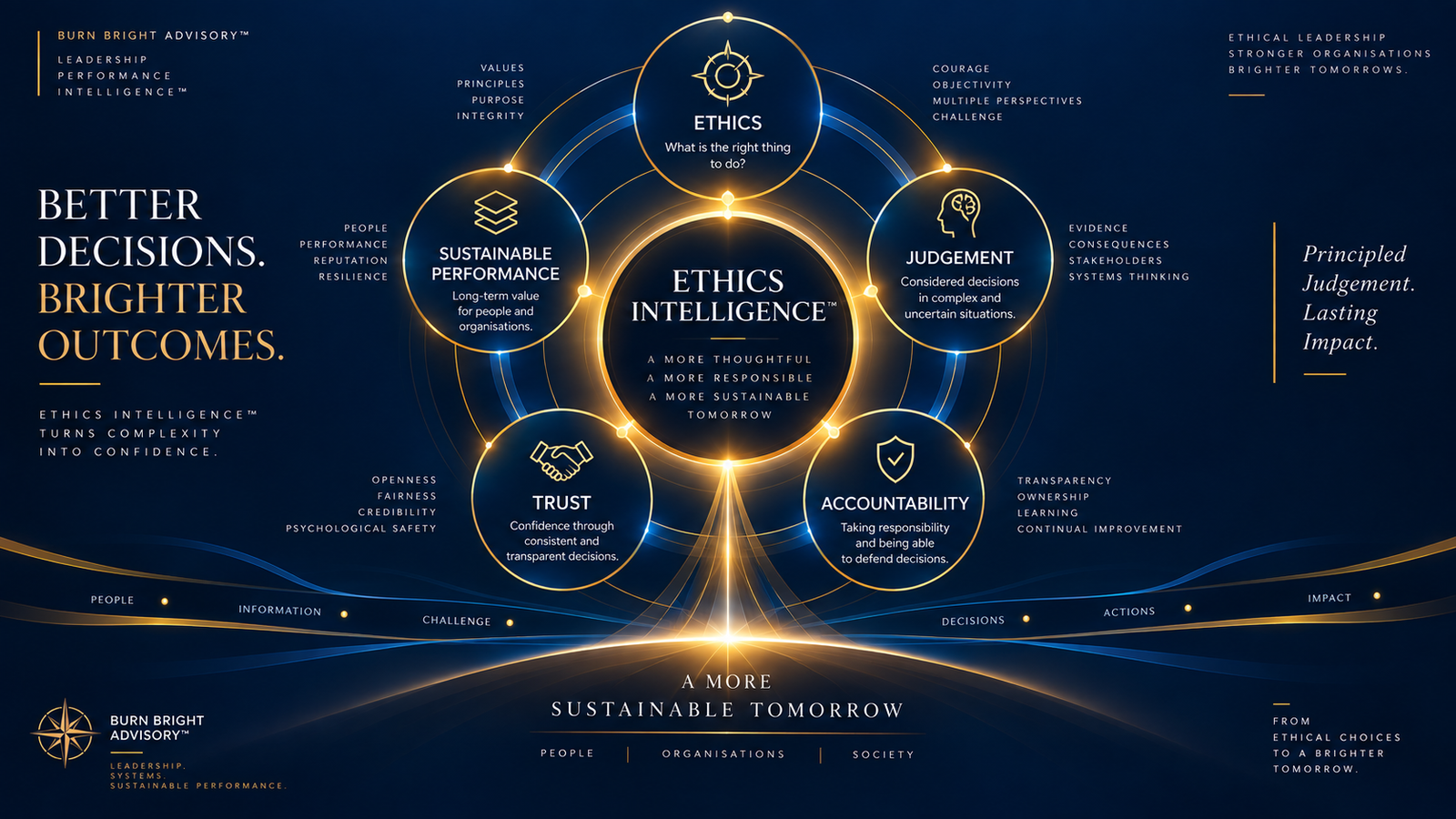
Ethics leadership is the capacity to make, communicate and uphold leadership decisions that are responsible, principled, transparent and defensible. It extends beyond compliance with rules. Effective ethics leadership requires leaders to recognise competing interests, examine consequences, challenge their own assumptions, exercise sound judgement and remain accountable for both what they decide and how they decide it.
Within Burn Bright Advisory’s Leadership Performance Intelligence™ framework, ethics should therefore be understood not simply as a set of values but as a leadership capability that influences trust, decision quality, organisational culture and sustainable performance.
Most Organisations Have Values. Few Have Ethics Intelligence™
Most organisations have values. Many have codes of conduct, governance processes, policies and compliance requirements. Yet none of these automatically produces ethical leadership.
The difficult ethical decisions confronting leaders rarely arrive labelled as ethical dilemmas.
They appear as recruitment decisions, resource allocations, restructuring proposals.
As performance conversations, budget pressures, confidentiality questions.
As technology choices, competing stakeholder demands and apparently reasonable requests to make an exception.
This is why ethics must be treated as a form of leadership intelligence, rather than merely a compliance responsibility. Ethics Intelligence™, within the Leadership Intelligence Compass™, concerns a leader’s capacity to recognise the ethical dimensions of decisions, interrogate competing obligations, anticipate consequences, exercise principled judgement and accept accountability.
That capability matters because technically correct decisions can still produce ethically questionable outcomes. A policy can be followed while someone is treated unfairly. A target can be achieved while trust is damaged. A restructuring can be financially rational while the process used to implement it undermines dignity. A leader can comply with every formal requirement and still create an environment in which people become reluctant to speak, challenge or question.
Ethics Leadership Begins Where the Rulebook Ends
Leadership would be considerably easier if every difficult decision had one clearly correct answer. Most do not.
Consider a senior leader facing a significant budget reduction. The financial requirement may be unavoidable. Something must change. But the ethical challenge begins when the leader considers how the burden should be distributed.
- Should vacant posts remain unfilled?
- Should programmes serving a relatively small population be reduced?
- Should employees absorb greater workloads?
- Should services be redesigned?
- Should investment in future capability be postponed?
- Should senior leadership costs be protected because those roles are considered strategically important?
Each option can potentially be justified. Each also creates consequences for somebody. The ethical question is therefore not simply whether the organisation should reduce expenditure. It concerns whose interests are prioritised, whose risks increase, who participates in the decision, what evidence is considered, what alternatives are explored and how transparently the eventual decision is explained.
This is the territory of ethics leadership. It is also why ethical leadership cannot be reduced to personal character. Integrity matters. Honesty matters. Fairness matters. But contemporary leaders require something more sophisticated: the capacity to translate principles into judgement under conditions of ambiguity, pressure and competing legitimate interests. That is an intelligence.
Featured Snippet
From Ethical Values to Ethics Intelligence™
Traditional discussions of ethical leadership frequently concentrate on desirable characteristics: honesty, integrity, fairness, responsibility and trustworthiness. These remain important. The limitation is that possessing a value does not automatically tell a leader what to do when two legitimate values conflict.
A school leader may value both inclusion and accountability. A healthcare leader may value patient access while also having responsibility for staff workload and clinical safety. A business leader may value loyalty to employees while carrying fiduciary responsibilities and confronting deteriorating financial performance. A public-service leader may value transparency while simultaneously holding information that cannot responsibly be disclosed.
The challenge is not necessarily that one value is right and another wrong. The challenge is deciding how competing responsibilities should be weighed. This is where Ethics Intelligence™ becomes important.
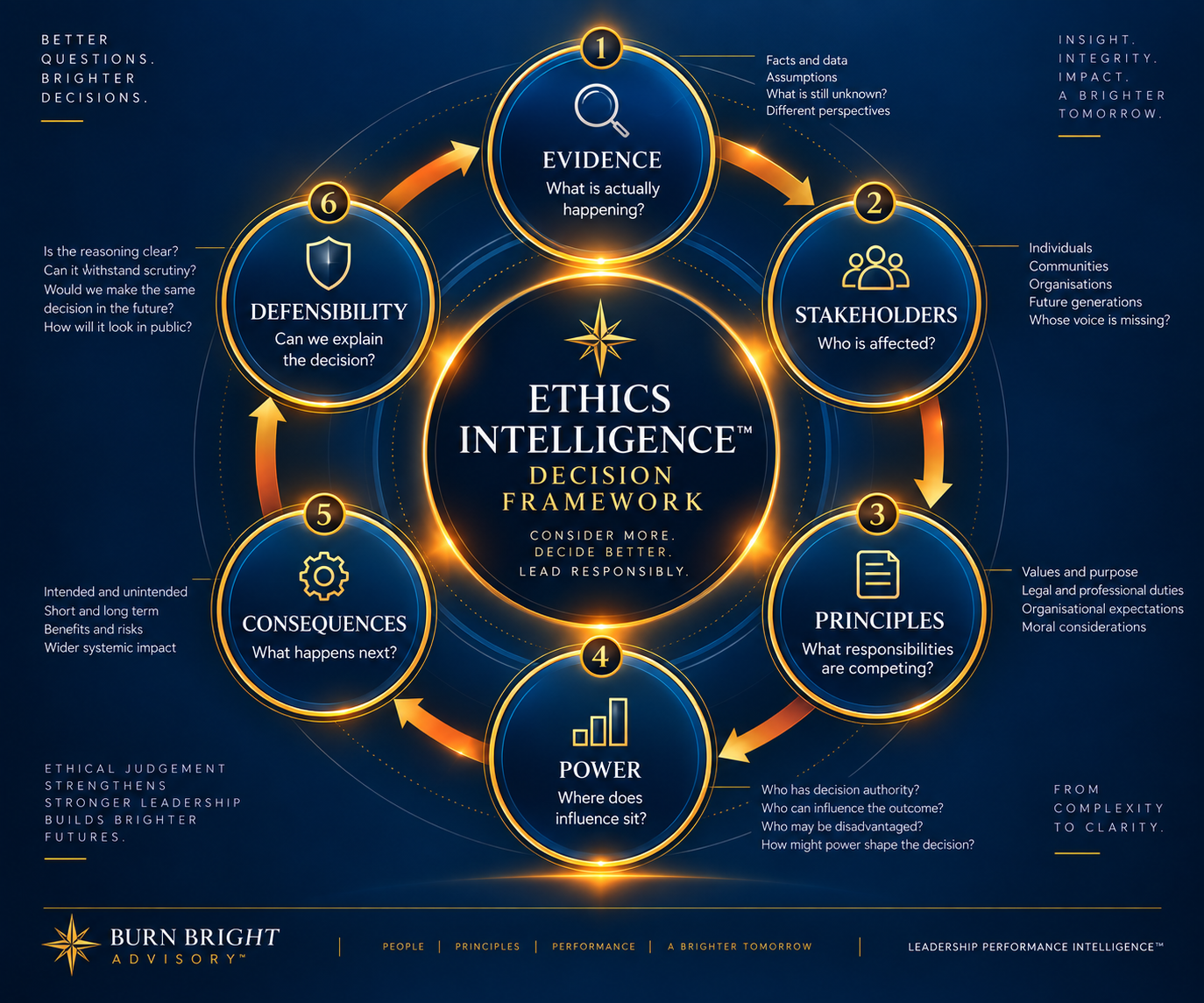
Within the Burn Bright Advisory™ approach, Ethics Intelligence™ can be understood as the developed leadership capacity to:
- Recognise the ethical dimension of apparently operational decisions
- Identify the people and groups affected
- Distinguish legal permission from ethical justification
- Surface competing principles and obligations
- Examine power, voice and vulnerability
- Test assumptions and potential bias
- Consider immediate and longer-term consequences
- Explain the reasoning behind a decision
- Invite legitimate challenge
- Accept accountability for the outcome
This shifts ethics from something leaders possess to something leaders must continually practise.
Why Ethics Is a Leadership Performance Issue
Ethics is sometimes treated as separate from performance. That separation is misleading. Leadership decisions determine how resources are allocated, whose knowledge is heard, which behaviours are rewarded, how mistakes are handled and what happens when performance pressures collide with organisational values.
A leader who repeatedly creates ambiguity about acceptable behaviour eventually creates operational consequences. A leader who tolerates high performance achieved through destructive conduct communicates that results outrank standards. A leader who applies rules differently depending on status weakens confidence in organisational fairness. A leader who discourages uncomfortable information may receive reassuring reports while becoming progressively less informed about reality.
These are ethical failures, but they are also leadership intelligence failures. They affect the quality of information available to leaders, the willingness of people to challenge assumptions, the reliability of organisational decision-making and ultimately the sustainability of performance.
This relationship is important within Leadership Performance Intelligence™ because performance cannot be assessed only through short-term output. A decision can improve this quarter’s numbers while reducing the organisation’s future capacity. A manager can deliver targets while exhausting a team. A school can improve a metric while narrowing attention away from less visible student needs.
The Compliance Trap
Compliance remains necessary. Leaders operate within laws, professional standards, regulations, governance frameworks and organisational policies for good reasons. Those structures establish boundaries and protect organisations, employees, customers, patients, students and communities.
But compliance establishes a minimum threshold. Leadership often operates above that threshold. A decision may be legal but unfair. A process may satisfy policy while excluding important voices. A manager may technically follow a performance-management procedure while using it in a manner that intimidates an employee.
The compliance question is: “What must we do?” The ethical leadership question is: “What should responsible leadership require of us?” The difference between those questions is where leadership judgement becomes visible — and it is often where leadership trust is either built or lost.
How Ethical Judgement Works When Values Conflict
The most revealing ethical decisions are rarely choices between an obviously good option and an obviously bad one. They are choices between competing responsibilities.
A leader may need to protect confidentiality while recognising that greater transparency would increase trust. A manager may want to support an employee experiencing difficulty while remaining fair to colleagues carrying additional workload. A healthcare leader may want to expand access to services while recognising that existing staff are already approaching unsustainable capacity.
These are not simply operational problems. They are tests of Ethics Intelligence™. The ethical quality of leadership becomes visible when there is no comfortable solution: when evidence is incomplete, resources are constrained, stakeholders disagree and every available option carries consequences.
This matters because leadership authority creates asymmetry. Leaders frequently have greater access to information, greater control over resources and greater ability to determine what happens next. Their decisions may affect people who have considerably less influence over the outcome. Ethical leadership therefore requires more than asking what the leader personally believes is right. It requires disciplined examination of power, evidence, consequences, voice and accountability.
The Burn Bright Ethical Leadership Decision Framework
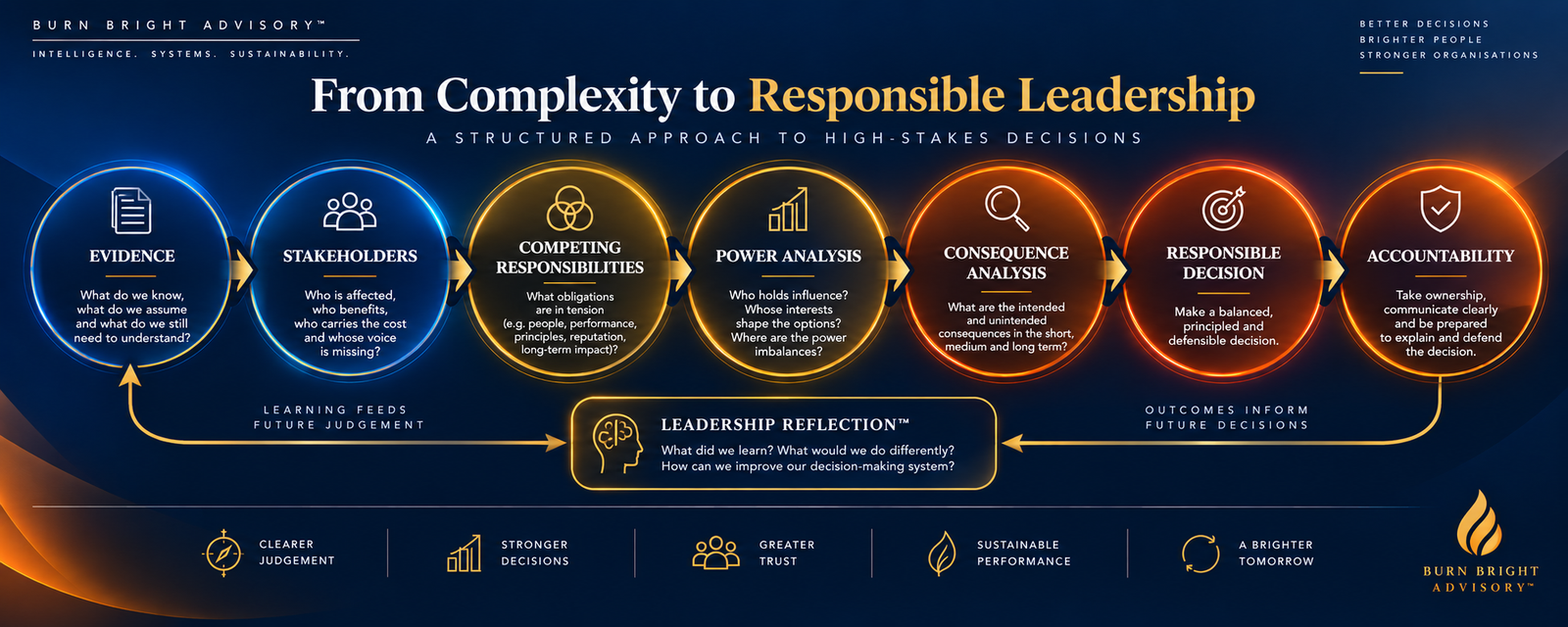
Within Leadership Performance Intelligence™, ethical judgement can be strengthened through a structured decision process. The purpose of a framework is not to automate morality — ethical leadership cannot be reduced to a checklist that produces a guaranteed correct answer. Its purpose is to slow down assumptions sufficiently for leaders to examine what might otherwise remain invisible.
Question 1 What is actually happening?
Begin with evidence rather than interpretation. What do we know? What are we assuming? What information is incomplete? Whose account of the situation has shaped our understanding? Ethically intelligent leadership separates what has been observed from what has been concluded.
Question 2 Who is affected?
Who benefits from this decision? Who carries the cost? Who faces increased risk? Who has influence over the decision, and who has little or none? Stakeholder analysis becomes particularly important when power is unevenly distributed — senior executives may experience a restructuring as strategy, while employees experience it as uncertainty about income, identity and security.
Question 3 Which principles are in tension?
Many difficult decisions contain more than one legitimate principle: fairness versus flexibility, transparency versus confidentiality, performance versus wellbeing, individual interests versus collective interests, speed versus participation. Instead of asking “which side is right?”, leaders can ask which legitimate responsibilities are competing and how they should be weighed.
Question 4 Where is power operating?
Leaders decide promotions, influence workloads, control information and determine who enters important conversations. Formal authority is not inherently problematic, but the ethical question concerns how it is exercised. A leader should ask: would this person respond differently if I did not control something important to them?
Question 5 What are the consequences — including the second-order ones?
Ethical decision-making requires leaders to look beyond immediate outcomes. Every repeated leadership choice teaches the organisation something: exceptions become precedents, silence becomes permission, behaviour that is rewarded becomes behaviour that is reproduced.
Question 6 Can we explain and defend the decision?
Not every stakeholder will agree with every decision, and ethical leadership does not mean universal approval. The test is whether the reasoning — the evidence considered, who was consulted, which alternatives were examined, why the final option was selected — can withstand scrutiny.
Ethical Leadership Across Different Sectors
The principles of Ethics Intelligence™ are universal, but their expression changes according to context. This is why Leadership Performance Intelligence™ must connect universal leadership capabilities with sector-specific realities.
Business Growth Intelligence™
A financially rational decision — such as reducing headcount while protecting a growth strategy — can become ethically and operationally weak if implementation destroys trust or creates unsustainable capacity demands. Ethics becomes part of Business Growth Intelligence™ because sustainable growth depends on how leadership decisions affect organisational capability, not simply where capital is allocated.
School Leadership Intelligence™
When an experienced teacher’s performance deteriorates, students deserve consistently strong teaching, the teacher deserves a fair process, and colleagues should not indefinitely compensate. An ethically intelligent leader pursues accountability with procedural fairness, professional dignity and appropriate support.
Healthcare Leadership Intelligence™
A compelling numerical case for increasing patient throughput may not reveal whether staff are reluctant to report concerns, whether the model depends on discretionary effort, or what happens to clinical judgement as fatigue increases. Here Ethics Intelligence™ connects directly with Leadership Sustainability™ and Leadership Capacity™.
Public Service Leadership Intelligence™
Public-service leaders operate between political priorities, statutory duties, professional advice and public expectations. Ethics Intelligence™ helps them distinguish legitimate authority from allowing short-term pressure to override responsible decision-making, defensible from the perspective of the public interest.
HR & People Leadership Intelligence™
Processes can appear objective while still being influenced by bias, unequal access to information or inconsistent application. Ethical consistency does not mean treating everybody identically — it means being able to explain why comparable cases were treated similarly, or why relevant differences justified a different response.
Entrepreneur Performance Intelligence™
When formal governance is still developing and one founder holds concentrated authority, deliberate mechanisms for challenge, transparency and accountability matter before growth magnifies weaknesses that were manageable when the organisation was small.
Ethics Intelligence™ and Leadership Sustainability™
Ethical leadership also has an internal dimension. Leaders can behave unethically towards themselves and their organisations by repeatedly accepting expectations that cannot be sustained. This is particularly important within Burn Bright Advisory’s wider work on leadership workload and burnout. Unsustainable leadership roles can emerge when organisations continually expand responsibilities while relying on individual leaders to absorb the difference through longer hours and personal sacrifice.
Is it responsible to build performance expectations around chronic overcapacity? Is it ethical to celebrate leadership sacrifice while ignoring the organisational design producing it? These questions connect Ethics Intelligence™ with Leadership Sustainability™, which asks whether effective performance can continue without progressively damaging the human capacity on which that performance depends.
From Ethical Decisions to Ethical Leadership Cultures
Ethical leadership is often framed as an individual responsibility. That is necessary, but incomplete. A leader can demonstrate integrity personally while presiding over a system that discourages challenge, rewards damaging behaviour or makes responsible decisions increasingly difficult. Organisations do not develop ethical cultures through statements of values alone — they develop them through repeated signals about what is rewarded, challenged, ignored, and what people believe they can safely say.
The Ethical Culture Gap
An ethical culture gap emerges when there is distance between an organisation’s stated principles and people’s lived experience.
| The Organisation Says | Employees Actually Experience |
|---|---|
| “We encourage people to speak up.” | Speaking up is acceptable until you challenge somebody powerful. |
| “We care about wellbeing.” | Workload concerns are treated as personal resilience problems. |
| “We value collaboration.” | Individual performance is rewarded even when it damages collective capability. |
| “We learn from mistakes.” | People become defensive because mistakes are remembered during performance discussions. |
The larger this gap becomes, the less credible formal leadership language becomes. Employees learn to interpret organisational behaviour rather than organisational messaging. This is particularly important in small teams, where toxic leadership can become highly concentrated, as Burn Bright’s existing work on toxic leadership identifies.
Ethical Drift: How Standards Weaken Gradually
Serious ethical failures are sometimes imagined as dramatic moments in which somebody consciously decides to abandon their principles. Reality can be more subtle. A deadline is unusually demanding, so a normal process is shortened — nothing goes wrong, and the exception is repeated. A performance target is missed, so a manager applies slightly more pressure than usual — results improve, and the behaviour becomes normal.
Ethics Intelligence™ therefore requires leaders to monitor not only obvious misconduct but also patterns of normalisation. A useful reflective question is: what are we accepting today that would have concerned us twelve months ago?
Psychological Safety Is an Ethical Infrastructure
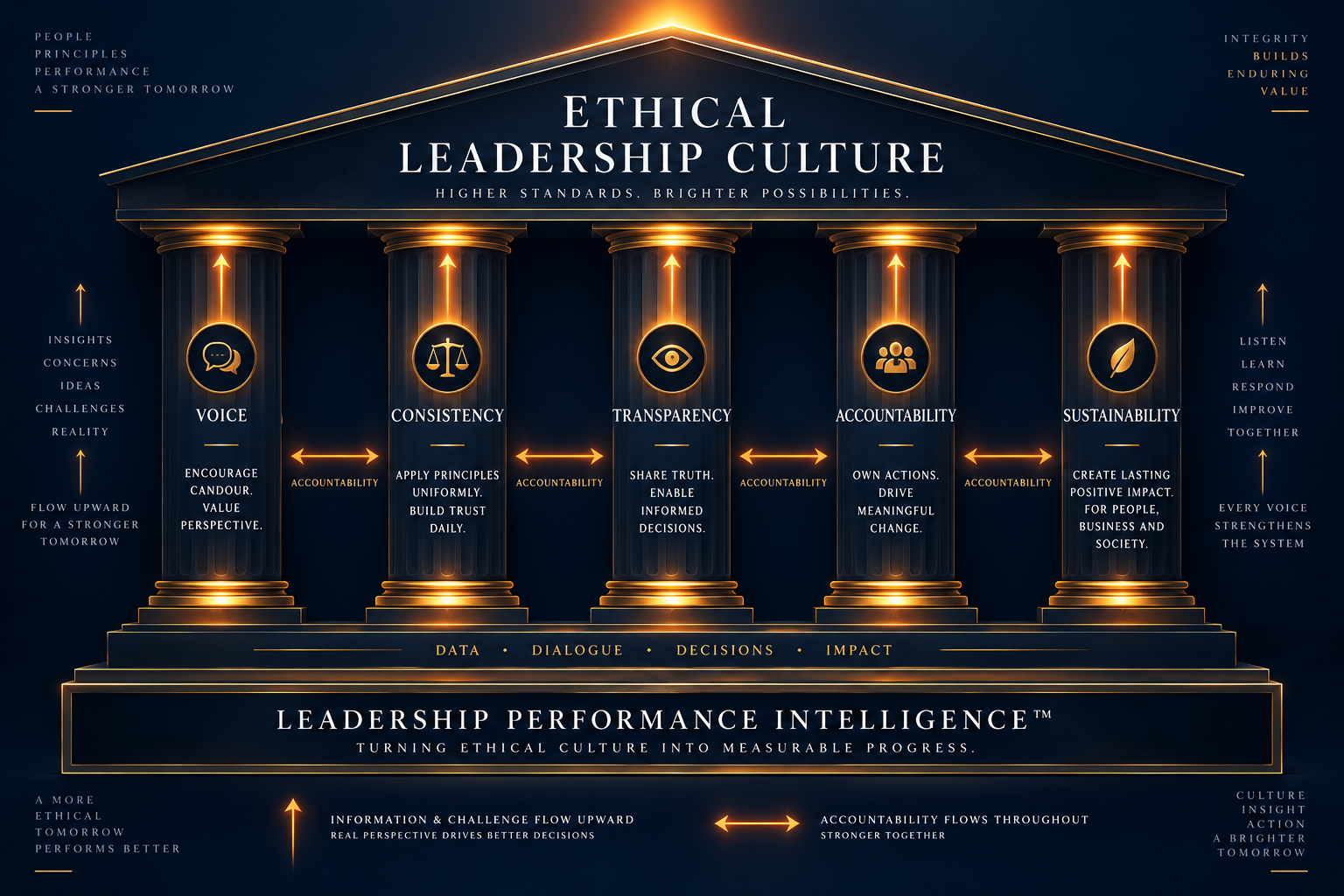
Ethical leadership depends upon information. This makes psychological safety more than a team-development concept — it is part of an organisation’s ethical infrastructure. People need sufficient confidence to say “I think we have missed something,” “I am concerned about the consequences,” or “I made a mistake.” These statements are organisational intelligence. Suppress them and leadership becomes less informed.
The more authority a leader holds, the less they can assume that silence means consent. As leadership authority increases, leaders may become more confident that people will tell them if something is wrong — yet increasing authority can make honest challenge more difficult. The ethically intelligent leader does not merely permit challenge; they design for it, by inviting alternative interpretations before expressing their own view, explicitly asking what risks have been overlooked, and rewarding people who identify legitimate problems.
Accountability: The Missing Half of Ethical Leadership
Ethical cultures require psychological safety. They also require accountability. Psychological safety does not mean an absence of standards, and understanding someone’s circumstances does not automatically remove responsibility. Ethical leadership requires leaders to hold two principles simultaneously: people should be treated with dignity, and people should remain accountable for their decisions and behaviour.
When damaging behaviour is repeatedly excused, the consequences are transferred to somebody else — colleagues compensate, customers experience poorer service, other employees learn that standards are negotiable. The ethical question is not whether accountability should exist, but how it can be exercised fairly, proportionately, consistently and with appropriate regard for context.
When High Performance Becomes an Ethical Blind Spot
Imagine two leaders. Leader A consistently exceeds targets but creates fear, turnover and dependency. Leader B delivers strong — but slightly lower — results while developing capability, encouraging challenge and creating a sustainable team. Traditional performance systems may favour Leader A because the most visible outputs are easier to measure.
Leadership Performance Intelligence™ requires a wider assessment: what happened to team capacity and trust, how much discretionary effort was consumed, and what happens if the leader leaves? This is why Leadership Benchmarking™ needs to extend beyond output measures — otherwise, toxic leadership can be misclassified as high performance.
A Practical Ethical Culture Diagnostic
Leaders seeking to understand their ethical culture can begin with five areas. These questions are deliberately behavioural — asking whether an organisation “has strong values” produces limited intelligence; asking what happens in specific moments reveals culture.
| Dimension | Leadership Question |
|---|---|
| Voice | Can people challenge decisions without unreasonable interpersonal or career risk? |
| Consistency | Are standards applied regardless of status or performance? |
| Transparency | Can leaders explain how important decisions are reached? |
| Accountability | Are damaging behaviours addressed rather than rationalised? |
| Sustainability | Are results being achieved without repeatedly transferring unreasonable costs to people or future capacity? |
Turning Ethics Intelligence™ Into Leadership Practice
Ethical leadership becomes meaningful when it changes what leaders actually do. The objective is not to create leaders who hesitate indefinitely because every decision contains competing interests, nor to create an additional layer of governance around every operational choice. The objective is to develop leaders capable of recognising when a decision carries significant ethical implications — and equipped to examine those implications intelligently before acting.
Action Steps: Building Ethics Intelligence™ Into Leadership Practice
1. Introduce an ethical pause for consequential decisions
Before approving a restructuring, significant performance action, resource reallocation, policy exception or technology deployment, ask: what is the ethical dimension of this decision?
2. Separate facts from interpretations
Write down what is objectively known, then separately record what has been inferred. Leaders frequently discover that certain conclusions depend on assumptions that have never been tested.
3. Map stakeholder consequences
Identify who benefits, who carries cost, who assumes risk and who has little influence over the decision. Do not restrict the exercise to the most visible stakeholders.
4. Test for power asymmetry
Ask whether this conversation, consultation or decision would look different if the people involved had equal organisational power. Where the answer is yes, strengthen voice and challenge.
5. Examine consistency
Compare the proposed response with previous decisions. Would the same standard apply to a senior executive and a junior employee? If not, investigate why.
6. Examine leadership capacity
Ask whether the proposed solution depends on people repeatedly absorbing additional workload, emotional labour or responsibility. A plan that only succeeds through chronic discretionary effort may not be sustainable.
7. Invite constructive dissent
Before finalising an important decision, ask somebody credible to make the strongest case against it — to expose blind spots before they become consequences.
8. Record the reasoning
Document the evidence considered, stakeholders affected, alternatives explored, ethical tensions identified, expected consequences and the rationale for the final decision.
9. Review outcomes, not merely intentions
Return to consequential decisions after implementation. Which assumptions proved accurate? Which consequences were missed? Ethical leadership becomes more intelligent when decisions generate learning rather than simply closure.
Leadership Reflection Questions
- Where are we currently treating compliance as sufficient evidence of ethical leadership?
- Which organisational decisions create the greatest ethical risk?
- Who has the least voice in those decisions?
- Are our behavioural expectations genuinely consistent across levels of seniority?
- Which high performers receive exceptions that others would not receive?
- What has become normal in our organisation that might deserve renewed scrutiny?
- When did somebody last openly challenge a senior leadership decision, and how did leadership respond?
- Where are performance expectations dependent upon unsustainable discretionary effort?
- What information are leaders least likely to hear?
- How do we know whether employees experience our stated values in practice?
Conclusion: Ethics Is Part of How Leadership Performs
Ethics leadership should not be confined to compliance training, organisational values or moments of misconduct. It belongs at the centre of leadership performance. Every significant leadership decision contains assumptions about responsibility: who matters, whose voice counts, what level of risk is acceptable, what behaviour is tolerated.
Ethics Intelligence™ makes that process visible. It enables leaders to move beyond asking whether an action is permitted and towards examining whether it is responsible, fair, explainable and sustainable. Rules remain essential. Governance remains essential. Compliance remains essential. But none can replace judgement.
FAQ: Ethics Leadership and Ethics Intelligence™
What is ethics leadership?
Ethics leadership is the practice of exercising leadership authority through responsible, principled and defensible judgement. It involves considering evidence, stakeholders, competing obligations, power relationships and consequences rather than relying solely on compliance or personal intention.
What is Ethics Intelligence™?
Ethics Intelligence™ is a domain within Burn Bright Advisory’s Leadership Intelligence Compass™. It describes a leader’s capacity to recognise ethical dimensions in leadership situations, evaluate competing responsibilities, examine consequences and power, make responsible decisions and remain accountable for those decisions.
What is the difference between ethical leadership and compliance?
Compliance asks whether an action conforms to laws, regulations, policies or required standards. Ethical leadership goes further by asking whether the action is responsible, fair, proportionate, transparent and defensible. Something can therefore be technically compliant while still requiring ethical scrutiny.
Why is ethics important in leadership?
Leaders control resources, influence opportunities, establish behavioural standards and make decisions affecting other people. Ethical judgement affects trust, organisational culture, psychological safety, accountability and the sustainability of performance.
Can ethical leadership improve organisational performance?
Ethical leadership can strengthen conditions important to sustainable performance, including trust, accountability, challenge, decision quality and consistency. Ethics Intelligence™ does not argue that every ethical decision produces the easiest or most profitable immediate outcome — responsible leadership sometimes requires accepting short-term cost to protect longer-term capability and legitimacy.
How can leaders improve their ethical decision-making?
Leaders can strengthen ethical decision-making by examining facts separately from assumptions, mapping stakeholders, identifying competing principles, analysing power relationships, considering second-order consequences, inviting challenge and reviewing outcomes after implementation.
What is ethical drift?
Ethical drift is the gradual normalisation of behaviours or decisions that would previously have caused concern. Small exceptions can become repeated practices, and repeated practices can become accepted norms. Leaders should monitor changes in what their organisations have gradually learned to tolerate.
How does Ethics Intelligence™ connect with Leadership Sustainability™?
Ethics Intelligence™ examines whether leadership decisions responsibly account for their consequences. Leadership Sustainability™ examines whether leadership performance can continue without progressively exhausting the people and capacity required to produce it. Together, they help leaders distinguish short-term output from sustainable leadership performance.
How Strong Is Your Ethics Intelligence™?
Discover how your leadership decisions hold up under pressure, ambiguity and competing stakeholder demands.
Free Leadership Intelligence
Get Weekly Leadership Insights
Join thousands of leaders receiving practical strategies on burnout prevention, workload design, and sustainable performance every week.