Quick Answer
Key Takeaways
- Delegation is a workload architecture decision, not simply a time-management technique.
- RACI clarifies who is Responsible, Accountable, Consulted and Informed for important work.
- Leaders should delegate authority with responsibility rather than transferring tasks while retaining every decision.
- Poor delegation creates dependency; structured delegation builds organisational capability.
- The objective is not to do less for its own sake — it is to ensure leadership capacity is being used where it creates the greatest value.
Delegation Frameworks for Leaders: A Practical Guide
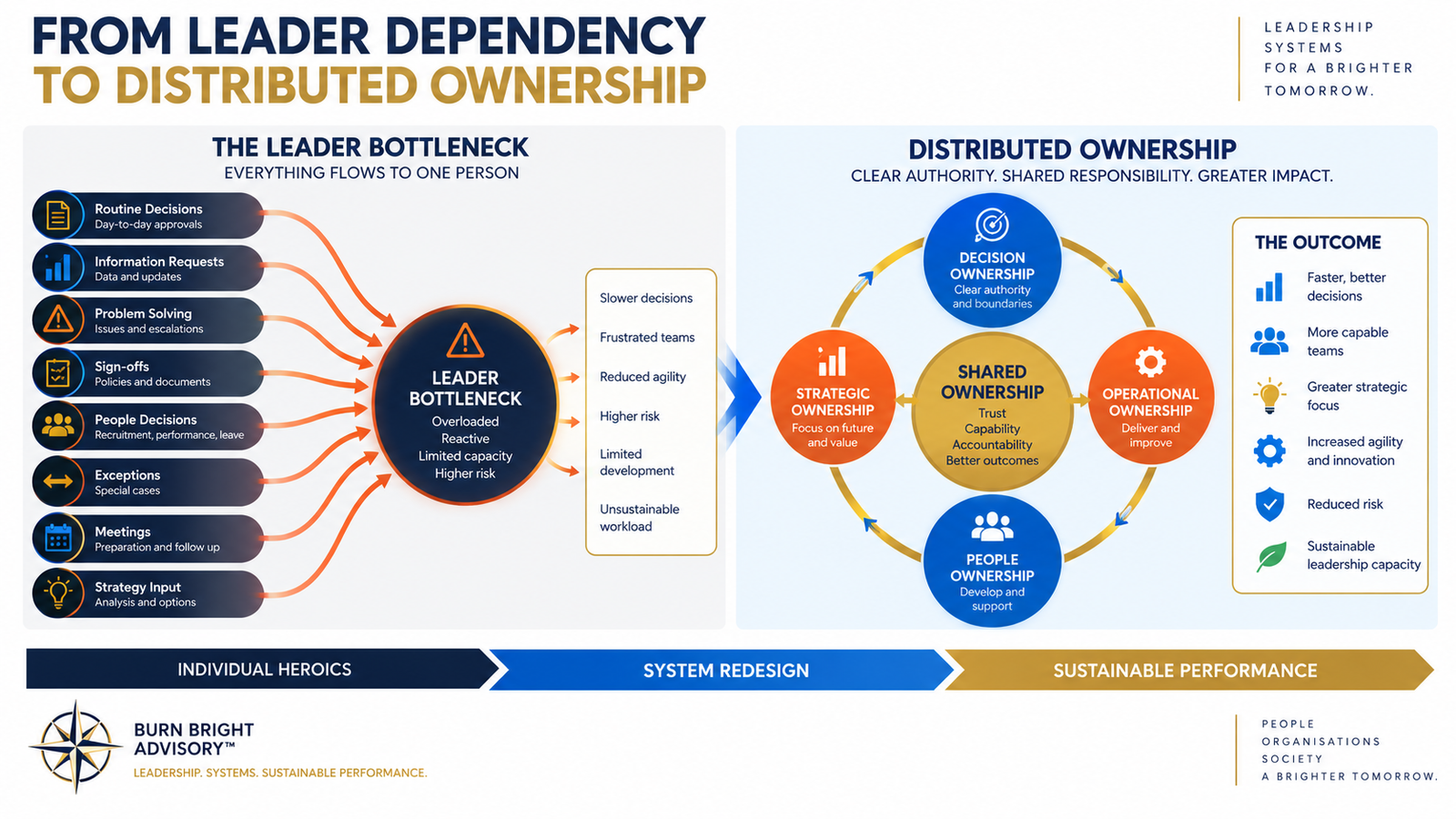
Delegation frameworks for leaders solve a problem that many organisations mistakenly treat as a personal productivity issue: too much work remains concentrated around too few people.
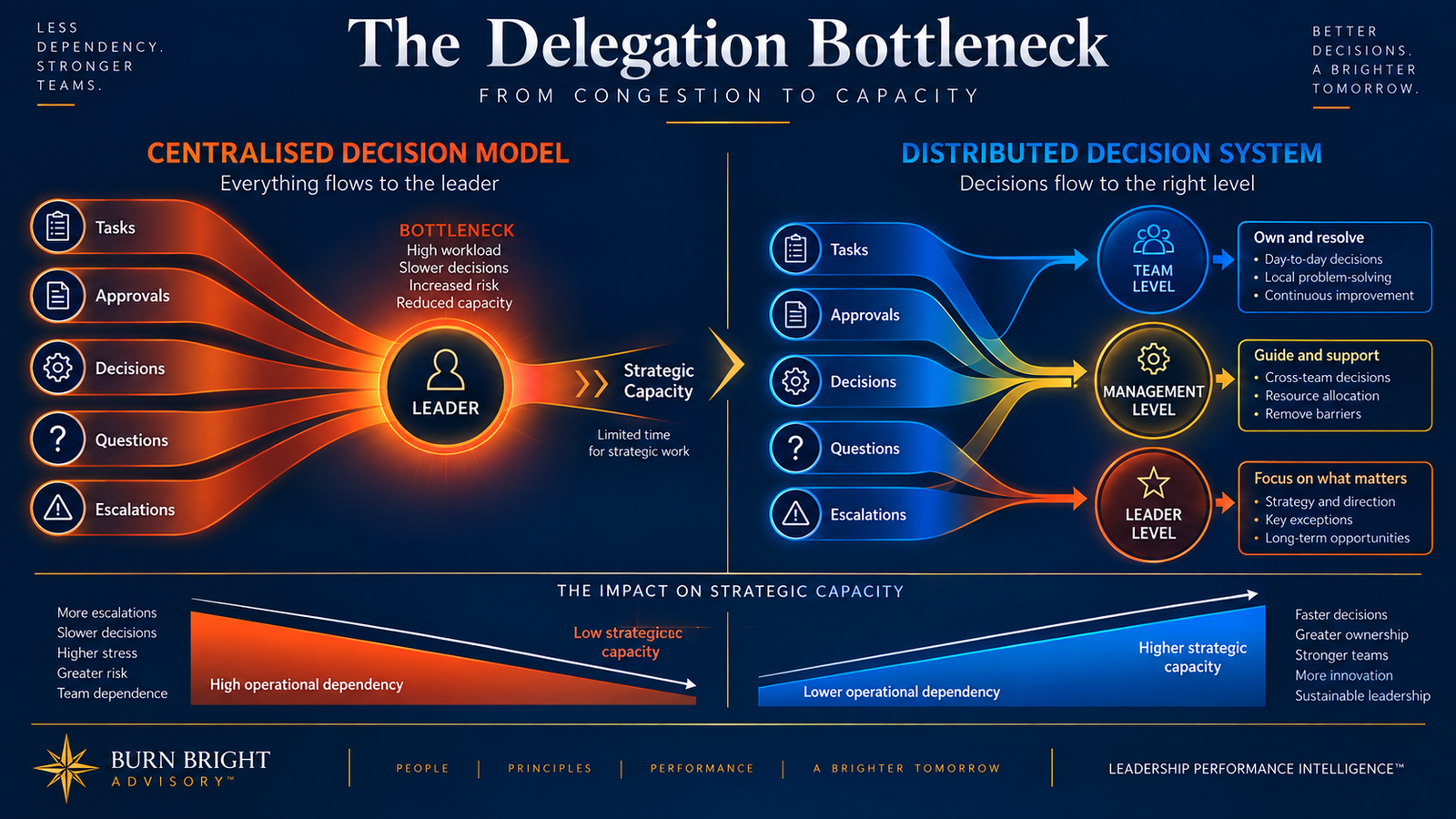
A senior leader can have an excellent team and still become the operational bottleneck. Every decision comes upwards. Every document needs approval. Problems return to the leader for resolution. Team members wait for permission. Strategic work is pushed into evenings because the working day has been consumed by decisions other people could have made.
The predictable response is to tell the leader to delegate more. That advice is incomplete.
Delegation without architecture often becomes little more than task distribution.
The leader hands over the activity but retains the thinking, approval, risk and accountability surrounding it.
The calendar becomes slightly lighter.
The cognitive load does not.
That distinction matters because burnout is not simply a question of how many hours someone works. The World Health Organization defines burnout as an occupational phenomenon resulting from chronic workplace stress that has not been successfully managed, characterised by exhaustion, increased mental distance or cynicism towards work, and reduced professional efficacy. For leaders, poor delegation can become part of that structural problem.
This article explains how to replace informal delegation with a clear system for distributing work, decisions and accountability. The goal is not loss of control. It is better organisational design. To understand the shift, start with the architecture rather than the individual leader.
Featured Snippet
Why Do Leaders Need a Delegation Framework?
Delegation problems rarely begin with an unwillingness to delegate. They usually begin with ambiguity. A leader gives a team member responsibility for a project but continues making the important decisions. Another person is told they “own” an initiative, yet three senior managers still expect to approve the outcome. Someone else receives a task without knowing what success looks like, what resources are available or when they should escalate a problem.
Technically, work has been delegated. Structurally, it has not.
This distinction is increasingly significant because managers themselves are under substantial pressure. Deloitte reported in its 2025 Global Human Capital Trends research that managers spend nearly 40% of their time solving immediate problems and completing administrative tasks, while only 13% is spent developing their people. It also found that 36% of managers felt insufficiently prepared to manage people and 40% reported declining mental health after moving into management.
Gallup’s 2026 State of the Global Workplace findings add another warning: global manager engagement fell from 31% in 2022 to 22% in 2025.
These numbers point towards something more substantial than a productivity problem. We have leaders occupying roles designed to create direction, judgement and organisational capability while spending significant amounts of capacity absorbing operational work. That is a system-design problem.
The Delegation Paradox
Many overloaded leaders know they need to delegate. But overload itself makes delegation harder. When you are under pressure, doing something yourself can feel faster than explaining it. Correcting a document can appear easier than coaching the person who produced it. Making another decision takes five minutes; building someone else’s decision-making capability takes longer.
So the leader repeatedly chooses the quickest short-term option. “I’ll do it.” Each individual decision appears rational. Collectively, they create dependency. The leader gradually becomes the organisation’s unofficial problem-solving department.
McKinsey has identified the same problem in organisational decision-making: micromanagement, unclear accountability and fear of losing control can cause delegated decisions to move straight back up the hierarchy.
What Is the RACI Delegation Framework for Leaders?
One of the most useful delegation frameworks for leaders is RACI. It creates clarity around four different relationships to work:
- Responsible — the person doing the work.
- Accountable — the person ultimately answerable for the outcome.
- Consulted — people whose expertise or input is required.
- Informed — people who need visibility but do not need to participate in the decision.
The distinction sounds simple. Its implications are significant. Many overloaded leaders operate as Responsible, Accountable, Consulted and Informed simultaneously — they initiate the work, review it, make the decisions, solve the problems and monitor the outcome. That creates a predictable bottleneck.
The Burn Bright approach uses RACI differently. The objective is not simply to populate a project-management table. It is to examine where the leader is unnecessarily occupying the Responsible position and determine whether responsibility can move elsewhere. Consider a senior leader responsible for producing a monthly performance report:
| Leader-Centred Approach | RACI-Based Approach |
|---|---|
| Leader personally collects performance data | Team member owns data collection (Responsible) |
| Leader chases and validates every department’s figures | Department heads validate their own figures (Responsible) |
| Leader produces the first analysis | Analyst produces the first analysis (Responsible) |
| Leader personally challenges every conclusion | Relevant experts challenge conclusions (Consulted) |
| Leader approves every detail | Leader approves the strategic interpretation (Accountable) |
| Leader builds the final presentation | Team member prepares the final presentation (Responsible) |
| Wider team waits for the leader to circulate results | Wider team receives the final outcome (Informed) |
The leader has not abandoned accountability. They have stopped confusing accountability with personal execution. When leaders believe being accountable means personally touching every part of the work, delegation becomes almost impossible. The result is not greater control — it is organisational dependency.
Why Does Delegation Fail Even When Leaders Hand Work Over?
Delegation often fails because leaders transfer the task without transferring enough of the surrounding authority. Imagine telling a manager: “You now own the client relationship.” It sounds like delegation. But then the conditions appear — they cannot change the delivery schedule without approval, cannot resolve a complaint above a certain threshold, cannot negotiate resources, cannot adjust priorities. Every important decision still travels upwards.
The manager owns the workload. The leader owns the authority. That is not effective delegation. It is responsibility without control — and it can increase frustration on both sides. The team member feels accountable for an outcome they cannot fully influence. The leader wonders why problems continue returning to them.
This is why delegation should answer four questions before work moves:
- What outcome is being delegated?
- Who owns the work?
- What decisions can they make independently?
- When does the issue genuinely need to return to the leader?
Burn Bright identifies scope creep, meeting culture, communication chaos, decision overload and perfectionism culture as five root causes of burnout. Poor delegation can intensify several of them at once. When ownership is unclear, work moves upwards, decisions accumulate and communication increases simply to establish who is supposed to do what. The solution is not to tell overwhelmed leaders to “let go.” The solution is structural clarity.
How Can Leaders Decide What to Delegate?
The wrong starting question is “what don’t I want to do?” Delegation is not a dumping exercise. A better question is: “where does my involvement genuinely add leadership value?”
Start by examining recurring work rather than exceptional work. Look at the previous two weeks of your calendar, task list and inbox, and for each recurring responsibility ask whether it requires your authority, whether it requires your expertise (being able to do something does not mean you should continue doing it), whether someone else could perform it to an acceptable standard rather than exactly as you would, and whether the responsibility could develop someone else.
That final question changes the economics of delegation — you are not merely removing work from yourself, you are converting operational work into organisational capability.
The Burn Bright Delegation Test
For any recurring responsibility, assess it against four categories:
Category Keep
The work requires your unique authority, judgement or accountability.
Category Delegate
Another person can own the work and make the necessary decisions.
Category Develop
Another person could own it with coaching, boundaries or temporary oversight.
Category Eliminate
The work no longer creates sufficient value to justify anybody doing it.
Not everything needs a new owner. Some work needs to disappear. If a report has not informed a meaningful decision for twelve months, the question is not who should produce it next month — the question is why it still exists.
How Do You Delegate Without Losing Control?
The fear behind poor delegation is often straightforward: if I stop doing the work, how do I know it will be done properly? The answer is not more supervision. It is better architecture. Strong delegation establishes the outcome, authority, constraints and review rhythm before the work begins.
1. Define the outcome
Do not delegate an activity when you can delegate an outcome. Weak delegation sounds like “can you put together the monthly report?” Stronger delegation sounds like “own the monthly performance report — the outcome is an accurate five-page executive summary identifying performance against target, significant variances and the three issues requiring leadership attention.”
2. Define decision authority
Be explicit about what the person can decide without you — for example, working directly with department heads, challenging incomplete data and determining the presentation format, coming back to you only if a variance creates material financial or regulatory risk. Now authority accompanies responsibility.
3. Define the boundaries
Delegation is not the absence of boundaries — good boundaries make autonomy possible. Clarify budget limits, regulatory requirements, deadlines, stakeholders and decisions that remain reserved. People can move faster when they know where the edges are.
4. Define the review rhythm
Agree the checkpoints in advance rather than asking for constant updates out of anxiety. Visibility should be proportionate to risk — high-risk work may need tighter checkpoints, while low-risk, reversible decisions should usually have greater autonomy.
This creates a controlled transition from leader dependency to distributed ownership. It also changes what “control” means. Traditional control means being involved in everything. Sustainable control means having designed a system in which the right people make the right decisions, with clear accountability and appropriate visibility. That is a stronger form of leadership.
What Does Sustainable Delegation Look Like?
The difference between traditional and sustainable delegation becomes clearer when the two approaches are compared directly.
| Traditional Delegation | Sustainable Delegation |
|---|---|
| Delegates tasks | Delegates outcomes |
| Leader retains decisions | Decision authority moves with responsibility |
| Success means doing it the leader’s way | Success means meeting agreed outcomes |
| Frequent checking creates visibility | Agreed checkpoints create visibility |
| Problems automatically escalate upwards | Clear escalation thresholds are defined |
| Leader remains operational bottleneck | Team capability expands |
| Delegation is used when the leader is overloaded | Delegation is part of workload architecture |
| Mistakes trigger tighter control | Appropriate mistakes become learning |
| Leader asks, “Can I trust them?” | Leader asks, “Have we designed enough clarity?” |
This is the deeper shift. Delegation is often described as a leadership skill. It is. But that description does not go far enough — delegation is also an organisational design mechanism. Every time you decide where work should sit, where authority should sit and who should make a decision, you are shaping the organisation.
Get those decisions wrong repeatedly and senior leaders become bottlenecks, middle managers become messengers, employees wait for approval, meetings multiply, decisions slow down and strategic capacity disappears. Get them right and decisions move closer to the work, managers develop judgement, senior leaders regain strategic capacity, and teams become less dependent on individual heroics.
This connects directly to the wider Burn Bright framework. Workload Architecture™ asks where work should sit. Decision Authority™ asks where decisions should sit. Management frameworks create clarity around execution. And Recovery Rhythms™ protect the capacity required to sustain effective leadership over time.
How Can Leaders Build Delegation Into the Organisation?
A delegation framework only works when it becomes part of normal management practice. If delegation happens only when a leader reaches breaking point, the organisation has already waited too long. The better approach is to build delegation into workload architecture with a simple monthly review.
Responsibilities accumulate for reasonable reasons — a colleague leaves and you temporarily absorb part of their workload, a new project starts and you become involved because of relevant expertise, a crisis requires closer oversight, a struggling employee needs additional supervision. Each decision can be reasonable. The problem is what happens afterwards: temporary responsibilities quietly become permanent. This is scope creep — one of the five root causes identified within the Burn Bright Not Out Framework™. Over time, the leader’s role becomes larger without ever being consciously redesigned.
The solution is a recurring delegation audit.
The Delegation Audit
- What am I doing that genuinely requires my authority?
- What am I doing because I have always done it?
- What decisions repeatedly come to me that could be made elsewhere?
- Where am I the bottleneck because ownership is unclear?
- What could disappear altogether without damaging performance?
Then apply the RACI framework: identify where you remain Responsible unnecessarily, determine where somebody else could become Responsible while you remain Accountable, look for areas where you could move from Accountable to Consulted, and identify work where your appropriate position is simply Informed. The objective is not to move yourself out of everything — it is to put your involvement at the correct level. That is organisational redesign, not a to-do list exercise.
What Is the Biggest Delegation Mistake Senior Leaders Make?
The biggest mistake is waiting until overload forces delegation. At that point, delegation becomes reactive. The leader is exhausted, the team feels the pressure, there is little time for coaching, and work is transferred quickly because something has to move.
Instructions are unclear. Expectations are assumed rather than stated. The person receiving the work lacks context. The leader becomes anxious about quality. Checking increases. The team member feels micromanaged. Eventually the leader takes the work back — creating a damaging belief: “I tried delegation. It didn’t work.” But delegation was not necessarily the problem. The conditions were.
Sustainable delegation happens before capacity becomes critical. That requires leaders to treat spare capacity as an organisational asset rather than evidence that they are not working hard enough. A calendar operating permanently at 100% capacity has no room for disruption, strategic thinking, difficult conversations or unexpected decisions — it is fragile by design. The same principle applies to teams: if every capable employee is permanently operating at maximum capacity, there is nowhere for delegated responsibility to go.
Sometimes the correct response is not “who can take this?” It is “why are we doing this at all?” or “what needs to stop before we add this?” Those questions require more leadership courage than simply asking somebody to work harder — but they also produce more sustainable organisations.
The Burn Bright Delegation Architecture
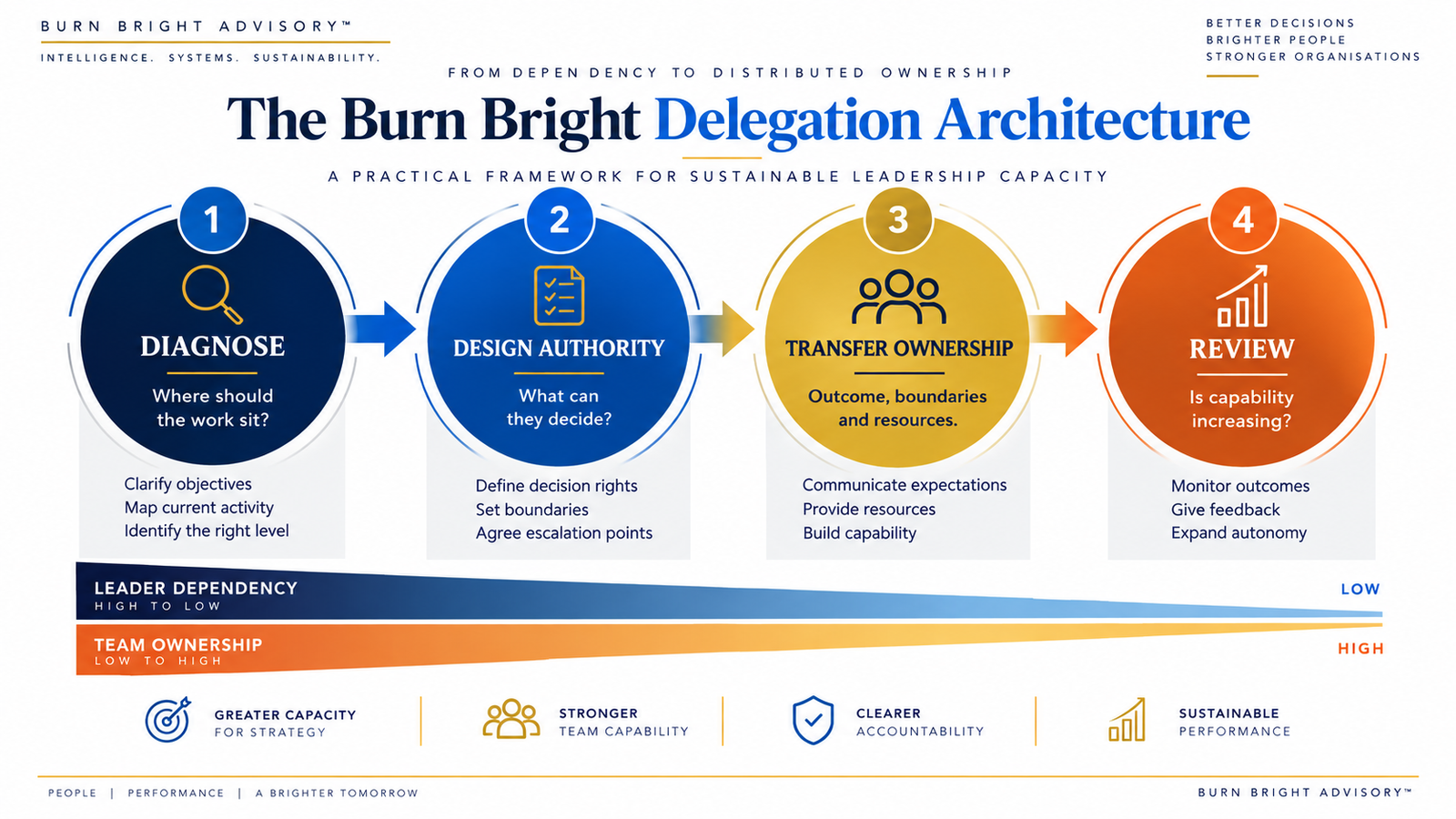
A useful way to visualise the shift is through a four-stage delegation architecture.
Stage 1
Diagnose
Identify work that no longer belongs at your level. Do not start with your least enjoyable activities — start with work where your involvement adds the least unique leadership value.
Stage 2
Design Authority
Define the decisions that accompany the responsibility. Ask: what can this person now decide without me? If the answer is “nothing,” you probably have not delegated enough authority.
Stage 3
Transfer Ownership
Clarify the outcome, boundaries, resources, authority and escalation conditions. Then allow the person to lead. Support should remain available. Dependency should not.
Stage 4
Review the Architecture
Do not judge delegation solely by whether the first attempt was perfect. Ask whether ownership is becoming clearer, decisions are moving closer to the work, and capability is increasing.
Why Does Better Delegation Reduce Leadership Burnout?
Delegation will not solve every cause of burnout, nor should it be presented as a universal cure. Burnout can emerge from workload, control, reward, community, fairness and values mismatches. But delegation matters because it can change several structural conditions surrounding leadership work.
- It reduces unnecessary workload concentration — execution stops accumulating around the most senior or experienced person.
- It reduces decision overload — not every decision deserves senior leadership attention.
- It creates greater control and clarity for other people — employees cannot genuinely own outcomes without authority to make decisions.
- It develops organisational capability — a team becomes stronger when judgement is distributed rather than permanently concentrated around one person.
- It creates space for leadership itself — strategy, thinking, coaching, difficult conversations, organisational design, risk assessment and future planning are easy to postpone because operational work arrives with greater urgency, but urgency and importance are not the same thing.
A leader who spends the entire week responding to immediate demands can appear highly productive while doing remarkably little leadership. This is why Burn Bright treats burnout as a structural problem. You cannot continually expand leadership responsibility, concentrate decision-making at the top, tolerate scope creep and then expect individual resilience to compensate indefinitely. Better systems outperform more effort. Delegation is one of those systems.
Conclusion: Delegation Is Organisational Design
Delegation frameworks for leaders are not primarily about getting unwanted work off your desk. They answer a more important question: where should work, authority and accountability sit for this organisation to perform sustainably?
That question changes leadership. Instead of measuring your value by how many problems you personally solve, you begin measuring it by the capability of the system you create. RACI can clarify ownership. A delegation audit can expose responsibilities that have accumulated through scope creep. Clear decision rights can stop routine problems travelling unnecessarily upwards. And defined outcomes, boundaries and review rhythms can give leaders visibility without recreating micromanagement.
None of this means leaders become detached. It means they become appropriately involved. Because leaders cannot outwork broken systems.
If your organisation depends on you personally approving, fixing, checking and rescuing everything, the answer is not greater effort. Fix the system, not the person. Build clearer ownership. Move decisions closer to the work. Develop capability before you desperately need it. Protect leadership capacity as deliberately as you protect financial capacity. That is what sustainable leadership looks like.
FAQ: Delegation Frameworks for Leaders
What are the best delegation frameworks for leaders?
RACI is one of the most practical because it separates Responsible, Accountable, Consulted and Informed roles. Leaders can combine it with a simple Keep, Delegate, Develop or Eliminate assessment to determine where work should sit before deciding who should own it.
What is the difference between delegation and task allocation?
Task allocation tells someone what to do. Effective delegation transfers ownership of an outcome together with appropriate decision authority, boundaries and accountability. Someone who receives additional tasks but must return to the leader for every meaningful decision has received workload, not genuine ownership.
How can leaders delegate without micromanaging?
Agree the outcome, authority, boundaries and checkpoints before work begins. Match the frequency of reviews to the level of risk and the person’s experience. Clear checkpoints provide visibility without requiring constant intervention. The objective is appropriate oversight rather than continual supervision.
What should a leader not delegate?
Leaders should retain responsibilities that genuinely require their formal authority, role-specific accountability or strategic judgement. Certain legal, ethical, confidential, personnel and high-risk decisions may also need to remain with the appropriate senior leader. The key question is whether leadership involvement is genuinely required rather than merely traditional.
How does delegation prevent burnout?
Delegation can reduce unnecessary workload concentration and decision overload by moving appropriate work and authority closer to the people capable of handling it. It also protects leadership capacity for strategy, judgement, coaching and recovery. Delegation is most effective when combined with broader workload and organisational redesign.
Why do good leaders struggle to delegate?
High performers are often promoted because they are technically capable and dependable. Those strengths can become liabilities when leaders continue solving problems themselves. Perfectionism, lack of trust, unclear decision rights and the belief that doing something personally is faster can all create dependency and eventually overload.
Diagnose Where Leadership Overload Is Building
If delegation feels difficult because everything appears to require your involvement, start by identifying where the pressure is actually coming from.
Free Leadership Intelligence
Get Weekly Leadership Insights
Join thousands of leaders receiving practical strategies on burnout prevention, workload design, and sustainable performance every week.