Quick Answer
Key Takeaways
- Accountability cannot simply be delegated away. You may delegate execution or decision authority while remaining accountable for the leadership outcome.
- Strategy requires visible leadership ownership. Teams can shape strategy, but leaders must provide direction, priorities and trade-offs.
- High-risk ethical decisions need leadership judgement. Delegation should never become a mechanism for avoiding difficult responsibility.
- Not every people decision belongs at the top. But serious conduct, trust and senior performance issues often require direct leadership involvement.
- Good delegation reduces burnout without creating an accountability vacuum. The answer is clear decision architecture, not either micromanagement or abdication.
What Should Leaders Never Delegate?
What should leaders never delegate? It is the question that usually appears immediately after a leader starts getting serious about delegation.
We hear constantly that leaders need to let go. Delegate more. Empower the team. Stop micromanaging. Get out of the operational detail. Most of that advice is directionally correct.
But taken too far, it creates another problem. Delegation is not the removal of leadership responsibility. It is the deliberate distribution of work, authority and decision-making within a system. That distinction matters.
Poor delegation leaves leaders carrying everything.
Poorly designed delegation can produce the opposite problem: nobody knows who owns the decision, accountability becomes blurred and important issues travel around the organisation without anyone taking responsibility.
McKinsey’s research illustrates the scale of the decision problem. More than half of respondents in one study reported spending over 30% of their working time making decisions, while 61% said much of that decision-making time was ineffective.
The solution is not for leaders to make every decision themselves. It is to know which decisions belong where. This article explains what leaders should never delegate, what they should delegate, and how to build a decision architecture that protects accountability without exhausting the person at the top.
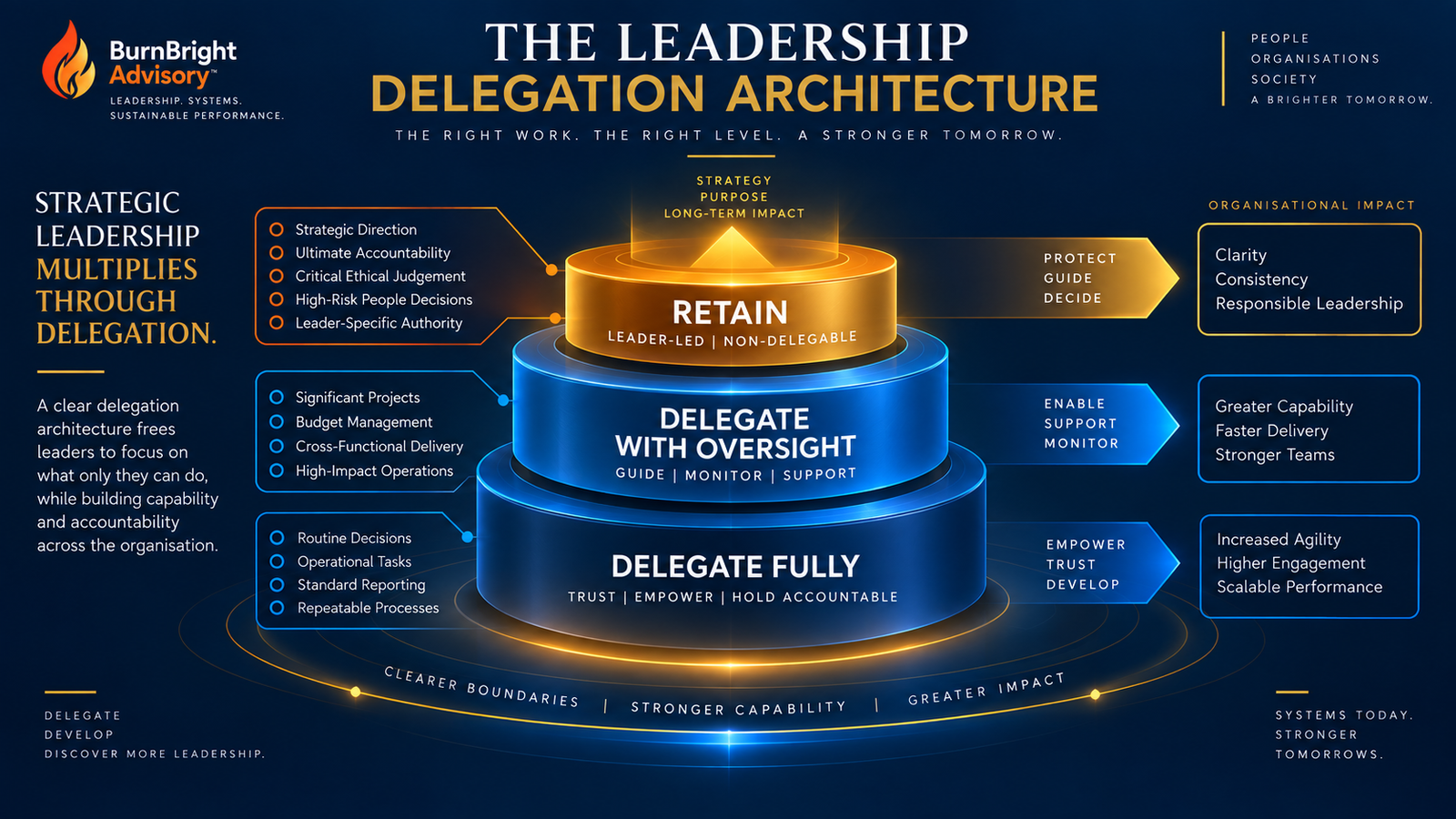
The distinction is structural. And getting it wrong is expensive. The framework below shows why effective delegation requires more than deciding whether to “keep” or “give away” a task.
Featured Snippet
The crucial point is that task ownership, decision authority and accountability are not the same thing. A leader can transfer one without necessarily transferring all three.
What Is the Difference Between Delegation and Abdication?
Delegation is often misunderstood as giving work away. It is better understood as redistributing ownership deliberately. A leader identifies the appropriate person, clarifies the expected outcome, establishes decision authority, provides the necessary resources and determines how accountability will work.
Abdication is different. Abdication sounds like: “I’ve delegated it. It’s their problem now.” That is not empowerment. It is an accountability vacuum.
McKinsey’s research into delegated decisions found that only around a quarter of surveyed organisations made delegated decisions both quickly and well. Its research suggests that empowerment works better when employees receive not merely permission to act, but sufficient authority, capability, guidance and support.
That distinction becomes particularly important for overwhelmed leaders. When your workload has become unsustainable, almost anything leaving your desk can initially feel like progress. You are carrying 60 responsibilities and somebody tells you to delegate 20 of them. Good advice. But which 20?
Without a framework, overloaded leaders tend to make one of two mistakes.
This matters because decision-making itself consumes leadership capacity. McKinsey found that some senior executives can spend more than 70% of their working time on decisions.
At the same time, burnout cannot be reduced to an individual’s inability to cope. The World Health Organization defines burnout as resulting from chronic workplace stress that has not been successfully managed, characterised by exhaustion, increased mental distance or cynicism towards work, and reduced professional efficacy.
That definition matters because it changes the question. Instead of “How can this leader become better at coping with all these responsibilities?” ask “Why does this role require one person to carry all these responsibilities in the first place?” That is the structural diagnosis.
The Burn Bright Not Out framework identifies scope creep as one of five root causes of burnout and places Workload Architecture and Decision Authority at the centre of structural transformation. The objective, therefore, is not maximum delegation. It is correctly designed delegation. And that starts by identifying the small number of responsibilities that genuinely belong with the leader.
This evidence base extends further. Deloitte has reported that 53% of managers say they are burned out at work, while separate Deloitte research found 70% of managers cite organisational barriers — including heavy workloads, policies, culture and inadequate skills — as obstacles to supporting their people.
What Responsibilities Should Leaders Never Delegate?
The purpose of delegation is not to empty the leader’s desk. It is to put responsibility at the right level. That means some work should move away from senior leaders. In many organisations, considerably more should move. But there is a boundary.
Certain responsibilities exist because of the position you hold. You can involve other people. You can ask for analysis. You can distribute execution. You can even give someone considerable decision authority. But you remain accountable.
Five areas usually belong within this Leadership Retention Zone:
- Ultimate accountability for your area
- Strategic direction and priorities
- Critical ethical judgements
- High-stakes people decisions
- Decisions requiring your specific authority
The mistake is assuming that keeping accountability means keeping all the work. It does not.
Consider a senior leader responsible for a major organisational change. They should not personally manage every project plan, meeting, communication or implementation decision. That would create dependency rather than leadership.
But if the change fails because priorities were unclear, resources were inadequate or serious risks were ignored, the leader cannot reasonably say “I delegated that.” The work may have been delegated. The leadership accountability was not.
This distinction sits at the heart of sustainable leadership. The Burn Bright framework identifies Decision Authority as one of four pillars of structural transformation alongside Workload Architecture, Recovery Rhythms and Management Frameworks. It also uses the RACI Delegation Framework to create clarity around responsibility and accountability.
The objective is not control. It is clarity. Who does the work? Who can make the decision? Who needs to be consulted? Who remains accountable for the outcome? When those questions have clear answers, delegation becomes a system. When they do not, work simply moves around.
Why Should Leaders Never Delegate Ultimate Accountability?
You can delegate responsibility. You can distribute authority. You cannot simply delegate away accountability that belongs to your role. This is one of the most important distinctions in leadership.
Imagine a director delegates responsibility for a major programme to a capable department head. The department head runs the meetings, manages the implementation team, monitors progress and makes agreed operational decisions. That is healthy delegation.
The director does not need to attend every meeting. They do not need to approve every action. They certainly should not be rewriting documents at 10 p.m. because they believe they could do them better.
But the director still needs sufficient visibility to know whether the programme is achieving its purpose, whether significant risks are emerging and whether organisational intervention is required. That is accountability.
Confusing accountability with execution creates overloaded leaders.
“If I am accountable, I need to be involved.”
“If I am involved, I need to approve it.”
“If I approve it, I need to check everything.”
Eventually, every meaningful decision travels upwards. The leader becomes the bottleneck.
This is one reason leaders can feel permanently behind despite working extraordinary hours. Their role has accumulated tasks, approvals, meetings and decisions without any deliberate redesign of its architecture.
The Burn Bright Not Out material describes exactly this pattern through scope creep: additional responsibilities accumulate, temporary duties become permanent, new initiatives arrive without old ones being removed, and eventually the role becomes structurally unmanageable.
Accountability does not require omnipresence. It requires visibility, clear authority and agreed escalation points. A useful test is: “What information do I need to remain accountable without becoming operationally involved?” That question changes delegation.
Instead of asking people to report everything, establish thresholds. For example: the team owns decisions within the agreed budget; the manager owns routine staffing decisions; significant financial variance is escalated; legal or safeguarding risk is escalated immediately; strategic deviation requires discussion. Everything else remains with the person closest to the work.
Now accountability exists without constant interference. That is sustainable delegation.
Why Must Leaders Retain Strategic Direction?
Strategy should be collaborative. Strategic accountability should not be vague. Leaders should listen to people closer to customers, employees and operations. They should invite challenge. They should use data. They should create space for different perspectives.
But eventually somebody must decide: Where are we going? What matters most? What are we willing to stop doing? Where will scarce resources go? Which trade-offs are acceptable? Those are leadership questions.
A common mistake occurs when leaders delegate activity while failing to establish direction. The team receives freedom but not clarity. People then make perfectly rational decisions based on different assumptions.
One department prioritises speed.
Another prioritises quality.
A third prioritises cost.
A fourth protects existing processes.
Everyone is busy. Everyone can justify what they are doing. But the organisation moves in four directions at once.
This is not empowerment. It is strategic ambiguity.
For overwhelmed leaders, the temptation can be particularly strong. Strategic thinking requires cognitive space. When your calendar is dominated by meetings, operational problems and constant communication, it is easier to let strategy become something discussed at an annual planning day rather than something actively led.
That creates a dangerous cycle. The less strategic clarity the organisation has, the more operational questions rise to senior leaders. The more questions that rise, the less time leaders have for strategic thinking. The less time they have for strategic thinking, the more ambiguity the organisation experiences. And the cycle repeats.
This is why delegation should protect strategic leadership rather than eliminate it. Move operational decisions closer to the work precisely so leaders can spend more time doing the work that genuinely requires leadership.
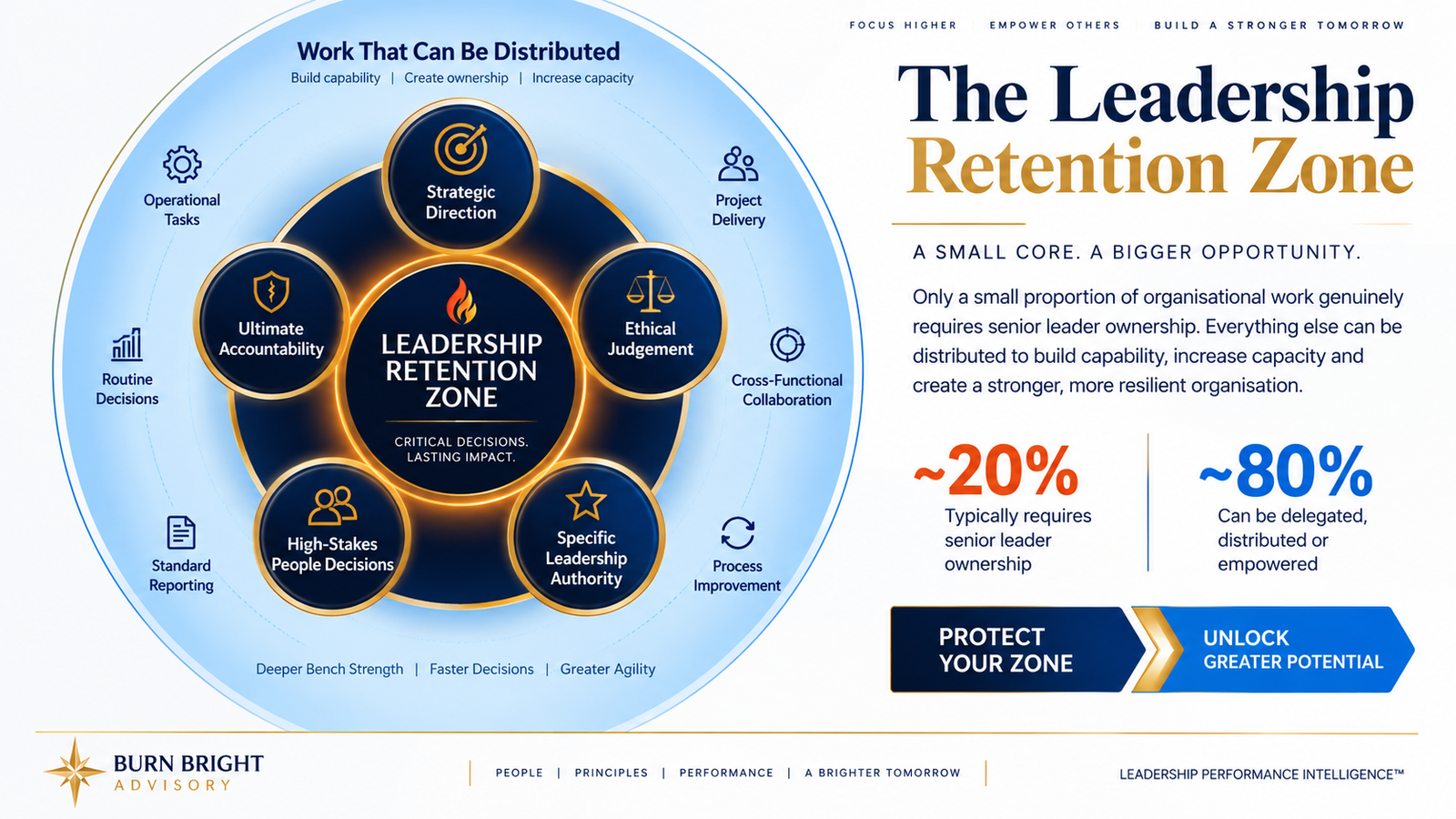
The model should not be read as an argument for centralised control. Its purpose is the opposite. The smaller and clearer the Leadership Retention Zone becomes, the easier it is to distribute everything else. When leaders know what they must retain, they become more confident about what they can release.
Why Should Leaders Retain Critical Ethical Judgement?
Some decisions should never disappear into a process simply because the process is convenient. Ethical responsibility is one of them.
Policies, committees, advisers and governance structures matter. They help leaders make better decisions and prevent individual judgement from becoming arbitrary. But there are moments when leadership requires a person to stand behind a decision.
Consider issues involving serious misconduct, safeguarding, discrimination, conflicts of interest, public trust or significant consequences for employees and customers. A leader should absolutely seek specialist advice where appropriate, gather evidence, follow established procedures and challenge their own assumptions. What they should not do is use delegation to create distance from an uncomfortable decision.
There is a significant difference between “I need expert advice before making this decision” and “I don’t want to own this decision.” The second is not delegation. It is avoidance.
Ethical leadership becomes particularly difficult when doing the right thing creates a cost. Perhaps a high performer has behaved in a way that violates organisational standards. Perhaps meeting a commercial target would require unacceptable pressure on employees. Perhaps a senior colleague wants an exception that would not be available to someone with less influence. These are precisely the moments when organisational values stop being statements on a website and become operational choices.
The leader’s job is not to make every ethical decision personally. That would be impossible and would undermine the judgement of managers throughout the organisation. The leader’s job is to establish the ethical architecture: what principles govern decisions, where the non-negotiable boundaries sit, what managers can decide independently, which issues require escalation, and what happens when performance and values conflict.
Without that architecture, difficult decisions travel upwards unpredictably or, worse, disappear because nobody feels authorised to confront them. Sustainable leadership requires distributed judgement within clear boundaries — not centralised morality, not ethical abdication. Clear principles. Clear authority. Clear accountability.
Which People Decisions Should Leaders Never Delegate Completely?
People decisions require more nuance because senior leaders should not personally manage every staffing issue. If every performance conversation, recruitment decision or disagreement requires executive involvement, the management system is broken. Managers need authority to manage.
But certain people decisions carry consequences significant enough to require direct leadership ownership. These can include serious misconduct, removal of senior leaders, significant organisational restructuring, succession into critical roles and situations where organisational trust is at stake.
Again, retaining accountability does not mean doing everything yourself. HR may manage process. Legal advisers may assess risk. A line manager may gather evidence. A panel may interview candidates. Other executives may contribute perspectives. But someone still owns the decision.
This is where poor delegation can become particularly damaging. A leader wants to avoid being seen as the “bad person”, so a difficult performance issue gets pushed towards HR. HR advises. The line manager waits. The senior leader assumes somebody else is dealing with it. The employee receives mixed messages. The team watches the problem continue.
Nobody has technically ignored it. Yet nobody has truly owned it. That ambiguity creates organisational drag. It also increases workload. Unresolved people problems rarely remain contained. They create additional meetings, informal conversations, complaints, workarounds and emotional labour. One avoided decision can generate dozens of secondary demands.
This is why decision clarity is also a burnout intervention. Burn Bright’s wider approach treats burnout as a consequence of the system around the leader rather than simply a failure of personal resilience. The framework identifies decision overload alongside scope creep, meeting culture, communication chaos and perfectionism culture as structural root causes.
Better delegation therefore does more than reduce a task list. It reduces the number of decisions unnecessarily travelling through the organisation.
When Does Delegation Become Dangerous?
Delegation becomes dangerous when responsibility moves but authority does not. This pattern is remarkably common.
A manager is told: “You own this.”
Then they discover they cannot change the budget.
They cannot alter the deadline.
They cannot select the team.
They cannot decline additional work.
They cannot approve expenditure.
And every meaningful decision still requires senior approval.
They have responsibility without authority. That is not empowerment. It is transferred pressure.
The leader may believe they have delegated. The manager experiences something very different: accountability for an outcome they do not have the power to control. This is where delegation can actually contribute to burnout rather than prevent it.
The Burn Bright material describes burnout as arising from structural mismatches, including situations where professionals have excessive workload and insufficient control over their work. That provides a useful diagnostic question whenever you delegate: “Am I transferring enough authority for this person to succeed?” If the answer is no, you have not completed the delegation. You have transferred a task.
Effective delegation requires alignment between five elements:
- Responsibility — What am I asking you to own?
- Authority — What can you decide without me?
- Resources — What capacity, information and support do you have?
- Accountability — How will we know whether the outcome has been achieved?
- Escalation — Under what conditions does the decision return to me?
When those five elements are explicit, delegation becomes much safer. The employee gains autonomy. The leader gains capacity. The organisation gains speed. And fewer decisions become trapped at the top. That is the point.
Sustainable leadership does not mean leaders withdrawing from responsibility. It means designing responsibility intelligently. Delegate execution where possible. Delegate decision authority where appropriate. Retain the accountability that genuinely belongs to your role. Everything else should be open to redesign.
How Can Leaders Decide What to Delegate?
Knowing what leaders should never delegate solves only half the problem. The next question is more practical: what should leave your desk?
For many overloaded leaders, delegation happens reactively. The calendar becomes impossible. A deadline approaches. Someone offers to help. A task gets handed over. That may create temporary relief, but it does not redesign the workload.
A stronger approach is to divide leadership responsibilities into three zones.
Zone 1
Retain
Responsibilities that genuinely require your leadership accountability. They may include:
- Strategic direction
- Significant ethical judgements
- High-risk organisational decisions
- Accountability for critical outcomes
- Decisions attached specifically to your authority
Retaining these responsibilities does not mean performing every task associated with them. You may retain accountability for strategy while delegating research, analysis, implementation and monitoring. Ask: “Which part of this responsibility genuinely requires me?”
Zone 2
Delegate With Oversight
This is where many leaders can recover significant capacity. These responsibilities can be owned by somebody else, but the leader retains defined visibility because of risk, strategic significance or organisational impact. The critical word is defined. Oversight might mean a fortnightly dashboard, a milestone review, a financial threshold, an exception report, or a 20-minute decision meeting at a predetermined stage. Good oversight is designed before the work begins. Poor oversight appears whenever the leader becomes anxious.
Zone 3
Delegate Fully
Responsibilities another person has the competence and authority to own without routine leadership involvement. Once delegated, they should stay delegated. Leaders frequently delegate work and then quietly reclaim it — rewriting a document that comes back at 80% of their standard, intervening when a team member takes longer to decide, taking control when someone chooses a different approach. Saving 30 minutes today can create hundreds of hours of future dependency.
How Does the RACI Framework Prevent Delegation Confusion?
One of the simplest ways to make delegation structural rather than informal is to separate responsibility from accountability. The Burn Bright framework incorporates RACI precisely because overloaded leadership teams frequently confuse the two. RACI establishes four roles:
- Responsible — Who performs the work?
- Accountable — Who ultimately owns the outcome?
- Consulted — Whose expertise or input is required?
- Informed — Who needs visibility but does not need to participate in the decision?
This sounds straightforward. In practice, it exposes enormous amounts of organisational waste.
Imagine a senior leadership team launching a new internal development programme. Without clear decision architecture, six executives attend every planning meeting. HR develops the programme. Finance checks the budget. Operations comments on implementation. The CEO asks for updates. Department heads suggest changes. Nobody is entirely certain who can make the final decision. So another meeting is scheduled.
RACI forces a different conversation. Perhaps the Head of Learning is Responsible. The HR Director is Accountable. Finance and Operations are Consulted. The executive team is Informed. Suddenly, six people do not need to participate in every stage.
That is more than project management. It is capacity design. Every unnecessary approval removed from a workflow returns cognitive capacity to somebody. Every meeting that no longer requires six senior leaders returns strategic time. Every decision that can be made at the appropriate level prevents another interruption higher in the organisation.
This is why delegation should be understood as part of Workload Architecture, not merely as an interpersonal skill. You cannot sustainably redesign workload without deciding where authority sits. And you cannot distribute authority effectively if nobody knows where accountability remains.
What Is the Five-Question Delegation Test?
Before retaining another responsibility, run it through five questions.
1. Does this genuinely require my authority?
Not “Am I capable of doing it?” Senior leaders are capable of doing many things. That does not mean they should. Ask whether the decision legally, strategically or organisationally requires your authority. If not, continue.
2. Am I the only person with the necessary expertise?
Sometimes the answer is yes. More often, the honest answer is: “I am currently the person with the most expertise.” Those are different statements. If nobody else can perform the responsibility because knowledge has never been transferred, you do not have a delegation problem. You have a capability dependency. That is an organisational risk.
3. What would happen if someone completed this to 80–90% of my standard?
This question is particularly uncomfortable for high performers. Not every task needs your maximum standard. Some do. Most do not. A routine internal presentation does not necessarily need three hours of executive polishing. If another capable person can deliver an acceptable outcome, retaining the task because you could improve it slightly may be a poor use of leadership capacity.
4. Is my involvement creating capability or dependency?
This is one of the strongest tests. After working with you, is the other person more capable of handling the issue next time? Or have they learnt that difficult problems should be returned to you? Sustainable delegation should progressively reduce dependency.
5. What is the opportunity cost of me keeping this?
Every yes has a cost. If you spend two hours preparing an operational report, those two hours cannot also be spent thinking strategically. If you personally approve every minor decision, you consume the cognitive capacity required for the decisions that actually need you. Time is finite. But leadership attention is even more constrained. Delegation is therefore not simply about reducing workload. It is about allocating scarce leadership attention where it creates the greatest value.
Why Does Perfectionism Stop Leaders Delegating?
Some delegation problems are structural. Others are reinforced by leadership behaviour. Perfectionism is one of the most persistent.
The Burn Bright framework identifies perfectionism culture as one of the five root causes contributing to burnout, alongside scope creep, meeting culture, communication chaos and decision overload.
Perfectionism sounds like a quality standard. Often, it is a control system. The leader thinks: “Nobody will do it as well as I do.” They may be correct. That is not the relevant question. The relevant question is: “Does this task need to be done as well as I would personally do it?”
Suppose you can produce a report at 95% quality in three hours. A manager can produce it at 85% quality in two. If 85% fully meets the organisational requirement, the extra quality has little value. Yet the leader continues producing the report. Multiply that behaviour across presentations, emails, meetings, project plans, recruitment decisions and routine approvals.
The result is predictable. The leader becomes indispensable to everything. And being indispensable to everything is another way of saying the system cannot function without you. That is not a leadership achievement. It is a design weakness.
There is another cost. Every time you take delegated work back because it does not look exactly as you would have produced it, you teach the team something. Not excellence. Dependency. People learn that ownership is temporary. They learn that the safest approach is to wait for your intervention. Eventually, they stop making independent decisions. Then the leader says: “My team won’t take enough ownership.” But the system has trained them not to.
Delegation therefore requires tolerance for different, not tolerance for poor performance.
Standards remain. Outcomes remain. Accountability remains.
What changes is the assumption that there is only one acceptable way to produce them.
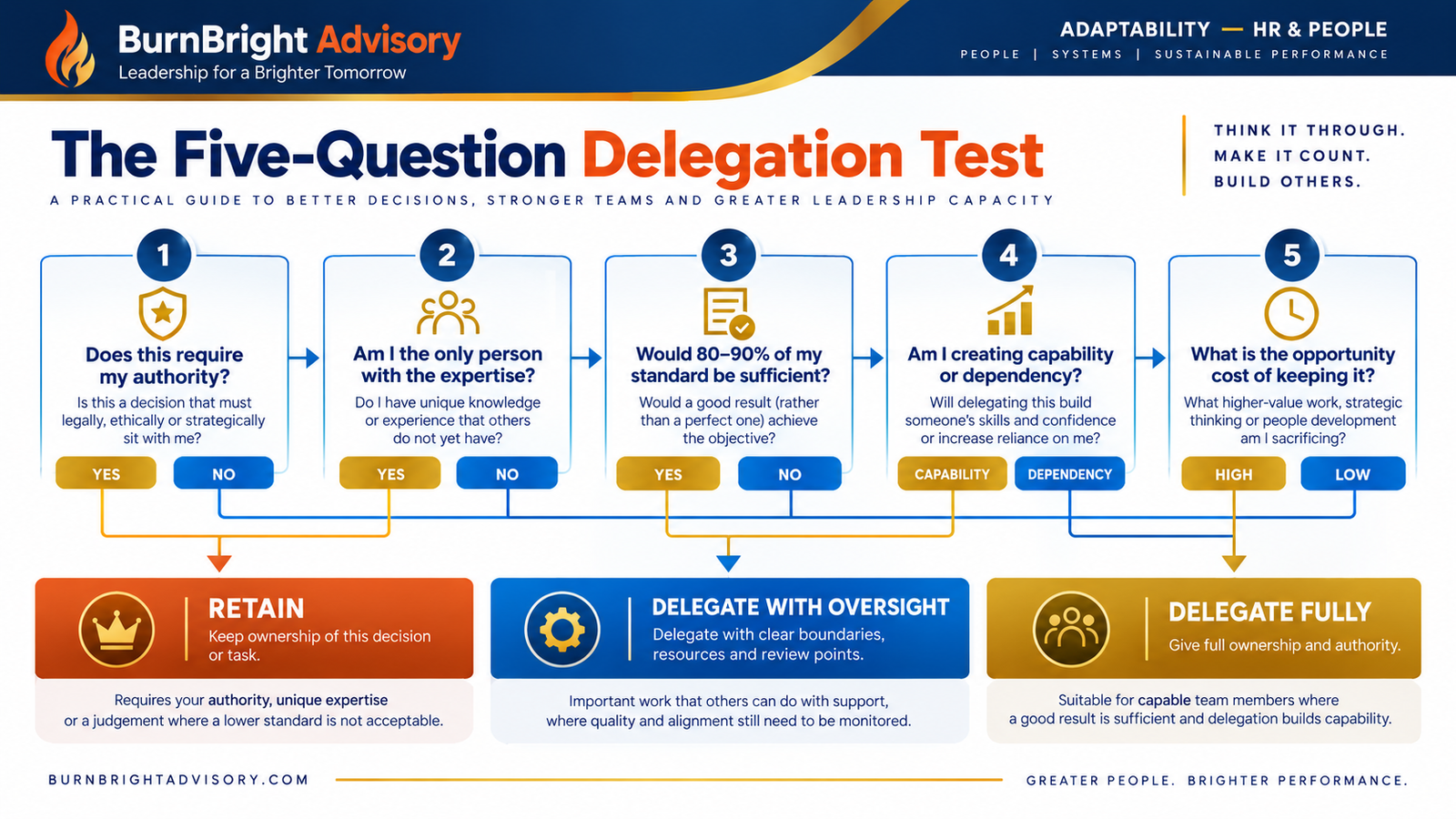
The purpose of the model is not to push the maximum possible workload downwards. That would simply move burnout from senior leaders to managers and teams. The purpose is to create appropriate ownership at every level. Burnout is not solved when the executive becomes sustainable by making everybody beneath them unsustainable. Better systems outperform transferred pressure.
How Can Leaders Delegate Without Losing Control?
The fear behind many delegation problems is not really about competence. It is about control. Leaders worry: What if something goes wrong? What if I discover the problem too late? What if somebody makes a decision I would not have made? What if I remain accountable for an outcome I did not personally control?
These are legitimate concerns. The solution is not to retain the work. It is to design the control system. There are four practical elements.
Define the Outcome
Do not delegate vague activity. Define what success looks like, along with the constraints, deadlines and measures of success. The clearer the outcome, the less need there is to control the method.
Define Decision Authority
Tell people what they can decide — for example, an expenditure limit they can approve without coming back to you, or a plan they can change provided the final deadline and budget remain unchanged. That is usable authority.
Define Escalation Thresholds
Not every problem needs to travel upwards. Establish when it should — significant financial variance, legal or regulatory exposure, safeguarding concerns, strategic deviation, serious reputational risk, or agreed performance thresholds being missed. Everything below those thresholds remains with the delegated owner.
Define the Review Rhythm
Agree how visibility will work — weekly, fortnightly, at milestones, by dashboard, by exception. Then resist the urge to create additional checking simply because you feel uncomfortable.
This is where leaders often undermine their own delegation. They establish a review structure on Monday. By Wednesday they are sending “Just checking where we are with this.” On Thursday, “Any update?” Friday, “Can you send me the latest version?” The work has technically been delegated. Psychologically, it has not. The leader is still carrying it. Sustainable delegation requires confidence in the architecture you created.
What Does Sustainable Delegation Look Like in Practice?
Picture two senior leaders. Both manage teams of 30 people. Both are accountable for significant budgets. Both operate in demanding environments.
The first leader is involved in almost everything. Their calendar is full. Team members ask permission before making decisions. Emails are copied to them “for visibility”. They attend meetings because something important might arise. They approve documents because their name ultimately sits above the department. They are constantly busy. And constantly needed.
The second leader has clear decision boundaries. Their managers know what they own. RACI is used for significant cross-functional work. Escalation thresholds are explicit. Routine reporting happens through dashboards rather than meetings. The leader becomes directly involved when strategic direction, significant risk or executive authority is required. They are still accountable. But they are not omnipresent.
Which leader has more control? At first glance, the first. In reality, probably the second. Because genuine control does not mean touching everything. It means creating a system in which the right information reaches the right person at the right time.
This is the transition Burn Bright is designed around.
From heroic leadership to sustainable leadership.
From personal capacity to organisational architecture.
From “everything depends on me” to “the system knows where responsibility belongs.”
That shift also changes burnout risk. The Burn Bright Not Out framework identifies a 30-60-90 Day Plan among its nine frameworks because structural transformation cannot depend on a burst of individual effort. Delegation works the same way. Do not try to hand off 40 responsibilities tomorrow. Diagnose first. Identify what only you can own. Identify what requires oversight. Identify what should move completely. Clarify authority. Build capability. Set escalation thresholds. Then allow the new architecture to work.
The objective is not to become less responsible. It is to stop confusing responsibility with personal involvement. That is the difference between delegation as a management technique and delegation as sustainable leadership. You do not need to control every decision to remain accountable for the system. You need to design the system so the right decisions can be made without you.
Traditional Delegation vs Sustainable Delegation
The difference between overloaded leadership and sustainable leadership is rarely whether delegation happens. It is how delegation is designed.
| Traditional Delegation | Sustainable Delegation |
|---|---|
| Delegates when the leader becomes overloaded | Designs responsibility before overload occurs |
| Focuses on getting tasks off the leader’s desk | Focuses on putting work at the correct organisational level |
| Confuses accountability with personal involvement | Separates accountability, responsibility and authority |
| Gives people tasks but retains decisions | Transfers appropriate decision authority with the work |
| Relies on frequent checking | Uses agreed review rhythms and escalation thresholds |
| Leader intervenes when work is done differently | Leader intervenes when agreed outcomes or boundaries are at risk |
| High standards can become perfectionism | Standards are matched to the importance of the outcome |
| Delegation can be reversed when pressure rises | Delegated ownership remains stable |
| Success means the leader has less to do | Success means the organisation has greater capacity |
| Creates temporary workload relief | Creates sustainable Workload Architecture |
The distinction matters because the purpose of delegation is not to make one person’s calendar look better. It is to increase the capacity of the system. A senior leader who reduces their workload by pushing poorly defined responsibilities onto already overloaded managers has not solved burnout. They have relocated it.
Sustainable delegation asks a more demanding question: where should this responsibility sit for the organisation to function effectively without unnecessary dependency? That may mean delegating downwards, distributing responsibility across functions, or eliminating the work completely. And sometimes it means deciding that the responsibility genuinely belongs with the leader. The answer should come from organisational design rather than habit.
Frequently Asked Questions About What Leaders Should Never Delegate
1. What should leaders never delegate?
Leaders should not delegate ultimate accountability, strategic direction, critical ethical judgement, certain high-risk people decisions or responsibilities that specifically require their authority. They can still delegate much of the work supporting those responsibilities. The key distinction is between doing the work and remaining accountable for the outcome.
2. Can a leader delegate decision-making?
Yes. Leaders should delegate appropriate decision-making authority. Failing to do so can create bottlenecks and decision overload. The leader should define which decisions employees can make independently, the boundaries around that authority, and the circumstances requiring escalation. Delegating a task without sufficient decision authority usually creates dependency rather than empowerment.
3. Can accountability be delegated?
Operational accountability can be assigned throughout an organisation, but a leader cannot simply remove the ultimate accountability attached to their own role. A director can appoint a manager to run a project while remaining accountable for whether their department delivers the required organisational outcome. Clear RACI structures help distinguish responsibility from accountability.
4. How do I know if I should delegate something?
Ask five questions: Does it genuinely require my authority? Am I the only person who can do it? Would 80–90% of my personal standard still produce an acceptable outcome? Is my involvement developing capability or dependency? What is the opportunity cost of keeping it? If the responsibility does not genuinely require you, it should at least be considered for redesign.
5. Why do senior leaders struggle to delegate?
Leaders may struggle because of perfectionism, fear of losing control, lack of trust, unclear decision authority or the belief that doing something themselves will be faster. The short-term logic can be compelling. The long-term effect is dependency, with the leader repeatedly solving problems instead of developing a system capable of solving them without constant intervention.
6. What is the difference between delegation and abdication?
Delegation transfers responsibility with clear outcomes, sufficient authority, appropriate resources, agreed accountability and defined escalation points. Abdication simply transfers the problem. Telling somebody they “own” an outcome while denying them the authority, information or resources needed to achieve it is not meaningful delegation — it transfers pressure without creating control.
7. Can better delegation prevent leadership burnout?
Delegation can reduce one significant source of leadership overload, but it is not a complete burnout solution. The Burn Bright framework treats burnout structurally. Scope creep, meeting culture, communication chaos, decision overload and perfectionism culture can all contribute to unsustainable leadership roles. Delegation works best as part of wider Workload Architecture and Decision Authority redesign.
What Should Leaders Never Delegate? The Real Answer
So, what should leaders never delegate? Not everything carrying their job title. Not every important task. And certainly not every decision.
Leaders should retain the accountability, strategic direction, critical judgement and specific authority that genuinely belong to their role. Most other responsibilities should be examined.
That examination matters because leadership overload rarely arrives dramatically. It accumulates.
One approval stays with you because it seems easier.
One temporary responsibility becomes permanent.
One meeting becomes a weekly commitment.
One struggling manager starts returning decisions upwards.
One report remains on your desk because nobody produces it quite the way you do.
Individually, each decision appears reasonable. Collectively, they redesign your role. Eventually, you are no longer primarily leading. You are processing the organisation’s unresolved complexity. That pattern sits directly inside the Burn Bright diagnosis of scope creep and decision overload as structural causes of burnout.
The answer is not heroic leadership. It is architecture. Build clear responsibility. Put decisions at the appropriate level. Give people sufficient authority. Create escalation thresholds. Protect the small number of responsibilities that genuinely require leadership attention. Then let the system work.
Take the Leadership Burnout Self-Assessment
If your workload has expanded to the point where everything seems to require your attention, delegation may be only one part of the problem. Use the Burn Bright Leadership Burnout Self-Assessment to identify where workload, decision pressure and structural demands may be creating unsustainable leadership conditions.
Free Leadership Intelligence
Get Weekly Leadership Insights
Join thousands of leaders receiving practical strategies on burnout prevention, workload design, and sustainable performance every week.