Quick Answer
Key Takeaways
- Fair leadership does not mean identical leadership. The test is whether a difference in treatment can be explained by relevant, defensible, consistently applied criteria.
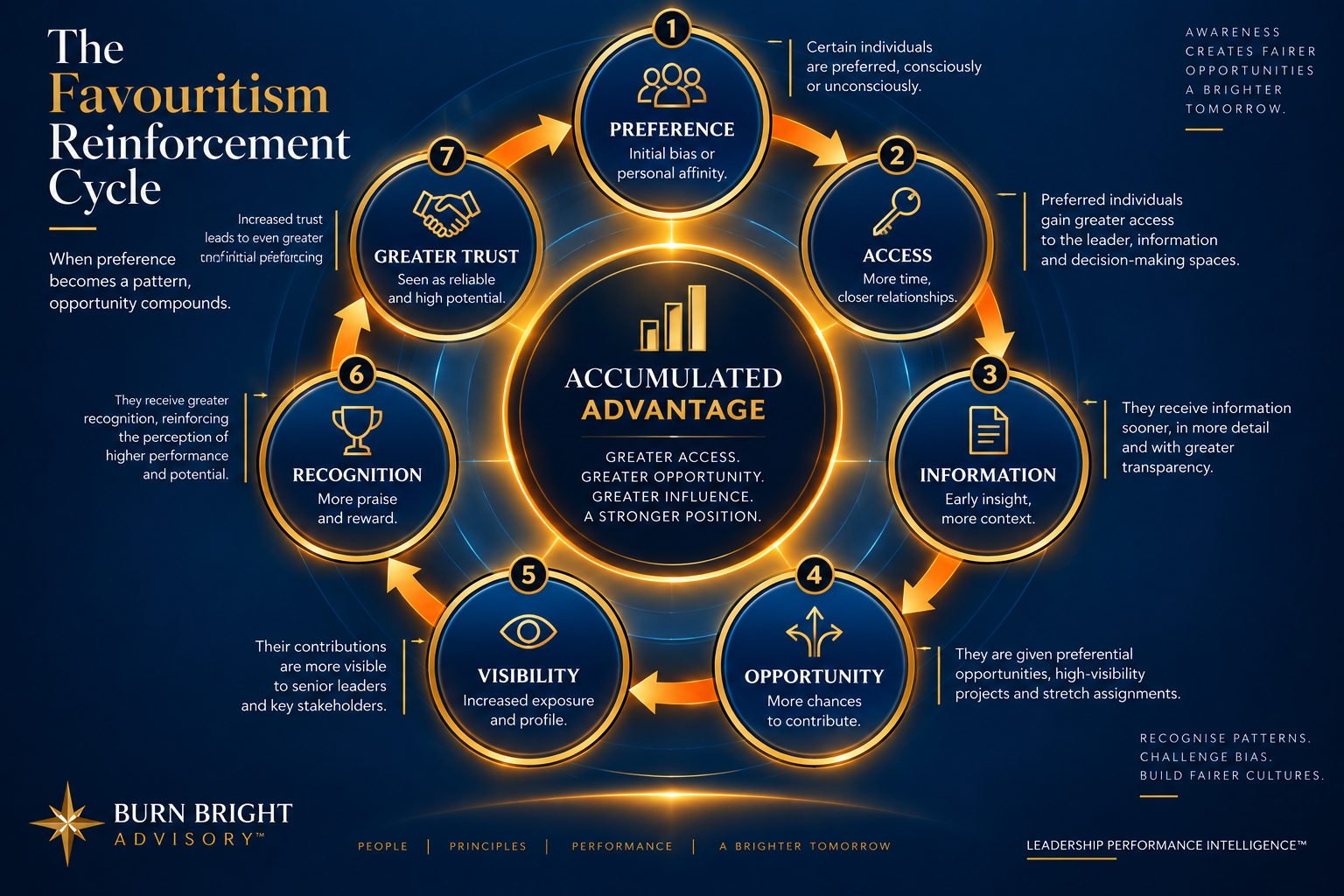
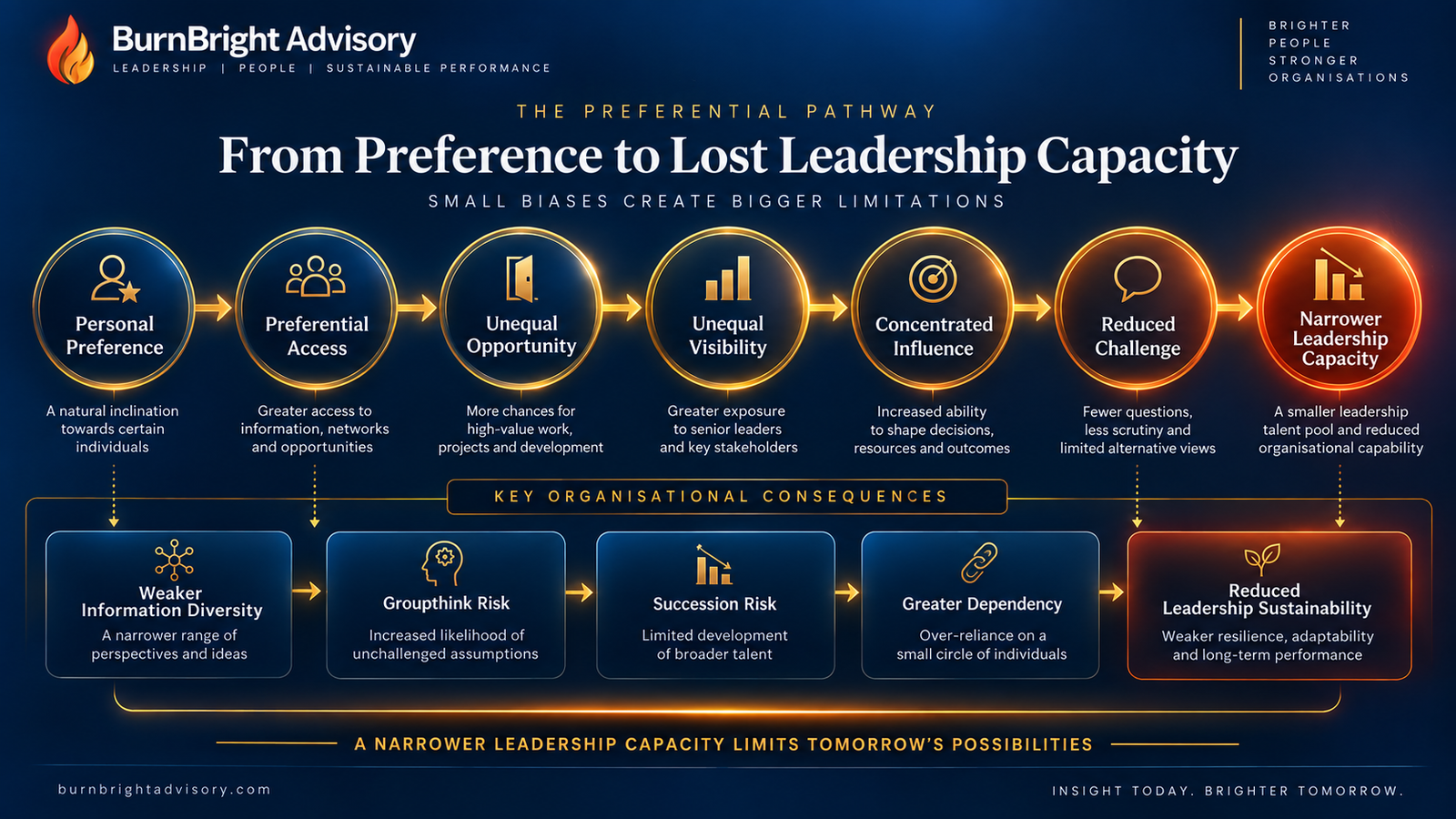
- Favouritism is rarely a single decision. It is usually a self-reinforcing cycle: preference creates access, access creates information, information creates opportunity, opportunity creates visibility, and visibility is later mistaken for proof the original preference was correct.
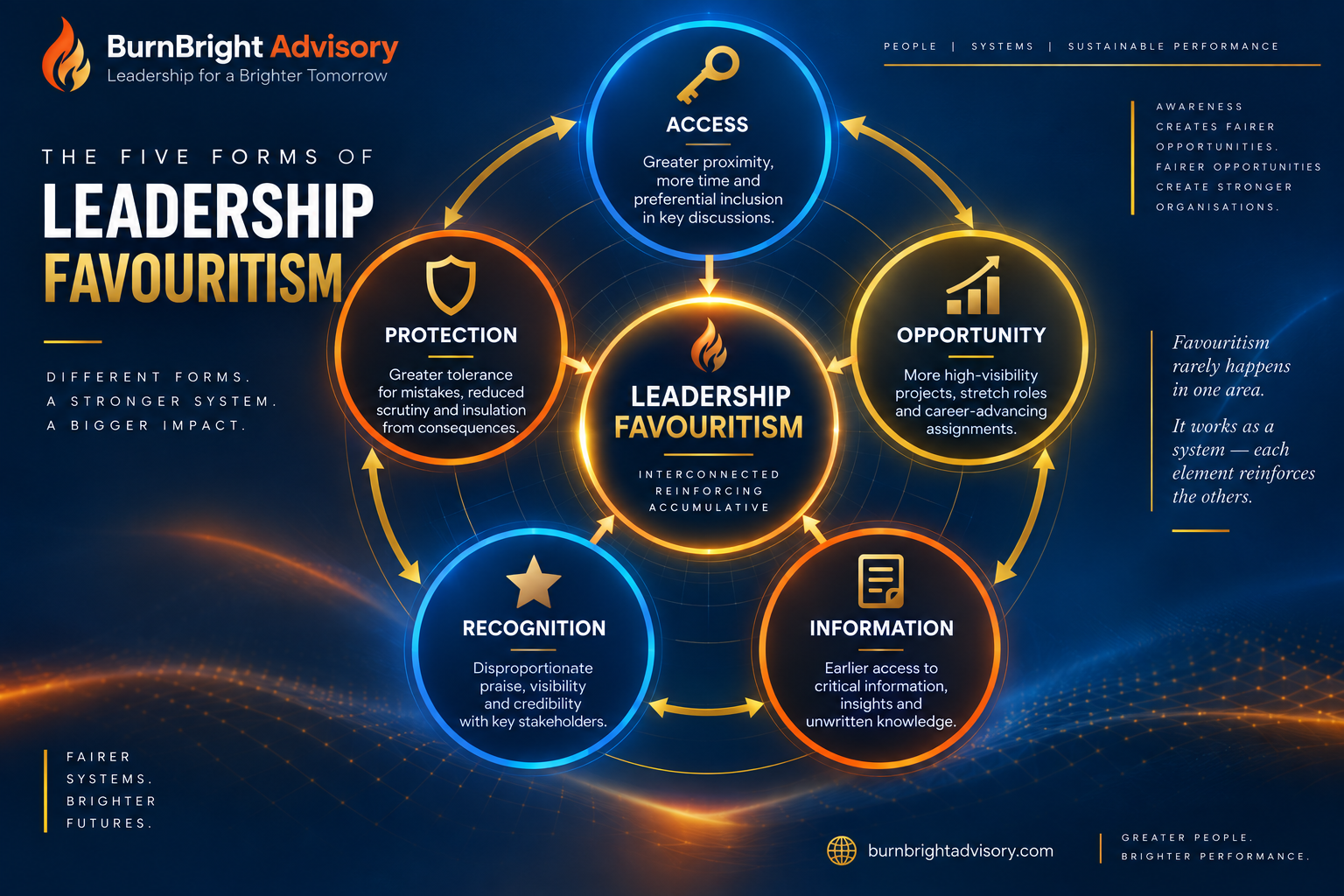
- Favouritism operates through five channels: access, opportunity, information, recognition and protection — and the most damaging form is often protection, where accountability quietly changes according to relationship.
- The organisational cost is broader than the individual relationship. Trust, psychological safety, talent decisions and leadership capacity all degrade when employees conclude the system isn’t fair.
- Reducing favouritism does not mean eliminating preference or discretion. It means building enough structure — criteria, audits, interrogation of judgement, and review of patterns — that preference cannot quietly override principle.
What Is Favouritism in Leadership?
Favouritism is often treated as an interpersonal problem: a manager simply “likes” one employee more than another. That interpretation substantially underestimates its significance.
Leadership is inherently relational. Leaders will naturally develop different relationships with different people. They will trust some employees with particular responsibilities because of demonstrated competence. They may provide additional support to someone facing exceptional circumstances. They may invest differently in individuals according to role, capability, developmental need or organisational priorities.
Ethical leadership therefore does not require identical treatment. It requires justifiable treatment.
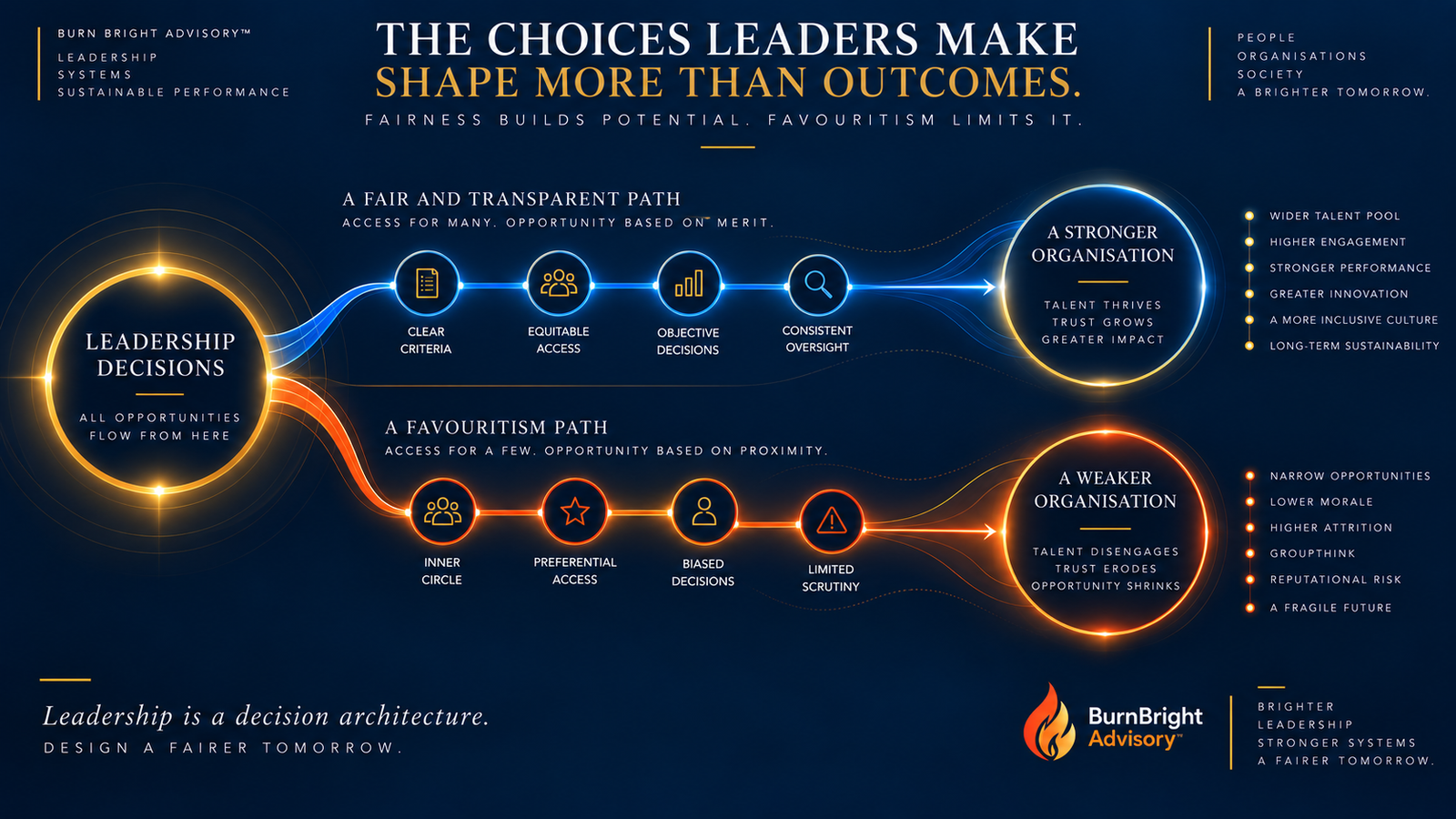
This distinction matters because favouritism affects considerably more than the individual who receives an advantage. Every promotion, assignment, opportunity, exception and leadership decision communicates something to the wider organisation about how the system actually works.
When employees repeatedly see the same people receiving privileged access to decision-makers, desirable assignments, informal information, protection from consequences or accelerated opportunities, they begin learning an unwritten organisational rule: formal standards may matter less than proximity to power. That perception can fundamentally alter behaviour. People may stop believing that excellent performance will be recognised fairly. Employees may become reluctant to challenge preferred colleagues. High performers may disengage or leave. Psychological safety can decline as employees calculate the interpersonal consequences of speaking honestly.
The result is degradation of the organisation’s Leadership Performance Intelligence™: its capacity to make sound leadership decisions, sustain trust, develop capability and translate leadership standards into consistent organisational performance.
From the Burn Bright Advisory™ perspective, favouritism is a leadership intelligence issue. It tests Ethics Intelligence™ because leaders must distinguish legitimate discretion from unjustified preference. It intersects with Professionalism Intelligence™ because authority must be exercised consistently. It requires Reflective Practice Intelligence™ because leaders may be unaware of their own relational preferences. And it involves Emotional Intelligence™ because interpersonal affinity can quietly influence judgement.
Ethical leadership is not demonstrated primarily when decisions are easy. It becomes visible when leaders must make decisions involving people they know, trust, like, depend upon — or find difficult.
Featured Snippet
The Decisions That Reveal What an Organisation Really Values
Most organisations have policies about fairness. Far fewer can confidently say that fairness characterises every important leadership decision.
Consider a relatively ordinary situation. Two employees want the opportunity to lead a high-profile project. One has consistently delivered strong results, has relevant experience and has openly expressed an interest in developing leadership capability. The other has a particularly strong relationship with the manager — they speak frequently, share similar views and have become someone the manager instinctively trusts.
The manager selects the second employee. Perhaps there is a legitimate reason. Perhaps there isn’t. But the ethical significance of the decision extends beyond those two people. The rest of the team is watching, asking questions even if nobody says them aloud:
- How are opportunities really allocated here?
- Does performance matter? Do relationships matter more?
- Would the same decision have been made if someone else were involved?
- Is challenging this decision professionally safe?
- What do I need to do to progress in this organisation?
Leadership decisions do more than distribute resources. They teach people how power works.
Favouritism Is Rarely Announced
Obvious favouritism is relatively easy to recognise — a leader repeatedly promotes friends despite stronger candidates, one employee is consistently protected from accountability, opportunities circulate among a small inner circle, rules are enforced strictly for some and flexibly for others.
The more difficult cases are subtler: a manager routinely asks one trusted colleague for an opinion before meetings; a school leader repeatedly selects the same teachers for development because they are “reliable”; a senior clinician gives desirable assignments to people they get on with personally; a founder overlooks behaviour from a long-standing employee that would trigger intervention from a newer recruit.
Individually, each decision may appear insignificant. Collectively, they can create an informal hierarchy of access. This is particularly important in small teams, where there are fewer organisational buffers: relationships are closer, interactions more frequent and leadership patterns harder to escape.
The favoured person receives more conversations.
More conversations create more information.
More information creates greater visibility.
Greater visibility creates more opportunities to demonstrate capability.
More opportunities create stronger evidence for promotion.
The leader can then point to that employee’s experience as proof the original preference was justified.
A seemingly interpersonal preference has become a self-reinforcing leadership system.
Fairness Does Not Mean Treating Everybody the Same
Fair leadership does not mean identical leadership. People have different responsibilities, capabilities, circumstances and developmental requirements. A new employee may legitimately require more coaching than an experienced colleague. A high-performing specialist may appropriately receive a complex assignment. Equality of treatment and ethical fairness are therefore not synonymous.
A useful ethical question is not “Did everybody receive exactly the same thing?” It is: “Can the difference in treatment be explained by relevant, defensible and consistently applied criteria?”
Ethical leaders need discretion — organisations could barely function if every decision required identical treatment irrespective of context. But discretion creates risk. The more discretion leaders possess, the more important self-awareness, transparency, accountability and reflection become.
This is where favouritism often hides. A leader may genuinely believe “she’s simply my strongest performer” or “he’s a better fit.” Any of these assessments could be accurate. They can also become convenient explanations for decisions shaped partly by familiarity, similarity, loyalty or personal comfort. The ethical task is not to eliminate judgement. It is to interrogate judgement.
From Personal Preference to Ethical Failure
Human beings naturally form preferences. We find some people easier to communicate with, trust people who have supported us previously, and feel more comfortable around those whose communication styles or assumptions resemble our own. Leadership does not eliminate those tendencies. Authority magnifies their consequences.
A colleague’s preference for another colleague has relatively limited organisational impact. A leader’s preference can determine promotion, pay, visibility, workload, development, information, recognition, access, performance evaluation — and sometimes whether misconduct has consequences.
A leader can have good intentions and still create an unfair system. Applied to favouritism, ethical leaders must be capable of asking an uncomfortable question:
Favouritism as a Leadership Performance Intelligence™ Problem
Burn Bright Advisory™ defines leadership development more broadly than the acquisition of isolated leadership skills. Leadership Performance Intelligence™ concerns the quality of the leadership system: how leaders interpret situations, exercise judgement, regulate behaviour, build capability and sustain effective performance over time. Viewed through that lens, favouritism is not merely a moral defect. It is a degradation of leadership intelligence.
When preferential treatment becomes normalised, the organisation receives less reliable information because people become cautious about challenging insiders. Talent decisions become less accurate because access and visibility distort perceptions of capability. Accountability becomes inconsistent. Development opportunities concentrate rather than distribute. Trust deteriorates. Eventually, leadership itself becomes harder — managers facing distrust must spend more time explaining decisions, managing conflict, replacing disengaged employees and correcting cultural problems that their own decision processes helped create.
This connects ethics directly to Leadership Sustainability™ and Leadership Capacity™. Ethical systems do not merely protect employees. They preserve organisational capacity.
Ethics Intelligence™: The Question Behind the Decision
A useful starting point for leaders is to move beyond asking “Am I allowed to do this?” and ask “Could I defend how I reached this decision?” Compliance establishes boundaries. Ethics examines judgement inside those boundaries.
A promotion process may technically comply with policy while still being heavily influenced by informal sponsorship. A leader may have discretion over flexible working while granting exceptions inconsistently. None of these situations necessarily involves explicit misconduct. Yet each deserves ethical scrutiny.
Ethics Intelligence™ asks leaders to examine four dimensions:
- Principle — What ethical principle should govern this decision?
- Process — Was the decision reached through a fair and sufficiently transparent process?
- Consistency — Would comparable circumstances produce comparable treatment?
- Impact — What does the decision communicate to everyone affected by it?
Employees do not experience an organisation’s ethics primarily through its values statement. They experience ethics through decisions — who gets heard, who gets opportunities, who receives forgiveness, who receives scrutiny, who gets developed, promoted and protected. That is where leadership ethics becomes real.
The Architecture of Favouritism: How Preferential Treatment Becomes a System
Favouritism rarely begins with a leader consciously deciding to create an unfair workplace. More often, it develops incrementally. A leader trusts one person slightly more than others. That person receives more informal information, so they become better prepared, so the leader gives them greater responsibility, which increases their visibility and generates further opportunities. Eventually, an informal advantage becomes difficult to distinguish from demonstrated merit — and it creates some of the evidence used to justify itself.
For Leadership Performance Intelligence™, this presents an important challenge: leaders must evaluate not only individual performance but also the conditions under which performance has been produced. Ethical leadership therefore requires leaders to examine the architecture surrounding performance — not simply the performance itself.
Five Ways Leadership Favouritism Operates
Preferential treatment is broader than promotion. Some of its most consequential forms occur long before a formal career decision is made.
Form 1
Access Favouritism
Who can speak informally with the leader? Who gets invited into conversations before decisions are made? Access creates knowledge and influence. When a new strategic initiative emerges, the person with the most proximity to the leader appears unusually prepared — but the advantage may reflect proximity to information and power rather than superior capability. Ethical leaders ask: who has access to me, and what advantages does that access create?
Form 2
Opportunity Favouritism
High-profile projects, stretch assignments and executive exposure generate experience — and experience becomes evidence of capability. If one employee repeatedly receives challenging assignments while a comparably capable colleague receives none, the first will look more “ready” for the next vacancy. But the ethical question begins earlier: how was the experience that now constitutes “merit” distributed? Fair selection cannot compensate for unfair opportunity formation.
Form 3
Information Favouritism
Employees who understand what senior leaders are thinking can anticipate priorities and position themselves accordingly. When leaders share information selectively through trusted relationships, they can unintentionally create an insider group with asymmetrical organisational intelligence — one that is particularly powerful because those outside it may not even know what they’re missing.
Form 4
Recognition Favouritism
Leaders constantly interpret performance for other people — deciding whose contribution gets mentioned in meetings, who receives public praise, and whose work disappears into collective language. One employee becomes known as a “rising star”; another becomes dependable but invisible, even when both contribute substantially. Recognition is reputational capital, and distributing it carelessly can influence careers.
Form 5
Protection Favouritism
Perhaps the most damaging form: accountability changes according to relationship. One employee’s mistake draws formal criticism; another’s draws an informal chat. One person’s difficult behaviour is “unprofessional”; a favoured colleague’s is “passionate” or “under pressure.” Employees notice these discrepancies remarkably quickly, and once they believe relationships determine consequences, formal policies lose authority.
The Difference Between Favouritism and Legitimate Differentiation
Not every difference in treatment is favouritism. Strong leaders differentiate — allocating responsibilities by capability, investing extra development in people preparing for new roles, adjusting support to individual circumstances. The question is not whether treatment differs. It is why.
| Favouritism (irrelevant relational factors) | Legitimate Differentiation (relevant professional factors) |
|---|---|
| Personal friendship | Demonstrated competence |
| Similarity to the leader | Relevant experience |
| Loyalty to the leader | Role requirements |
| Social proximity | Documented performance |
| Personal comfort | Developmental need |
| Unquestioning agreement | Organisational priorities |
| Membership of an informal inner circle | Reasonable individual circumstances |
The difficult territory lies between them. A leader may genuinely believe someone is more capable while simultaneously being influenced by the fact that the person thinks like them. This is where Reflective Practice Intelligence™ becomes essential.
The Similarity Trap
Leaders frequently need to make judgements under uncertainty: who has leadership potential, who can be trusted with a difficult client, who is ready for greater responsibility. These are rarely purely objective questions — interpretation can be influenced by familiarity. A leader may experience someone with a similar communication style as more competent because communication feels effortless, while someone who approaches problems differently may appear less intuitive simply because they require more explanation.
Familiarity can feel like competence.
Agreement can feel like judgement.
Loyalty can feel like trustworthiness.
Confidence can feel like capability.
Similarity can feel like cultural fit.
This is precisely why ethical leadership requires more than good intentions. It requires disciplined reflection — the capacity to examine the preferences that feel most natural.
When Favouritism Becomes Cultural
The greatest danger appears when preferential treatment stops being an individual behaviour and becomes an organisational expectation. If advancement appears to depend on proximity to leaders, people invest in proximity. If disagreement reduces opportunity, employees learn to agree. If insiders receive protection, people compete to become insiders.
The organisation may say “we value challenge.” The lived message becomes “challenge carefully.”
It may say “opportunities are available to everyone.” The lived message becomes “opportunities go to people leadership already knows.”
It may say “we hold everyone accountable.” The lived message becomes “accountability depends on who you are.”
This gap between declared values and experienced values is one of the most important ethical indicators leaders should monitor, because organisational ethics are ultimately judged through experience.
Favouritism Can Damage the Favoured Employee Too
Suppose an employee earns a promotion after years of visibly close association with the senior leader. They may genuinely deserve the role. Yet if colleagues believe the process was influenced by favouritism, the new leader inherits a legitimacy problem — their achievements questioned, their decisions interpreted through suspicion, their success attributed to sponsorship rather than capability.
Ethical processes therefore protect everyone: unsuccessful candidates from arbitrary decisions, organisations from distorted talent decisions, and successful candidates by ensuring their achievement has procedural legitimacy.
The Ethics Intelligence™ Test
Before making a consequential people decision, leaders can apply a simple Burn Bright ethical test:
- Relevance — What professional criteria justify this difference in treatment?
- Evidence — What evidence supports my judgement?
- Consistency — Have I applied comparable standards to other people?
- Relationship — Would my decision change if I had a different personal relationship with this individual?
- Transparency — Could I explain the reasoning to the affected team without embarrassment or defensiveness?
- Opportunity — Have previous decisions given this individual advantages that are now influencing my assessment?
- Impact — What will observers learn about how opportunity and accountability operate here?
No single question eliminates bias. Together, they create friction between instinct and action — and that friction is valuable. Ethical leadership sometimes requires leaders to slow down precisely when a decision feels obvious.
What Favouritism Does to an Organisation
Favouritism does not remain contained within the relationship between a leader and a favoured employee. It changes the behaviour of everyone observing that relationship — which is where it becomes a Leadership Performance Intelligence™ problem rather than simply an interpersonal one.
Favouritism Erodes Trust Before It Erodes Performance
Organisational trust requires confidence that the leadership system is sufficiently predictable, competent and fair — not agreement with every decision, but belief that decisions follow legitimate criteria. Once an employee concludes “the system is not fair,” that broader conclusion matters more than any single decision. Discretionary effort can decline: people become more cautious about contributing beyond their formal responsibilities when they believe it won’t produce fair recognition or opportunity.
The Psychological Safety Consequence
When a leader has a particularly close relationship with one team member, another employee who spots a problem with that person’s idea faces a psychological calculation, not just a technical choice — will challenging it be read as challenging the favoured colleague? The employee may decide silence is safer, even though nothing explicit has happened and no policy has been violated. A leader can say “my door is always open” while employees simultaneously believe certain relationships are protected from challenge.
Silence Is an Ethical Warning Signal
Leaders sometimes assume the absence of disagreement indicates alignment. It may indicate calculation. If previous challenges to preferred colleagues have been dismissed, people begin conserving their voice — producing what looks like a harmonious team while concealing declining organisational intelligence. A quiet organisation is not necessarily a healthy one.
Favouritism Distorts Talent Intelligence
Access generates opportunity, opportunity generates experience, and experience generates visibility — meaning the employees who appear most “ready” for advancement may simply be those who received the greatest opportunity to become ready. Talent management risks becoming circular: give opportunities to people believed to have potential, then use their accumulated opportunities as evidence they had greater potential all along. This is a performance issue, not only an inclusion issue — organisations may be systematically underusing capable people.
The Exit of the Quiet High Performer
The employee most damaged by favouritism is not always the person who complains — sometimes it’s the person who quietly leaves. High performers usually have alternatives. When they repeatedly conclude that progression depends on relationships rather than contribution, leaving can feel more rational than confronting the system. By the time the resignation arrives, the leadership failure may have occurred months earlier.
Favouritism and Leadership Workload™
A leader develops a small group of trusted people. Because they’re trusted, they receive more responsibilities; because they receive more responsibilities, the leader relies on them increasingly — while other employees’ capability remains underused. The leader concludes “there are only two or three people here I can really rely on,” which may partly be a leadership development problem: opportunity has been concentrated rather than capability distributed. Favoured employees become overloaded, others underutilised, succession risk increases, and Leadership Capacity™ narrows.
The Leadership Intelligence Compass™ and Favouritism
Favouritism demonstrates why ethical leadership cannot be separated from other forms of leadership intelligence.
Ethics Intelligence™ — Is the Decision Justifiable?
Ethics Intelligence™ requires leaders to examine whether differences in treatment can be justified through relevant, defensible and consistently applied criteria. The test is not whether a leader believes themselves fair — it’s whether their decisions can withstand scrutiny.
Professionalism Intelligence™ — Are Standards Consistent?
Favouritism becomes particularly damaging when professional expectations change according to relationship — one employee follows procedure, another receives exceptions. This doesn’t require robotic consistency; contextual judgement should simply be explainable. Professionalism deteriorates when exceptions become privileges.
Emotional Intelligence™ — What Am I Feeling About This Person?
Leadership judgement is never entirely detached from emotion. Affinity, frustration, admiration and loyalty provide information — they should not automatically become decision criteria. The critical question: am I evaluating this person’s performance, or my experience of this person?
Reflective Practice Intelligence™ — What Might I Be Missing?
Favouritism often survives because leaders cannot see it in themselves. A leader may be able to justify every decision separately while still discovering the cumulative pattern is unequal — which is why ethical reflection must examine patterns, not merely incidents.
Leadership Benchmarking™ — Measure the Pattern
Rather than asking leaders whether they believe opportunities are distributed fairly, organisations can examine what actually happens: who receives stretch assignments, external development, executive exposure, sponsorship and progression. Unequal outcomes don’t automatically prove favouritism — but they create questions leadership should be able to answer.
Leadership Reflection™: The Inner-Circle Audit
A leader can privately list the people they instinctively turn to for advice, urgent support, strategic thinking and representation — then ask whether the same names keep appearing, and why. This is not an instruction to dismantle trusted relationships; it’s a check against trust becoming closed organisational architecture.
Ethical Leadership Is Not the Absence of Preference
Leaders will always have preferences. Trying to eliminate every difference would create another form of poor leadership. The objective is different: ensuring personal preference does not become institutional privilege without scrutiny. That requires enough self-awareness to recognise preference, enough Ethics Intelligence™ to interrogate it, enough Professionalism Intelligence™ to maintain defensible standards, enough Emotional Intelligence™ to separate feeling from evidence, and enough Reflective Practice Intelligence™ to notice patterns over time.
Favouritism Across Sectors: When the Same Ethical Failure Creates Different Risks
Favouritism is a universal leadership risk, but it does not produce identical consequences everywhere. The ethical principle remains consistent — leadership discretion must be exercised through relevant, defensible and sufficiently transparent criteria rather than personal preference — but Leadership Performance Intelligence™ requires leaders to understand how their behaviour interacts with the particular system they lead.
Business Growth Intelligence™
When speed becomes the justification for repeatedly relying on the same trusted managers, expertise, trust and decision authority stay concentrated. What looks like proven loyalty can become a constraint on scaling: potential leaders stay underdeveloped, succession options narrow, and what appeared to be loyalty was partly dependency.
School Leadership Intelligence™
Professional relationships are highly visible in schools. Teachers notice who gets working-group leadership, external development and rapid approvals. The question is not always whether the successful candidate deserves a role, but whether the school created sufficiently fair opportunities for potential to become visible in the first place.
Healthcare Leadership Intelligence™
Trust is indispensable in clinical teams, but unquestioned loyalty can become dangerous — particularly when an influential clinician’s dismissive behaviour is reframed as “passion” or “high standards” while comparable behaviour from someone with less status is addressed immediately. The relevant question: can the least powerful credible voice challenge the most powerful person in the room when something important may be wrong?
Public Service Leadership Intelligence™
Public leaders operate within institutions expected to demonstrate impartiality and accountability, so perceived favouritism can matter almost as much as actual favouritism. Public Service Leadership Intelligence™ requires attention to both substantive fairness and procedural legitimacy — whether people can understand why a process should be trusted.
HR & People Leadership Intelligence™
People leaders may design fair systems while operating within cultures that don’t consistently follow them. If promotion policy says merit-based while senior leaders informally pre-select candidates, the policy loses credibility. The diagnostic question: where can leadership discretion override our people systems, and how do we know that discretion is exercised ethically?
Entrepreneur Performance Intelligence™
Founder-led organisations often build through close early relationships that become an enormous strength — and can also complicate ethics as the organisation grows. Historical loyalty cannot automatically justify unlimited contemporary influence; as an organisation grows, personal trust must increasingly be translated into professional governance.
Consider a senior leader whose trusted deputy of six years has, unsurprisingly, become the strongest succession candidate — more strategic experience, established executive relationships, repeated acting responsibility. Ethical leadership does not require rejecting the deputy. It requires recognising how the organisation’s own decisions helped create the apparent difference between candidates, and then asking: who else should now receive meaningful opportunities to build comparable capability?
This is the most important conclusion about favouritism: fairness is not simply about preventing people from being treated badly. It helps organisations discover and develop more of the capability they already possess. Favouritism concentrates; ethical development distributes. Favouritism creates dependency; leadership development creates capacity.
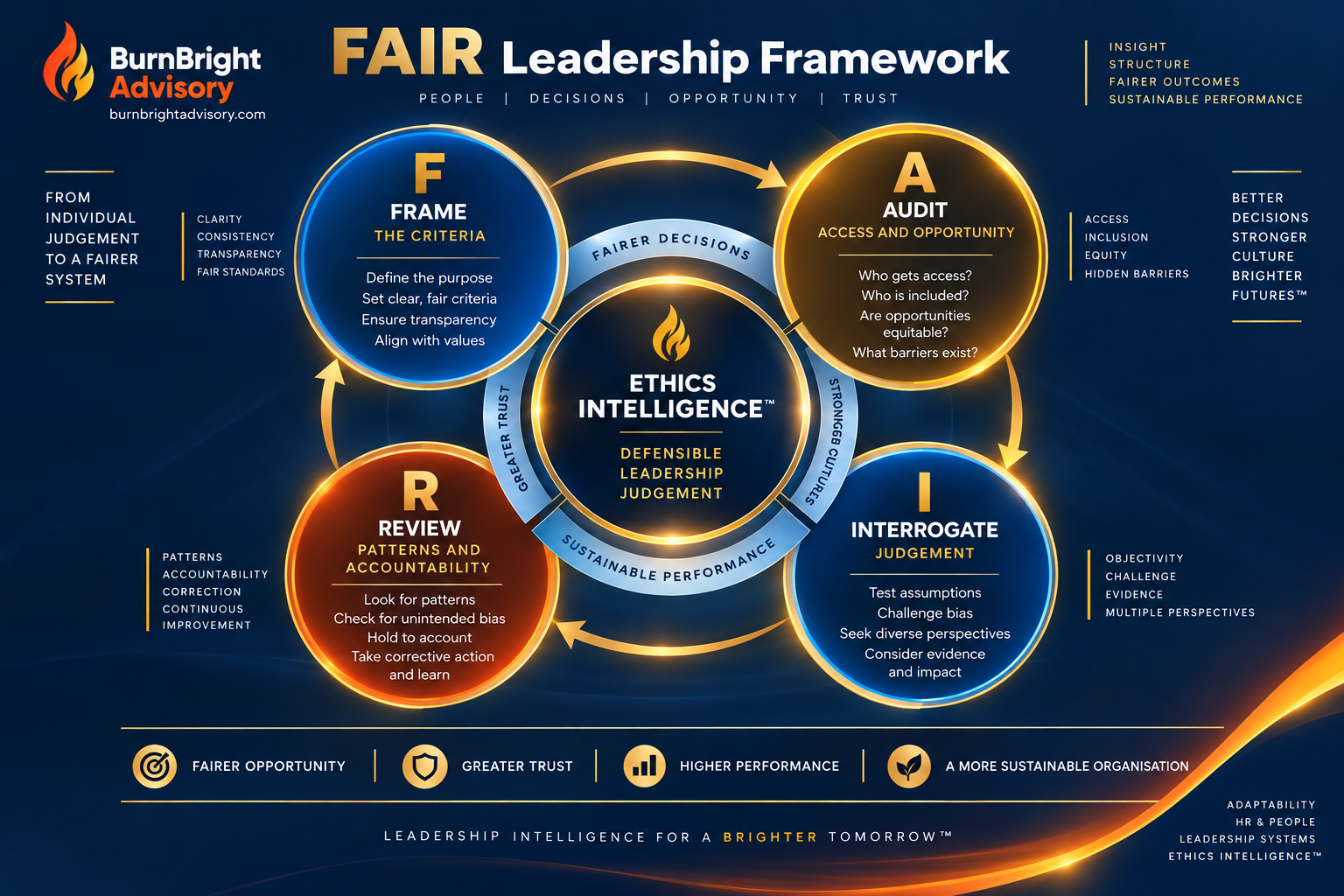
The Burn Bright FAIR Leadership Framework™
The greater the consequence of a leadership decision, the stronger the requirement for evidence, transparency, reflection and accountability. Choosing who takes notes in a meeting requires little governance. Choosing who is promoted, disciplined, rewarded or protected requires considerably more. Leaders can use four interconnected disciplines:
F Frame the Criteria
Establish what the work requires before considering candidates — analytical capability, stakeholder management, relevant expertise, developmental readiness — rather than starting from “who do I trust?” Criteria before candidate, not candidate before criteria. Test: could another reasonable leader understand the criteria you used and see how they relate to the decision?
A Audit Access and Opportunity
Over six or twelve months, examine who keeps appearing across strategic projects, acting roles, external representation, executive exposure and development. Repeated names aren’t proof of favouritism, but concentration should trigger reflection. Audit informal access too — who speaks with you before meetings, whose advice you instinctively seek, who can walk in without an appointment.
I Interrogate Judgement
Distinguish observation from interpretation — “Sarah challenges my proposals frequently” is an observation; “Sarah is difficult” is an interpretation open to other explanations. Apply the relationship-reversal test: would I interpret this behaviour the same way if another employee had done it? For consequential decisions, introduce ethical friction — a second reviewer, documented criteria, or a short reflective conversation with someone willing to challenge you.
R Review Patterns and Accountability
A decision can appear reasonable in isolation while contributing to an unreasonable pattern. One flexible-working exception may be justified; ten granted mostly to a trusted circle deserve examination. Ask both “was this decision defensible?” and “what pattern are our defensible decisions collectively producing?” Accountability should be understood as leadership infrastructure, not suspicion of bad leadership.
What Leaders Should Do When They Discover Their Own Favouritism
Suppose a leader completes the FAIR review and recognises a pattern — the same employees have received most opportunities, a particular colleague has been given repeated exceptions. The wrong response is defensiveness. The second wrong response is dramatic overcorrection, which would simply create another unfair system. Instead, correct the architecture:
- Acknowledge the pattern — establish what actually occurred, based on evidence rather than intent.
- Correct future processes — clearer criteria, broader consideration, greater visibility of development routes, more scrutiny for consequential decisions.
- Expand rather than punish — don’t disadvantage employees simply because they previously benefited from leadership trust; expand opportunity to others instead.
- Repair inconsistent accountability — make professional requirements explicit and apply them consistently going forward.
- Invite credible challenge — build in people who can say “you always go to the same three people” and treat that challenge as a leadership asset.
What If the Favouritism Is Deliberate?
Deliberate cases may require formal oversight, independent review, clearer decision rights, documented processes, HR or governance intervention, and consequences where policies or professional standards have been breached. Leadership development should never become a substitute for accountability — some problems need coaching, some need system redesign, some need governance, and effective Leadership Performance Intelligence™ means knowing the difference.
The Role of Senior Leaders
Senior leaders shape whether favouritism becomes culturally acceptable. If executives themselves operate through inner circles and selective accountability, asking middle managers to behave differently will achieve little — people observe upward. Senior leaders should ask themselves:
- Who receives access to us? Whose careers are we sponsoring?
- Who receives high-visibility opportunities?
- Whose poor behaviour do we rationalise because they produce results?
- Who can challenge us safely?
- Which capable people do we know almost nothing about — and why has our leadership system given us so little opportunity to know them?
From Inner Circles to Leadership Networks
Healthy organisations still contain trusted relationships — the difference is that trust does not become a closed system. Instead of a small inner circle, leaders can build broader leadership networks: deliberately hearing from different levels, rotating opportunities, exposing emerging leaders to strategic work, seeking challenge from people who think differently, and developing more than one successor. More information reaches leadership, more people develop, dependency decreases, and Leadership Capacity™ increases — connecting directly to Leadership Sustainability™.
A 30-Day Leadership Favouritism Review
Week 1 — Observe
Don’t change anything yet. Notice who receives your time, who you instinctively trust, who irritates you, who receives opportunities, flexibility and challenge.
Week 2 — Examine
Review several recent decisions involving opportunity, recognition, accountability or development. Apply the FAIR questions: what criteria were used, what evidence existed, what role did relationship play, would you make the same decision again?
Week 3 — Broaden
Identify capable people receiving less access or developmental opportunity. Identify meaningful responsibilities aligned with genuine development and organisational need, and broaden your sources of advice and information.
Week 4 — Systemise
Decide which practices should continue — an opportunity register, clearer selection criteria, quarterly access audits, rotating strategic assignments, second-review processes, structured succession discussions. Awareness fades; systems persist.
Ethical Leadership Must Be Designed
Good intentions are not enough. Most leaders want to believe they are fair, but fairness cannot depend entirely on leaders seeing their own biases accurately — human judgement is too complex for that. Strong leadership systems make ethical behaviour easier: they clarify criteria, distribute opportunity, make patterns visible, create appropriate challenge, and hold power accountable. This does not weaken leadership authority. It makes authority more credible.
Leadership Reflection™ Questions
Use these questions individually, in leadership supervision, during executive coaching, or as part of a wider Leadership Development System™ review.
Leadership Reflection Questions
- Who currently has the greatest informal access to me, and what professional advantages might that access create?
- Whose views do I routinely seek before making important decisions — and which capable people rarely have meaningful access to those conversations?
- Who received the most significant developmental opportunities during the last twelve months, and could I clearly explain why?
- Who might be capable of more if I deliberately created an appropriate opportunity for them?
- Which employees do I find easiest to trust, and which do I find difficult — what evidence actually supports each judgement?
- Do I interpret mistakes differently depending on who makes them?
- Would I make the same decision if the employee involved were someone I liked less — or someone I liked more?
- Are professional standards applied consistently across status, performance and relationship?
- Have I excused behaviour from a valued employee that I would challenge in somebody else?
- Can employees credibly challenge people who have close relationships with senior leaders?
- What patterns would appear if we mapped access, development, recognition and progression across the team?
- What would employees say actually determines who succeeds here?
Action Steps: Building a Fairer Leadership System
Leaders do not need to wait for a grievance, resignation or cultural crisis before addressing favouritism. They can act proactively:
- Define criteria before choosing people — criteria before candidate.
- Map opportunity, not just promotion, by tracking who receives capability-building experiences.
- Audit the leadership inner circle and ask whether familiarity has become dependency.
- Separate evidence from interpretation when assessing any employee.
- Use the relationship-reversal test on mistakes, flexibility, conflict, recognition and promotion.
- Create ethical friction for consequential decisions through documentation or peer review.
- Make opportunity more visible so informal networks cannot dominate through opacity.
- Apply accountability consistently — status and loyalty should not purchase immunity.
- Review cumulative patterns, not just individual decisions, across opportunity and accountability.
- Build leadership capacity beyond familiar people to strengthen the whole system, not just prevent unfairness.
Frequently Asked Questions
What is favouritism in leadership?
Leadership favouritism occurs when particular employees receive preferential access, opportunities, recognition, protection, information or influence for reasons that cannot be adequately justified through relevant and defensible professional criteria. It’s important to distinguish favouritism from legitimate differentiation — ethical leadership does not require identical treatment, only treatment that can be reasonably explained.
Is favouritism an ethical leadership issue?
Yes. Leaders control resources that affect people’s professional lives — opportunity, recognition, workload, development, accountability, information and progression. When personal relationships improperly influence those decisions, leadership authority is no longer being exercised solely according to legitimate professional considerations, which makes favouritism an Ethics Intelligence™ issue.
Is favouritism always intentional?
No. Some favouritism is deliberate, but it can also emerge unintentionally as leaders naturally develop trust and familiarity with certain people, who then receive more conversations, information and opportunities. Repeated over time, ordinary preference can become structural advantage even when the leader never intended to create an unfair system.
What is the difference between favouritism and rewarding high performance?
Rewarding demonstrated capability can be entirely legitimate. The distinction lies in the evidence and criteria — and in also examining how that capability became visible. If one employee has repeatedly received opportunities others were never given, their eventual experience may partly reflect the organisation’s previous distribution of opportunity rather than pure merit.
How does favouritism affect employee trust?
Favouritism can weaken trust because employees become uncertain whether formal standards genuinely determine organisational decisions. Once employees conclude that relationships matter more than performance, they may become more cautious about contributing, challenging decisions or investing in long-term development within the organisation.
Can favouritism affect psychological safety?
Yes. Employees may become reluctant to challenge a colleague perceived as close to the leader, even when leaders openly invite disagreement, because they calculate that questioning a favoured person could affect their own standing. The result can be organisational silence — psychological safety depends on whether the distribution of power makes speaking genuinely credible, not only on whether leaders say people can speak.
How can leaders identify favouritism in themselves?
Examine patterns rather than relying on intention — repeatedly giving opportunities to the same people, seeking advice from a narrow group, applying accountability inconsistently, or interpreting comparable behaviour differently depending on who’s involved. The Burn Bright FAIR Leadership Framework™ (Frame, Audit, Interrogate, Review) provides a structured way to surface these patterns.
What should a leader do if they realise they have shown favouritism?
Avoid both defensiveness and overcorrection. Identify the actual pattern, then improve future processes by clarifying criteria, widening access to development, strengthening accountability and introducing appropriate review. Don’t automatically penalise an employee who previously benefited from leadership preference — the objective is to correct the leadership architecture, not create another form of unfair treatment.
How can organisations prevent leadership favouritism?
Through clearer decision criteria, transparent development routes, opportunity monitoring, consistent performance standards, credible challenge mechanisms, leadership reflection and appropriate governance of consequential decisions — including examining whether succession and talent systems repeatedly favour people who already have access to influential leaders. Preventing favouritism is both a cultural and a systems-design responsibility.
Conclusion: Ethical Leadership Is Revealed in the Distribution of Power
Most leaders would describe themselves as fair. That is not the standard that matters most. The more useful question is whether employees experience a leadership system in which access, opportunity, recognition and accountability are distributed according to principles they can reasonably understand and trust.
Favouritism challenges leadership because it develops at the intersection of two legitimate realities: leadership is relational, and leadership involves power. Leaders need trust, strong professional relationships, discretion and people they can rely upon. But the moment those relationships begin influencing who receives opportunity, information, recognition, protection or accountability, leadership enters ethical territory.
This is why eliminating personal preference is neither realistic nor necessary. The task is to prevent preference from becoming unexamined privilege — through Ethics Intelligence™ to test whether decisions are defensible, Professionalism Intelligence™ to maintain credible standards, Emotional Intelligence™ to recognise how affinity influences judgement, Reflective Practice Intelligence™ to expose assumptions and patterns, Leadership Benchmarking™ to make cumulative outcomes visible, and Leadership Sustainability™ to ensure opportunity does not stay concentrated around a small number of trusted people.
The most important leadership question is therefore not “Do I have favourites?”
It is “Does my leadership system allow personal preference to determine outcomes that should be governed by professional principle?”
Employees do not experience organisational ethics primarily through value statements. They experience ethics through what happens when opportunities are scarce, decisions are difficult, and relationships matter — who gets heard, developed, forgiven, challenged, promoted and protected. From those decisions, they learn what leadership actually values.
Take the Leadership Burnout Self-Assessment
Favouritism, unclear decision criteria and concentrated leadership dependency don’t just create fairness problems — they add to the structural load a leader carries. Use the Burn Bright Leadership Burnout Self-Assessment to identify where workload, decision pressure and leadership architecture may be creating unsustainable conditions.
Free Leadership Intelligence
Get Weekly Leadership Insights
Join thousands of leaders receiving practical strategies on burnout prevention, workload design, and sustainable performance every week.