Quick Answer
Key Takeaways
- Expertise matters, but it is increasingly insufficient alone. Leadership performance now depends on a leader’s ability to create new understanding, not just apply existing knowledge.
- Constructivism Intelligence™ reframes the leadership question from “How do I provide the right answer?” to “How do we develop the best possible understanding of this situation?”
- Positional authority can create an information paradox: the person with the greatest decision-making power can become the person least exposed to contradictory information.
- The Constructivist Leadership Cycle — Experience, Interpretation, Perspective, Reflection, Reconstruction — shows learning only counts once a belief, process or decision actually changes.
- Constructivism is not consensus leadership. Leaders retain accountability for decisions; the goal is better-informed judgement, not endless consultation.
What Is Constructivism in Leadership?
Leadership has traditionally rewarded the person who knows. The experienced executive knows what decision to make. The school leader knows what good practice looks like. The clinical leader knows the appropriate response. The entrepreneur knows where the business needs to go.
Expertise matters. But expertise alone is increasingly insufficient for leadership in complex environments. Many of the problems confronting organisations do not arrive with established answers. Artificial intelligence is reshaping professional roles faster than many organisations can redesign them. Workforce expectations are changing. Regulatory environments are evolving. Customers, communities, employees and other stakeholders bring competing perspectives to increasingly interconnected decisions.
Under these conditions, leadership performance depends on more than what a leader already knows. It depends on the leader’s ability to create new understanding.
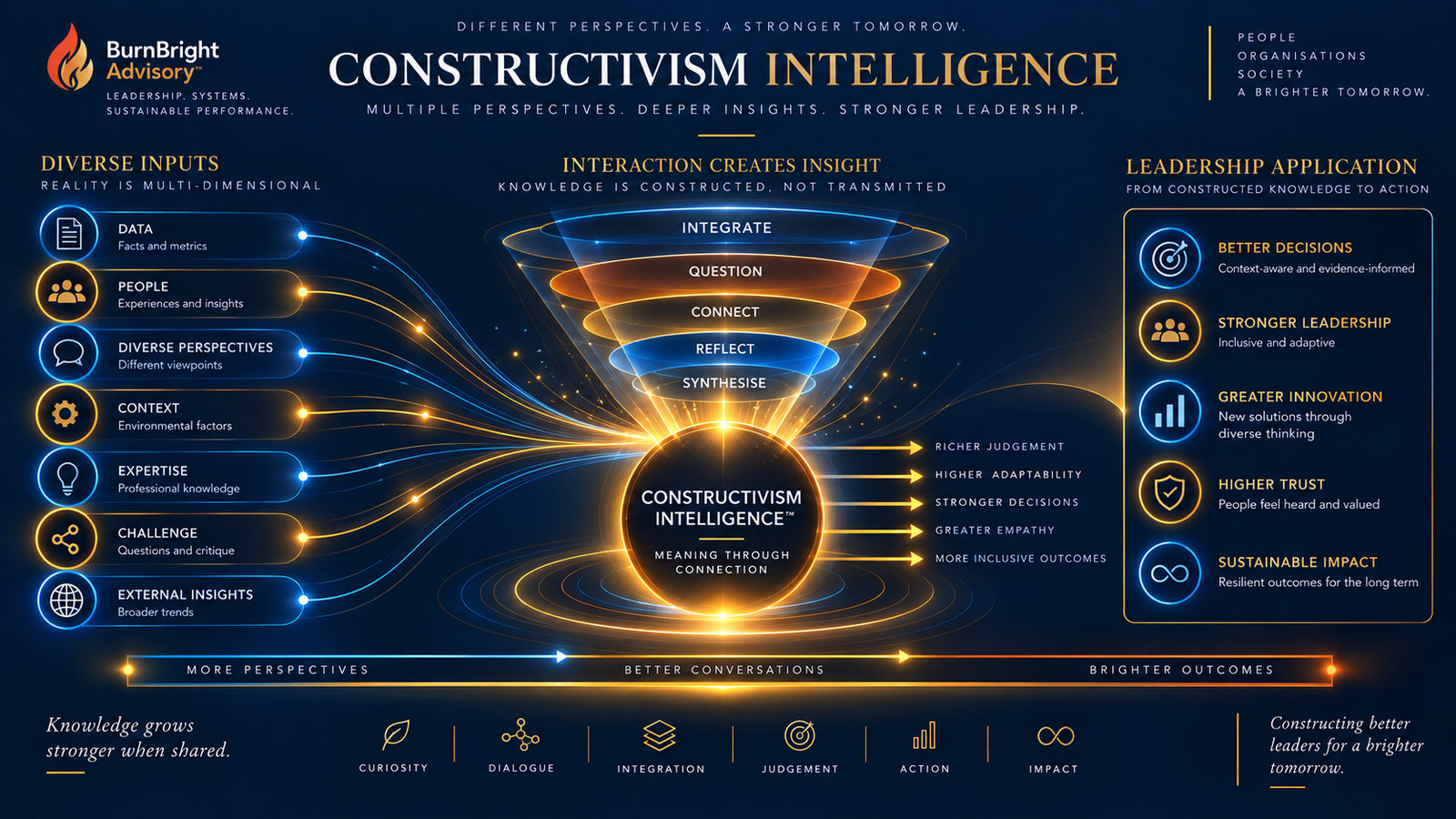
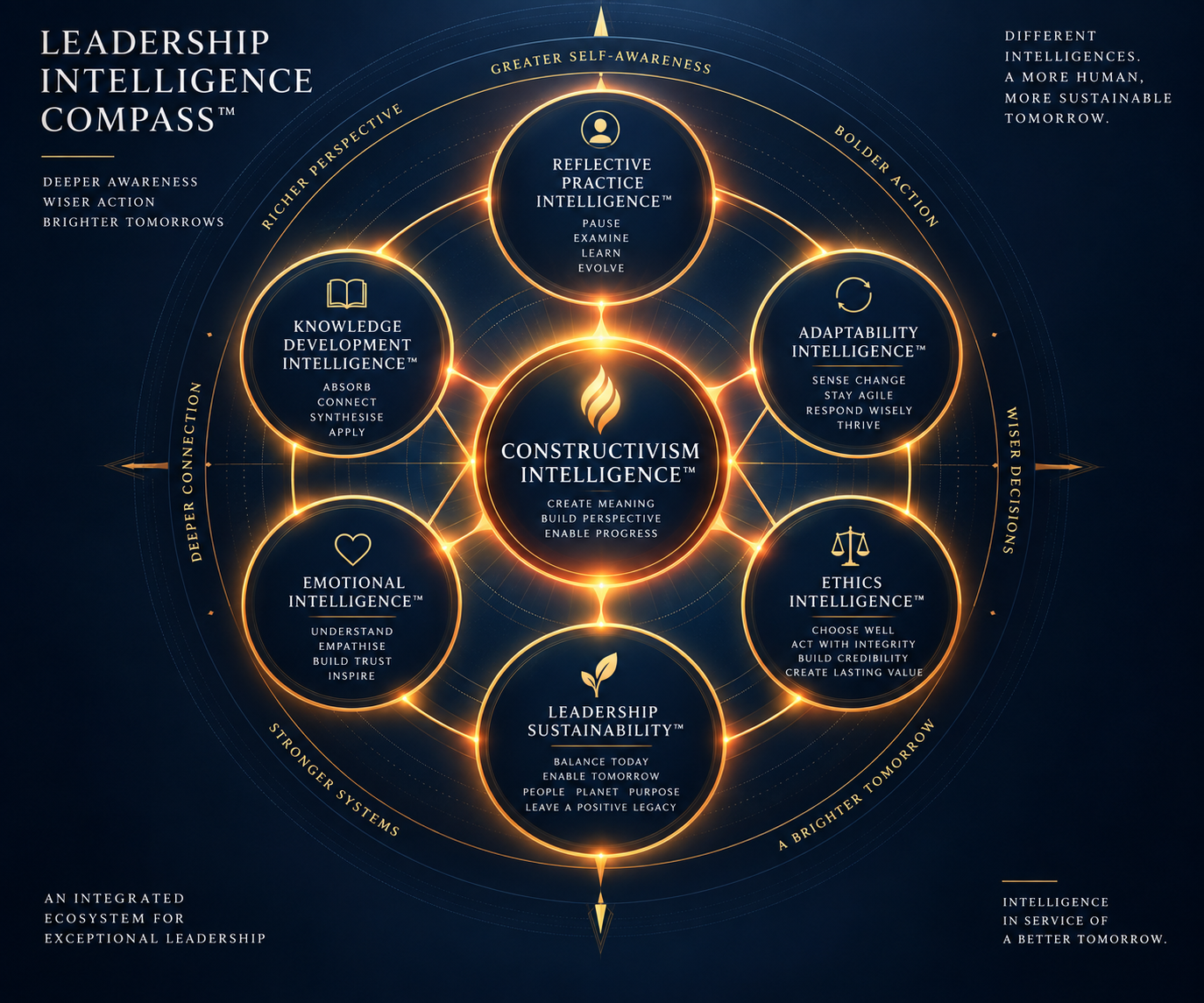
That distinction sits at the heart of Constructivism Intelligence™, one of the domains within the Burn Bright Advisory™ Leadership Intelligence Compass™. It concerns a leader’s capacity to recognise that knowledge is developed rather than merely received — constructed by connecting experience, evidence, reflection, dialogue and alternative perspectives.
This changes the fundamental leadership question. Instead of asking “How do I provide the right answer?”, the constructivist leader asks “How do we develop the best possible understanding of this situation?”
It changes meetings from information-delivery mechanisms into opportunities for collective reasoning.
It changes disagreement from something to suppress into information to investigate.
It changes mistakes from evidence of incompetence into potential sources of organisational learning.
It changes leadership development from acquiring isolated techniques into continually reconstructing how leaders understand themselves and their organisations.
The strongest leader is no longer necessarily the individual who possesses the greatest amount of knowledge. Increasingly, it is the leader who can create the conditions through which knowledge continues to develop.
Featured Snippet
Constructivism in Leadership: From Knowing to Learning
There is an assumption embedded deeply within traditional leadership culture: leaders are supposed to know. Promotion frequently reinforces it. People become leaders because they have demonstrated competence, and as responsibility increases, organisations begin directing increasingly difficult questions towards them. Eventually, expertise becomes intertwined with leadership identity — people stop asking the leader merely to contribute; they expect the leader to know.
That expectation can create a subtle but important leadership vulnerability. When authority becomes associated with having answers, admitting uncertainty becomes psychologically difficult. Questions can feel like threats to credibility. Alternative perspectives can feel like challenges to authority. Changing one’s mind can appear inconsistent. Mistakes can become something to defend rather than examine. The leader who was promoted because of expertise can gradually become trapped by it.
Constructivist leadership offers a different model. It does not reject expertise — it places expertise inside a larger learning system. A constructivist leader can say “This is what I currently understand,” then add “What are we missing?” The first acknowledges expertise. The second acknowledges incompleteness. Together, they create the intellectual conditions required for learning.
What Is Constructivism?
Constructivism is most commonly associated with theories of learning. At its simplest, it proposes that people do not merely receive knowledge as passive recipients — they develop understanding by interpreting new information through previous experience, existing beliefs, social interaction and reflection. Learning therefore involves more than collecting information. It involves constructing meaning. Two people can encounter the same event and interpret it differently because they bring different experiences, assumptions and mental models to it.
Leadership works in much the same way. Consider an organisation experiencing declining performance. One executive may interpret the problem as weak accountability. Another may see inadequate capability. Employees may see unrealistic workload. Customers may identify deteriorating service. Finance may point towards resource constraints. HR may identify turnover and capability gaps. None necessarily possesses the complete explanation — each is viewing the organisational reality through a different informational lens.
Traditional leadership can respond by deciding which interpretation is correct. Constructivist leadership begins differently. It asks: what can we understand by examining these perspectives together? That question matters because organisational problems rarely exist within one person’s field of vision.
Constructivism Intelligence™ as Leadership Capability
Within Burn Bright Advisory’s Leadership Performance Intelligence™ framework, Constructivism Intelligence™ can be understood as the capacity to actively build, test and reconstruct understanding. It involves the leader’s ability to:
- recognise that their current interpretation may be incomplete;
- surface assumptions influencing decisions;
- integrate different perspectives;
- distinguish evidence from interpretation;
- learn from experience;
- encourage productive questioning;
- revise mental models when new information emerges;
- create environments in which knowledge can be developed collectively.
This is not indecisiveness. Nor does it mean every decision must become a democratic exercise. Leadership still requires judgement — there are moments when leaders must decide quickly, particularly when safety, ethics, regulation or operational continuity is at stake. Constructivism Intelligence™ improves the quality of the understanding from which judgement is exercised.
Why Constructivism Matters More in Complex Organisations
In relatively stable environments, accumulated experience can be a powerful predictor of future success — a leader recognises the pattern, remembers what worked, and applies the established response. But complexity changes this equation. When technology, markets, workforce expectations, regulation or social conditions change rapidly, previous experience remains useful without necessarily remaining sufficient.
The danger is not experience itself. The danger is assuming that because something worked before, the underlying conditions remain unchanged. This is where leaders can become prisoners of successful mental models: a strategy produces strong results, the organisation repeats it, it becomes standard practice, and standard practice becomes organisational wisdom nobody thinks to question — until the environment changes.
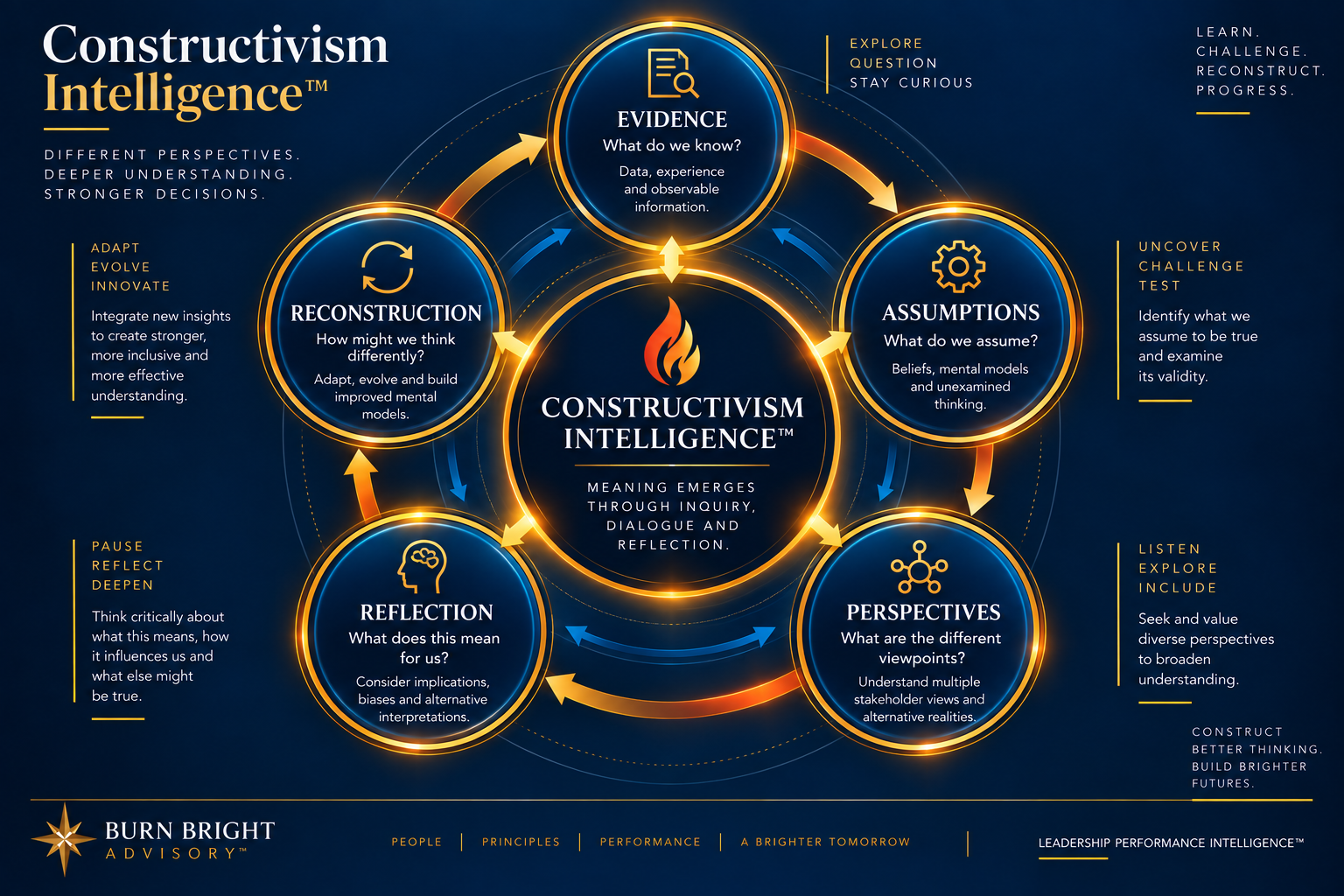
Constructivism Intelligence™ interrupts this process by institutionalising inquiry. The question becomes not simply “What do we know?” but also “How do we know it, and under what conditions might it no longer be true?” This matters particularly for senior leaders because authority can unintentionally protect assumptions from challenge — the more senior the leader, the less likely some employees may be to contradict them openly. As a result, positional authority can create an information paradox: the person with the greatest decision-making power can become the person least exposed to contradictory information. Constructivist leadership deliberately counteracts that risk.
The Constructivist Leadership Cycle
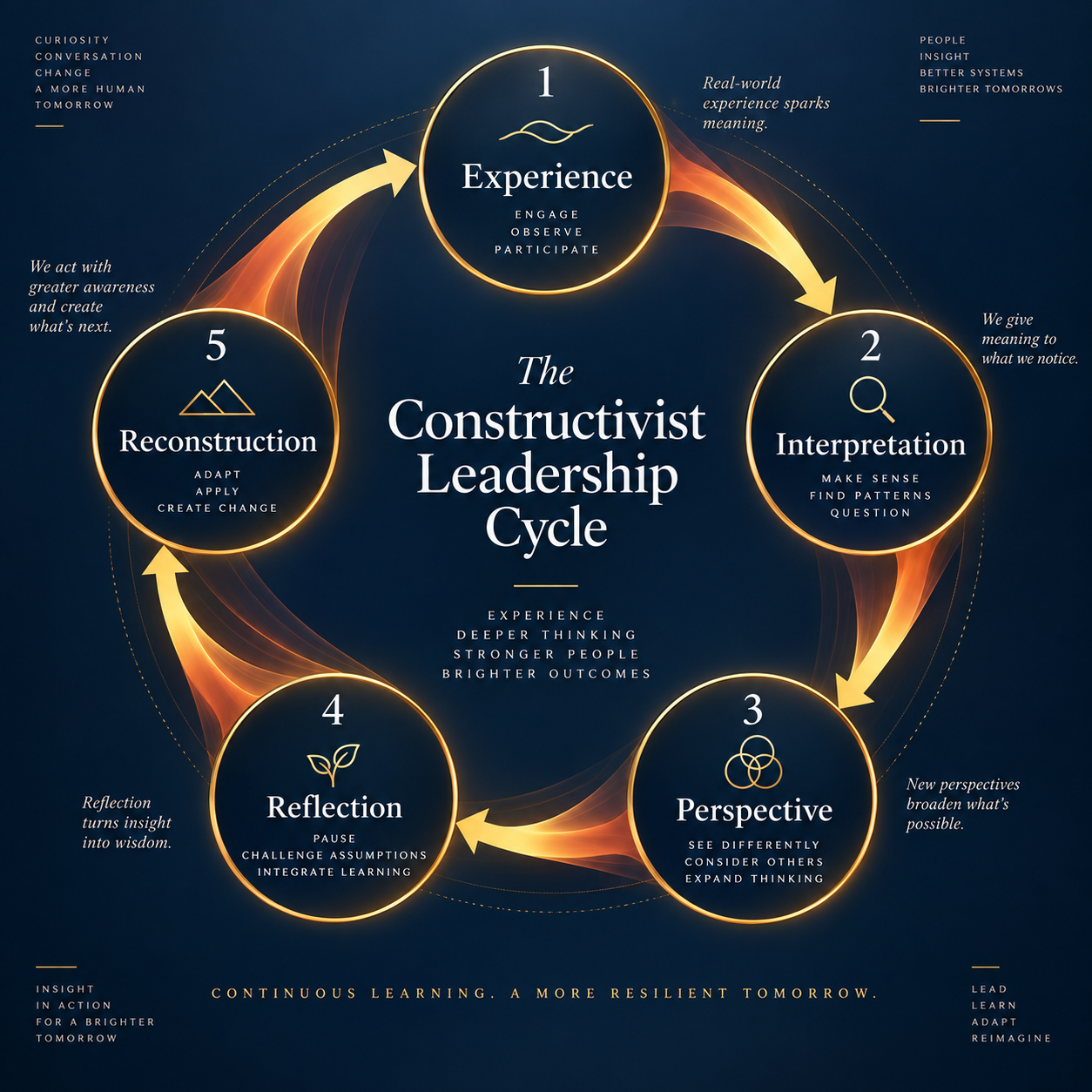
A useful way to understand Constructivism Intelligence™ is through a five-stage cycle.
Stage 1
Experience
Leadership begins with reality. Something happens — performance falls, a project succeeds, a customer complains, an employee leaves, a strategy underperforms. Weak learning cultures rush immediately towards explanation. Constructivist leaders resist premature certainty and first ask: what actually happened?
Stage 2
Interpretation
Human beings automatically assign meaning to events — the failed project becomes “poor execution,” the resignation becomes “a better offer.” But interpretation is not the same as fact. Constructivist leaders deliberately separate observation from explanation and ask: what are we assuming this means?
Stage 3
Perspective
Different stakeholders possess different pieces of organisational reality. The leader expands the informational field: what does the frontline see, what does the customer experience, what does the data indicate, where are people disagreeing? Instead of treating variation as noise, constructivist leaders treat it as potential intelligence.
Stage 4
Reflection
Information alone does not create learning. Leaders need space to examine what the information means, asking what has changed in our understanding. This is where Constructivism Intelligence™ connects strongly with Reflective Practice Intelligence™: constructivism develops understanding, reflection examines it.
Stage 5
Reconstruction
The final stage is often overlooked. Learning requires something to change — a belief, a process, a decision, a strategy. If leaders repeatedly gather information but their mental models remain untouched, organisational learning has not genuinely occurred. Constructivist leadership culminates in asking: given what we now understand, what should we think or do differently?
The cycle then begins again: Experience → Interpretation → Perspective → Reflection → Reconstruction. This is how leadership knowledge evolves — and in environments where yesterday’s assumptions can rapidly become tomorrow’s constraints, that capacity is becoming central to sustainable leadership performance.
Five Behaviours of Constructivist Leaders
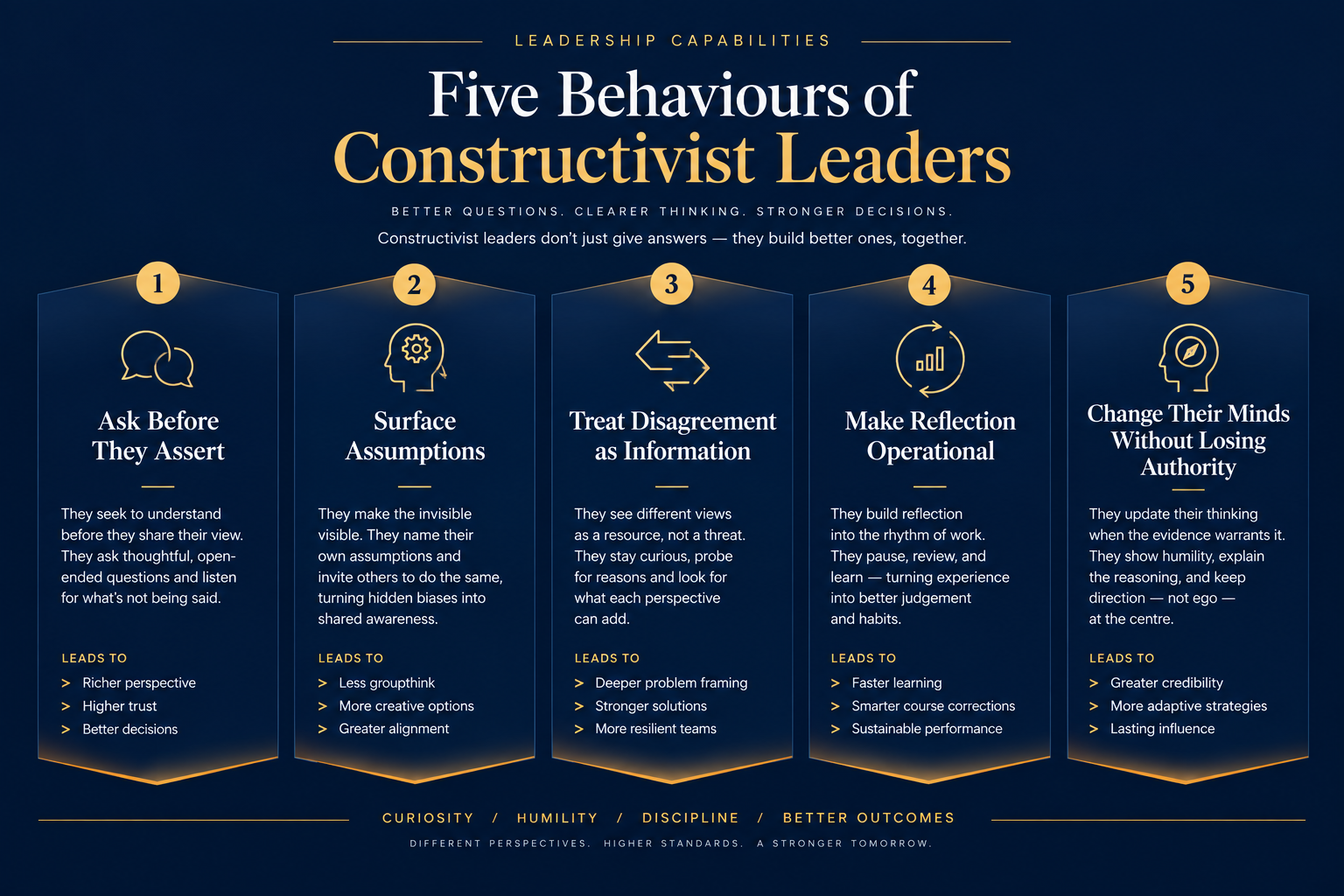
Constructivism Intelligence™ becomes valuable when it changes leadership behaviour. A leader may intellectually agree that multiple perspectives matter while still dominating meetings, or value learning while punishing mistakes. The test, therefore, is not whether leaders describe themselves as open-minded — it is whether their behaviour creates conditions in which understanding can genuinely develop.
1. They Ask Before They Assert
Leadership authority creates an asymmetry in conversation. When a senior leader speaks first, other people often adjust their contributions accordingly — some agree, others soften disagreement, some withhold contradictory information altogether. A leader may believe the team has reached the same conclusion when the team has actually adapted itself to the leader’s conclusion.
A traditional opening might be “Our problem is customer service — we need to improve frontline performance,” which anchors the meeting immediately. A constructivist opening is different: “Retention has declined for three consecutive periods. Before we decide why, what does each part of the organisation tell us about what may be happening?” The first approach asks people to solve the leader’s interpretation of the problem. The second asks them to help construct the interpretation itself.
2. They Surface Assumptions
Every important decision contains assumptions — a recruitment strategy assumes something about what attracts talent, a digital transformation assumes something about how people will use technology. Problems emerge when assumptions become invisible; once an assumption is treated as fact, leaders stop testing it. Before approving an important initiative, constructivist leaders ask what must be true for the plan to succeed, which of those conditions have been verified, which are assumptions, and what evidence would cause them to reconsider.
3. They Treat Disagreement as Information
Many organisations claim to value challenge; fewer make challenge comfortable. Constructivism Intelligence™ reframes disagreement — instead of asking “Who is right?”, the leader asks “What does this disagreement reveal?” Two departments may disagree because they hold different information; a senior leader and a frontline employee may disagree because they experience different parts of the same system. This doesn’t mean all opinions are equally valid — evidence, expertise, ethics and professional standards still matter — but disagreement should be examined before it is dismissed.
4. They Make Reflection Operational
Reflection is often treated as something leaders should do when time permits. Constructivist leadership treats it as part of the operating system: after a significant project, ask what did we expect, what actually happened, what explains the difference, what have we learned, what will we change. Experience is what happened; learning is what changed because you examined what happened. Reflection without reconstruction risks becoming contemplation; construction without reflection risks becoming premature interpretation.
5. They Change Their Minds Without Losing Authority
One of the most difficult behaviours in leadership is publicly revising a position. Some leaders fear it communicates weakness — in reality, the greater risk may be defending an increasingly weak position simply because it was previously stated with confidence. Constructivist leaders distinguish consistency of purpose from consistency of opinion: purpose can remain stable while strategy changes. A leader can say “Based on what we knew at the time, that was a reasonable decision. We now have additional evidence, so our approach needs to change” — that is not indecision, it can be evidence of learning.
Constructivism Is Not Consensus Leadership
There is an important misconception to address. Constructivist leadership does not mean every person participates equally in every decision. It does not require endless consultation, remove hierarchy, or mean leaders surrender accountability to the group — and it certainly does not mean every perspective carries equal evidential weight.
The distinction is between participation in knowledge construction and authority for decision-making. A chief executive may remain accountable for the decision while drawing upon perspectives from employees, customers and specialists. A clinical leader may encourage questioning and multidisciplinary dialogue while recognising that clinical accountability and patient safety establish clear boundaries around decision authority. Constructivist leadership therefore requires leaders to know when to open a question and when to close it — that judgement is itself an intelligence.
| Leadership Situation | Constructivist Response |
|---|---|
| Problem is poorly understood | Expand inquiry |
| Multiple perspectives contain relevant knowledge | Invite contribution |
| Assumptions are uncertain | Test them |
| Evidence conflicts | Investigate disagreement |
| Experimentation is safe | Learn through action |
| Ethical boundary is clear | Protect the boundary |
| Safety-critical response is required | Act decisively |
| Consultation has produced sufficient understanding | Decide |
| New evidence emerges | Reassess |
The objective is therefore not consensus. It is better-informed judgement.
A Practical Example: When the Problem Is Not the Problem
Consider a fictional organisation experiencing increasing employee turnover. Senior leaders conclude that compensation is the primary issue — competitors have increased salaries, recruiters are active in the market, and exit interviews occasionally mention pay. The proposed solution is straightforward: increase compensation for critical roles.
A constructivist leader slows the reasoning process before approving the intervention. The leadership team examines turnover data by department, tenure, role and manager. They speak with current employees rather than relying exclusively on exit interviews. They examine workload, analyse promotion patterns, explore employee perceptions of development opportunities, and compare teams with similar compensation but significantly different retention.
A more complex picture emerges. Compensation matters, but it is not the entire problem. Employees in several high-turnover teams report unclear priorities, inconsistent management, excessive workload and limited development, while other teams with almost identical salary structures retain people successfully.
Compensation may still need attention. But compensation alone would have treated a multidimensional leadership problem as a single-variable financial problem. The value here does not come from holding more meetings. It comes from improving the quality of the organisational mental model before committing resources to a solution.
Constructivism Across Leadership Sectors
Constructivism Intelligence™ matters within the Leadership Intelligence Compass™ because the capability transfers across sectors even though its application changes with context.
Business Growth Intelligence™
When a flagship product is losing market share, the conventional response asks senior executives to diagnose the problem alone. A constructivist approach widens the knowledge system — customer service, sales, product and marketing each see a different piece — so the question becomes not “What strategy should we adopt?” but “What do we need to understand before we decide what strategy the evidence supports?”
School Leadership Intelligence™
Education is a natural setting for constructivist leadership, yet practice can remain transmission-oriented — an initiative designed centrally and delivered to teachers. A constructivist school leader investigates variation in implementation instead of assuming teachers simply need more training, turning the school into an organisation capable of learning about its own practice.
Healthcare Leadership Intelligence™
Clinical standards and evidence-based protocols matter profoundly, yet outcomes also depend on information distributed across a system — a nurse notices a change in condition, a pharmacist spots a medication risk. Constructivist leadership lets relevant knowledge travel across professional boundaries without confusing differences in responsibility or expertise, asking: can the system hear important information regardless of where it originates?
Public Service Leadership Intelligence™
A policy that appears effective at strategic level may produce unintended consequences during implementation, where frontline professionals understand barriers invisible to policymakers. Constructivist public leadership requires mechanisms through which implementation experience feeds back into policy understanding — consultation alone is insufficient; the organisation must be capable of changing what it thinks because of what it learns.
HR & People Leadership Intelligence™
Concepts like culture, engagement and belonging are difficult to understand through a single metric. Declining engagement scores might reflect leadership quality, workload, role ambiguity or declining trust. Constructivist HR leadership combines quantitative evidence with qualitative understanding to construct a more accurate explanation of the reality behind the data, not simply to collect more of it.
Entrepreneur Performance Intelligence™
Founders often begin with strong convictions — without which many ventures would never start. But the same conviction can eventually prevent learning when customer behaviour contradicts the original proposition. Constructivist entrepreneurship requires conviction strong enough to act and curiosity strong enough to learn, without abandoning vision at the first disagreement or protecting the original idea from every piece of contradictory evidence.
The Connection to Psychological Safety
Constructivist leadership cannot function effectively without sufficient psychological safety. A leader can ask “What are we missing?” — but if employees believe the wrong answer will damage their career, the question produces little useful intelligence. A leader can request challenge, but if previous challengers have been marginalised, people learn that agreement is safer. A leader can announce that mistakes are learning opportunities, but if performance conversations punish every unsuccessful experiment, behaviour will follow the consequences rather than the slogan.
This creates an important connection between Constructivism Intelligence™, Emotional Intelligence™, Professionalism Intelligence™ and Ethics Intelligence™. Constructing knowledge is not merely a cognitive process — it is relational. People must believe they can contribute information responsibly. Leaders need the emotional capacity to hear challenge without reflexively defending themselves. And the organisation requires ethical boundaries that prevent openness from becoming licence for disrespect or irresponsible behaviour.
This is why the Leadership Intelligence Compass™ should not be understood as a collection of isolated leadership competencies. The domains interact. Constructivism Intelligence™ strengthens the organisation’s capacity to learn. Reflective Practice Intelligence™ helps examine that learning. Knowledge Development Intelligence™ helps deepen and distribute it. Adaptability Intelligence™ enables leaders to respond to it. Ethics Intelligence™ helps determine how new understanding should be used. Leadership Sustainability™ asks whether the resulting practices can be maintained without exhausting the people responsible for delivering them.
From the Leader Who Knows to the Organisation That Learns
The deepest implication of constructivist leadership is therefore organisational rather than individual. The objective is not simply to create leaders who ask better questions. It is to create organisations that become better at learning from themselves.
Experience must become accessible.
Reflection must influence future practice.
Frontline insight must travel upwards.
Strategic context must travel downwards.
Mistakes must produce learning rather than merely blame.
Successful practices must be examined rather than blindly repeated.
Assumptions must remain open to responsible challenge.
When these conditions exist, leadership begins to shift from an individual capability towards an organisational intelligence system. Because in increasingly complex environments, sustainable competitive and institutional advantage may not come from knowing more than everyone else. It may come from being able to learn better than everyone else.
Reflection Questions
Constructivism Intelligence™ begins with the willingness to examine not only what we know, but how we came to know it. Use the following questions individually, with a leadership team, or as part of a wider Leadership Intelligence Assessment™ conversation.
Leadership Reflection Questions
- Where am I most likely to confuse experience with certainty?
- When was the last time someone genuinely changed my mind about an important leadership issue?
- Whose knowledge is missing from the decisions I make?
- How do I respond when someone challenges my interpretation — curious, defensive, dismissive or interested in the evidence?
- Which organisational assumptions have become accepted as facts?
- How effectively does my organisation convert experience into learning?
- Where does useful knowledge currently become trapped, and between which teams or levels?
- What have we learned during the past year that has genuinely changed how we operate?
- Do I create more certainty than the evidence justifies?
- What would I need to learn differently to lead better?
Action Steps: Building Constructivism Intelligence™
Constructivism Intelligence™ develops through practice rather than declaration. Leaders can begin with five actions.
Use BUILD on One Current Leadership Challenge
Choose a genuine strategic, operational or people challenge and apply the BUILD framework. Do not begin by asking how to solve the problem — begin by asking whether the organisation understands the problem accurately enough.
B Broaden
Broaden the perspectives involved in understanding the challenge.
U Uncover
Uncover the assumptions currently shaping how the challenge is understood.
I Investigate
Investigate the evidence rather than relying on the first plausible explanation.
L Learn
Learn through structured reflection on what the evidence and perspectives reveal.
D Develop
Develop a revised understanding — and act from that, not from the original assumption.
Introduce an Assumption Check
For one significant decision this week, ask the team “What must be true for this decision to succeed?”, write down the answers, then classify them as Known, Likely or Uncertain. This can reveal how much strategy depends on assumptions that have never been explicitly examined.
Change One Meeting Question
Replace “Does everyone agree?” with “What perspective or risk have we not considered?” The objective is not to manufacture disagreement — it is to make responsible challenge legitimate.
Create One Learning Loop
Select a recurring source of organisational intelligence — customer feedback, project reviews, employee experience, incidents or operational data. Map what currently happens to that information, then ask: does it reach the people capable of learning from it and changing something because of it? If not, close the loop.
Demonstrate Reconstruction Publicly
Identify one area in which evidence has changed your thinking, and explain what you previously believed, what you learned, what changed in your understanding, and what you will now do differently. Leaders who demonstrate learning give others permission to learn.
Frequently Asked Questions
What is constructivism in leadership?
Constructivism in leadership is an approach that recognises useful leadership knowledge is actively developed through experience, evidence, dialogue, reflection and multiple perspectives, rather than simply transmitted from leaders to followers. A constructivist leader does not abandon expertise — they create conditions in which existing expertise can be questioned, combined and developed into stronger understanding.
What is Constructivism Intelligence™?
Within the Burn Bright Advisory™ Leadership Intelligence Compass™, Constructivism Intelligence™ describes a leader’s capacity to build, test and reconstruct understanding — recognising assumptions, seeking different perspectives, learning from experience, examining evidence and changing mental models when new information requires it.
Why is constructivism important for leaders?
Constructivism is increasingly important because many leadership problems are complex, interconnected and changing, and no single leader possesses complete information. Constructivist leadership helps organisations integrate distributed knowledge, identify weak assumptions and develop better-informed responses.
Is constructivist leadership the same as collaborative leadership?
They overlap but are not identical. Collaborative leadership emphasises working with others; constructivist leadership specifically focuses on how understanding is developed. A leader can collaborate extensively while still protecting existing assumptions — constructivism requires leaders to remain open to the possibility that collaboration will change what they think.
Does constructivism mean leaders should seek consensus?
No. Constructivism is about improving understanding, not ensuring universal agreement. Leaders remain responsible for making decisions within appropriate professional, ethical and organisational boundaries — the objective is better-informed judgement, not permanent consultation.
Can constructivist leadership slow decision-making?
It can if poorly applied. Excessive consultation, repeated analysis and an unwillingness to act under uncertainty can create decision paralysis. Effective Constructivism Intelligence™ therefore includes knowing when sufficient understanding exists to make a responsible decision.
How does constructivism improve organisational learning?
Constructivism encourages organisations to examine experience, question assumptions, compare perspectives and translate learning into changed practice — creating a cycle in which experience does more than accumulate, it develops organisational knowledge.
What is the relationship between constructivism and reflective practice?
The two capabilities are closely connected. Reflective Practice Intelligence™ helps leaders examine experiences, actions and outcomes; Constructivism Intelligence™ helps leaders use that examination to develop or reconstruct understanding. Reflection creates the opportunity to learn; constructivism helps transform that learning into a revised mental model.
How can leaders develop Constructivism Intelligence™?
By asking better questions, separating evidence from assumptions, inviting responsible challenge, conducting structured reflection, seeking perspectives beyond their immediate leadership circle, and demonstrating willingness to revise their thinking when evidence changes. The Burn Bright BUILD framework — Broaden, Uncover, Investigate, Learn, Develop — provides a practical sequence.
Conclusion: Leadership Is Not the Possession of Answers
For generations, leadership authority has been closely associated with knowing. The leader knows the direction. The leader provides the answer. The leader resolves uncertainty. There will always be situations in which expertise, clarity and decisive action are required.
But complexity creates another leadership responsibility. Leaders must also know how to learn. They must recognise when their knowledge is incomplete, distinguish evidence from interpretation, expose assumptions to examination, and hear perspectives that positional authority might otherwise silence. They must reflect on the consequences of decisions and, when the evidence demands it, possess enough intellectual confidence to reconstruct what they previously believed.
It transforms curiosity from a personality trait into a leadership capability.
It transforms reflection from contemplation into organisational learning.
It transforms disagreement from inconvenience into potential intelligence.
And it transforms leadership from the responsibility to possess every answer into the responsibility to create conditions in which stronger answers can emerge.
Within Burn Bright Advisory’s Leadership Performance Intelligence™, this capability cannot operate alone. Constructivism Intelligence™ requires Professionalism Intelligence™ to make challenge productive, Ethics Intelligence™ to ensure that what organisations learn is translated into responsible action, Emotional Intelligence™ so leaders can hear difficult information without defensiveness, Reflective Practice Intelligence™ to convert experience into insight, Knowledge Development Intelligence™ to expand and distribute learning, and Adaptability Intelligence™ to turn new understanding into changed behaviour. It ultimately contributes to Leadership Sustainability™ by helping organisations become less dependent on individual heroics and more capable of collective learning.
The question for leaders is therefore no longer simply “Do I know enough to lead?” A more powerful question is: “Have I built the capacity to keep learning what leadership now requires?”
Take the Leadership Burnout Self-Assessment
Leaders who feel they must always have the answer often carry a heavier structural load than they realise. Use the Burn Bright Leadership Burnout Self-Assessment to identify where workload, decision pressure and the expectation of certainty may be creating unsustainable leadership conditions.
Free Leadership Intelligence
Get Weekly Leadership Insights
Join thousands of leaders receiving practical strategies on burnout prevention, workload design, and sustainable performance every week.