Quick Answer
Key Takeaways
- Adaptability is the intelligence to interpret change, not simply the willingness to react to it.
- Every adaptive decision answers three questions: what has changed, what must change and what must remain consistent.
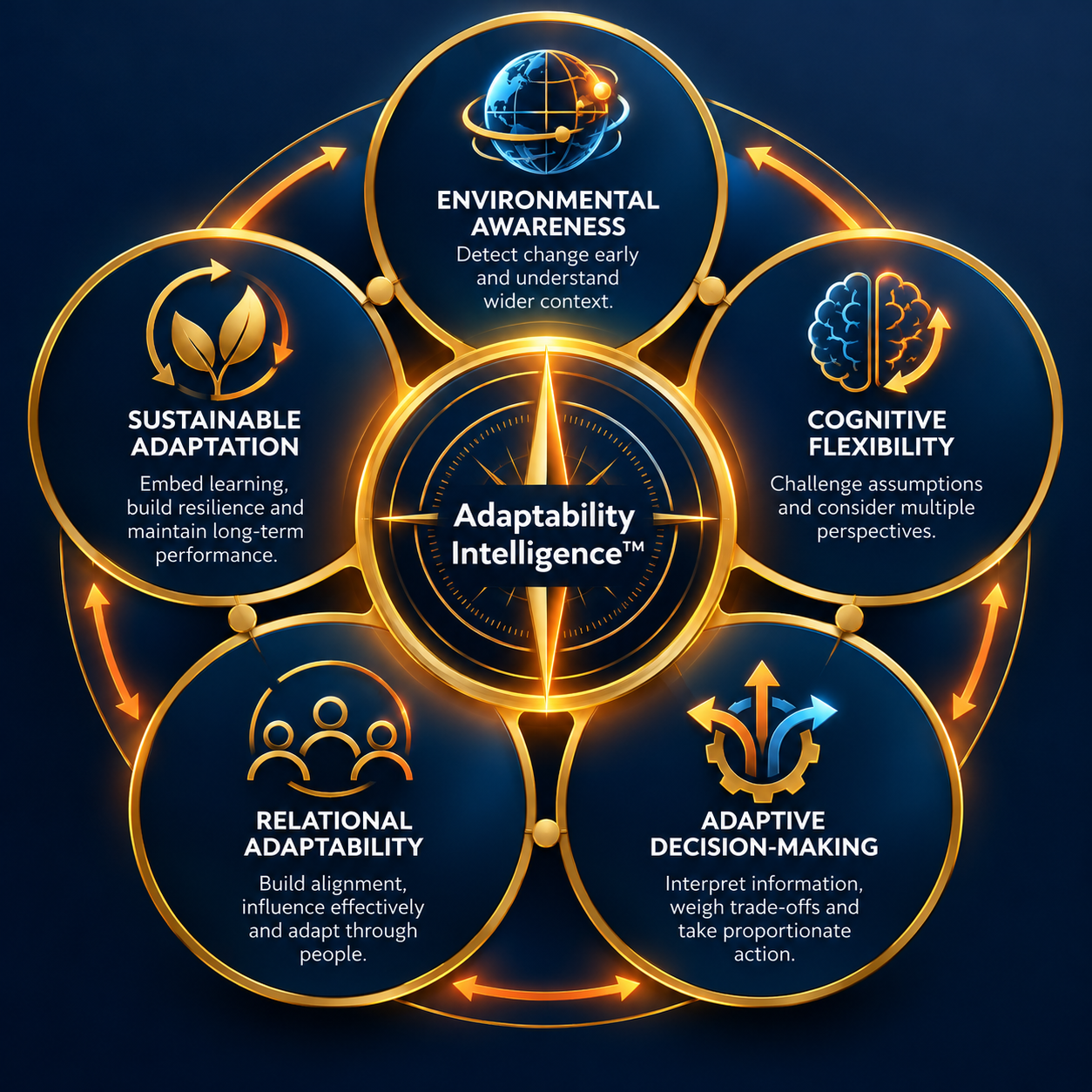
- Adaptability Intelligence™ rests on five capabilities: Environmental Awareness, Cognitive Flexibility, Adaptive Decision-Making, Relational Adaptability and Sustainable Adaptation.
- Poorly managed adaptation creates strategic instability, change fatigue and ethical compromise.
- Adaptability becomes an organisational capability only when culture, decision authority and Leadership Capacity™ support it — burnout and reactivity are system failures, not personal ones.
Adaptability Leadership: Building the Intelligence to Lead Through Complexity and Change
Why the future of leadership depends not simply on responding to change, but on developing the intelligence to interpret, navigate and shape it.
Adaptability has become an essential leadership capability in organisations confronting technological disruption, workforce transformation, economic uncertainty and increasing operational complexity.
Yet adaptability is frequently misunderstood.
Organisations often associate adaptable leadership with flexibility, rapid responses or a willingness to embrace new initiatives. Although these behaviours can be valuable, they do not necessarily demonstrate effective leadership.
A leader who changes direction constantly may create uncertainty rather than resilience. A leader who responds immediately to every emerging demand may undermine strategic coherence. Similarly, an organisation that continually restructures without examining its underlying capabilities may become increasingly reactive.
Within Burn Bright Advisory’s Leadership Performance Intelligence™ approach, Adaptability Intelligence™ represents a critical dimension of leadership effectiveness. It connects a leader’s capacity to interpret changing conditions with their ability to make informed decisions, sustain professional judgement, support others and preserve organisational capability.
This article examines how leaders can develop Adaptability Intelligence™, distinguish purposeful adaptation from organisational reactivity and integrate adaptability into a sustainable leadership development system. Its central proposition is that leadership adaptability should be understood as a measurable and developable capability rather than an assumed personality characteristic.

Featured Snippet
Is Constant Change Draining Your Leadership Capacity?
Reactive leadership environments quietly erode the capacity leaders need to adapt well. Find out where you stand in a few minutes.
Introduction: The Leadership Challenge Is No Longer Change Alone
Change has always been part of leadership. What distinguishes contemporary leadership environments is the interaction between multiple forms of change occurring simultaneously.
Technological innovation influences workforce expectations. Economic pressures affect organisational investment. Regulatory developments reshape operational responsibilities. Social expectations influence institutional legitimacy. Meanwhile, leaders must continue delivering outcomes while supporting employees navigating uncertainty.
These pressures do not operate independently.
A decision about technology may introduce workforce implications.
A financial restructuring may influence organisational trust.
A change in service delivery may create new ethical considerations.
Consequently, leadership effectiveness increasingly depends on the ability to understand relationships between changing conditions rather than responding to individual challenges in isolation.
Consider a school principal implementing a new digital learning platform. The technological transition may appear straightforward: select the system, train staff and monitor implementation. However, the leadership challenge is considerably broader.
Teachers may differ in digital confidence. Parents may question the educational value. Financial limitations may restrict training opportunities. Existing workloads may reduce implementation capacity.
An effective principal must therefore consider not only the technology but also professional learning, organisational readiness, stakeholder confidence and leadership sustainability. The same principle applies to a healthcare executive introducing new clinical systems, a business leader responding to market disruption or a public service director managing policy reform.
In each situation, adaptability requires more than operational adjustment. It requires leadership intelligence.
From Reactive Leadership to Intelligent Adaptation
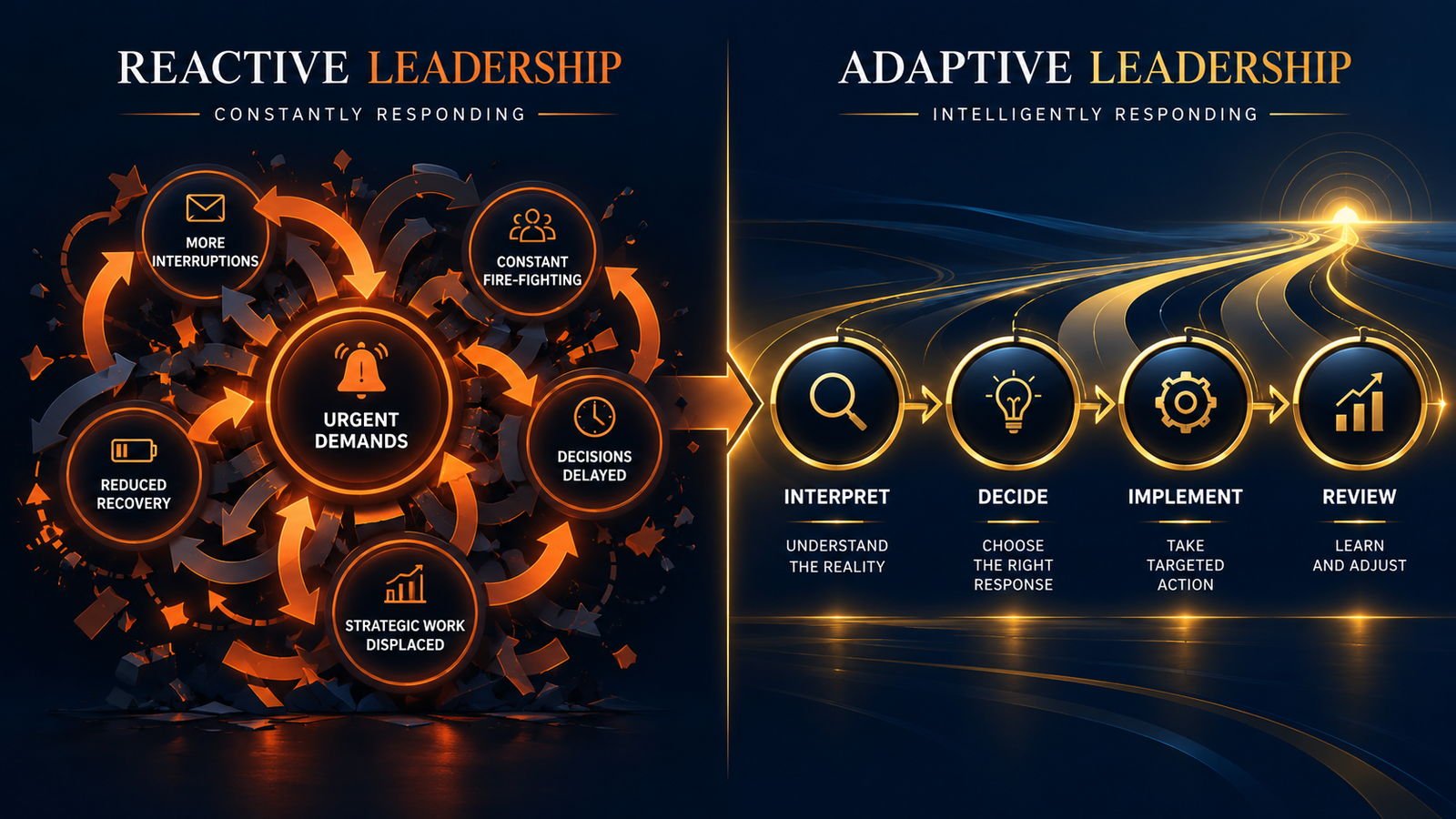
Reactive leadership begins with an external event and concentrates on producing an immediate response. Intelligent adaptation begins with interpretation.
The leader examines the nature of the change, identifies its implications, evaluates organisational capacity and determines an appropriate course of action.
This distinction matters because speed and effectiveness are not interchangeable. Rapid decisions may be necessary during emergencies. However, repeatedly prioritising speed over understanding can create unintended consequences, particularly when decisions affect people, resources and institutional trust.
Adaptability Intelligence™ provides a way to examine how leaders balance responsiveness with judgement. It asks whether leaders possess the capabilities needed to recognise emerging conditions, challenge established assumptions, learn from evidence and adjust their approach without abandoning essential organisational principles.
This connects adaptability directly to the wider Leadership Intelligence Compass™:
- Ethics Intelligence™ supports responsible decision-making.
- Reflective Practice Intelligence™ enables leaders to examine assumptions and learn from experience.
- Emotional Intelligence™ supports constructive responses to uncertainty.
- Leadership Sustainability™ helps ensure that adaptation does not depend on unlimited personal effort.
Together, these capabilities position adaptability as part of an integrated leadership performance system rather than an isolated skill.
What Is Adaptability Intelligence™ in Leadership?
Adaptability Intelligence™ is the capacity to recognise changing conditions, interpret their significance and adjust leadership decisions, behaviours and organisational approaches while maintaining strategic coherence, professional integrity and sustainable performance.
Within the Burn Bright Advisory™ Leadership Performance Intelligence™ framework, adaptability is not treated as an instinctive response to uncertainty. It is understood as a leadership capability that can be examined, developed and strengthened through deliberate practice.
This distinction is important. Some leaders appear highly adaptable because they respond quickly to new circumstances. Others demonstrate adaptability through careful analysis, consultation and measured adjustment. Neither approach is inherently superior.
The effectiveness of adaptation depends on whether the leadership response is appropriate to the situation, informed by evidence and aligned with organisational purpose. A leader demonstrating Adaptability Intelligence™ must therefore answer three questions:
- What has changed? Understanding the nature, significance and potential consequences of emerging conditions.
- What must change? Identifying which decisions, processes, behaviours or assumptions require adjustment.
- What must remain consistent? Protecting the ethical principles, strategic priorities and professional standards that provide organisational stability.
The third question is frequently overlooked.
Without continuity, adaptability can become instability.
Without adaptability, continuity can become institutional rigidity.
Effective leadership requires both.
The Difference Between Reactive Leadership and Adaptive Leadership
Reactive leadership and adaptive leadership may appear similar because both involve responding to changing circumstances. Their underlying decision-making processes, however, are fundamentally different.
| Reactive Leadership | Adaptive Leadership |
|---|---|
| Responds primarily to immediate pressure | Interprets changing conditions before acting |
| Prioritises short-term resolution | Balances immediate and long-term consequences |
| Frequently changes direction | Adjusts direction while maintaining strategic purpose |
| Relies heavily on established assumptions | Questions assumptions and considers alternatives |
| Concentrates decisions around the leader | Uses collective intelligence and appropriate delegation |
| Measures activity and immediate outputs | Evaluates outcomes, learning and sustainability |
Reactive leadership is not always inappropriate. Emergencies may require decisive action before comprehensive analysis is possible. The problem arises when emergency-style responses become the organisation’s normal operating model.
Leaders may then confuse constant activity with progress.
Meetings multiply.
Priorities shift.
Employees become uncertain about expectations.
Strategic planning gives way to immediate problem-solving.
Over time, the organisation may appear responsive while becoming less capable of managing complexity. Adaptability Intelligence™ offers a different approach: responsiveness guided by interpretation, judgement and learning.
The Five Capabilities of Adaptability Intelligence™
Burn Bright Advisory™ proposes five interconnected capabilities for examining how leaders adapt to complexity. This conceptual framework provides a structure for leadership reflection and development. It should not be interpreted as a psychometrically validated measurement model without further testing.
Capability 1
Environmental Awareness
Effective adaptation begins with recognising meaningful changes in the operating environment. Leaders must distinguish significant developments from temporary fluctuations, incomplete information and organisational noise.
Environmental awareness involves examining external pressures alongside internal organisational conditions. For example, a business leader evaluating artificial intelligence adoption must consider technological opportunities, workforce readiness, financial implications and governance responsibilities.
Awareness without interpretation, however, produces information rather than intelligence.
Capability 2
Cognitive Flexibility
Cognitive flexibility is the ability to reconsider assumptions, evaluate alternative perspectives and revise established approaches when evidence warrants change.
Experienced leaders may be particularly vulnerable to relying on methods that previously delivered success. Professional expertise remains valuable, but it can become restrictive when leaders assume that familiar solutions remain appropriate in unfamiliar circumstances.
Cognitive flexibility requires intellectual discipline: maintaining confidence in professional judgement while remaining willing to challenge it. This capability connects directly with Constructivism Intelligence™ and Knowledge Development Intelligence™ within the Leadership Intelligence Compass™.
Capability 3
Adaptive Decision-Making
Adaptability becomes meaningful when interpretation influences action. Adaptive decision-making requires leaders to evaluate options, consider consequences and select responses proportionate to the circumstances.
Not every organisational challenge requires transformation. Sometimes the most intelligent response is a limited adjustment. In other situations, incremental changes may be insufficient and structural redesign becomes necessary.
The leadership capability lies in recognising the difference.
Capability 4
Relational Adaptability
Organisational change is experienced through people. A technically sound decision may fail when leaders underestimate professional concerns, communication needs or the impact of uncertainty on trust.
Relational adaptability involves adjusting communication, consultation and support according to stakeholder needs without compromising fairness or accountability. Emotional Intelligence™ and Professionalism Intelligence™ therefore play essential supporting roles.
Capability 5
Sustainable Adaptation
Adaptation must remain achievable within the organisation’s available capacity. A transformation programme that relies on excessive working hours, constant urgency or the continued sacrifice of leadership wellbeing may produce temporary results while weakening future performance.
Sustainable adaptation connects Adaptability Intelligence™ with Leadership Workload™, Leadership Capacity™ and Leadership Sustainability™. The objective is not merely to implement change successfully, but to preserve the organisation’s ability to respond effectively to subsequent challenges.
Why Adaptability Must Be Developed as a Leadership System
Leadership development programmes frequently address adaptability through workshops, change-management techniques or individual coaching. These interventions can be useful, but their impact may be limited when organisational structures continue rewarding rigid thinking or reactive behaviour.
A leader encouraged to experiment may face punishment when a reasonable initiative fails. A manager expected to delegate may operate within approval systems that prevent meaningful autonomy.
Consequently, adaptability cannot be developed solely through individual behavioural expectations. It requires alignment between leadership capability, organisational culture, decision-making authority and performance evaluation.
Within the Leadership Development System™, the Leadership Intelligence Assessment™ can be positioned as a mechanism for examining development needs, while Leadership Reflection™ and Leadership Benchmarking™ provide complementary approaches to reviewing progress. These elements should be integrated with practical development activities rather than treated as separate administrative exercises.
This is the distinction between asking leaders to become more flexible and building an organisation capable of intelligent adaptation.
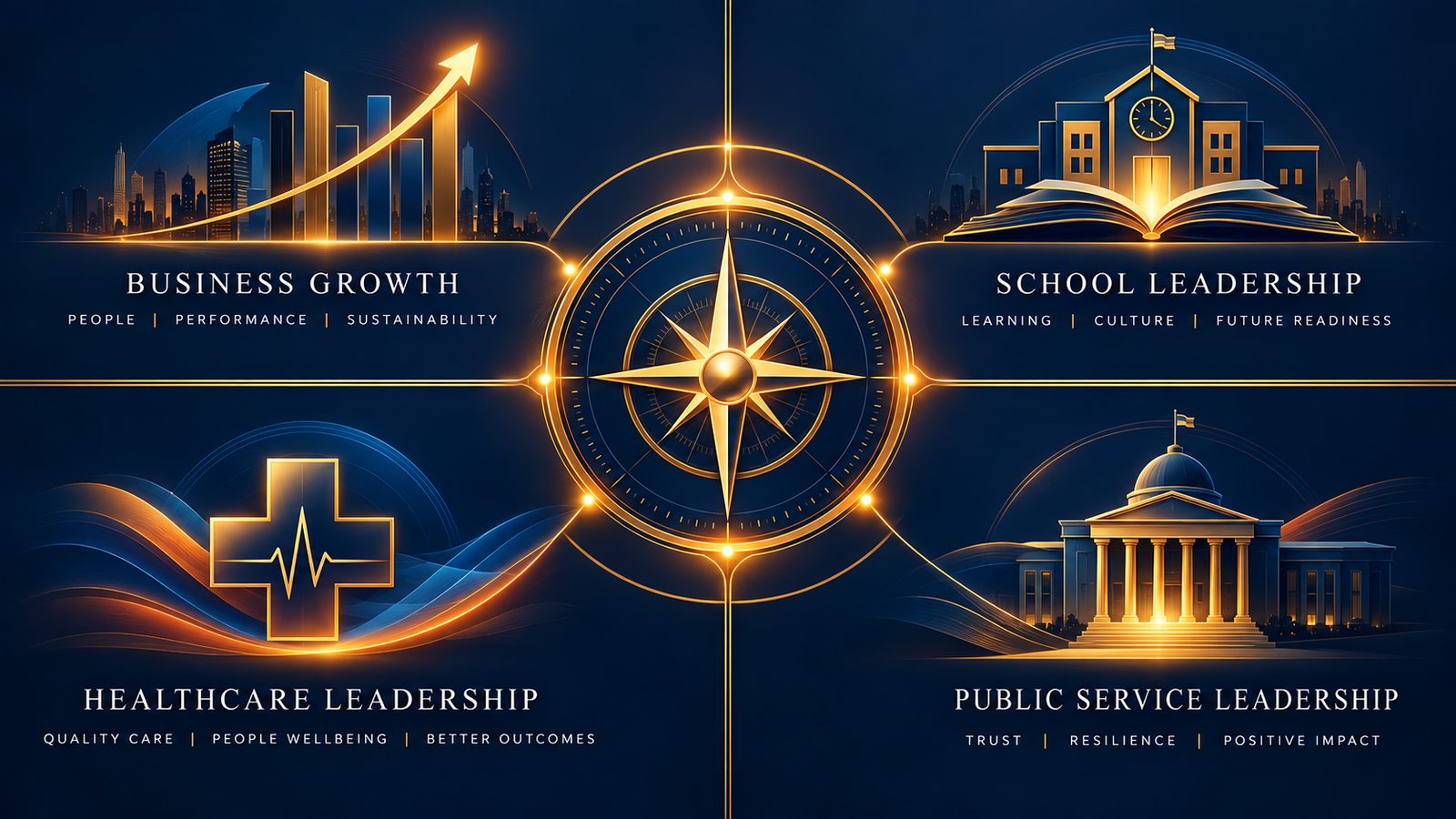
How Adaptability Intelligence™ Strengthens Leadership Across Sectors
The value of Adaptability Intelligence™ becomes particularly evident when examining how leaders respond to uncertainty across different organisational environments.
Although business executives, school principals, healthcare leaders and public service directors operate within distinct professional contexts, they share a common challenge: responding to changing demands without compromising performance, professional standards or organisational sustainability. The following illustrative scenarios demonstrate how intelligent adaptation can be applied in practice. Explore more sector-specific guidance in our leadership sector hubs.
Business Growth Intelligence™: Adapting Without Losing Strategic Direction
Consider a growing business experiencing increased competition alongside rapidly developing artificial intelligence capabilities. The executive team faces pressure to automate operations, reduce expenditure and introduce new services.
A reactive leader might implement multiple technological solutions simultaneously, assuming that rapid adoption demonstrates innovation.
An adaptable leader approaches the situation differently. They evaluate which technologies address genuine operational problems, assess employee capability and consider the financial and cultural implications of implementation. Rather than pursuing transformation for its own sake, they establish priorities and introduce changes proportionate to organisational readiness.
This demonstrates an important relationship between Adaptability Intelligence™ and Visionary Leadership Intelligence™. Visionary leadership establishes strategic direction. Adaptability Intelligence™ enables leaders to adjust the route without unnecessarily abandoning the destination.
School Leadership Intelligence™: Leading Educational Change Responsibly
School leaders regularly navigate curriculum reform, technological developments, workforce pressures and changing expectations from families and regulators.
Imagine a principal introducing a revised approach to assessment. A reactive response might involve immediately replacing established procedures and expecting teachers to implement the new model within an unrealistic timeframe.
An adaptable principal instead examines existing practice, consults teachers, evaluates professional development needs and considers the implications for students. Implementation may occur in stages, supported by structured feedback and reflection.
This approach connects Adaptability Intelligence™ with Constructivism Intelligence™, recognising that professional understanding develops through experience, dialogue and purposeful learning. Effective educational adaptation therefore requires more than introducing new policies. It requires developing the collective capability to implement them intelligently.
Healthcare Leadership Intelligence™: Balancing Adaptation and Safety
Healthcare leaders operate in environments where change can have immediate consequences for patients, staff and clinical quality.
Consider a department introducing a new digital patient management system. Although the technology promises improved coordination, implementation may create temporary workload pressures and unfamiliar clinical processes.
An adaptable healthcare leader must balance innovation with professional accountability. They establish appropriate training, consult clinical teams, monitor operational risks and provide mechanisms for reporting concerns. Crucially, they distinguish between processes that can be adjusted and safety standards that must remain protected.
Here, Adaptability Intelligence™ works alongside Ethics Intelligence™ and Professionalism Intelligence™. Adaptation becomes responsible when innovation is governed by evidence, clinical judgement and clear accountability.
Public Service Leadership Intelligence™: Adapting While Maintaining Public Trust
Public service leaders frequently manage changing policy priorities, resource constraints and expectations of transparency.
For example, a local authority may need to redesign service delivery following significant budget reductions. A reactive response could prioritise immediate financial savings without adequately considering service accessibility or community impact.
An adaptable leader examines competing obligations, consults relevant stakeholders and evaluates alternative delivery models. The objective is not simply to reduce expenditure, but to preserve public value within changing constraints.
This illustrates why adaptability cannot be separated from ethical judgement.
The Risks of Poorly Managed Leadership Adaptation
Adaptability is not automatically beneficial. When poorly understood, it can introduce significant organisational risks. Three risks deserve particular attention.
These risks demonstrate why Adaptability Intelligence™ must be integrated with the wider Leadership Intelligence Compass™.
Adaptability without Ethics Intelligence™ may produce irresponsible decisions.
Adaptability without Reflective Practice Intelligence™ may encourage repeated mistakes.
Adaptability without Leadership Sustainability™ may create performance that cannot be maintained.
Adaptability, Leadership Capacity™ and Sustainable Performance
A central principle of Leadership Performance Intelligence™ is that effective leadership must be evaluated over time. Immediate organisational results provide only part of the performance picture.
Leaders must also consider whether their decisions strengthen or deplete the capacity required for future performance. This is particularly important during organisational transformation.
A leader may successfully deliver a major change initiative while simultaneously increasing employee exhaustion, weakening trust or creating excessive dependence on individual effort. From a short-term perspective, the initiative may appear successful. From a leadership sustainability perspective, its effectiveness is more questionable.
Burn Bright Advisory™ therefore positions sustainable adaptation as the relationship between three considerations:
Sustainable Adaptation Three Considerations
- Performance: Does the change improve meaningful organisational outcomes?
- Capacity: Can leaders and teams deliver the change within realistic resource and workload constraints?
- Continuity: Does the organisation retain the capability to respond effectively to future challenges?
Leadership Workload™ provides insight into operational demands, while Leadership Reflection™ helps leaders examine the consequences of their decisions. Leadership Benchmarking™ can support structured comparisons over time, provided that indicators are appropriate to the organisation and interpreted in context.
Together, these concepts provide a more comprehensive perspective on adaptability. The objective is not to create organisations that change continuously. It is to develop organisations capable of changing intelligently, responsibly and sustainably when circumstances require it.
How Leaders Can Strengthen Adaptability Intelligence™
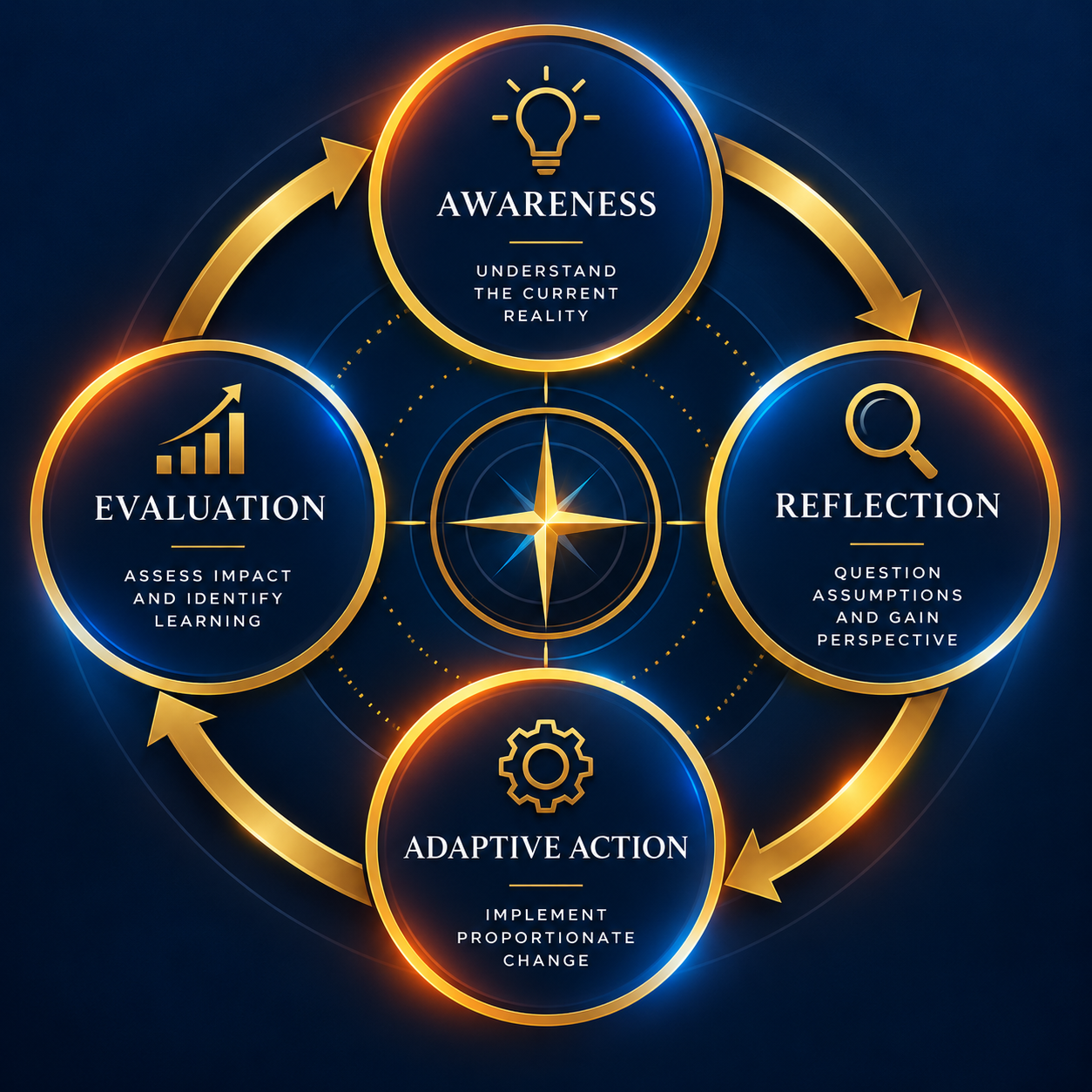
Developing Adaptability Intelligence™ requires more than exposure to change. Leaders must establish deliberate practices that improve their ability to interpret uncertainty, evaluate alternatives and adjust their behaviour.
The Leadership Intelligence Compass™ provides a structure for examining these capabilities in relation to wider leadership effectiveness. A practical development process begins with five activities.
1. Examine Existing Leadership Assumptions
Leaders should identify the beliefs and established practices influencing their decisions. Questions such as “What evidence supports our current approach?” and “Which assumptions may no longer be valid?” encourage cognitive flexibility without undermining professional expertise.
2. Establish Structured Leadership Reflection™
Reflection enables leaders to examine how decisions were made, whether assumptions were accurate and what consequences emerged. This should occur during implementation rather than exclusively after major initiatives conclude.
3. Strengthen Collective Decision-Making
Adaptable organisations benefit from diverse professional perspectives. Leaders should create opportunities for constructive challenge, particularly from individuals closest to operational problems.
Collective intelligence does not remove leadership accountability. It improves the quality of information informing decisions.
4. Monitor Leadership Capacity™
Adaptation requires sufficient organisational capacity. Before introducing additional initiatives, leaders should examine existing workloads, resource availability and competing priorities. Where necessary, lower-value activities should be reduced or discontinued.
5. Evaluate Adaptation Over Time
Successful adaptation should be assessed through meaningful performance indicators alongside workforce experience, organisational learning and sustainability. Leadership Benchmarking™ can help establish a consistent approach to monitoring progress, while the Leadership Intelligence Assessment™ can inform individual development priorities.
Leadership Reflection Questions
- Which recent organisational changes have challenged my established leadership assumptions?
- Do I distinguish between genuinely urgent decisions and situations requiring deeper interpretation?
- How effectively do I invite alternative perspectives before making consequential decisions?
- Which aspects of our organisational strategy should remain stable during change?
- Are current transformation demands consistent with available Leadership Capacity™?
- How do I evaluate the longer-term consequences of my decisions for employees, stakeholders and organisational performance?
Leaders can use these questions individually, during executive coaching or within structured leadership development discussions.
Practical Leadership Action Steps: A 30-Day Adaptability Review
A useful starting point is a structured 30-day adaptability review.
| Period | Leadership Action | Intended Outcome |
|---|---|---|
| Week 1 | Identify a significant current change and examine existing assumptions | Improved environmental awareness |
| Week 2 | Consult stakeholders and evaluate alternative responses | Stronger cognitive and relational adaptability |
| Week 3 | Implement a proportionate adjustment with clear accountability | More informed adaptive decision-making |
| Week 4 | Review outcomes, workload implications and lessons learned | Sustainable adaptation and leadership reflection |
The review should establish a repeatable process rather than become another administrative obligation.
Conclusion: Adaptability as Leadership Intelligence
The defining characteristic of effective adaptability leadership is not the frequency or speed of change. It is the quality of judgement applied when circumstances evolve.
Leaders must recognise emerging conditions, challenge assumptions, consider alternative responses and preserve the organisational capabilities necessary for sustained performance.
Within Burn Bright Advisory’s Leadership Performance Intelligence™ approach, Adaptability Intelligence™ provides a connection between strategic responsiveness, professional judgement, organisational learning and Leadership Sustainability™. Its development therefore requires more than individual flexibility. It requires systems that support informed decisions, meaningful reflection, ethical accountability and realistic leadership workloads.
To take this further with your leadership team, explore our leadership development workshops or browse the Leadership Intelligence Library™.
Frequently Asked Questions
What is adaptability leadership?
Adaptability leadership is the ability to adjust leadership decisions, behaviours and organisational approaches in response to changing circumstances while maintaining strategic direction, ethical standards and effective performance.
What is Adaptability Intelligence™?
Adaptability Intelligence™ is a Burn Bright Advisory™ leadership development concept describing the capabilities required to interpret change, challenge assumptions, make informed adjustments and maintain sustainable leadership effectiveness.
Why is adaptability important for leaders?
Adaptability enables leaders to respond to uncertainty, evaluate emerging risks, recognise opportunities and guide organisational change without relying exclusively on established practices.
What is the difference between adaptability and flexibility?
Flexibility concerns the willingness or ability to adjust. Adaptability includes interpreting why adjustment is necessary, selecting an appropriate response and evaluating its consequences.
Can adaptability be developed through leadership training?
Yes. Leadership adaptability can be strengthened through reflective practice, scenario analysis, exposure to alternative perspectives, structured feedback and practical decision-making experience.
How does adaptability relate to emotional intelligence?
Emotional Intelligence™ supports adaptability by helping leaders recognise emotional responses, understand stakeholder concerns and communicate effectively during uncertainty.
How can organisations assess leadership adaptability?
Organisations can examine decision-making behaviours, learning practices, stakeholder feedback, responses to uncertainty and the sustainability of implemented changes. Assessment methods should be evaluated for reliability and suitability before being used for consequential personnel decisions.
How does adaptability support leadership sustainability?
Adaptability supports Leadership Sustainability™ when leaders adjust priorities, processes and resource allocation in ways that preserve organisational capacity rather than depending on continuous urgency or excessive individual effort.
Go Deeper with the Burn Bright Full Diagnostic™
A comprehensive view of your leadership capacity, workload and sustainability — the foundation for adapting intelligently rather than reactively.
Can Your Leadership Capacity Sustain the Change Ahead?
Intelligent adaptation depends on leaders who are not running on empty. Take the free self-assessment to see where your capacity stands today.
Free Leadership Intelligence
Get Weekly Leadership Insights
Join thousands of leaders receiving practical strategies on burnout prevention, workload design, and sustainable performance every week.