Quick Answer
Key Takeaways
- Audit before eliminating. Identify which meetings produce decisions, solve problems or create genuine value.
- Replace updates with better communication systems. Information sharing rarely requires everyone to attend a meeting.
- Clarify decision authority. Many meetings exist because nobody knows who has permission to decide.
- Protect leadership capacity. Reclaimed calendar time should support strategic thinking, focused work and recovery.
- Measure outcomes, not attendance. A successful meeting culture improves decisions and reduces organisational friction.
How to Reduce Unnecessary Meetings at Work
By Vincent Walters | Burn Bright Advisory | 15 October 2026
How to reduce unnecessary meetings is no longer simply a productivity question. It is a leadership effectiveness question.
Across organisations, senior leaders are spending increasing amounts of time discussing work rather than making progress on it. Calendars fill with operational updates, coordination calls, project reviews, committee meetings and conversations that could have been handled through clearer communication.
The result is predictable.
Leaders finish their working day having attended six or seven meetings, answered dozens of messages and made countless small decisions. Yet the work requiring their judgement remains untouched. They then complete that work in the evening.
In more than 30 years of frontline leadership across education, business and the public sector, I have seen how easily meetings become a substitute for clear systems.
The problem is rarely that people enjoy wasting time. Meetings accumulate because organisations lack effective decision structures, communication rules and workload boundaries.
In this article, I will explain why unnecessary meetings persist, how they contribute to leadership burnout and how to redesign meeting culture without losing collaboration or accountability. The answer is structural, not motivational.
Is Your Calendar Pushing Your Real Work Into the Evening?
Meeting overload is often one part of a wider workload pattern. Find out where your leadership capacity stands in a few minutes.
The first step is understanding how meeting overload becomes embedded in the leadership system.
Unclear decisions + excessive reporting + weak boundaries
→ Meeting overload and calendar fragmentation
→ Less focus, slower decisions, reduced recovery
→ Leadership fatigue and organisational drag
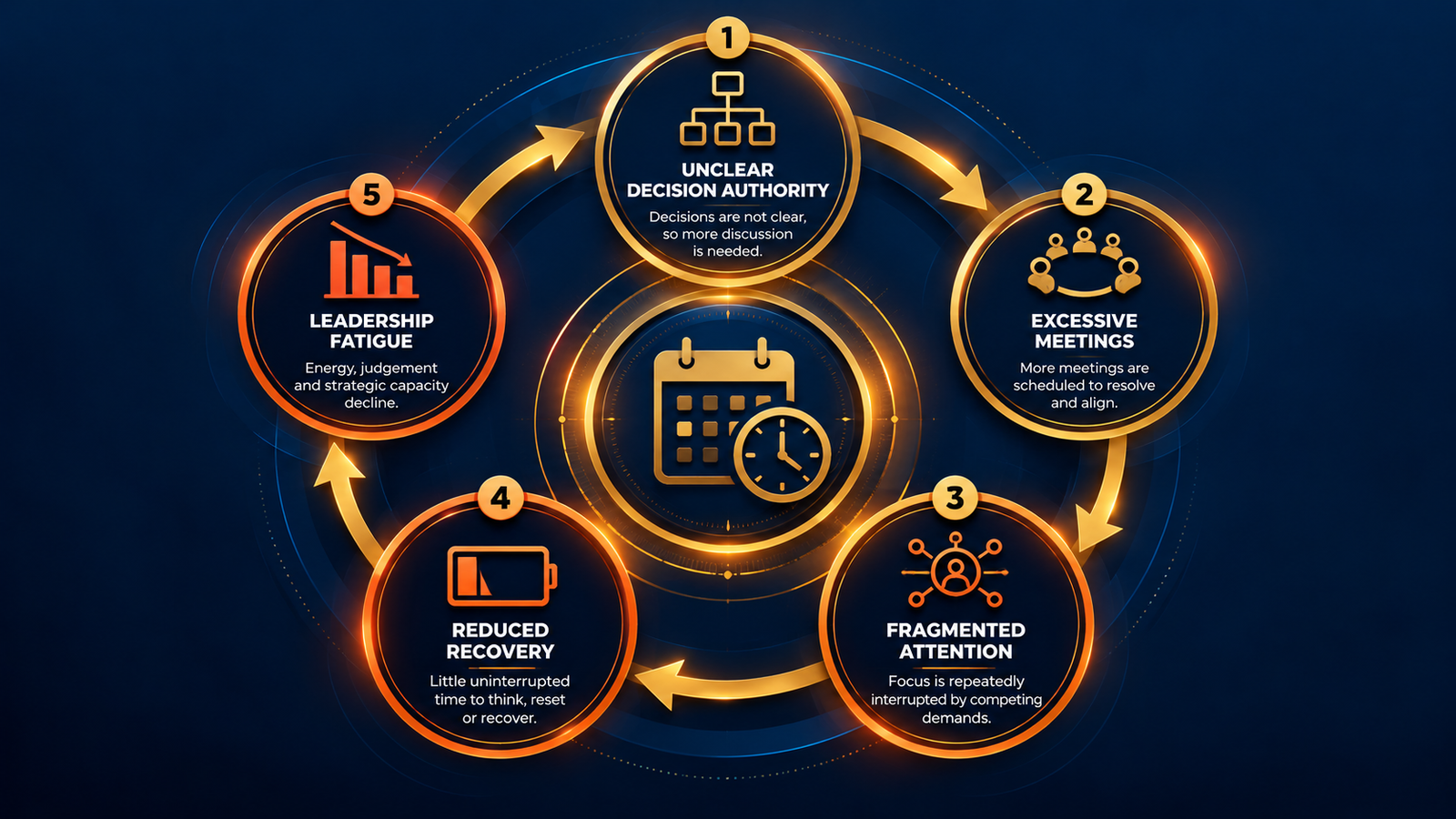
The diagram makes one point clear: reducing meeting overload requires changing the conditions that produce it.
What Are Unnecessary Meetings and Why Do They Persist?
An unnecessary meeting is not simply a meeting that feels boring.
Featured Snippet
This distinction matters. A difficult performance conversation may be uncomfortable but essential. A safeguarding discussion, critical operational review or complex strategic decision may require people to meet.
By contrast, a weekly meeting where eight managers read updates from a document rarely adds equivalent value.
The difference is purpose.
Five reasons meeting overload develops
Within the Burn Bright Not Out Framework™, meeting culture is one of five structural root causes of burnout. Unnecessary meetings usually emerge through five patterns.
None of these problems is solved permanently by asking people to decline more invitations. They require structural changes.
What does the research show?
Harvard Business Review’s Stop the Meeting Madness reported that executives were spending an average of nearly 23 hours per week in meetings, compared with fewer than 10 hours during the 1960s. This is a historical research finding, not a current universal benchmark.
The implication remains relevant: meetings can gradually consume the capacity required to perform the work they are intended to support.
Consider a senior manager attending 18 hours of meetings each week. If only six hours produce decisions or necessary collaboration, the remaining 12 hours represent a substantial opportunity for redesign.
The correct question is not, “How can this manager become more efficient?”
That question changes the diagnosis.
How Do Unnecessary Meetings Contribute to Leadership Burnout?
Meeting overload contributes to burnout by increasing cognitive demands, fragmenting attention and reducing opportunities for meaningful recovery.
A calendar can appear manageable when measured only in hours. But the cognitive cost is often much greater.
Consider a leader moving between a financial review, a difficult employee conversation, an operational briefing and a strategic planning meeting. Each requires a different form of attention. The leader must repeatedly change context, absorb information, regulate emotional responses and make decisions.
By the afternoon, their calendar may be clear, but their mental capacity is depleted.
The hidden cost of fragmented work
Microsoft’s 2025 Work Trend Index research found that, among the 20% of users receiving the highest volume of digital interruptions, employees experienced an average of 275 meeting, email and chat notifications per day. The same research found that 60% of meetings were unscheduled or ad hoc within the high-meeting-volume group studied.
These figures describe particular high-volume user groups, not every employee. Nevertheless, they illustrate the intensity of modern digital work.
A leader does not simply attend meetings.
They prepare for them, switch between them, respond to their consequences and recover from the attention they consume.
Meeting overload and burnout risk
The World Health Organization defines burnout as an occupational phenomenon resulting from chronic workplace stress that has not been successfully managed. Its three dimensions include exhaustion, growing mental distance from work and reduced professional effectiveness.
Excessive meetings are not themselves a clinical diagnosis. But persistent calendar saturation can contribute to the conditions in which burnout develops, particularly when leaders lose control over their workload and have little opportunity to recover.
Gallup’s 2026 State of the Global Workplace report found that global manager engagement fell from 27% in 2024 to 22% in 2025. That decline cannot be attributed to meetings alone. It does, however, reinforce the need to examine the pressures placed on managers.
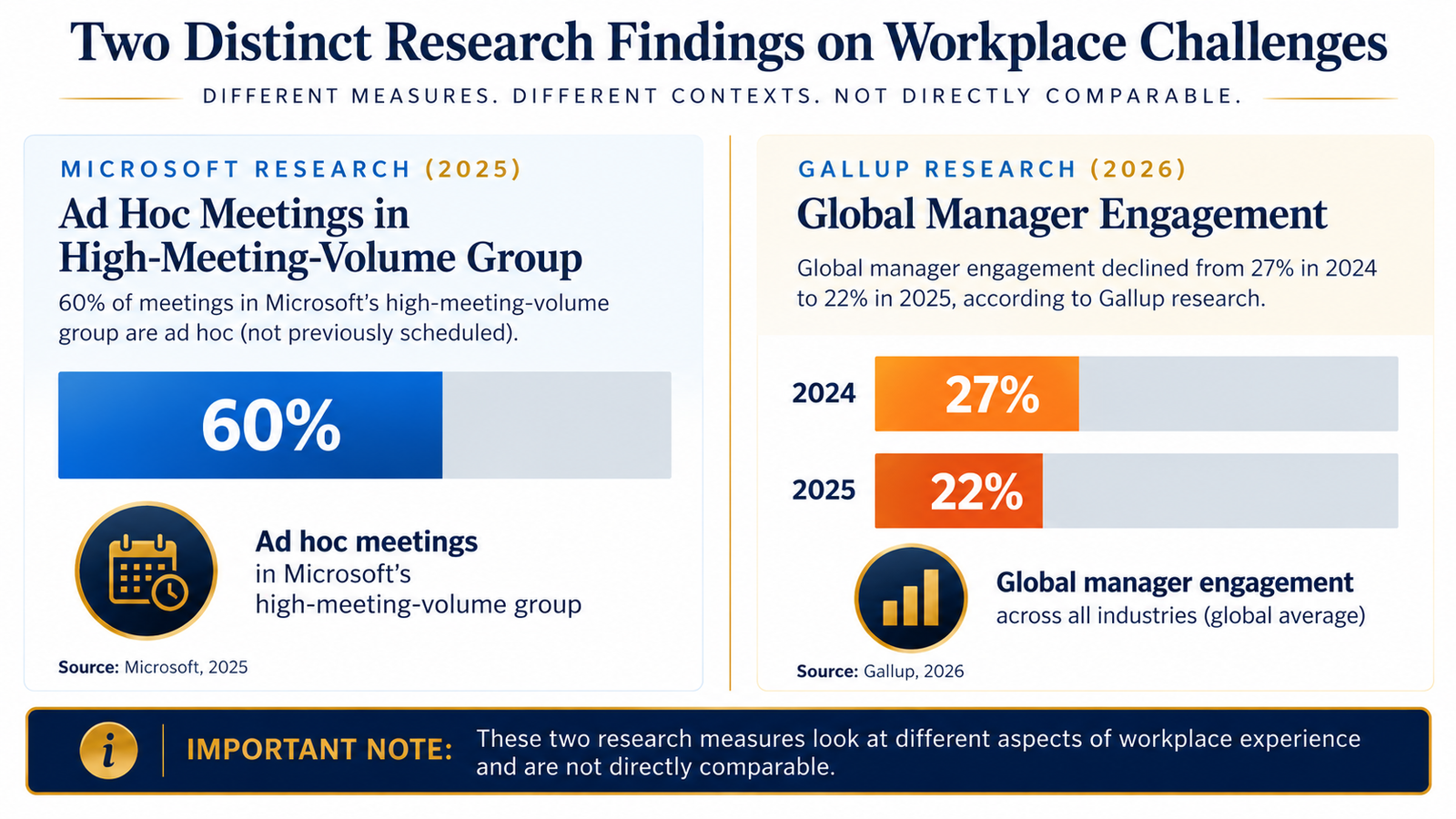
The findings are not evidence that meetings directly caused declining engagement. They are signals that organisations should examine how managerial time and attention are allocated.
For leaders experiencing persistent exhaustion, recognising the early signs of leadership burnout can help identify when workload pressures are becoming unsustainable.
The objective should be to reduce the pressure at its source.
How Can Leaders Audit and Reduce Unnecessary Meetings?
The most effective starting point is a structured meeting audit.
Not a blanket ban.
Not an arbitrary instruction to cancel half the calendar.
A proper audit identifies which meetings contribute to organisational outcomes and which exist because the system has never been questioned.
Step 1: Review two weeks of meetings
Export or examine your calendar for the previous fortnight. Record the purpose, duration, attendees, frequency and outcome of each meeting. Then ask five questions:
- What specific outcome did this meeting produce?
- Was a decision made or a problem resolved?
- Could the same outcome have been achieved asynchronously?
- Did every attendee need to participate?
- Would anything important have been lost if the meeting had not happened?
The answers reveal patterns that calendar totals alone cannot show.
Step 2: Apply the IMPACT Matrix™
Within Burn Bright’s structural approach, the IMPACT Matrix™ provides a way to examine work through the value it creates relative to the capacity it consumes. For a meeting audit, use the practical decision categories in the table below. This prevents the common mistake of treating every meeting as equally necessary.
| Meeting Value | Required Action |
|---|---|
| High value, essential collaboration | Retain |
| High value, excessive duration | Shorten |
| Useful information, no discussion required | Replace with written update |
| Relevant to only a few people | Reduce attendance |
| No clear outcome or continuing purpose | Eliminate |
Step 3: Calculate the actual cost
A one-hour meeting with eight attendees consumes eight person-hours, excluding preparation and follow-up. If it happens every week for 46 working weeks, that represents 368 person-hours annually.
Illustrative Meeting Cost Calculation
- Attendees: 8
- Duration: 60 minutes, once per week
- Meetings per year: 46
- Cost per person-hour: £50 (fully loaded)
- Annual person-hours: 368
- Estimated labour cost: £18,400
Excludes preparation, follow-up and opportunity costs.
That does not mean every pound is wasted. It means the meeting should produce value sufficient to justify the investment.
Step 4: Remove meetings systematically
Start with meetings that have no clear purpose, no accountable owner or no meaningful output. For recurring meetings, establish a review date. Do not allow a temporary coordination mechanism to become a permanent obligation without justification.
Where meetings are necessary, reduce duration or attendance before eliminating valuable collaboration. The aim is a better operating system.
What Should Replace Unnecessary Meetings?
Removing meetings without improving communication simply transfers the problem elsewhere.
The calendar becomes quieter, but inboxes become noisier.
Teams lose clarity. Decisions slow down.
People create informal meetings to compensate.
Effective meeting reduction therefore requires replacement systems.
Replace status meetings with structured updates
Routine information should be available without requiring simultaneous attendance. A useful weekly update contains four elements:
- Progress against agreed priorities.
- Risks or barriers requiring attention.
- Decisions needed, with named decision owners.
- Next actions and deadlines.
This allows leaders to review information when appropriate and reserve meetings for genuine discussion.
Replace approval meetings with decision authority
Many organisations create unnecessary meetings because decisions repeatedly travel upwards.
A department head is asked to approve routine expenditure.
A project manager cannot adjust a timeline without a committee.
A team leader needs permission to resolve a straightforward operational issue.
The problem is not communication. It is unclear authority.
The Burn Bright RACI Delegation Framework™ can help distinguish who is responsible, accountable, consulted and informed. When ownership is clear, fewer decisions require group discussion. It also clarifies what leaders should retain responsibility for when delegating.
Replace constant coordination with clear management rhythms
An effective organisation does not eliminate every recurring meeting. It creates a predictable rhythm.
For example, a department might use a short operational huddle for urgent coordination, a fortnightly decision meeting for unresolved cross-team issues and a monthly strategic review.
Each meeting has a different purpose.
Each has defined decision rights.
Each exists because it adds value.
This approach also reduces the role overload that develops when leaders become the default coordination point for every activity.
How Can Organisations Build a Sustainable Meeting Culture?
A sustainable meeting culture is not created through calendar discipline alone. It requires leadership agreement about how the organisation will operate.
Without that agreement, individual attempts to reduce meetings are often reversed by established expectations.
A manager declines a meeting.
A colleague interprets the absence as a lack of commitment.
A senior leader schedules another discussion because the decision remains unclear.
The system restores the behaviour.
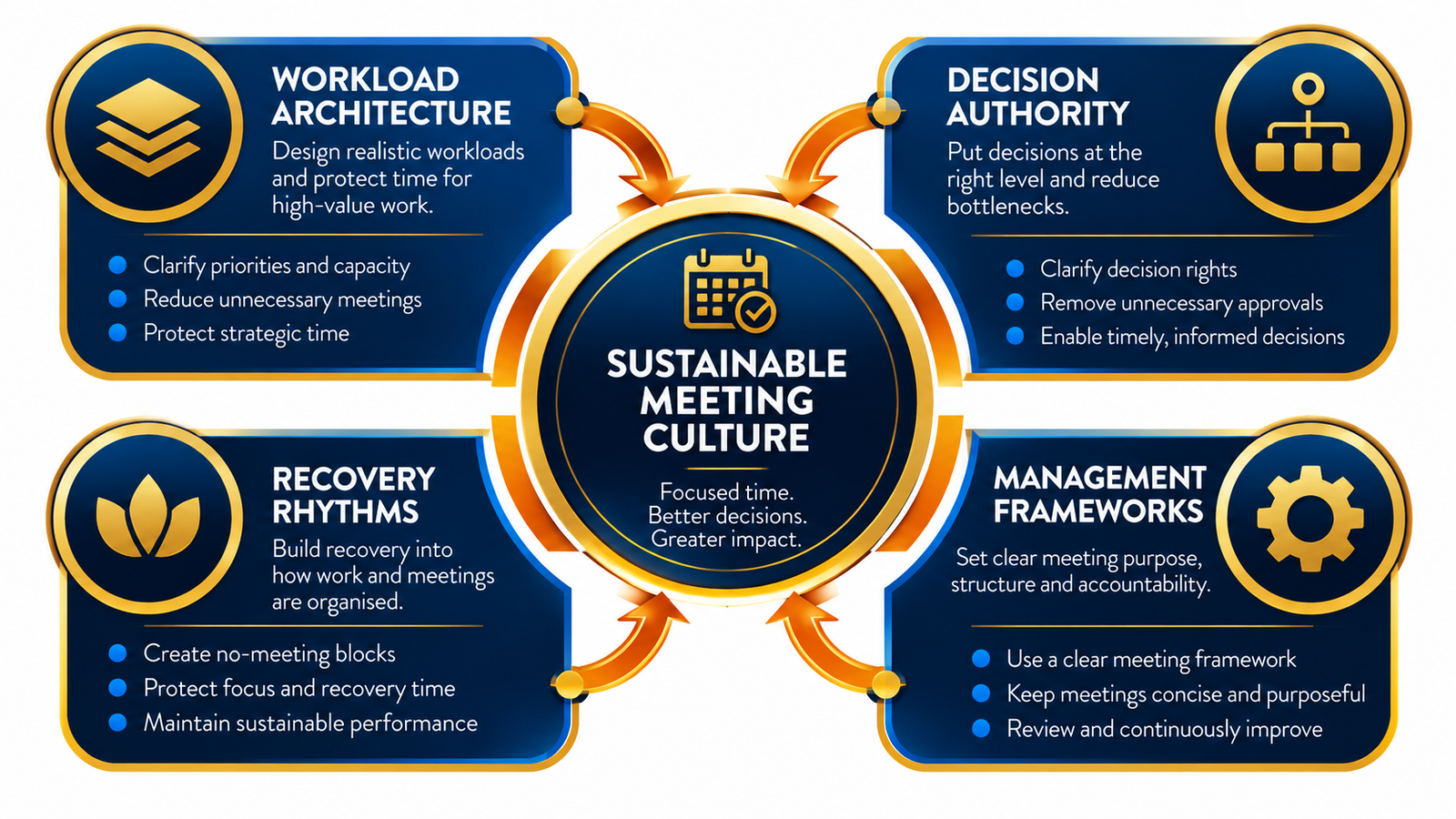
Apply the four pillars of structural transformation
The Burn Bright Not Out Framework™ identifies four pillars for creating sustainable leadership systems.
Pillar 1
Workload Architecture™
Treat meeting attendance as part of workload capacity, not as time that sits outside the real work. Set realistic limits and review whether meeting commitments leave sufficient time for delivery.
Pillar 2
Decision Authority™
Identify which decisions require collaboration, consultation or individual ownership. Stop using meetings as a substitute for accountability.
Pillar 3
Recovery Rhythms™
Protect breaks, transition time and periods of uninterrupted work. Avoid designing calendars that demand continuous cognitive switching without recovery.
Pillar 4
Management Frameworks
Establish consistent rules for agendas, attendance, decisions, actions and meeting reviews. Make effective meeting design a management expectation rather than an optional preference.
What does this look like in practice?
Imagine a school leadership team with a weekly two-hour management meeting. Each department provides updates, discusses operational issues and seeks approval for routine decisions. The meeting regularly overruns.
A structural redesign might introduce written departmental updates, clear spending authority, a 30-minute exceptions meeting and a separate monthly strategic review.
The result is not less accountability. It is more precise accountability.
The same principles apply in healthcare, business, government and the voluntary sector. Where meeting culture is redesigned around outcomes rather than attendance, leaders can recover capacity for the work only they can do.
That is sustainable leadership.
Traditional Meeting Culture vs Sustainable Meeting Culture
| Traditional Meeting Culture | Sustainable Meeting Culture |
|---|---|
| Meetings demonstrate commitment | Outcomes demonstrate contribution |
| Everyone attends for visibility | Only essential participants attend |
| Updates are delivered verbally | Updates are shared asynchronously |
| Decisions are made by committees | Authority sits with clear owners |
| Meetings continue indefinitely | Recurring meetings are reviewed |
| Calendars are filled reactively | Strategic time is protected |
| Success is measured by activity | Success is measured by outcomes |
| Leaders absorb coordination failures | Systems reduce unnecessary coordination |
The distinction is not between organisations that meet and organisations that do not. It is between organisations that use meetings deliberately and organisations that depend on meetings because their underlying systems are weak.
How Can Leaders Implement Meeting Reform in 30 Days?
Reducing unnecessary meetings requires practical execution. A 30-day intervention is enough to test meaningful changes, although wider cultural transformation may take longer.
Days 1–7: Diagnose
Audit recurring meetings, record their purpose and calculate the total person-hours consumed. Identify the five meetings with the weakest relationship between time invested and outcomes produced.
Days 8–14: Redesign
Cancel meetings without clear value. Shorten meetings that need less time. Remove attendees who only require information. Introduce written updates where live discussion is unnecessary.
Days 15–21: Protect capacity
Establish protected periods for strategic work. Clarify decision ownership and escalation rules. Make sure leaders are not expected to compensate for cancelled meetings through additional evening work.
Days 22–30: Measure and adjust
Review meeting hours, decision speed, employee feedback and the quality of work produced. Ask whether time has genuinely been reclaimed or merely transferred into email and messaging platforms. Use the findings to refine the new system.
A meeting reduction initiative should not be judged by how many calendar invitations disappear. It should be judged by whether the organisation operates more effectively afterwards.
The broader myths surrounding leadership burnout often lead organisations to mistake personal efficiency for structural improvement. A 30-day meeting redesign provides an opportunity to challenge that assumption.
Frequently Asked Questions
How do you reduce unnecessary meetings without damaging communication?
Start by identifying the purpose of each meeting. Replace routine updates with structured written communication, retain meetings requiring genuine collaboration and clarify who owns decisions. The aim is not to communicate less. It is to make communication more deliberate, reduce duplication and ensure important information reaches the right people.
What percentage of meetings are unnecessary?
There is no reliable universal percentage because meeting value depends on organisational context. Microsoft’s 2025 research found that 60% of meetings were unscheduled or ad hoc among a high-meeting-volume group, but unscheduled does not necessarily mean unnecessary. Organisations should conduct their own audits rather than apply arbitrary cancellation targets.
How can managers say no to unnecessary meetings?
Managers should focus on the outcome rather than rejecting the invitation personally. Ask what decision is required, whether your participation is essential and whether a written contribution would be sufficient. Senior leaders should establish explicit permission to decline meetings where attendance adds little value. Without organisational support, individual boundary-setting is difficult to sustain.
Can too many meetings cause leadership burnout?
Excessive meetings can contribute to leadership burnout when they create chronic workload pressure, reduce control over working time and prevent adequate recovery. Meetings are rarely the only cause. Scope creep, decision overload, communication demands and organisational culture often interact. Effective prevention requires examining the entire leadership workload rather than simply reducing calendar commitments.
How many meetings should a leader attend each week?
There is no ideal number. Meeting requirements depend on leadership responsibilities, team structure and operational risk. The better measure is whether leaders have sufficient capacity for strategic thinking, decision-making, team development and recovery. A calendar that consistently forces essential work into evenings is a warning that workload architecture needs attention.
What is the best alternative to weekly status meetings?
A structured asynchronous update is often the best alternative. Team members provide progress, risks, decisions needed and next actions in a shared document or management platform. Leaders then schedule live discussions only for unresolved problems, important decisions or issues requiring collaboration. This maintains visibility while reducing unnecessary collective time.
Conclusion: Better Systems Create Better Leadership
Learning how to reduce unnecessary meetings is about far more than creating space in a calendar. It is about examining how an organisation makes decisions, shares information, allocates responsibility and protects leadership capacity.
Unnecessary meetings are often symptoms of deeper structural problems.
Unclear authority creates approval meetings.
Weak communication systems create status meetings.
Poor workload design creates constant coordination.
And cultures that reward visibility over outcomes create calendars filled with activity rather than meaningful progress.
The solution is not asking leaders to work faster between meetings. It is redesigning the system so that fewer meetings are needed in the first place.
Start with a meeting audit. Clarify decision ownership. Replace unnecessary discussions with structured communication. Protect time for strategic work and measure the outcomes.
At Burn Bright Advisory, the principle remains consistent.
Sustainable leadership does not require constant availability. It requires clear priorities, effective management structures and sufficient capacity to lead well.
As you look at your own situation today — are you leading from a place of clarity or a place of depletion?
Go Deeper with the Burn Bright Full Diagnostic™
A comprehensive view of your workload, decision load and leadership capacity — so you can see which structures are driving the pressure.
Is Your Leadership Workload Sustainable?
If your calendar is permanently full and your strategic work keeps moving into evenings, identify the structural pressures affecting your energy, decision-making and effectiveness.
Free Leadership Intelligence
Get Weekly Leadership Insights
Join thousands of leaders receiving practical strategies on burnout prevention, workload design, and sustainable performance every week.