Quick Answer
Key Takeaways
- Recognise the early signs. Reduced concentration, irritability and decision avoidance can indicate growing meeting fatigue.
- Address the system. Meeting fatigue is often caused by poor workload design rather than inadequate personal discipline.
- Reduce cognitive switching. Group related discussions and create protected time between demanding activities.
- Redesign meeting expectations. Clear agendas, decision ownership and asynchronous updates reduce unnecessary demands.
- Measure leadership capacity. Meeting reform should improve decision quality, strategic focus and sustainable performance.
Meeting Fatigue in Leaders: Causes and Solutions
By Vincent Walters · Burn Bright Advisory · 16 October 2026
Meeting fatigue in leaders has become one of the most overlooked pressures affecting organisational effectiveness.
A senior leader can spend an entire day attending meetings and still finish with the uncomfortable feeling that nothing meaningful has been achieved.
The calendar suggests productivity.
The mind tells a different story.
By late afternoon, concentration becomes difficult. Routine decisions require more effort. Small interruptions feel disproportionately frustrating. Strategic problems that would normally invite curiosity begin to feel overwhelming.
The leader is not necessarily lacking motivation or capability.
Their cognitive capacity has been consumed.
Across more than 30 years in leadership, including education, business and the public sector, I have observed how meeting culture gradually expands until it becomes the organising principle of the working day.
Meetings replace clear communication. Committees replace decision ownership. Constant availability replaces strategic thinking.
Eventually, leaders find themselves managing the process of work rather than leading the work itself.
This article examines why meeting fatigue develops, how it affects decision-making, the warning signs organisations overlook and the structural changes required to restore sustainable leadership capacity.
Because meeting fatigue is not solved by simply becoming better at sitting through meetings.
The following framework shows how meeting demands become leadership fatigue.
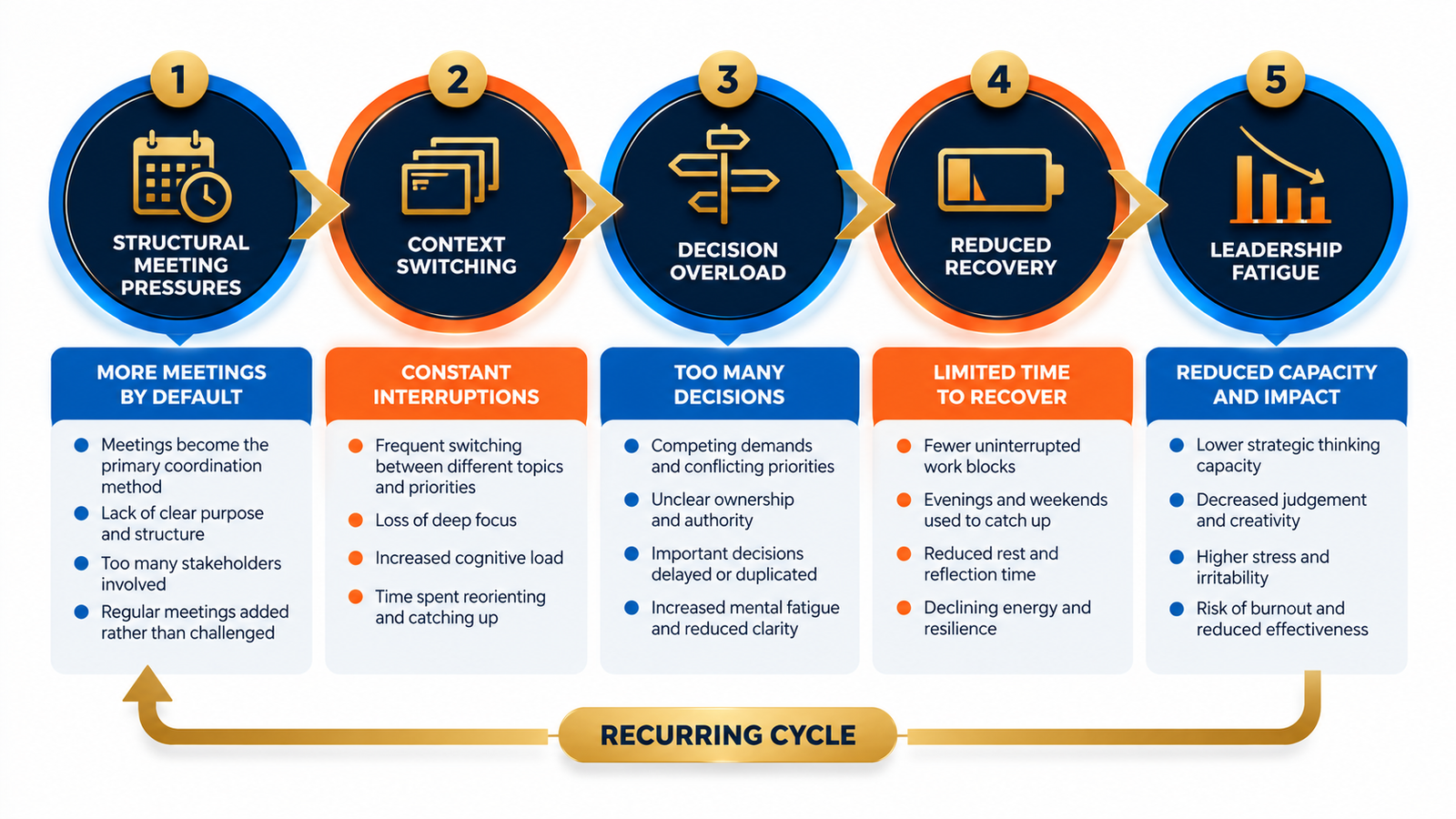
This is the central distinction: meeting fatigue is often the visible symptom of a poorly designed leadership operating system.
What Is Meeting Fatigue in Leaders?
Featured Snippet
It is not a formal medical diagnosis.
Nor is it simply another name for being tired.
A leader may feel tired after an important strategic workshop and still experience a sense of progress and satisfaction.
Meeting fatigue is different. It often involves spending significant cognitive effort without experiencing a corresponding sense of achievement.
Why meetings consume more energy than calendars suggest
Every meeting requires some combination of listening, interpreting information, regulating responses, recalling details and making judgements.
For leaders, these demands are frequently intensified.
A senior manager may need to consider financial implications, employee concerns, operational risks and organisational priorities during a single discussion. The following meeting may require an entirely different mindset.
The leader moves from budget decisions to safeguarding concerns, from performance management to strategic planning, without sufficient time to process the previous conversation.
This creates repeated attention switching.
The problem becomes more serious when meetings are poorly prepared.
Unclear agendas force participants to work out the purpose while the discussion is already underway.
Missing information delays decisions.
Unresolved disagreements produce further meetings.
How is meeting fatigue different from burnout?
The World Health Organization describes burnout as an occupational phenomenon associated with chronic workplace stress that has not been successfully managed. It identifies three dimensions: exhaustion, increased mental distance or cynicism towards work, and reduced professional efficacy.
Meeting fatigue may contribute to these conditions, but the two are not interchangeable.
Meeting fatigue can be temporary and improve when meeting demands are reduced. Burnout involves a broader pattern of chronic workplace stress.
The distinction matters because an organisation should not diagnose burnout solely from an employee’s meeting schedule. Instead, leaders should examine whether excessive meetings form part of a wider pattern of unsustainable demands.
For a fuller explanation, read what leadership burnout is and how it develops.
The central question is whether the meeting system supports effective work or continuously consumes the capacity required to perform it.
Why Does Meeting Fatigue Develop in Senior Leaders?
Meeting fatigue rarely develops because one person has organised a particularly long meeting.
It develops through accumulated organisational decisions.
An additional weekly update seems reasonable.
A new project requires a coordination call.
Senior management requests another reporting meeting.
A temporary committee becomes permanent.
Each decision makes sense in isolation.
Together, they create a working week that leaves insufficient capacity for the actual responsibilities of leadership.
Five structural causes of meeting fatigue
The Burn Bright Not Out Framework™ identifies five root causes of burnout: scope creep, meeting culture, communication chaos, decision overload and perfectionism culture. All five can influence meeting demands.
What does the research tell us?
Harvard Business Review’s 2017 article Stop the Meeting Madness reported that executives spent nearly 23 hours per week in meetings on average, compared with fewer than 10 hours in the 1960s.
This historical comparison does not establish the meeting burden of every leader in 2026. It demonstrates how significantly meeting demands have expanded over time.
Microsoft’s 2025 Work Trend Index found that, among the top 20% of users by meeting volume, 60% of meetings were unscheduled or ad hoc.
Unscheduled meetings are not necessarily unnecessary. Genuine emergencies and complex collaboration sometimes require immediate discussion.
But a high level of unplanned coordination raises an important organisational question.
If the answer is unclear ownership, weak communication or poor planning, the solution lies in redesigning those systems.
How Does Meeting Fatigue Affect Leadership Decisions?
One of the most significant consequences of meeting fatigue is its potential effect on decision-making.
Leadership requires more than processing information.
It requires judgement.
Leaders must recognise patterns, assess risks, consider competing interests and decide when to act. These activities require attention and cognitive capacity.
When that capacity is repeatedly consumed by meetings, leaders may have less room for thoughtful decisions.
The hidden cost of constant switching
Consider a director responsible for several departments.
At 9 am, they attend a financial review.
At 10 am, they manage a difficult staffing issue.
At 11 am, they join a project update.
At midday, they participate in an operational risk meeting.
Each discussion involves different information, emotional demands and decisions.
By early afternoon, the director may have attended four useful meetings. But usefulness does not remove cognitive cost.
The director still needs time to absorb information, complete follow-up actions and consider wider implications.
Without that time, decisions become compressed into the gaps between meetings.
Some are postponed.
Others are made reactively.
The growing pressure on managers
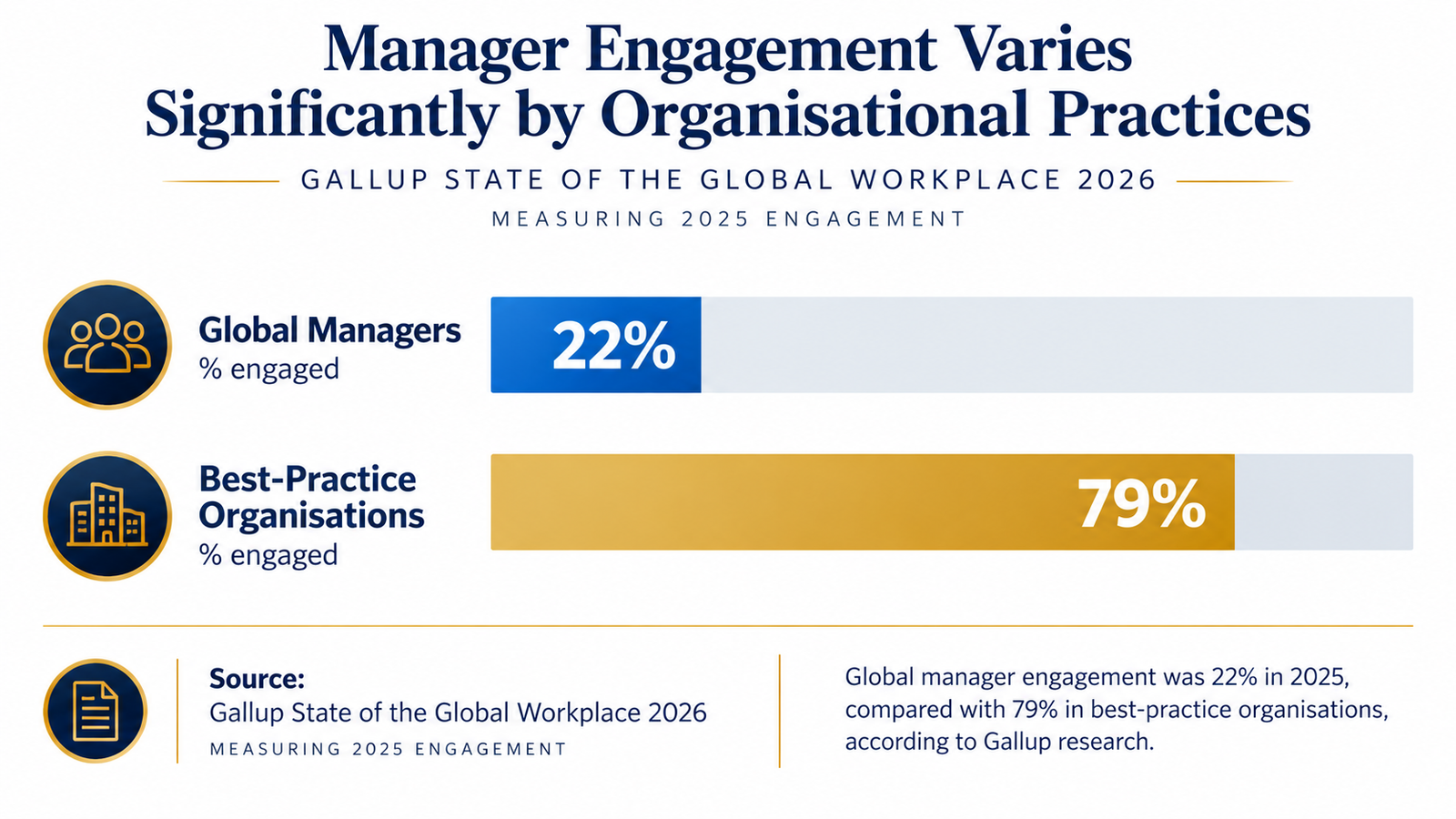
Gallup’s 2026 State of the Global Workplace report found that global manager engagement declined from 27% in 2024 to 22% in 2025. Gallup also reported that engagement among managers in its best-practice organisations reached 79% in 2025.
These figures do not prove that meetings caused lower engagement. They demonstrate a wider challenge: leadership environments differ substantially in how effectively they support managers.
The chart illustrates the gap between global manager engagement and best-practice organisations.
Three decision-making risks
Excessive meeting demands can create conditions in which leaders become more likely to experience:
- Decision delay: Important choices are postponed because there is insufficient time to examine them.
- Reactive judgement: Immediate demands receive attention at the expense of longer-term priorities.
- Reduced strategic perspective: Leaders focus on the latest operational problem rather than the wider system.
These are risks, not inevitable outcomes for every individual.
The appropriate response is to protect the conditions required for good judgement. That includes clear decision rights, preparation time, fewer unnecessary interruptions and realistic workloads.
The related article how burnout affects decision-making explores the broader relationship between leadership exhaustion and judgement.
A calendar filled with discussion is not evidence of effective leadership.
What Are the Early Warning Signs of Meeting Fatigue?
Meeting fatigue rarely announces itself through one dramatic event.
It usually develops through small changes in behaviour that leaders explain away as the normal demands of the role.
The challenge is that high-performing leaders often continue delivering results while their available capacity steadily declines. They become skilled at hiding the cost.
Six warning signs to recognise
1. Concentration declines during routine discussions.
You find yourself rereading documents, losing track of conversations or struggling to retain information that would normally be straightforward.
2. Irritability increases.
Questions that previously seemed reasonable begin to feel intrusive. You become frustrated when meetings run over or when colleagues raise issues that could have been resolved independently.
3. Decisions are repeatedly postponed.
You attend discussions but struggle to reach conclusions. Matters return to the agenda because nobody has the time or authority to resolve them.
4. Strategic thinking disappears from the calendar.
You spend your working day responding to other people’s priorities. Planning, analysis and improvement work are pushed into evenings or weekends.
5. You begin avoiding interaction.
Another invitation creates a sense of dread. You become less willing to participate in discussions, even when they are genuinely important.
6. Recovery becomes increasingly difficult.
The working day ends, but your mind continues processing unfinished conversations, decisions and commitments.
These indicators should prompt a workload review rather than an immediate assumption of burnout. Persistent symptoms may also warrant support from an appropriate healthcare professional.
The team can reveal the problem first
Leaders are not always the first people to recognise their own fatigue. Their teams may notice changes in communication, responsiveness and decision-making.
A previously supportive manager begins cancelling one-to-one meetings.
A decisive director starts requesting repeated updates.
A collaborative leader becomes unusually controlling.
These behaviours can have several causes. Meeting fatigue is one possible contributor.
The important leadership response is curiosity rather than blame.
Ask whether the person’s role has become structurally unmanageable. Examine meeting volume, decision responsibilities, interruptions and workload expectations.
For a more detailed diagnostic perspective, explore the early signs of leadership burnout.
The earlier an organisation identifies capacity problems, the more options it has for redesigning work before exhaustion becomes entrenched.
How Can Leaders Reduce Meeting Fatigue Without Losing Control?
The solution is not to eliminate collaboration.
Organisations need meetings for complex decisions, relationships, problem-solving and accountability. The objective is to make those interactions deliberate.
A sustainable meeting system should answer three questions:
- Who needs to participate?
- What outcome is required?
- Why must this happen through a meeting?
If those questions cannot be answered, the meeting should be reconsidered.
Apply the four pillars of structural transformation
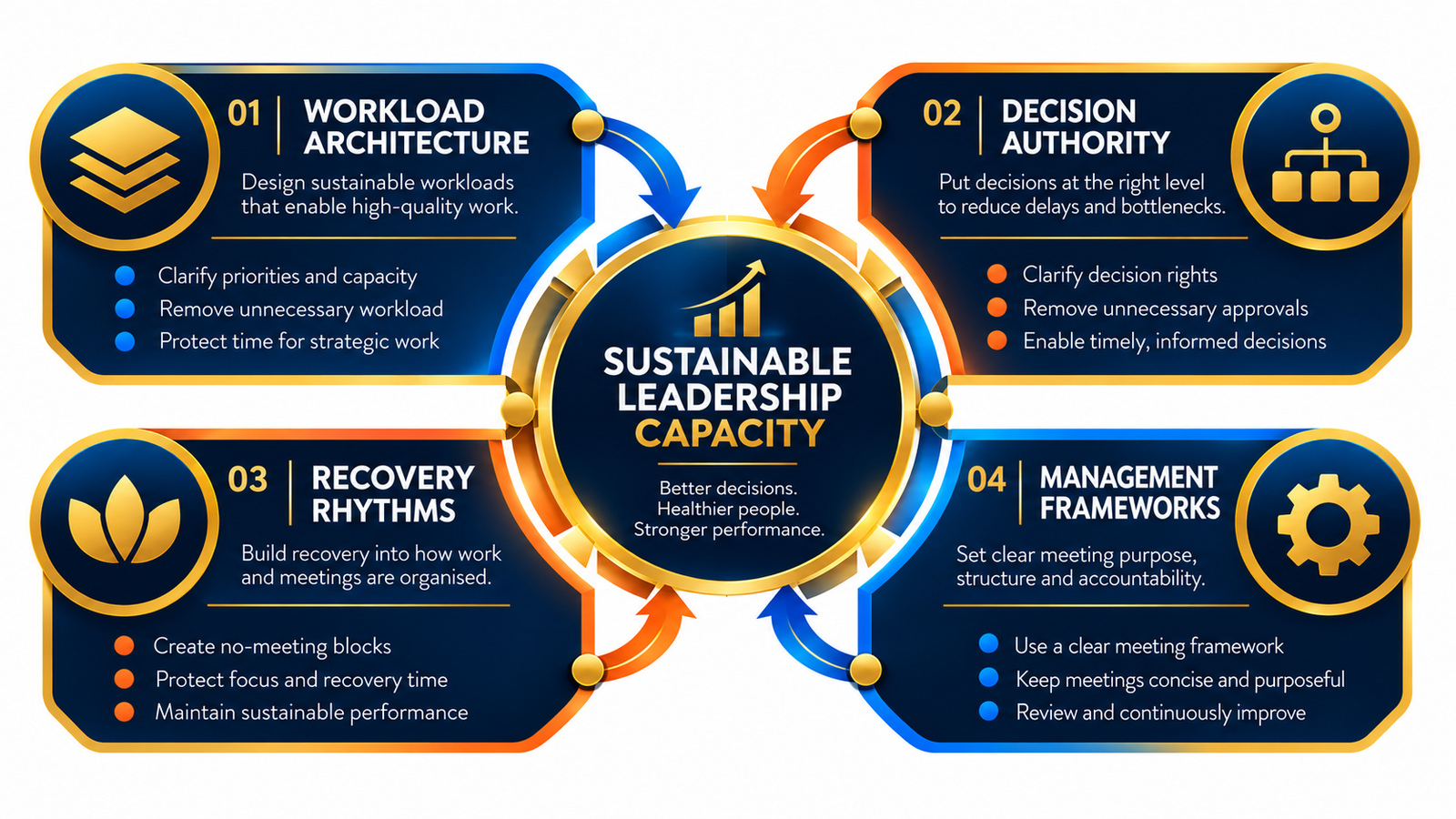
The Burn Bright Not Out Framework™ provides four connected pillars for redesigning leadership work.
Pillar 01
Workload Architecture™
Limit meeting saturation and protect time for essential work.
Pillar 02
Decision Authority™
Move routine decisions to clearly accountable owners.
Pillar 03
Recovery Rhythms™
Create space between demanding conversations and protect focus.
Pillar 04
Management Frameworks
Standardise agendas, accountability and meeting reviews.
Redesign the working week
Begin by protecting time for work that requires uninterrupted attention.
- Group similar meetings where practical.
- Avoid placing emotionally demanding conversations immediately before complex strategic decisions.
- Introduce appropriate breaks between discussions.
- Replace routine status meetings with structured written updates.
- Reduce attendance to those whose participation is necessary.
These changes should not be imposed without considering operational responsibilities. Some leaders must remain available for urgent clinical, safeguarding or safety decisions.
The principle is not rigid scheduling.
It is deliberate capacity management.
Clarify who can make decisions
One of the strongest interventions is reducing unnecessary escalation.
When a team has the authority, information and resources to resolve a problem, it should not need another management meeting.
Use the RACI Delegation Framework™ to clarify responsibility, accountability, consultation and information requirements.
A well-designed decision structure reduces repeated discussion while preserving appropriate oversight.
Stop rewarding constant availability
Leaders also shape meeting culture through their behaviour.
A senior executive who schedules meetings throughout the evening signals that uninterrupted availability is expected.
A director who demands attendance at every discussion teaches managers that visibility matters more than judgement.
Changing these expectations requires visible leadership commitment. Leadership expectations can also discourage honest conversations about capacity — one of the reasons why leaders hide burnout.
Sustainable leadership requires a different standard.
How Can Organisations Prevent Meeting Fatigue Long Term?
Short-term calendar changes are useful.
But they are rarely enough.
If an organisation reduces meetings without changing how information flows, how decisions are made or how performance is assessed, the old patterns tend to return.
Meeting fatigue prevention must therefore become part of organisational design.
Introduce a 30-day meeting fatigue reset
A practical intervention can follow four stages.
Week 1 — Diagnose the workload
Audit meeting hours, recurring commitments, decision bottlenecks and after-hours work. Ask leaders which meetings consume capacity without producing meaningful outcomes.
Week 2 — Remove structural waste
Cancel obsolete meetings, shorten routine discussions and replace unnecessary updates with asynchronous communication.
Week 3 — Rebuild leadership capacity
Protect strategic thinking time, establish recovery intervals and clarify which decisions can be made without senior management involvement.
Week 4 — Measure and refine
Review meeting hours, decision speed, work quality, leader feedback and whether demands have shifted into email or messaging.
Measure what actually improves
A meeting reduction programme should never be judged solely by the number of invitations removed. That creates the risk of replacing one ineffective metric with another.
Instead, examine whether decisions are being made more effectively, whether leaders have time for strategic work and whether teams understand their responsibilities.
- Track meeting hours alongside the quality of outcomes.
- Review the volume of unresolved decisions.
- Monitor whether leaders are completing essential work within reasonable working hours.
- Ask whether the changes have improved clarity or simply created additional communication elsewhere.
Make meeting design an organisational responsibility
Human Resources can support the process, but responsibility cannot sit with HR alone.
Senior leadership must establish expectations.
Department heads must apply them.
Teams must understand when collaboration is necessary and when independent action is appropriate.
Meeting fatigue prevention works best when it is treated as a management system rather than an individual productivity technique.
The wider principles of sustainable leadership and workload design provide a useful foundation for this work.
That is how organisations protect leadership capacity over time.
Traditional Meeting Culture vs Sustainable Meeting Culture
| Traditional meeting culture | Sustainable meeting culture |
|---|---|
| Attendance demonstrates commitment | Outcomes demonstrate contribution |
| Meetings are the default communication method | Meetings are reserved for necessary collaboration |
| Senior leaders approve routine decisions | Decision authority is distributed appropriately |
| Calendars are filled reactively | Leadership capacity is planned deliberately |
| Meetings follow one another without breaks | Cognitive demands and recovery are considered |
| Every stakeholder attends for visibility | Attendance reflects a genuine contribution |
| Success is measured through activity | Success is measured through outcomes |
| Individuals absorb excessive demands | Organisations redesign unsustainable structures |
The distinction is fundamental.
Traditional meeting culture assumes leaders can absorb unlimited demands if they organise themselves effectively enough.
Sustainable meeting culture recognises that attention, judgement and recovery are finite resources.
The objective is not less leadership.
It is more effective leadership.
Frequently Asked Questions
What causes meeting fatigue in leaders?
Meeting fatigue develops when leaders experience sustained cognitive demands from excessive meetings, repeated context switching, unclear agendas and insufficient recovery time. Structural problems such as weak decision authority, communication overload and unnecessary reporting can increase the pressure. Reducing meeting fatigue requires addressing these underlying conditions rather than relying only on personal productivity techniques.
Is meeting fatigue the same as leadership burnout?
No. Meeting fatigue describes exhaustion associated with meeting demands, while leadership burnout is a broader occupational phenomenon linked to chronic workplace stress. Meeting fatigue can contribute to burnout when it becomes persistent and combines with excessive workloads, limited control and inadequate recovery. Not everyone experiencing meeting fatigue is experiencing burnout.
How many meetings per day are too many?
There is no universal limit. The appropriate number depends on meeting complexity, duration, responsibilities and available recovery time. A leader may manage several short, focused meetings effectively but struggle with fewer emotionally demanding discussions. The better test is whether meetings leave sufficient capacity for decisions, strategic work and recovery.
Can meeting fatigue affect decision-making?
Yes. Excessive meeting demands can reduce the time and attention available for thoughtful judgement. Leaders may postpone complex decisions, rely on familiar approaches or respond reactively to immediate problems. These effects are not inevitable, but organisations should protect the conditions required for effective decision-making, including preparation time and clear authority.
How can organisations reduce meeting fatigue?
Organisations can audit recurring meetings, remove unnecessary attendance, clarify decision ownership, replace routine updates with written communication and protect uninterrupted working time. They should also review meeting duration, scheduling and recovery opportunities. Sustainable improvement requires changing organisational expectations rather than asking individual leaders to manage excessive demands alone.
Do shorter meetings always reduce fatigue?
Not necessarily. Shorter meetings can improve efficiency when they have clear agendas and outcomes. However, replacing one long meeting with several fragmented discussions may increase context switching. The objective should be fewer unnecessary interruptions and better decisions, not simply shorter calendar appointments.
Conclusion: Restore Leadership Capacity, Not Just Calendar Space
Meeting fatigue in leaders is a warning that an organisation may be consuming more leadership capacity than its systems can sustainably support.
The symptoms are familiar.
Full calendars.
Reduced concentration.
Delayed decisions.
Growing frustration.
Strategic work pushed into evenings.
But these problems should not automatically be interpreted as evidence that a leader lacks resilience, discipline or time management skills.
Often, the real issue is structural.
Meetings expand because decision authority is unclear.
Communication becomes fragmented because information systems are weak.
Leaders become exhausted because workload architecture ignores the cognitive cost of constant interaction.
The solution is to redesign how work happens.
Audit meeting demands. Clarify responsibilities. Protect strategic thinking. Build recovery into the working week. Measure outcomes rather than attendance.
Most importantly, recognise that effective leadership requires sustainable capacity.
At Burn Bright Advisory, our philosophy is clear:
You cannot outwork a broken system.
And you cannot build sustainable performance on permanently depleted leadership.
Is Your Leadership Workload Sustainable?
If meeting fatigue has become part of your normal working week, identify the patterns of overload, decision pressure and exhaustion that may be affecting your effectiveness.
Free Leadership Intelligence
Get Weekly Leadership Insights
Join thousands of leaders receiving practical strategies on burnout prevention, workload design, and sustainable performance every week.