Quick Answer
Key Takeaways
- Adaptability is not the same as responsiveness, flexibility or the ability to manage continuous disruption. These qualities are related, but they are not equivalent.
- Effective adaptability requires the intelligence to determine what should change, what must remain stable and how organisational capacity can be preserved throughout the transition.
- Adaptability Intelligence™ has five interconnected dimensions: Situational Awareness, Cognitive Flexibility, Adaptive Judgement, Implementation Capability and Reflective Evaluation.
- Adaptability should be assessed by the quality of leadership decisions, the effectiveness of organisational responses and the capacity retained for future challenges, not by the frequency or speed of change.
- Sometimes the most intelligent adaptation is to simplify, consolidate or stop.
Adaptability Intelligence™: Why Effective Leadership Requires More Than Responding to Change
Introduction: The Leadership Challenge Is No Longer Change Itself
Organisations have always experienced change. Markets evolve, technologies develop, professional expectations shift and institutions respond to changing economic and social conditions.
What distinguishes the contemporary leadership environment is not simply the presence of change, but the interaction between its speed, complexity and consequences.
A decision made in one part of an organisation can create unexpected pressures elsewhere. Technological improvements may increase operational efficiency while introducing new demands for workforce development. Strategic restructuring may strengthen financial performance while weakening institutional knowledge or employee confidence.
For leaders, these interconnected pressures create a difficult challenge: how to remain responsive without becoming reactive.
Consider an organisation introducing artificial intelligence into its operational processes.
Senior executives may initially view implementation as a technology project. They establish efficiency targets, approve investment and expect departments to adopt new systems.
However, the implications extend beyond technology.
Employees must develop new capabilities. Managers must reconsider established workflows. Professional responsibilities may change. Questions emerge about accountability, information quality, ethical decision-making and the continued relevance of existing expertise.
A leader focused exclusively on implementation speed may overlook these wider consequences.
A leader demonstrating Adaptability Intelligence™ examines the relationship between technological change, workforce capability, organisational culture and long-term performance before determining the appropriate response.
The distinction matters.
Change is an external condition.
Adaptability is an organisational capability.
Adaptability Intelligence™ concerns the quality of leadership judgement connecting the two.
This perspective moves adaptability beyond the conventional expectation that leaders should simply become more comfortable with uncertainty.
Instead, it positions adaptability as a capability that can be developed, examined and strengthened through deliberate leadership practice.

Free Self-AssessmentIs constant change quietly draining your leadership capacity? Find out in a few minutes.
What Is Adaptability Intelligence™?
Featured Snippet
It combines several interconnected dimensions of leadership.
- Situational awareness: the ability to distinguish meaningful changes from temporary disruption or organisational noise.
- Cognitive flexibility: the willingness to reconsider existing interpretations when new evidence becomes available.
- Sound judgement: the ability to determine which elements of strategy, practice or organisational structure should be adjusted.
- Implementation capability: the capacity to translate revised decisions into coordinated action.
- Reflective evaluation: the discipline to examine whether their adaptations have improved outcomes or merely introduced additional complexity.
These dimensions distinguish intelligent adaptability from continuous organisational movement.
An organisation that repeatedly restructures, introduces new initiatives and changes strategic priorities is not necessarily adaptable. It may instead be demonstrating an inability to establish coherent direction.
Similarly, a leader who consistently changes decisions in response to stakeholder pressure may appear flexible while weakening organisational trust.
Adaptability Intelligence™ requires leaders to balance responsiveness with consistency.
The objective is not to preserve existing practices at all costs, nor to embrace every emerging development. It is to make proportionate, evidence-informed adjustments that strengthen organisational effectiveness.
Adaptability Is Not the Same as Flexibility
Flexibility generally describes the willingness or ability to accommodate different circumstances.
Adaptability involves changing behaviour, decisions or systems in response to those circumstances.
Adaptability Intelligence™ adds another requirement: determining whether the adjustment is appropriate, effective and sustainable.
This distinction becomes particularly important in complex leadership environments.
A school principal who changes the timetable to accommodate staffing pressures demonstrates flexibility.
A principal who analyses recurring staffing difficulties, reviews workload distribution, consults teachers and redesigns operational arrangements demonstrates a more developed adaptive response.
The second approach addresses the conditions creating the problem rather than responding only to its immediate symptoms.
The same principle applies to healthcare leadership, business operations and public service delivery.
Why Adaptability Intelligence™ Matters for Leadership Performance
Leadership effectiveness depends partly on the relationship between established expertise and emerging organisational demands.
Experience provides valuable knowledge. It helps leaders recognise patterns, anticipate risks and make decisions under pressure.
However, experience can also reinforce assumptions that no longer reflect current conditions.
A strategy that delivered strong results five years ago may be less effective in a changed market. A management approach developed within a stable workforce may prove inadequate when organisational roles become more fluid.
The challenge is not that previous expertise becomes irrelevant. It is that leaders must continually examine where established knowledge remains useful and where new understanding is required.
This is a central concern of Leadership Performance Intelligence™.
Leadership capability cannot be evaluated only through historical achievement, formal qualifications or confidence in decision-making. It must also consider whether leaders can maintain effective judgement as the conditions surrounding their responsibilities evolve.
Adaptability Intelligence™ contributes to this broader understanding by connecting three essential questions:
- Interpretation: What has changed, and why does it matter?
- Judgement: What response is justified by the available evidence?
- Sustainability: Can the organisation implement this response without undermining its future capability?
These questions help distinguish considered adaptation from impulsive organisational change.
They also introduce an important relationship between adaptability and Leadership Sustainability™.
A leader may successfully manage repeated periods of disruption while gradually depleting their own capacity and that of their team.
Without attention to workload, decision demands and organisational resources, adaptability can become another expectation placed upon already stretched leadership systems.
Sustainable adaptability therefore requires leaders to consider not only the immediate effectiveness of change but also its cumulative human and operational consequences.

The Five Dimensions of Adaptability Intelligence™
Adaptability Intelligence™ becomes valuable when it moves beyond an abstract leadership characteristic and becomes a capability that leaders can examine, develop and apply.
Within Burn Bright Advisory’s Leadership Performance Intelligence™ approach, five interconnected dimensions provide a practical framework for understanding how leaders respond to changing conditions.
These dimensions are presented as a developmental framework rather than a scientifically validated psychometric scale. They establish a structured basis for leadership reflection, diagnostic exploration and organisational development.
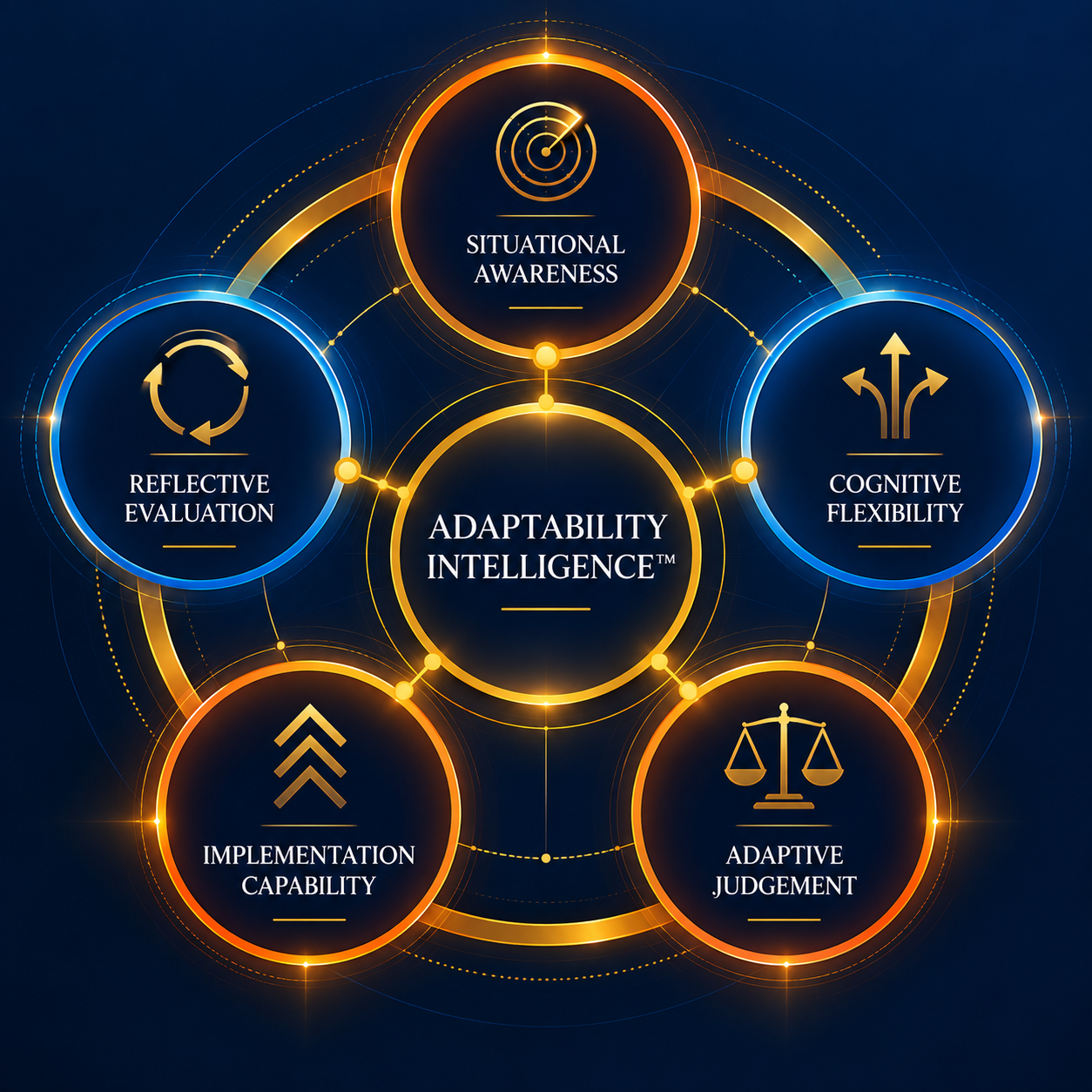
1. Situational Awareness: Recognising What Has Actually Changed
Effective adaptation begins with accurate interpretation.
Leaders must distinguish structural developments from temporary disruption, emerging risks from routine operational variation, and genuine opportunities from organisational enthusiasm.
This requires more than collecting information. It involves questioning the assumptions through which information is interpreted.
For example, declining employee engagement may initially appear to reflect resistance to organisational change. Further investigation might reveal unclear responsibilities, inconsistent communication or excessive workloads.
Without situational awareness, leaders risk responding to symptoms rather than causes.
A central diagnostic question is:
2. Cognitive Flexibility: Reconsidering Established Thinking
Leadership experience provides valuable expertise, but it can also create established patterns of interpretation.
Cognitive flexibility enables leaders to reconsider those patterns without abandoning professional judgement.
It requires openness to contradictory evidence, alternative perspectives and emerging knowledge.
Importantly, cognitive flexibility is not indecision.
A cognitively flexible leader can maintain a clear strategic direction while recognising that the methods used to achieve it may need revision.
This connects Adaptability Intelligence™ with Constructivism Intelligence™ and Knowledge Development Intelligence™ within the Leadership Intelligence Compass™.
3. Adaptive Judgement: Deciding What Should Change
Not every disruption requires transformation.
Some circumstances justify minor operational adjustments. Others require strategic reconsideration, resource redistribution or fundamental organisational redesign.
Adaptive judgement concerns the ability to distinguish between these responses.
Leaders must evaluate proportionality, consequences, stakeholder needs and organisational capacity.
This dimension also requires ethical consideration.
An operational change that improves efficiency but creates unacceptable risks for employees, patients or service users cannot automatically be considered effective leadership adaptation.
Adaptability must remain connected to professional responsibility.
4. Implementation Capability: Translating Decisions Into Organisational Action
Recognising the need for change does not guarantee successful implementation.
Leaders must establish clear responsibilities, communicate the rationale for decisions, allocate appropriate resources and monitor the consequences of implementation.
They must also understand the difference between organisational compliance and genuine capability development.
Employees may adopt a new process because they are instructed to do so without understanding its purpose or developing confidence in its application.
Intelligent adaptation therefore includes participation, learning and feedback.
5. Reflective Evaluation: Learning From the Consequences
The final dimension concerns the ability to evaluate adaptation after implementation.
- Did the response address the original problem?
- Were unintended consequences introduced?
- Has organisational capability improved?
- What should be retained, revised or discontinued?
Reflective evaluation transforms individual experiences of change into organisational knowledge.
It also creates the foundation for future adaptability.
Without reflection, organisations risk repeating familiar mistakes under different circumstances.
How Adaptability Intelligence™ Connects to the Leadership Intelligence Compass™
Adaptability does not operate independently of other leadership capabilities.
The Leadership Intelligence Compass™ provides a broader structure through which leaders can examine the relationships between their judgement, behaviour, knowledge and organisational responsibilities.
Several connections are particularly significant.
| Compass Domain | Contribution to Intelligent Adaptability |
|---|---|
| Reflective Practice Intelligence™ | Helps leaders examine assumptions, decisions and consequences |
| Knowledge Development Intelligence™ | Supports the acquisition and application of emerging knowledge |
| Emotional Intelligence™ | Strengthens awareness of uncertainty, resistance and stakeholder concerns |
| Ethics Intelligence™ | Ensures adaptations remain consistent with professional responsibilities |
| Visionary Leadership Intelligence™ | Maintains strategic direction while operational methods evolve |
| Leadership Sustainability™ | Protects leadership and organisational capacity during repeated change |
These relationships demonstrate why adaptability should not be treated as a standalone personality characteristic.
A leader may be open to change but lack the emotional intelligence required to understand employee concerns.
Another may demonstrate strong strategic judgement but insufficient reflective practice to recognise when established assumptions have become outdated.
Leadership Performance Intelligence™ brings these capabilities into a connected developmental perspective.
The objective is not to maximise one domain independently, but to understand how different dimensions of leadership contribute to effective performance.

Adaptability Intelligence™ Across Different Leadership Sectors
Although the underlying principles of intelligent adaptation are transferable, their practical application varies across professional environments. Explore the full range of sector-specific leadership hubs for deeper context.
The following examples are illustrative scenarios rather than documented organisational case studies.
🏢 Business Growth Intelligence™: Adapting Without Losing Strategic Direction
Consider a growing business experiencing rapid changes in customer expectations and competitive conditions. Its leadership team responds by introducing new products, restructuring departments and revising performance targets.
Individually, each decision appears reasonable. Collectively, however, the changes create uncertainty, fragmented priorities and increasing pressure on middle managers.
An Adaptability Intelligence™ approach begins by examining whether the organisation’s responses are strategically connected. Rather than launching additional initiatives, leaders assess which changes are essential, which activities should be discontinued and whether employees have sufficient capacity to deliver the revised strategy.
The central leadership challenge becomes maintaining coherence during adjustment. In this context, adaptability is demonstrated through disciplined strategic choices rather than the volume of organisational activity.
🎓 School Leadership Intelligence™: Balancing Educational Innovation and Stability
School leaders operate within environments shaped by curriculum developments, inspection expectations, workforce pressures and changing student needs.
A principal introducing a new assessment system may recognise potential improvements in the quality of educational information. However, implementation also affects teacher workload, professional confidence, reporting arrangements and classroom practice.
An adaptable school leader evaluates these relationships before determining the pace and scope of implementation. Teachers are involved in identifying practical difficulties. Professional development addresses genuine capability gaps. Feedback is gathered before full implementation.
The objective is not simply successful adoption of a new system. It is improved educational practice without unnecessary disruption to teaching and learning. This illustrates the relationship between Adaptability Intelligence™, Professionalism Intelligence™ and Leadership Sustainability™.
🏥 Healthcare Leadership Intelligence™: Adapting While Protecting Safety
Healthcare leaders frequently manage changes involving clinical guidance, technology, staffing and service demand. Their adaptability must operate within clear professional, ethical and safety boundaries.
Consider a clinical department introducing a revised patient management process. The leadership team must evaluate operational efficiency alongside staff competence, communication, escalation procedures and patient safety.
Rapid implementation may create avoidable risks if employees have not received appropriate preparation. Equally, excessive resistance to necessary improvement may prevent the department from addressing established weaknesses.
Adaptability Intelligence™ supports proportionate decision-making: recognising the need for change while ensuring that implementation remains consistent with professional standards and safe practice.
🏛️ Public Service Leadership Intelligence™: Responding to Complexity and Accountability
Public service leaders must balance changing community needs, policy requirements, financial constraints and institutional accountability. Unlike some commercial environments, success cannot always be measured through a narrow set of financial outcomes.
A public service department redesigning access to its services may introduce digital processes to improve efficiency. However, leaders must also consider accessibility, public confidence, service continuity and the needs of individuals who cannot easily use digital systems.
An intelligent adaptive response considers both operational improvement and equitable service provision.
The wider lesson is that leadership adaptability must remain connected to the purpose of the institution.
Change that improves one performance measure while undermining the organisation’s fundamental responsibilities may represent poor adaptive judgement.
The Strategic Risk: When Adaptability Becomes Continuous Disruption
One of the most important leadership distinctions is between adaptability and organisational instability.
Frequent change can create the appearance of progress while weakening the conditions necessary for effective performance.
This is where Leadership Workload™, Leadership Capacity™ and Leadership Sustainability™ become essential considerations.
Leaders must examine the cumulative demands created by change rather than evaluating each initiative in isolation.
Three questions are particularly important:
- Does this change address a clearly identified organisational need?
- Have we created sufficient capacity to implement it effectively?
- What existing activity must be reduced, redesigned or discontinued to accommodate the new demand?
These questions introduce discipline into adaptive leadership.
They also challenge the assumption that organisational responsiveness must always involve additional activity.
The capacity to make those decisions is an important indicator of leadership maturity.

| Common Assumption | Adaptability Intelligence™ |
|---|---|
| Adaptability is judged by the speed or frequency of change | Adaptability is judged by the quality of decisions, the effectiveness of responses and the capacity retained |
| Responsiveness always means additional activity | Sometimes the most intelligent adaptation is to simplify, consolidate or stop |
| Adaptable leaders embrace every emerging development | Adaptable leaders make proportionate, evidence-informed adjustments |
| Changing decisions under stakeholder pressure shows flexibility | Balancing responsiveness with consistency protects organisational trust |
| A change implemented successfully is a sustainable change | Change that repeatedly exhausts employees and overwhelms managers is not sustainable |
From Leadership Awareness to Measurable Adaptive Capability
Understanding adaptability is important. Developing the capacity to apply it consistently is a more demanding leadership responsibility.
Many organisations invest in change management programmes without establishing whether their leaders possess the capabilities required to interpret uncertainty, evaluate competing priorities and guide sustainable adaptation.
Training may focus on communication, stakeholder engagement or implementation planning. These activities are valuable, but they do not necessarily reveal how effectively leaders recognise changing conditions or adjust their judgement.
Within Burn Bright Advisory’s Leadership Performance Intelligence™ approach, adaptability development begins with structured leadership reflection and diagnostic inquiry.
The objective is to identify patterns in leadership thinking, decision-making and organisational behaviour that either strengthen or constrain adaptive performance.
This requires moving beyond the question:
Towards a more useful set of questions:
- Under what conditions does this leader adapt effectively?
- What limits their judgement?
- How do their decisions affect organisational performance and capacity?
These questions provide a stronger foundation for meaningful leadership development.
The Adaptability Intelligence™ Leadership Diagnostic
A practical diagnostic should examine the five dimensions introduced earlier: Situational Awareness, Cognitive Flexibility, Adaptive Judgement, Implementation Capability and Reflective Evaluation. Each dimension provides a different perspective on leadership behaviour.
The reflection exercise below is an exploratory self-reflection based on the Burn Bright Advisory™ conceptual framework. It is not a validated psychometric assessment. Rate each statement from 1 (rarely demonstrated) to 5 (consistently demonstrated).
Dimension 1 Situational Awareness
I distinguish significant changes from temporary operational pressures before responding.
Dimension 2 Cognitive Flexibility
I actively reconsider established assumptions when credible new evidence emerges.
Dimension 3 Adaptive Judgement
I evaluate the risks, benefits and wider consequences before adjusting direction.
Dimension 4 Implementation Capability
I ensure people have the clarity, resources and capability required to implement change.
Dimension 5 Reflective Evaluation
I systematically review the outcomes of changes and apply the learning to future decisions.
Interpreting the Diagnostic Responsibly
A leadership diagnostic should generate meaningful discussion rather than reduce complex professional capability to a single number.
Self-assessment can reveal how leaders perceive their behaviour, but perception does not always correspond with observable practice.
For this reason, Burn Bright’s Leadership Intelligence Assessment™ should be considered alongside structured reflection, colleague feedback and evidence from actual leadership decisions.
A leader who rates themselves highly in cognitive flexibility, for example, might examine how frequently they revise decisions when presented with contradictory evidence.
Another who reports strong implementation capability might review whether organisational changes have been delivered without persistent workload escalation.
Developing Adaptability Intelligence™ Through a Structured Leadership Cycle
Adaptability develops through repeated opportunities to interpret, decide, act and learn.
Organisations can support this development by embedding a structured cycle within existing leadership processes.
The Intelligent Adaptation Cycle
1. Observe
Identify emerging developments, operational pressures and stakeholder concerns. Separate evidence from assumptions.
2. Interpret
Examine the implications of change and determine which existing practices remain appropriate.
3. Decide
Select a proportionate response, considering professional responsibilities, organisational priorities and available capacity.
4. Implement
Communicate expectations, establish accountability and provide the resources necessary for effective action.
5. Evaluate
Review outcomes, unintended consequences and learning before determining whether further adjustment is necessary.
This cycle should not become another administrative burden.
Its value lies in improving the quality of conversations already taking place within leadership meetings, performance reviews and organisational planning.
For example, a monthly leadership meeting might dedicate time to examining one significant organisational adjustment. Rather than reviewing implementation milestones alone, participants would consider the assumptions behind the original decision, emerging evidence, workforce implications and lessons for future practice.
Over time, this creates a more disciplined approach to organisational learning.
It also connects Adaptability Intelligence™ with Leadership Reflection™ and Leadership Benchmarking™.
Reflection examines the reasoning and behaviour behind decisions. Benchmarking can support comparison against agreed organisational standards or previous performance, provided the measures are relevant and appropriately interpreted.
Together, these practices create a stronger foundation for leadership development.
A 30-Day Adaptability Intelligence™ Development Plan
Leaders do not need to initiate large-scale transformation to begin developing adaptive capability.
A focused 30-day programme can establish the habits and evidence required for further development.
| Period | Leadership Priority | Practical Output |
|---|---|---|
| Week 1 | Examine current assumptions and changing conditions | Leadership adaptability reflection |
| Week 2 | Identify one significant adaptive challenge | Evidence-based problem definition |
| Week 3 | Design and implement a proportionate response | Documented adjustment and accountability |
| Week 4 | Evaluate outcomes and organisational impact | Reflective review and development priorities |
During the first week, leaders should examine where established approaches may no longer reflect current circumstances.
In the second week, they should select one specific challenge rather than attempting to redesign multiple organisational systems simultaneously.
The third week focuses on implementation, including stakeholder communication, resource requirements and clear responsibilities.
The final week provides an opportunity to review what changed, what was learned and whether the response improved performance.
Thirty days will not establish complete adaptive leadership capability.
However, this approach can provide an initial evidence base for more sustained development through leadership workshops, diagnostics and the wider Leadership Development System™.
Protecting Leadership Capacity During Organisational Adaptation
Adaptability becomes counterproductive when the demand for continuous adjustment exceeds organisational capacity.
This is particularly important for leaders operating in environments characterised by persistent staffing pressures, limited resources or competing accountability requirements.
Leadership Sustainability™ therefore provides an essential boundary around adaptive decision-making.
Before implementing significant change, leaders should consider three forms of capacity.
Capacity 1
Operational Capacity
Whether sufficient time, resources and organisational infrastructure exist to deliver the adjustment.
Capacity 2
Leadership Capacity™
Whether managers have the decision-making space, authority and support required to guide implementation.
Capacity 3
Human Capacity
The cumulative demands placed upon employees, including workload, learning requirements and the emotional consequences of uncertainty.
These considerations should inform both the design and timing of organisational change.
A technically sound initiative may still be poorly timed if its implementation creates demands the organisation cannot reasonably absorb.
Intelligent adaptation recognises that sustainable performance depends upon the relationship between organisational ambition and available capability.
The purpose is not to eliminate difficulty or avoid necessary transformation. It is to ensure that the pursuit of improvement does not systematically weaken the people and systems responsible for delivering it.
Leadership Reflection Questions
- Which assumptions currently influence my leadership decisions, and when were they last critically examined?
- How effectively do I distinguish genuine organisational change from temporary operational disruption?
- When presented with contradictory evidence, do I reconsider my position or defend established decisions?
- How do I balance responsiveness with strategic consistency?
- What evidence demonstrates that recent organisational changes have improved performance?
- Have my decisions increased or reduced the workload carried by colleagues?
- How effectively do I involve stakeholders in understanding and implementing necessary adjustments?
- What have I learned from an adaptation that did not produce its intended outcome?
These questions can support individual reflection, executive coaching and leadership team discussion. They are most valuable when supported by specific examples rather than general impressions.
Practical Action Steps for Leaders
To translate Adaptability Intelligence™ into leadership practice, begin with a manageable set of commitments.
- Identify one adaptive challenge. Select an issue where changing conditions have made established practices less effective.
- Examine the evidence. Distinguish observable developments from assumptions, preferences and organisational narratives.
- Consult relevant stakeholders. Seek perspectives that may challenge your existing interpretation.
- Determine a proportionate response. Avoid unnecessary restructuring when a targeted adjustment would address the problem.
- Evaluate capacity. Consider operational resources, leadership workload and the implications for employee sustainability.
- Review the consequences. Establish what improved, what remained unresolved and what should inform future decisions.
These actions can be incorporated into leadership planning tools and revisited through structured reflection.
Their purpose is to strengthen the quality of adaptive judgement rather than increase the volume of leadership activity.
Conclusion: Adaptability Intelligence™ as a Foundation for Sustainable Leadership Performance
The capacity to adapt has become an essential feature of effective leadership.
However, adaptability should not be confused with constant movement, unquestioning acceptance of change or the expectation that leaders and employees must absorb unlimited disruption.
Effective adaptation requires disciplined interpretation, cognitive flexibility, proportionate judgement, coordinated implementation and reflective learning.
These capabilities enable leaders to respond to changing circumstances without abandoning strategic coherence, professional responsibility or organisational sustainability.
Within Burn Bright Advisory’s Leadership Intelligence Compass™, Adaptability Intelligence™ contributes to a broader understanding of Leadership Performance Intelligence™. It connects the ability to recognise change with the judgement required to respond effectively and the responsibility to preserve future leadership capacity.
For organisations, the implication is significant. Leadership development should not focus exclusively on preparing individuals to manage change initiatives. It should also develop their capacity to determine when change is necessary, how it should be approached and whether the resulting decisions strengthen organisational performance.
For individual leaders, the challenge is equally important.
The objective is not to become endlessly flexible.
It is to develop the intelligence to recognise what matters,
reconsider what no longer works
and act with clarity when circumstances demand adjustment.
That is the foundation of Adaptability Intelligence™. And it is an essential component of sustainable Leadership Performance Intelligence™.
Frequently Asked Questions
What is Adaptability Intelligence™ in leadership?
Adaptability Intelligence™ is the capacity to recognise changing circumstances, reconsider established assumptions, make informed adjustments and sustain effective organisational performance during uncertainty.
Within Burn Bright Advisory’s Leadership Intelligence Compass™, it connects situational awareness, cognitive flexibility, adaptive judgement, implementation capability and reflective evaluation. Unlike general flexibility, Adaptability Intelligence™ emphasises the quality, proportionality and sustainability of leadership responses.
Why is adaptability important for effective leadership?
Adaptability enables leaders to respond appropriately when existing strategies, processes or assumptions no longer reflect organisational conditions. It supports decision-making, organisational learning and the ability to navigate uncertainty without abandoning strategic direction.
Effective adaptability also helps leaders avoid unnecessary disruption by distinguishing changes that require intervention from temporary operational pressures.
What is the difference between adaptability and adaptive leadership?
Adaptability describes the ability to adjust to changing conditions. Adaptive leadership commonly refers to approaches that help people and organisations address complex challenges requiring learning and behavioural change.
Adaptability Intelligence™ is Burn Bright Advisory’s conceptual framework for examining the leadership capabilities involved in interpreting change, exercising judgement, implementing adjustments and evaluating their consequences. These concepts overlap but are not interchangeable.
What are the five dimensions of Adaptability Intelligence™?
Burn Bright Advisory™ identifies five interconnected dimensions:
- Situational Awareness
- Cognitive Flexibility
- Adaptive Judgement
- Implementation Capability
- Reflective Evaluation
Together, they provide a structured approach to understanding how leaders recognise change, make decisions, implement responses and learn from outcomes.
How can leaders develop Adaptability Intelligence™?
Leaders can develop Adaptability Intelligence™ through structured reflection, feedback, evidence-informed decision-making and deliberate evaluation of organisational change.
A practical development approach involves identifying an adaptive challenge, examining assumptions, consulting stakeholders, implementing a proportionate response and reviewing outcomes. Development should be supported by opportunities to practise these behaviours in real leadership situations.
How can organisations assess leadership adaptability?
Organisations can explore leadership adaptability through behavioural reflection, colleague feedback, decision reviews and evidence from change implementation. Assessment should examine how leaders interpret changing circumstances, reconsider assumptions, evaluate risks and learn from outcomes.
Self-assessment alone is insufficient for establishing competence. Formal benchmarking requires appropriately developed measures, clear criteria and evidence supporting their interpretation.
How does Adaptability Intelligence™ support leadership sustainability?
Adaptability Intelligence™ supports Leadership Sustainability™ by encouraging leaders to consider the cumulative operational and human consequences of change. Rather than introducing continuous initiatives, leaders evaluate workload, available resources, decision-making capacity and implementation demands.
This helps organisations pursue necessary improvement while protecting their ability to perform effectively over time.
Can Adaptability Intelligence™ be applied across different sectors?
Yes. The underlying capabilities are relevant across business, education, healthcare, public service and other leadership environments. Their application varies according to professional responsibilities, stakeholder expectations and organisational constraints.
For example, healthcare leaders must consider clinical safety, while school leaders must balance educational improvement with teacher workload and continuity of learning.
Burn Bright Full Diagnostic™Go deeper than self-reflection with a full diagnostic of your leadership capacity, workload and sustainability. £144.
Develop the Intelligence to Lead Through Change
Continuous disruption quietly erodes leadership capacity. Find out where you stand before change outpaces the people delivering it.
Free Leadership Intelligence
Get Weekly Leadership Insights
Join thousands of leaders receiving practical strategies on burnout prevention, workload design, and sustainable performance every week.