Quick Answer
Key Takeaways
- Visionary leadership is not simply the ability to describe a desirable future — it is the disciplined capability to connect that future to the decisions, behaviours, resources and systems of the present.
- Strategic foresight must inform present-day decisions rather than remain an abstract prediction of future conditions.
- Organisational vision must be supported by Leadership Capacity™, ethical judgement, adaptive systems and collective understanding.
- A strategically attractive future is not necessarily an organisationally achievable future — ambition that depends on permanent overextension is not a sustainable strategy.
- The Burn Bright Strategic Foresight-to-Performance Framework connects five stages: Anticipate, Interpret, Align, Execute, and Learn and Adapt.
- Within the Leadership Intelligence Compass™, Visionary Leadership Intelligence™ operates as an interconnected capability, not an isolated leadership attribute.
Is your strategic ambition outpacing your leadership capacity?
Visionary Leadership Intelligence™: How Leaders Turn Strategic Foresight into Organisational Performance
Introduction: The Growing Distance Between Vision and Execution
Every organisation operates with assumptions about its future.
Business executives anticipate changing markets, technological disruption and competitive pressures. School leaders prepare for evolving educational expectations, demographic changes and workforce challenges. Healthcare executives must consider new clinical technologies, shifting patient needs and increasing operational complexity. Public service leaders navigate policy uncertainty, financial constraints and changing community expectations.
Across these environments, the ability to think beyond immediate operational demands is essential.
Yet the existence of a strategic vision does not guarantee organisational readiness.
- A leadership team may identify artificial intelligence as a transformational opportunity without understanding the implications for workforce capability, governance or professional judgement.
- A school may commit to developing a future-ready curriculum while continuing to allocate professional development resources according to outdated priorities.
- A healthcare organisation may announce a digital transformation strategy without addressing the leadership workload, staff confidence and operational dependencies that determine whether implementation is sustainable.
In each example, the organisation possesses an intention about the future. What remains uncertain is its capacity to act on that intention.
For Burn Bright Advisory™, this connection represents the central purpose of Visionary Leadership Intelligence™.
Rather than treating vision as a personal characteristic possessed by exceptional individuals, it examines the leadership intelligence required to turn strategic foresight into coordinated organisational performance.

What Is Visionary Leadership Intelligence™?
Featured Snippet
It combines several complementary forms of leadership judgement:
- Strategic foresight enables leaders to recognise emerging trends, consider alternative futures and identify the implications of uncertainty.
- Strategic interpretation allows leaders to distinguish meaningful developments from temporary distractions and understand their relevance to organisational purpose.
- Collective alignment ensures that employees and stakeholders understand not only where the organisation intends to go, but why that direction matters and what it requires of them.
- Execution intelligence connects long-term ambition to current priorities, investment decisions, capability development and operational accountability.
- Reflective adaptation enables leaders to revise assumptions and strategies as new evidence emerges.
Together, these capabilities create a more rigorous understanding of visionary leadership.
The central question changes from “Does this leader have an inspiring vision?” to “Does this leader possess the intelligence, judgement and organisational capacity to translate future possibilities into sustainable performance?”
This is not merely a linguistic distinction. It changes how leadership effectiveness can be examined, developed and evaluated.
A compelling vision may generate initial enthusiasm. Visionary Leadership Intelligence™ seeks to determine whether that enthusiasm can become informed commitment, practical capability and measurable progress.
Why Traditional Approaches to Visionary Leadership Are Insufficient
Conventional leadership development frequently presents visionary leadership as a combination of charisma, confidence and strategic communication.
Leaders are encouraged to articulate ambitious goals, communicate a compelling purpose and motivate others to pursue transformational outcomes.
These practices can contribute to organisational direction. However, they may overlook the complex conditions that determine whether a vision can be implemented. Three limitations are particularly significant.
| Traditional Visionary Leadership | Visionary Leadership Intelligence™ |
|---|---|
| Vision as charisma, confidence and strategic communication | Vision as an integrated capability that converts foresight into performance |
| “Does this leader have an inspiring vision?” | “Can this leader translate future possibilities into sustainable performance?” |
| Strategic ambition expands beyond organisational capacity | Ambition is tested against Leadership Capacity™ and Leadership Workload™ |
| A preferred future narrative is held despite changing evidence | Strategic assumptions are continually challenged and revised |
| Strategic direction concentrated in one charismatic leader | Strategic understanding distributed across leadership teams |
| Success judged by milestones delivered | Success judged alongside the conditions that make continued progress possible |

Visionary Leadership Intelligence™ Within the Leadership Intelligence Compass™
The Leadership Intelligence Compass™ provides a broader architecture for understanding the capabilities that influence leadership performance.
Within this architecture, Visionary Leadership Intelligence™ is closely connected to several other intelligence domains.
| Compass Domain | Contribution to Visionary Leadership |
|---|---|
| Ethics Intelligence™ | Ensures strategic ambition respects organisational values, stakeholder responsibilities and long-term consequences. |
| Adaptability Intelligence™ | Enables strategic direction to evolve when circumstances or evidence change. |
| Constructivism Intelligence™ | Supports collective meaning-making and the development of shared understanding. |
| Reflective Practice Intelligence™ | Encourages critical examination of strategic assumptions and leadership decisions. |
| Knowledge Development Intelligence™ | Builds the organisational expertise needed to implement future-focused strategies. |
| Emotional Intelligence™ | Helps leaders recognise uncertainty, resistance and the human consequences of change. |
| Leadership Sustainability™ | Tests whether strategic ambitions can be delivered without progressively exhausting organisational capacity. |
These relationships illustrate an important principle of Leadership Performance Intelligence™:
- A leader with strong strategic foresight but limited ethical judgement may pursue opportunities that create unacceptable organisational risks.
- A leader with an ambitious vision but weak adaptability may continue investing in strategies that are no longer viable.
- A leader with excellent communication skills but insufficient attention to leadership sustainability may secure commitment to initiatives that teams cannot realistically deliver.
The Leadership Intelligence Compass™ offers a way to examine these interdependencies rather than evaluating leadership through isolated competencies.
For executive teams, this creates an opportunity to move from broad leadership descriptions towards a more structured conversation about capability, evidence and development priorities.
From Strategic Foresight to Organisational Execution
Recognising future opportunities is only the beginning of visionary leadership. The greater challenge is translating those opportunities into decisions that strengthen organisational performance.
Many organisations possess considerable strategic knowledge. They commission market reports, examine emerging technologies, analyse workforce trends and participate in long-term planning exercises.
Yet access to information does not necessarily produce strategic intelligence. The distinction lies in what leaders do with the information available to them.
A healthcare executive who anticipates increasing demand for digitally supported care must consider the implications for clinical capability, workforce development, patient accessibility and governance.
A school principal who recognises the growing influence of artificial intelligence on education must move beyond discussing technological change towards examining curriculum relevance, teacher capability, assessment practices and ethical responsibilities.
Similarly, a business leader anticipating market disruption must determine which existing assumptions, investments and operating practices require reconsideration.
In each situation, visionary leadership requires a disciplined connection between future possibilities and present organisational choices. This is where Visionary Leadership Intelligence™ becomes operational.
The Burn Bright Strategic Foresight-to-Performance Framework
Burn Bright Advisory™ proposes a five-stage conceptual framework for examining how visionary leadership can translate strategic foresight into sustainable organisational outcomes:
- Anticipate — identify emerging signals, opportunities and risks
- Interpret — evaluate strategic significance and assumptions
- Align — connect direction with people, purpose and capacity
- Execute — translate strategic choices into accountable action
- Learn and Adapt — evaluate outcomes and refine future direction
It is a continuous intelligence cycle, rather than a one-time strategic planning exercise.

Stage 1 Anticipate Emerging Conditions
Visionary leaders systematically examine developments that may influence organisational performance. These include technological innovation, demographic change, regulatory developments, workforce expectations and evolving stakeholder needs.
The objective is not to predict the future with certainty. It is to improve organisational preparedness by considering plausible alternatives. Effective anticipation requires leaders to seek evidence beyond their immediate operational environment and actively question established assumptions.
Stage 2 Interpret Strategic Significance
Not every emerging trend requires organisational transformation. Leaders must distinguish between developments that warrant immediate action, those requiring continued observation and those with limited strategic relevance.
Interpretation therefore involves assessing potential consequences, organisational exposure and the credibility of available evidence. This stage draws particularly on Knowledge Development Intelligence™ and Reflective Practice Intelligence™. Without disciplined interpretation, organisations risk pursuing fashionable initiatives while neglecting more consequential challenges.
Stage 3 Align Vision with Organisational Capacity
Strategic direction must be translated into shared priorities and realistic commitments. Alignment involves more than securing agreement from stakeholders. It requires examining whether people understand the intended outcomes, possess the necessary capabilities and have sufficient resources to deliver them.
This is where Leadership Capacity™ and Leadership Workload™ become essential considerations. A strategy that exceeds available capacity requires prioritisation, redesign or additional investment — not simply stronger motivational communication.
Stage 4 Execute Through Accountable Systems
Vision becomes operational when leaders establish clear responsibilities, decision rights, implementation milestones and feedback mechanisms. Execution should connect strategic priorities to everyday decisions without creating unnecessary administrative complexity.
Leaders must also identify dependencies between initiatives, particularly where several programmes compete for the same people, budgets or operational resources. The quality of execution is therefore influenced by organisational design as much as individual leadership behaviour.
Stage 5 Learn, Evaluate and Adapt
Visionary leadership requires continuous examination of whether strategic actions are producing their intended effects. Leaders should assess both performance outcomes and the conditions under which those outcomes are achieved.
Progress that depends on unsustainable workloads, declining professional confidence or deteriorating service quality may represent short-term delivery rather than genuine strategic success. Learning and adaptation complete the framework by returning new evidence to the anticipation and interpretation stages.
The framework is intended as a practical organising model. Its effectiveness should be evaluated through application rather than assumed.
Applying Visionary Leadership Intelligence™ Across Sectors
The principles of visionary leadership are broadly transferable, but their application must reflect sector-specific responsibilities and constraints.
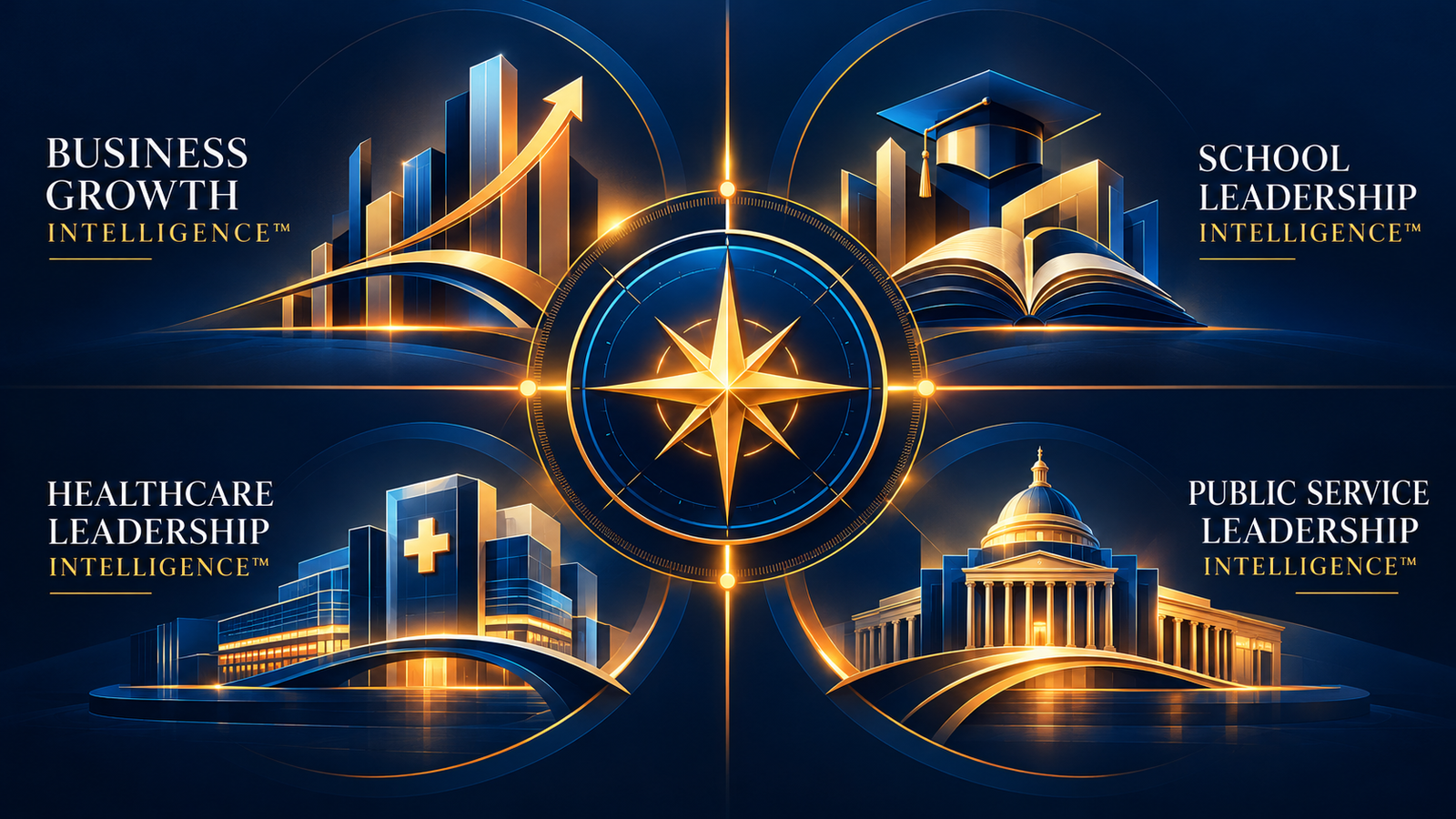
🏢 Business Growth Intelligence™: Anticipating Competitive Change
Consider a mid-sized professional services organisation facing increased competition from AI-enabled service providers. Its leadership team recognises the need to adapt but initially responds by purchasing new technology.
A Visionary Leadership Intelligence™ approach begins with a broader examination of the business model. Leaders consider which services will remain differentiated, what expertise employees will require, how client expectations may change and which ethical safeguards must accompany technological adoption.
The strategic priority shifts from technology acquisition to organisational capability development. Success can then be examined through indicators such as service quality, workforce readiness, client retention and the effectiveness of redesigned processes.
🏫 School Leadership Intelligence™: Preparing Education for Emerging Needs
A school leadership team identifies growing expectations for digital literacy, critical thinking and responsible AI use.
Rather than introducing disconnected initiatives, leaders examine how these priorities relate to curriculum design, teacher development, assessment and existing workload. They involve teachers in interpreting the implications of change, establish achievable implementation phases and review the effect on learning experiences.
The vision becomes credible because professional capability and organisational capacity develop alongside strategic ambition.
🏥 Healthcare Leadership Intelligence™: Balancing Innovation and Clinical Responsibility
A healthcare organisation considers introducing AI-supported administrative and clinical workflows. Visionary leadership requires more than recognising potential efficiency gains.
Executives must examine clinical governance, patient safety, professional accountability, staff training and the reliability of proposed technologies. They must also distinguish between activities that can appropriately be automated and decisions requiring professional judgement.
The resulting strategy connects innovation with Ethics Intelligence™, Knowledge Development Intelligence™ and Leadership Sustainability™. Performance is evaluated through service outcomes, safety indicators, staff experience and operational effectiveness.
🏛️ Public Service Leadership Intelligence™: Building Long-Term Institutional Capability
Public service leaders frequently operate within changing political priorities, statutory obligations and constrained budgets. A visionary approach must therefore preserve strategic continuity while remaining responsive to legitimate changes in public expectations.
For example, a local authority planning future community services may use demographic scenarios to inform workforce development, infrastructure investment and service accessibility.
The objective is not simply to produce a long-term plan. It is to establish institutional capabilities that remain valuable across changing conditions.
These four examples are illustrative scenarios rather than documented case studies. They demonstrate how the same leadership intelligence principles can be adapted to different organisational responsibilities.
Measuring the Difference Between Strategic Ambition and Leadership Performance
A significant limitation of traditional visionary leadership assessment is its emphasis on communication and perceived inspiration. Although these dimensions matter, they do not establish whether a leader is improving organisational readiness.
Burn Bright Advisory™ advocates examining visionary leadership through evidence across four complementary dimensions.
| Performance Dimension | Illustrative Evidence |
|---|---|
| Strategic clarity | Shared understanding of priorities, assumptions and desired outcomes |
| Organisational readiness | Capability gaps, workforce preparedness and resource alignment |
| Execution effectiveness | Milestone achievement, decision quality and implementation learning |
| Leadership sustainability | Workload pressures, leadership capacity and continuity of performance |
These dimensions should not be reduced to a single score without appropriate validation. Instead, they provide a structured basis for leadership reflection, organisational diagnostics and future Leadership Benchmarking™.
The most important assessment question is not whether leaders appear visionary. It is whether their future-focused judgement improves the organisation’s capacity to make sound decisions, adapt responsibly and deliver meaningful outcomes over time.
When Vision Exceeds Leadership Capacity
One of the most significant risks in visionary leadership occurs when strategic ambition develops faster than the organisation’s capacity to deliver it.
Executives may establish compelling transformation agendas, announce ambitious growth objectives or commit to extensive organisational change without adequately examining the demands these commitments place on leadership teams.
Initially, this imbalance may remain concealed.
Employees absorb additional responsibilities.
Managers extend their working hours.
Senior leaders intervene personally to resolve operational difficulties.
Projects continue to progress, creating the appearance of successful implementation.
Over time, however, the consequences become more visible.
Decision-making slows. Strategic priorities compete for limited resources. Experienced professionals become increasingly occupied with immediate operational pressures, leaving insufficient capacity for innovation, reflection and long-term planning.
The organisation may continue achieving short-term objectives while progressively weakening the conditions required for future performance. This represents a fundamental challenge for Visionary Leadership Intelligence™.
Effective visionary leadership therefore requires continuous evaluation of the relationship between strategic ambition, available leadership capacity and the sustainability of organisational performance.
Leadership Capacity™ as a Strategic Constraint
Within Burn Bright Advisory’s Leadership Performance Intelligence™ framework, Leadership Capacity™ concerns the resources, capabilities and operating conditions available to leaders to fulfil their responsibilities effectively.
Capacity is not simply a question of how many hours individuals can work. It includes the availability of appropriate expertise, decision-making authority, operational support, organisational knowledge and opportunities for professional reflection.
A leadership team may possess considerable technical competence yet lack the capacity to implement several major strategic initiatives simultaneously. Similarly, an organisation may have sufficient financial resources but inadequate management capability to coordinate transformation effectively.
Visionary leaders must therefore distinguish between three questions:
- What does the organisation aspire to achieve?
- What capabilities and resources are required?
- What can realistically be delivered without undermining existing responsibilities?
The answers should inform strategic sequencing, investment decisions and the pace of implementation.
This is not an argument for reducing ambition. It is an argument for strengthening the intelligence through which ambition becomes achievable.
Leadership Sustainability™: The Missing Dimension of Strategic Vision
Leadership Sustainability™ extends the assessment of performance beyond immediate results. It examines whether leaders and organisations can maintain effectiveness, sound judgement and developmental capacity over time.
This distinction matters because short-term delivery can conceal long-term deterioration.
An organisation may achieve a demanding transformation milestone while experiencing increased leadership turnover, declining trust or growing dependence on a small number of exhausted individuals. Traditional performance reporting may recognise the milestone without adequately examining these underlying vulnerabilities.
Visionary Leadership Intelligence™ requires a broader interpretation of success. Strategic progress should be considered alongside the organisational conditions that make continued progress possible. This includes examining leadership workload, succession readiness, professional development, team confidence and the capacity to respond to unexpected demands.
The relationship is particularly important during periods of transformation. When leaders are expected to manage existing operations while simultaneously implementing new systems, structures and strategic priorities, the cumulative workload can become substantial.
Without appropriate prioritisation and support, the organisation risks weakening the very leadership capability upon which successful transformation depends.
Using Leadership Reflection™ to Strengthen Strategic Judgement
Strategic foresight involves making decisions under uncertainty. Leaders must interpret incomplete information, assess competing priorities and determine which assumptions deserve continued confidence.
These responsibilities create considerable scope for cognitive bias. Previous success may encourage leaders to repeat familiar strategies. Organisational consensus may discourage alternative interpretations. Investment in an existing initiative may make it difficult to acknowledge that circumstances have changed.
Leadership Reflection™ provides a structured opportunity to examine these influences. Within the Leadership Intelligence Compass™, Reflective Practice Intelligence™ supports the capacity to question assumptions, evaluate decisions and learn from emerging evidence.
For visionary leadership, reflection should extend beyond reviewing whether strategic objectives have been achieved. It should examine the quality of the reasoning behind those objectives.
Leaders might consider whether they have interpreted emerging trends accurately, involved sufficiently diverse perspectives or underestimated the organisational consequences of proposed changes. They should also distinguish between evidence that confirms existing expectations and evidence that challenges them.
Reflection becomes strategically valuable when it informs subsequent decisions. An executive team that identifies weaknesses in its assumptions but continues operating without adjustment has generated insight without organisational learning.
The purpose of reflective practice is therefore not merely greater awareness. It is improved judgement and adaptive action.
Assessing Visionary Leadership Intelligence™
Visionary Leadership Intelligence™ should be examined through observable practices and organisational evidence rather than personal confidence or communication style alone.
Burn Bright Advisory’s Leadership Intelligence Assessment™ provides a relevant platform concept for connecting leadership capability evaluation with structured development.
A focused visionary leadership diagnostic could examine five questions:
| Assessment Dimension | Diagnostic Question |
|---|---|
| Strategic foresight | How systematically does the leader examine emerging opportunities, risks and alternative futures? |
| Strategic judgement | How effectively does the leader distinguish credible evidence from assumptions? |
| Collective alignment | To what extent do stakeholders understand strategic direction and their contribution to it? |
| Organisational capacity | Are strategic commitments aligned with available capabilities, resources and workload? |
| Adaptive learning | How consistently does the leader review outcomes and adjust decisions when evidence changes? |
These questions provide a proposed diagnostic structure, not a validated psychometric instrument.
Formal Leadership Benchmarking™ would require clearly defined assessment criteria, reliable evidence, appropriate comparison groups and validation before numerical scores could support high-stakes decisions.
Nevertheless, the framework provides a useful starting point for executive reflection, leadership development conversations and organisational planning. Its principal value lies in making the relationship between visionary ambition and leadership effectiveness more explicit.

From Individual Vision to Organisational Intelligence
A final consideration concerns where visionary capability resides.
Organisations frequently associate strategic direction with the chief executive, principal, founder or senior leadership team. Executive accountability remains essential. However, an organisation becomes vulnerable when its understanding of the future depends excessively on a single individual.
Visionary Leadership Intelligence™ should therefore contribute to the development of wider organisational intelligence. This involves creating opportunities for employees to identify emerging challenges, question established practices and contribute specialist knowledge to strategic decisions.
It also requires leaders to communicate the reasoning behind priorities, rather than expecting commitment based solely on positional authority.
The relationship with Constructivism Intelligence™ is particularly important. When stakeholders participate meaningfully in developing shared understanding, strategic direction can become more informed and implementation more coherent. Knowledge Development Intelligence™ further strengthens this process by ensuring that organisational learning is retained, transferred and applied.
The result is a more resilient form of visionary leadership: one in which strategic direction is accountable, collective understanding is developed and the capacity to adapt is distributed throughout the organisation.
The Future of Visionary Leadership: From Strategic Ambition to Leadership Intelligence
The future of visionary leadership will not be determined simply by who communicates the most ambitious organisational vision.
It will increasingly depend on who can interpret uncertainty, exercise sound judgement, develop collective capability and translate strategic direction into sustainable performance.
For executive leaders, this requires reconsidering the relationship between vision and responsibility.
Strategic ambition cannot be separated from the people expected to deliver it.
Innovation cannot be evaluated independently of ethical judgement.
Transformation cannot be considered successful if its implementation progressively undermines organisational capacity.
These are not peripheral leadership considerations. They are fundamental conditions of long-term effectiveness.
Visionary Leadership Intelligence™ offers a more integrated way to examine these relationships. Within Burn Bright Advisory’s Leadership Intelligence Compass™, visionary capability connects with Adaptability Intelligence™, Ethics Intelligence™, Reflective Practice Intelligence™, Knowledge Development Intelligence™ and Leadership Sustainability™.
Together, these domains provide a broader understanding of how leaders anticipate change, make decisions and maintain organisational effectiveness.
This approach also challenges the assumption that visionary leadership belongs exclusively to senior executives. Although strategic accountability may reside with designated leaders, organisational foresight can be strengthened through the knowledge and perspectives of employees, professional teams and stakeholders.
When strategic understanding becomes more widely distributed, organisations are better positioned to identify emerging challenges, test assumptions and respond constructively to uncertainty.
Leadership Performance Intelligence™ as the Integrating Principle
Burn Bright Advisory™ positions Leadership Performance Intelligence™ as the wider architecture through which leadership capabilities can be understood, developed and connected to organisational outcomes.
Visionary Leadership Intelligence™ contributes to this architecture by addressing the relationship between future direction and present capability.
The Leadership Intelligence Assessment™ can support structured examination of development needs, while Leadership Reflection™ encourages leaders to challenge their assumptions and evaluate the consequences of strategic decisions. Leadership Benchmarking™ offers a potential basis for monitoring capability development where appropriate measures and validation have been established.
The Leadership Intelligence Library™ provides a wider environment for connecting these insights with diagnostics, planning tools and professional development resources.
Collectively, these elements form part of the Burn Bright Leadership Development System™: an integrated approach to leadership learning, capability development and performance improvement.
Conclusion: Vision Must Become Organisational Capability
Visionary leadership is most valuable when it changes what an organisation is capable of achieving.
A compelling future direction provides purpose.
Strategic foresight improves preparedness.
Collective understanding supports alignment.
Organisational capacity makes implementation possible.
Reflection and adaptation help sustain progress when circumstances change.
None of these elements is sufficient in isolation.
Leaders who focus exclusively on future possibilities risk overlooking present constraints. Those who concentrate only on immediate operational demands risk failing to prepare their organisations for emerging challenges.
Visionary Leadership Intelligence™ connects these responsibilities. It encourages leaders to move beyond inspiration towards disciplined foresight, accountable execution and sustainable organisational development.
For Burn Bright Advisory™, this represents an essential dimension of Leadership Performance Intelligence™.
The defining question for tomorrow’s leaders is therefore not simply: What future do we want to create?
Executive Reflection Questions
- Strategic foresight: Which emerging developments could materially affect our organisation within the next three to five years, and how systematically are we examining them?
- Strategic assumptions: What assumptions underpin our current vision, and what evidence would cause us to reconsider them?
- Leadership capacity: Do our strategic commitments reflect the capabilities, resources and decision-making capacity currently available?
- Collective understanding: Can employees explain how their responsibilities contribute to our longer-term direction?
- Ethical responsibility: Have we adequately considered the consequences of our strategy for employees, customers, patients, students and other stakeholders?
- Leadership sustainability: Are we achieving strategic progress by strengthening organisational capability or by relying on excessive individual effort?
- Adaptive learning: What have we learned from recent strategic decisions, and how has that learning influenced subsequent action?
These questions can be incorporated into Leadership Reflection™ sessions, executive strategy reviews and Leadership Intelligence Compass™ development conversations.
Practical Action Steps: A 30-Day Visionary Leadership Review
Days 1–7: Examine Strategic Assumptions
Identify three developments that could affect organisational performance. Record the evidence supporting each assumption and the uncertainties requiring further investigation.
Days 8–14: Assess Organisational Readiness
Review workforce capability, Leadership Workload™, resource availability and implementation dependencies. Identify where strategic commitments exceed realistic capacity.
Days 15–21: Strengthen Collective Alignment
Engage relevant stakeholders in examining strategic priorities. Clarify decision rights, capability requirements and the practical implications of the vision.
Days 22–30: Establish Evidence and Accountability
Select a small number of strategic indicators, assign ownership and schedule a review of progress, workload implications and emerging evidence.
The objective is not to complete organisational transformation within 30 days. It is to establish a disciplined process for connecting strategic direction with leadership intelligence and operational reality.
Frequently Asked Questions
What is visionary leadership?
Visionary leadership is the ability to establish a meaningful future direction and mobilise people and organisational resources towards achieving it. Effective visionary leadership combines strategic foresight, communication, sound judgement and the capacity to translate long-term objectives into coordinated action.
What is Visionary Leadership Intelligence™?
Visionary Leadership Intelligence™ is Burn Bright Advisory’s conceptual approach to understanding how leaders anticipate change, interpret its significance, establish strategic direction and develop the organisational capability required for sustainable performance.
Why is visionary leadership important?
Visionary leadership helps organisations prepare for emerging challenges, identify opportunities, align strategic priorities and develop capabilities before they become urgently necessary. Its value depends on the quality of implementation and the organisation’s ability to adapt as conditions change.
How does visionary leadership differ from strategic leadership?
Strategic leadership concerns organisational direction, resource allocation and long-term decision-making. Visionary leadership places particular emphasis on interpreting future possibilities and establishing a compelling direction. The two overlap substantially and are most effective when combined.
Can visionary leadership be developed?
Yes. Relevant capabilities can be strengthened through scenario analysis, strategic reflection, stakeholder engagement, evidence-based decision-making and structured leadership development. Progress should be evaluated through observable behaviour and organisational outcomes rather than confidence alone.
What are the risks of visionary leadership?
Potential risks include unrealistic strategic ambition, excessive dependence on individual leaders, confirmation bias, inadequate stakeholder involvement and failure to consider organisational capacity. These risks can be reduced through governance, reflection, ethical judgement and regular strategic review.
How can organisations assess visionary leadership?
Organisations can examine strategic foresight practices, decision quality, stakeholder alignment, organisational readiness and adaptive learning. Formal assessment requires clearly defined criteria and reliable evidence. High-stakes benchmarking should rely on appropriately validated instruments.
How does visionary leadership support Leadership Sustainability™?
Visionary leadership supports sustainability when long-term ambitions are aligned with realistic workload, capability development, adequate resources and responsible implementation. This helps prevent strategic progress from depending on persistent overextension of leaders and teams.
How does Visionary Leadership Intelligence™ relate to the Leadership Intelligence Compass™?
It is one of the Compass domains and connects with Adaptability Intelligence™, Ethics Intelligence™, Reflective Practice Intelligence™, Constructivism Intelligence™ and Knowledge Development Intelligence™. These relationships help leaders understand visionary capability as part of an integrated leadership system.
Test Your Vision Against Your Capacity
Go beyond the self-assessment with a full diagnostic of leadership capacity, workload and sustainability — the conditions that decide whether your strategy is achievable. £144.
Is Your Strategy Outrunning Your Leadership Capacity?
Ambition that depends on permanent overextension isn’t a strategy. Find out where your leadership capacity really stands.
Free Leadership Intelligence
Get Weekly Leadership Insights
Join thousands of leaders receiving practical strategies on burnout prevention, workload design, and sustainable performance every week.