Quick Answer
Key Takeaways
- Diagnose meeting dependency: Identify meetings that exist because ownership, trust or decision authority is unclear.
- Measure the real cost: Include preparation, context switching, delayed decisions and lost strategic capacity.
- Redesign decision rights: Give capable people authority to act without unnecessary approvals.
- Protect strategic thinking: Make uninterrupted leadership time part of the operating model.
- Replace meeting volume with outcomes: Measure decisions made, actions completed and problems resolved.
Leadership Meeting Addiction: The Burnout Trap
Leadership meeting addiction is one of the least recognised causes of executive exhaustion.
Most senior leaders do not begin their working day intending to spend six hours in meetings. Yet their calendars gradually become occupied by updates, check-ins, steering groups, project reviews and conversations about conversations that have already taken place.
Each meeting appears reasonable in isolation.
Together, they create an operating system that leaves little room for leadership.
The problem is not collaboration. Effective organisations need discussion, challenge and shared understanding. The problem begins when meetings become the default response to every uncertainty, decision or operational issue.
Over time, leaders become permanently available but increasingly ineffective.
They attend meetings throughout the day, then complete their actual responsibilities in the evening. Strategic thinking becomes something they hope to find time for. Recovery becomes an afterthought.
In this article, I will explain why meeting dependency develops, how it contributes to burnout, what it costs organisations and how leaders can redesign their management systems to restore clarity, capacity and sustainable performance.
Is your calendar draining your leadership capacity? Find out where your burnout risk sits today.
Featured Snippet
The first step is understanding the structure behind the behaviour.
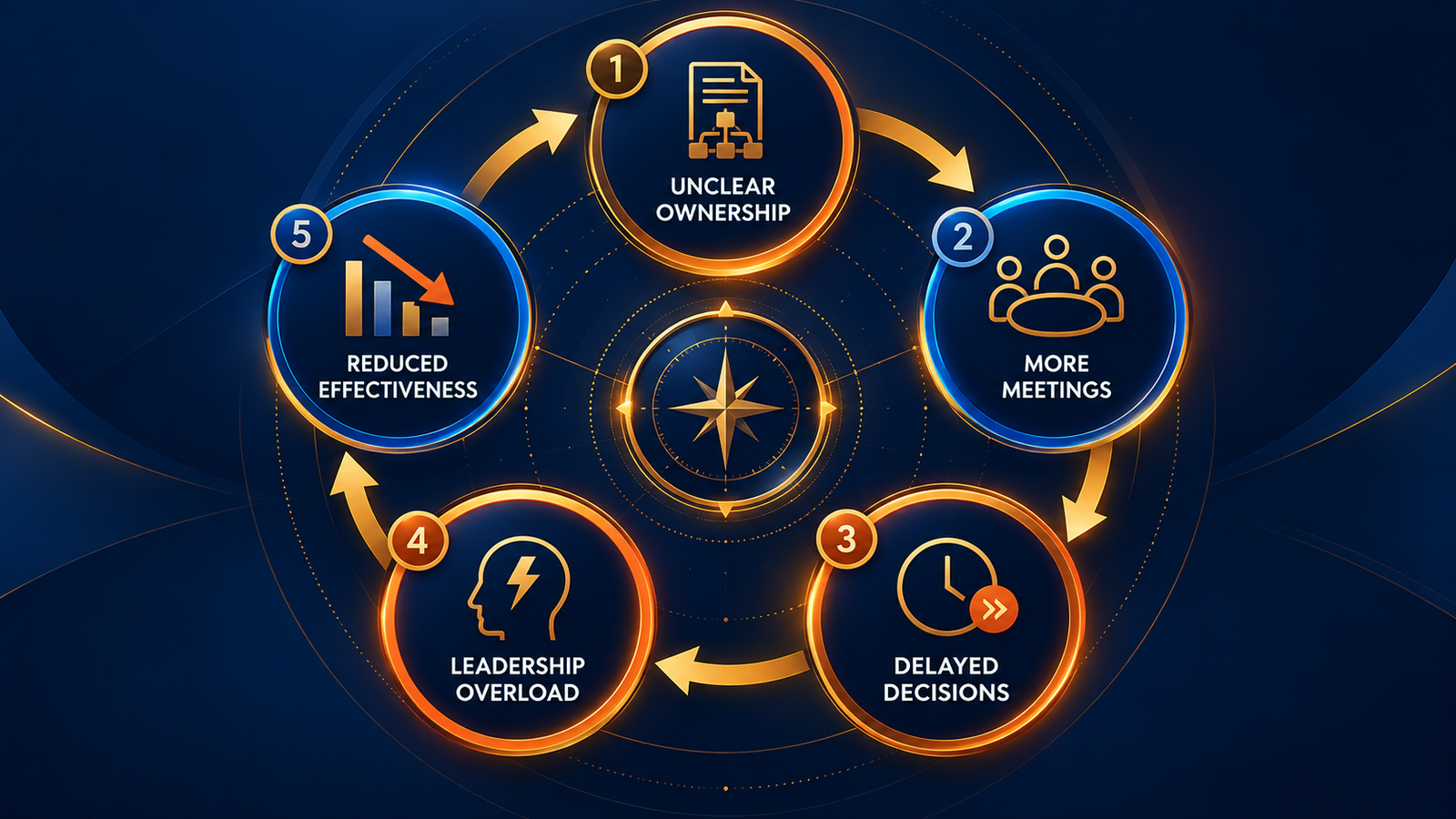
The cycle becomes self-reinforcing. Leaders attend more meetings to regain control, but every additional meeting reduces the capacity available to resolve the underlying problems.
Why Does Leadership Meeting Addiction Develop?
Meeting dependency rarely begins with poor intentions.
It develops because meetings provide an immediate response to uncertainty.
A project is falling behind. Someone schedules a review.
Communication is inconsistent. A weekly alignment meeting appears.
Senior leaders want greater visibility. Another reporting meeting is introduced.
Nobody deliberately creates an overloaded calendar.
The organisation accumulates meetings one apparently sensible decision at a time.
Meetings become a substitute for clarity
In my experience across education, business and the public sector, one recurring pattern stands out: when responsibilities are unclear, meetings multiply.
Consider a school leadership team responsible for implementing a new attendance strategy.
The deputy head needs information from pastoral staff. Department leaders need clarification about procedures. Administrative teams need decisions about reporting. Senior leaders want assurance that implementation is progressing.
Without clear ownership, everyone attends a weekly coordination meeting.
The meeting grows because nobody has defined who can decide what.
Eventually, the group spends more time discussing implementation than implementing the strategy.
The same pattern appears in corporate organisations, healthcare systems and government departments.
Meetings can become a form of organisational reassurance
A meeting often creates the feeling that something is being managed.
People have attended.
Information has been exchanged.
Minutes have been recorded.
But activity is not the same as progress.
A project can be discussed repeatedly without a meaningful decision being made.
This is particularly common when leaders fear making decisions without collective approval.
The five structural causes
Within the Burn Bright Not Out Framework™, five root causes contribute to leadership burnout:
- Scope creep
- Meeting culture
- Communication chaos
- Decision overload
- Perfectionism culture
Meeting dependency connects all five.
Scope creep adds responsibilities. Communication chaos generates coordination meetings. Decision overload increases approval requirements. Perfectionism creates repeated reviews.
The result is a leadership role built around constant participation.
The structural question is not whether a meeting is useful. It is whether the organisation needs that meeting to function effectively.
That distinction changes the conversation.
How Does Meeting Overload Contribute to Leadership Burnout?
Meeting overload contributes to burnout by consuming time, fragmenting concentration, increasing emotional demands and reducing a leader’s control over their working day.
These effects are cumulative.
The World Health Organization defines burnout as an occupational phenomenon associated with chronic workplace stress that has not been successfully managed. It identifies three dimensions: exhaustion, increased mental distance or cynicism, and reduced professional efficacy.
Source: WHO — Burn-out an “occupational phenomenon”
Meeting dependency can contribute to all three.
Exhaustion without visible achievement
Imagine a director whose calendar contains seven hours of meetings.
During those meetings, they listen, interpret information, manage disagreement, answer questions and make decisions.
These activities require sustained cognitive and emotional effort.
Yet by 5 pm, the director may have made little progress on their most important strategic responsibilities.
The day has been demanding without being productive in the ways that matter most.
The director then works into the evening to complete tasks that require concentration.
Reduced control over work
Gallup’s State of the Global Workplace 2025 reported that global employee engagement fell from 23% in 2023 to 21% in 2024, with manager engagement falling from 30% to 27%.
These figures do not prove that meetings caused the decline. They do, however, reinforce the importance of examining the conditions under which managers are expected to perform.
Source: Gallup — State of the Global Workplace
When leaders cannot control their schedules, they lose the ability to organise work around priorities.
They become reactive rather than deliberate.
Emotional labour accumulates
Leadership meetings also require emotional regulation.
A leader may manage conflict in one meeting, deliver difficult feedback in another, negotiate resources in a third and explain an unpopular decision in a fourth.
These interactions are legitimate leadership work.
The problem is their concentration without adequate recovery.
A calendar filled with emotionally demanding conversations leaves little room for reflection.
Eventually, leaders may become less patient, less curious and more defensive.
These changes are often interpreted as leadership weaknesses.
Frequently, they are signals that the operating system is demanding more than it can sustainably support.
Recognising the early signs of leadership burnout helps identify when this pattern has become harmful.
What Is the Real Organisational Cost of Excessive Meetings?
The financial cost of meetings is only one part of the problem.
Organisations also lose decision quality, responsiveness, strategic capacity and leadership energy.
Research by Microsoft in its 2023 Work Trend Index found that 68% of people surveyed said they did not have enough uninterrupted focus time during the working day.
The same research reported that 57% of Microsoft 365 users’ time, in the analysed activity data, was spent communicating through meetings, email and chat, compared with 43% spent creating in documents and other applications.
Source: Microsoft — 2023 Work Trend Index
This is not evidence that all communication is unnecessary. It shows how much of modern knowledge work is occupied by coordination.
The pressure on focus and management capacity
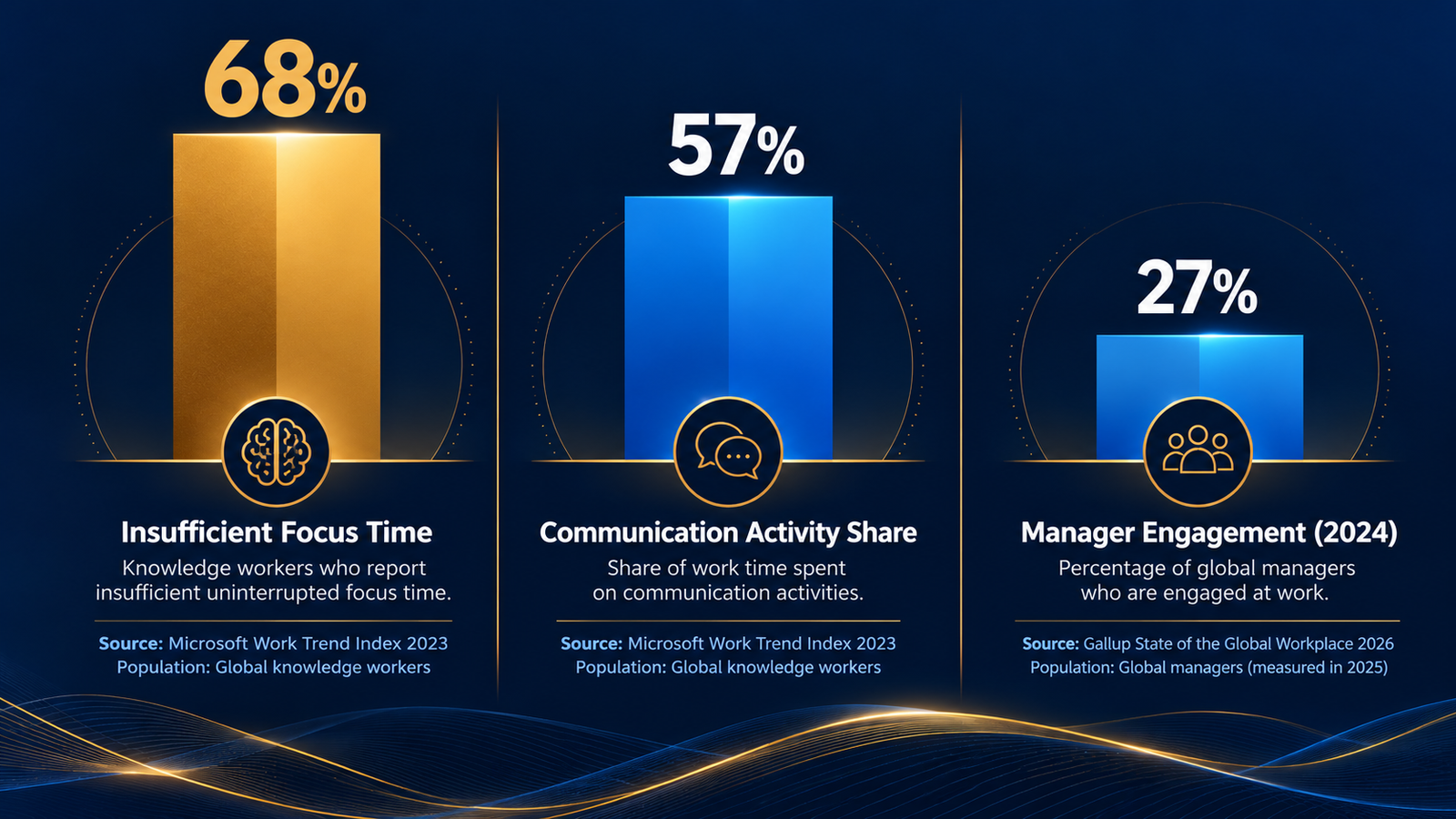
The figures point towards a practical management question: how much organisational capacity is being consumed by coordination rather than meaningful progress?
A simple meeting cost calculation
Consider a weekly leadership meeting attended by eight people, each with an illustrative employment cost of £60 per hour.
| Illustrative Annual Cost | Amount |
|---|---|
| Cost per meeting (8 people × £60 × 1 hour) | £480 |
| 48 meetings per year | £23,040 |
Now imagine that meeting produces no decisions and duplicates information already available in a shared dashboard.
The organisation is not merely spending £23,040.
It is also losing 384 hours of combined leadership capacity.
Those hours could support coaching, strategic planning, problem-solving or operational improvement.
The hidden Culture Tax™
I use the term Culture Tax™ to describe the recurring organisational cost created by inefficient structures, disengagement, avoidable turnover and burnout.
Meeting dependency contributes to that tax when leaders become so occupied with coordination that they cannot improve the systems creating the work.
It also damages succession.
Talented professionals observe senior leaders spending their days in meetings and their evenings catching up.
They may reasonably question whether promotion represents an opportunity or an unsustainable burden.
This is why understanding how burnout affects decision-making matters to organisational performance, not just individual health.
Why Do Traditional Meeting Reduction Strategies Fail?
Many organisations recognise that they have too many meetings.
Their response is predictable.
They introduce 25-minute meetings, meeting-free Fridays, stricter agendas or calendar limits.
These changes can help.
But they often fail to address the underlying reason the meetings exist.
Efficiency does not correct unnecessary work
A 30-minute meeting that serves no useful purpose remains unnecessary.
Reducing it to 20 minutes does not create meaningful value.
Similarly, a meeting-free day may simply move the same meetings into the remaining four days.
The calendar looks different.
The operating system has not changed.
Meeting problems are often authority problems
Consider a regional manager who must obtain approval from three senior colleagues before changing a routine operational process.
The organisation introduces a faster approval meeting.
Decisions still depend on the same three people.
The bottleneck remains.
A more effective intervention would clarify the manager’s authority to make defined decisions independently.
This is where the Burn Bright Not Out RACI Delegation Framework™ becomes useful.
RACI identifies who is:
- Responsible for completing work.
- Accountable for the outcome.
- Consulted before decisions.
- Informed after decisions.
When these roles are clear, many coordination meetings become unnecessary.
Traditional versus structural meeting management
| Traditional approach | Sustainable structural approach |
|---|---|
| Shorten every meeting | Eliminate meetings without a clear purpose |
| Introduce meeting-free days | Protect strategic capacity throughout the week |
| Require more detailed agendas | Clarify decision ownership before scheduling |
| Invite everyone for visibility | Consult only those whose input is necessary |
| Track attendance | Track decisions, actions and outcomes |
| Encourage better time management | Redesign communication and decision systems |
The difference is fundamental.
Traditional approaches try to make existing meetings more efficient.
Structural approaches question whether those meetings should exist at all.
Harvard Business Review research on meeting overload has highlighted how organisations can become trapped in cycles of excessive collaboration and the need for deliberate changes to meeting practices.
Further reading: Harvard Business Review — Stop the Meeting Madness
The objective is not an empty calendar.
How Can Leaders Break the Meeting Addiction Cycle?
The most effective solution is to redesign the operating system that creates unnecessary meetings.
Within the Burn Bright Not Out Framework™, I use four structural pillars to address unsustainable leadership demands: Workload Architecture™, Decision Authority™, Recovery Rhythms™ and Management Frameworks.
Applied to meeting culture, these pillars provide a practical alternative to endless calendar optimisation.
Pillar 1
Redesign Workload Architecture™
Begin with a meeting audit. Review every recurring meeting over the previous four weeks. For each meeting, record its purpose, attendees, duration, decisions and outputs.
Ask three questions:
- What would happen if this meeting stopped?
- Could the same outcome be achieved asynchronously?
- Does this meeting require my personal involvement?
Classify each meeting as retain, redesign, delegate or eliminate.
Do not begin by reducing every meeting by 15 minutes. Begin by removing meetings that do not justify their existence.
Pillar 2
Clarify Decision Authority™
Meetings multiply when people lack authority to act. Use the RACI Delegation Framework™ to identify who owns decisions and who genuinely needs consultation.
For example, a department head might have authority to approve routine operational changes within agreed financial and risk limits. They should not need an executive committee meeting for every decision.
Escalation should occur when a decision exceeds agreed boundaries, not simply because someone wants reassurance.
This is particularly important for leaders who struggle with the workload patterns that cause high performers to burn out.
Pillar 3
Establish Recovery Rhythms™
Strategic thinking requires uninterrupted attention. Protect blocks of time for planning, analysis, coaching preparation and complex decisions.
These blocks should not be treated as empty calendar space available for meetings. They are part of the leader’s essential work.
Recovery also requires transitions between demanding interactions. A ten-minute interval after a difficult meeting may provide the opportunity to record decisions, reset attention and prepare for the next responsibility.
Pillar 4
Build Management Frameworks
Replace unnecessary meetings with reliable information systems.
- A shared performance dashboard can replace repetitive status updates.
- Written decision logs can prevent the same issues being reopened.
- Clear escalation rules can reduce emergency meetings.
The goal is to make progress visible without requiring constant attendance.
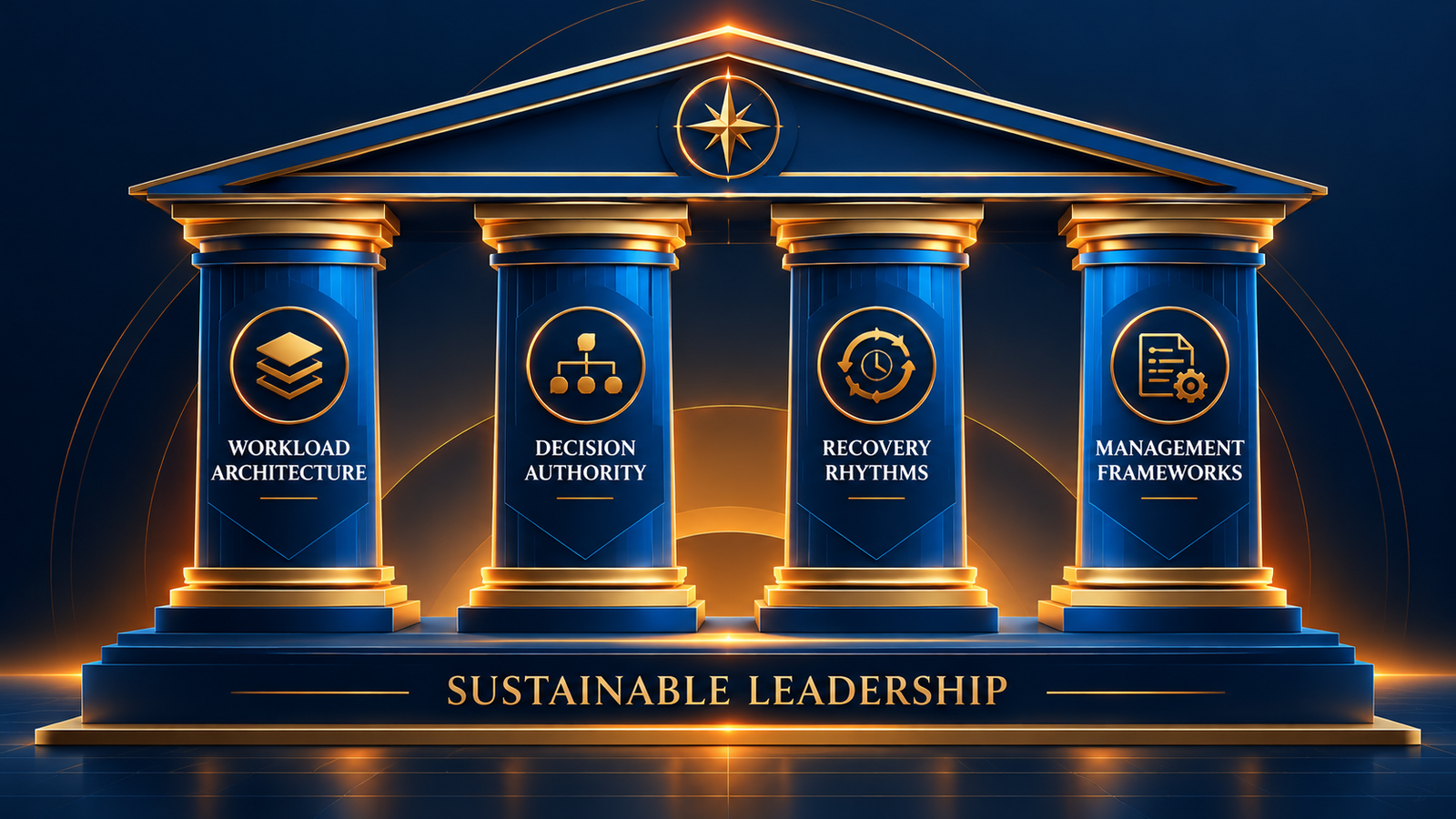
The critical insight is simple.
How Can Organisations Sustain Better Meeting Habits?
Meeting redesign should be treated as an organisational change programme, not an individual productivity challenge.
I recommend a structured 30-60-90 day approach.
30 Days — Diagnose
Audit recurring meetings, identify decision bottlenecks, measure meeting hours and establish a baseline for protected strategic time.
60 Days — Redesign
Remove low-value meetings, clarify decision rights, introduce asynchronous reporting and protect leadership thinking time.
90 Days — Embed
Measure decisions completed, strategic capacity recovered, workload sustainability and whether unnecessary meetings are returning.
The organisation should review outcomes, not simply celebrate fewer meetings.
A reduction in meeting hours is valuable only when communication, accountability and decision quality are maintained or improved.
This requires senior leaders to model the new expectations.
If executives continue demanding attendance at every discussion, managers will struggle to change their own behaviour.
For further guidance, explore the Burn Bright Not Out leadership burnout course and the principles behind the Leadership Burnout Reset programme.
Frequently Asked Questions
What is leadership meeting addiction?
Leadership meeting addiction is an organisational dependency on meetings for routine communication, decisions, reassurance and oversight. It becomes problematic when leaders spend so much time attending meetings that they lose capacity for strategic thinking, independent decisions and essential responsibilities. The underlying causes often include unclear accountability, weak delegation and excessive approval requirements.
Can too many meetings cause leadership burnout?
Excessive meetings can contribute to leadership burnout by increasing cognitive demands, reducing autonomy and displacing important work into evenings and weekends. Meetings are not inherently harmful. The risk grows when they are unnecessary, emotionally demanding, poorly organised or combined with workloads that leave insufficient time for recovery.
How many meetings should a senior leader attend?
There is no universal ideal number. Meeting requirements depend on the leader’s responsibilities, team structure and organisational context. A more useful measure is whether meetings produce necessary outcomes while leaving sufficient capacity for strategic work, decision-making, people development and recovery. Meeting volume should be assessed alongside effectiveness.
How can leaders reduce meetings without losing control?
Leaders can reduce meetings by clarifying decision authority, establishing reliable reporting systems and defining escalation thresholds. Delegation should include clear outcomes, accountability and review points. This allows leaders to maintain appropriate oversight without becoming personally involved in every operational discussion or routine decision.
Are meeting-free days effective?
Meeting-free days can create useful space for concentrated work, but they are not a complete solution. If the same meetings are compressed into other days, workload pressure may remain unchanged. Lasting improvement requires organisations to eliminate unnecessary meetings, improve decision ownership and establish communication practices that reduce coordination demands.
What is the difference between meeting overload and meeting addiction?
Meeting overload describes the excessive number or duration of meetings. Meeting addiction describes a deeper organisational dependency in which meetings become the default mechanism for managing work. Reducing meeting overload may provide temporary relief. Addressing meeting addiction requires changing the systems, authority structures and expectations that continually generate meetings.
Conclusion: Leadership Meeting Addiction Is a Design Problem
Leadership meeting addiction is not simply the result of poor diary management.
It reflects how organisations distribute responsibility, communicate information and make decisions.
When every uncertainty produces another meeting, leadership becomes increasingly reactive.
Strategic thinking disappears beneath coordination.
Important work moves into evenings.
Recovery is sacrificed to maintain performance.
Eventually, the organisation mistakes constant availability for effective leadership.
The answer is not to reject collaboration.
It is to make collaboration purposeful.
Clear decision rights, better Workload Architecture™, protected strategic time and reliable management systems allow leaders to remain connected without becoming consumed by meetings.
This is the central principle behind the Burn Bright Not Out Framework™.
Leaders cannot sustainably compensate for weak organisational design through greater personal effort.
Better systems outperform more effort.
When meeting culture is redesigned around decisions and outcomes rather than attendance, organisations can recover capacity while strengthening accountability.
And that creates something more valuable than a less crowded calendar.
It creates space for leadership.
Go beyond the calendar. Get a complete structural diagnosis of the demands shaping your leadership.
Take the First Step Towards Sustainable Leadership
If your calendar is full but meaningful progress feels increasingly difficult, the problem may be deeper than time management. Start with a structured assessment of the pressures, working patterns and structural conditions affecting your leadership capacity.
Free Leadership Intelligence
Get Weekly Leadership Insights
Join thousands of leaders receiving practical strategies on burnout prevention, workload design, and sustainable performance every week.