Quick Answer
Yes. Leaders can prevent burnout, but not through resilience training alone. Burnout prevention requires structural changes to workload, decision-making, communication, recovery, and organisational expectations. The most effective leaders redesign systems before exhaustion appears, treating burnout as a system failure rather than a personal weakness.
Key Takeaways
- Burnout is usually caused by structural issues rather than personal shortcomings.
- Early intervention is significantly easier than recovery after burnout.
- Scope creep, decision overload, and communication chaos are major burnout drivers.
- Sustainable leaders manage systems, not just time.
- Prevention requires organisational redesign, not motivational advice alone.
Introduction
Can leaders prevent burnout? The short answer is yes — but only if they stop treating burnout as an individual problem.
Across every sector, leaders are being asked to deliver more with fewer resources, navigate increasing complexity, manage larger stakeholder groups, and remain constantly available. The result is predictable. Leadership burnout continues to rise because leadership roles themselves have expanded faster than organisational support structures.
Many burnout prevention strategies focus on mindfulness, productivity hacks, or resilience. While these approaches may provide temporary relief, they rarely address the root causes. Burnout develops when workload, expectations, authority, and recovery become structurally misaligned.
The evidence is clear. Sustainable leadership comes from better systems, clearer boundaries, smarter workload architecture, and healthier organisational design. This article explores what burnout prevention actually looks like and how leaders can build sustainable performance without sacrificing effectiveness.
Definition
Leaders prevent burnout by redesigning workload, decision-making, communication, and recovery systems before exhaustion becomes chronic. Burnout prevention is primarily a structural leadership challenge, not a personal resilience challenge.
What Causes Leadership Burnout in the First Place?
The biggest misconception about burnout is that it results from working hard. Most leaders are willing to work hard. The real problem is that many organisations create conditions where hard work is no longer enough.
According to the Burn Bright Not Out framework, five structural causes repeatedly appear in burnout cases:
These factors create cumulative pressure. Individually they may appear manageable. Combined, they create chronic overload. The problem is not a lack of effort. The problem is structural overload.
This distinction matters because prevention strategies change completely depending on the diagnosis. If burnout is personal weakness, the solution is self-improvement. If burnout is system failure, the solution is redesign.
Fix the system, not the person.
— Vincent Walters, Burn Bright Advisory
Why Do Traditional Burnout Solutions Often Fail?
Many leaders have already tried the common solutions. They have attended wellbeing workshops, downloaded productivity apps, and read books about time management. Yet exhaustion remains.
Because most interventions focus on symptoms rather than causes. Modern work has shifted dramatically — complexity has increased, communication channels have multiplied, and expectations have expanded. Meanwhile, support structures have remained largely unchanged.
A useful comparison is pain management. If someone has a broken leg, painkillers may reduce discomfort temporarily — they do not repair the fracture. Similarly, resilience programmes may reduce stress temporarily — they do not redesign an unsustainable workload.
Burnout prevention requires deeper intervention:
Without those changes, burnout often returns regardless of how much effort individuals invest in personal resilience.
How Can Leaders Identify Burnout Before It Becomes Serious?
Prevention depends on early detection. Burnout rarely appears suddenly. It develops gradually through a series of warning signs. The leadership burnout research outlined in Burn Bright Not Out identifies three major symptom categories.
PHYSICAL SIGNS
→ Poor sleep quality
→ Frequent headaches
→ Increased illness
→ Caffeine dependence
EMOTIONAL SIGNS
→ Irritability
→ Reduced empathy
→ Emotional detachment
→ Feeling trapped
COGNITIVE SIGNS
→ Poor concentration
→ Reduced creativity
→ Slower thinking
→ Increased mistakes
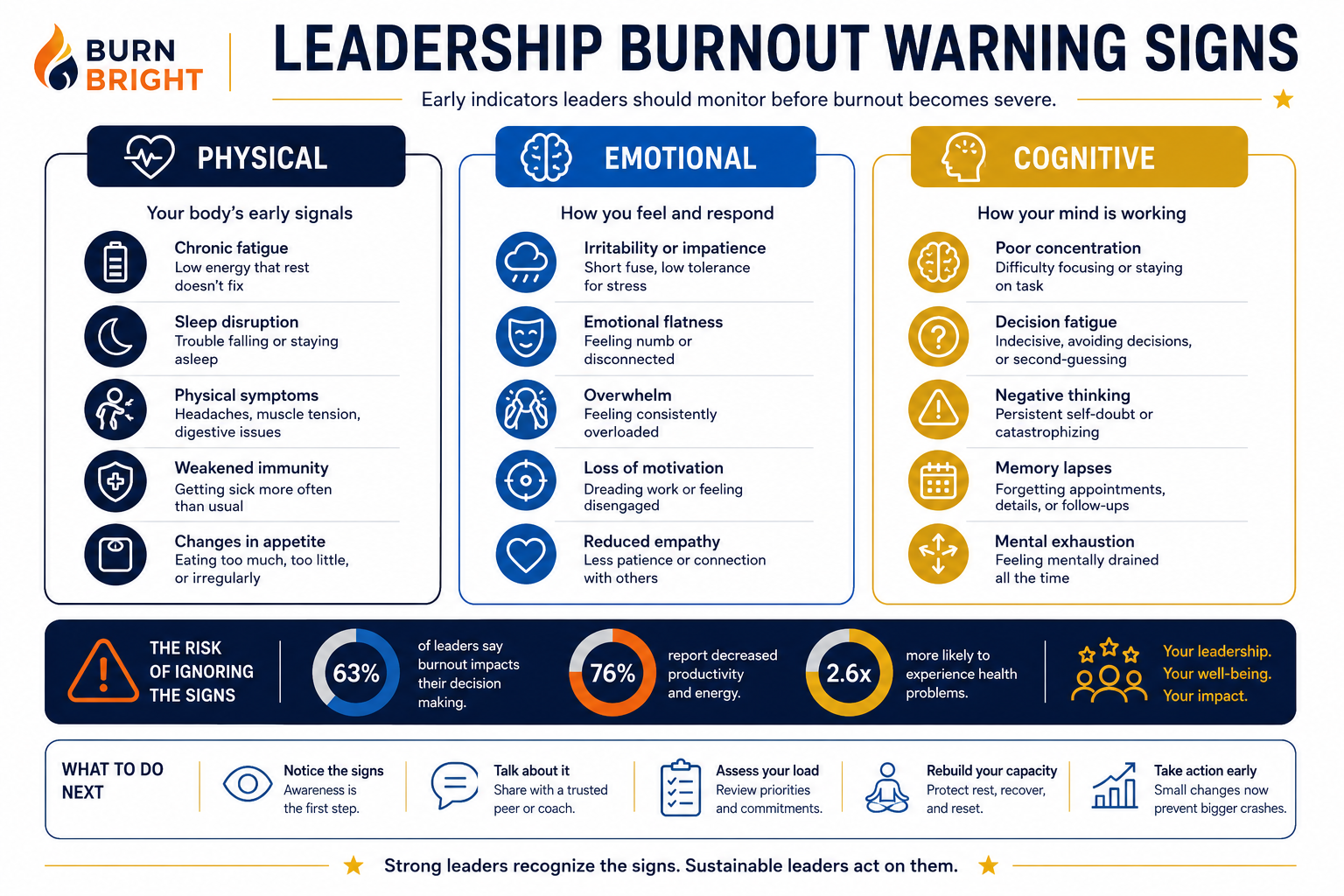
One particularly important indicator is decision fatigue. Leaders often assume they are simply busy. In reality, their decision-making capacity is becoming depleted. When routine decisions feel overwhelming, burnout risk increases significantly.
Do not wait for collapse. Detect patterns early. Prevention becomes dramatically easier when intervention occurs during the early warning stage rather than after full exhaustion.
What Systems Prevent Burnout Most Effectively?
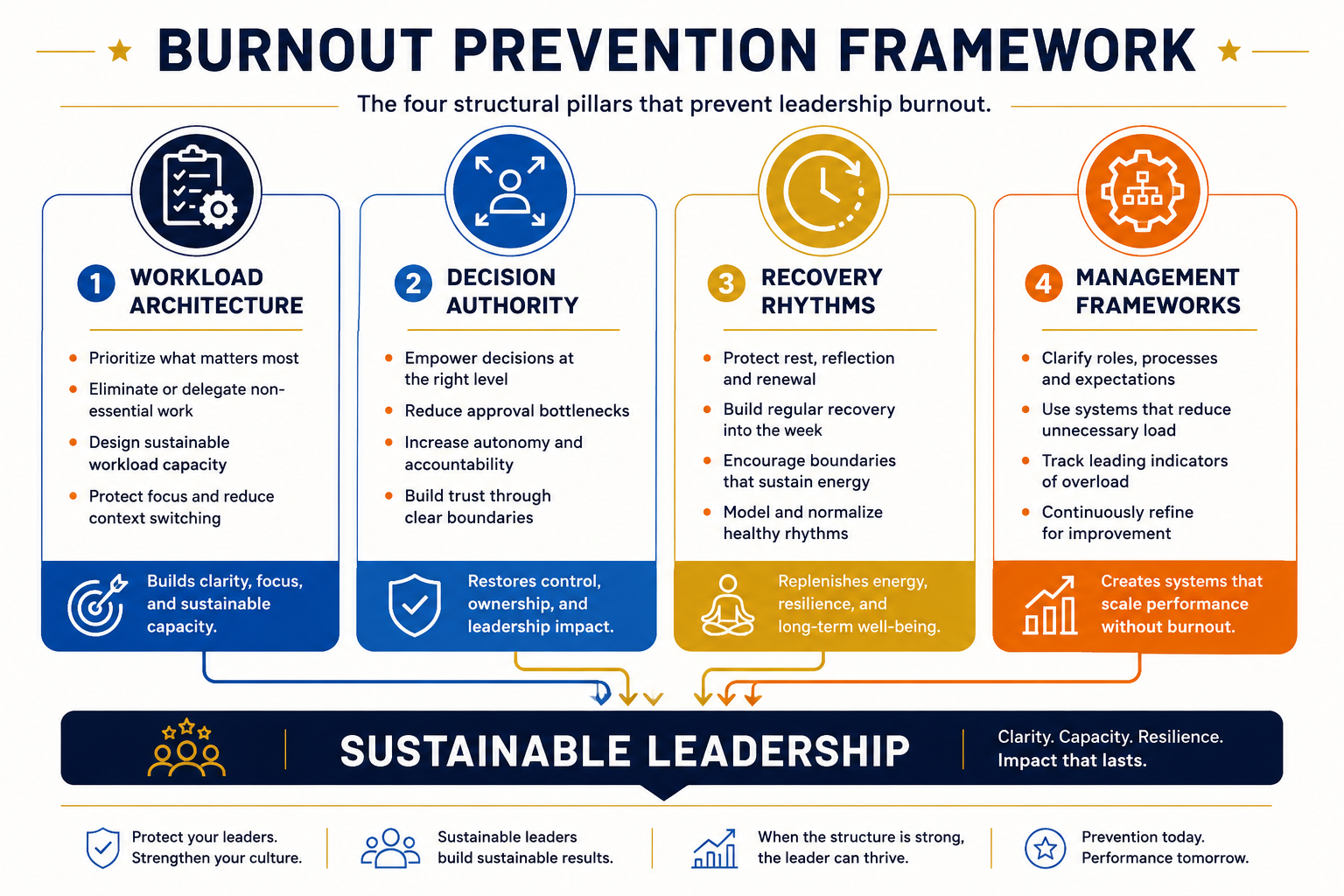
The Burn Bright framework identifies four organisational pillars that reduce burnout risk:
Workload Architecture
Leaders need visibility into actual workload demand. Most burnout occurs because work accumulates invisibly. Effective organisations measure capacity, prioritise ruthlessly, and remove unnecessary tasks.
Decision Authority
Many leaders become overwhelmed because they are accountable for decisions they do not control. Clear decision ownership reduces cognitive overload and accelerates execution.
Recovery Rhythms
Recovery should not be accidental. It must be built into leadership systems. Sustainable leaders schedule recovery with the same discipline they schedule performance.
Management Frameworks
Frameworks reduce decision fatigue. When processes are clear, leaders spend less energy reinventing solutions and more energy on work that matters.
What Does Sustainable Leadership Look Like?
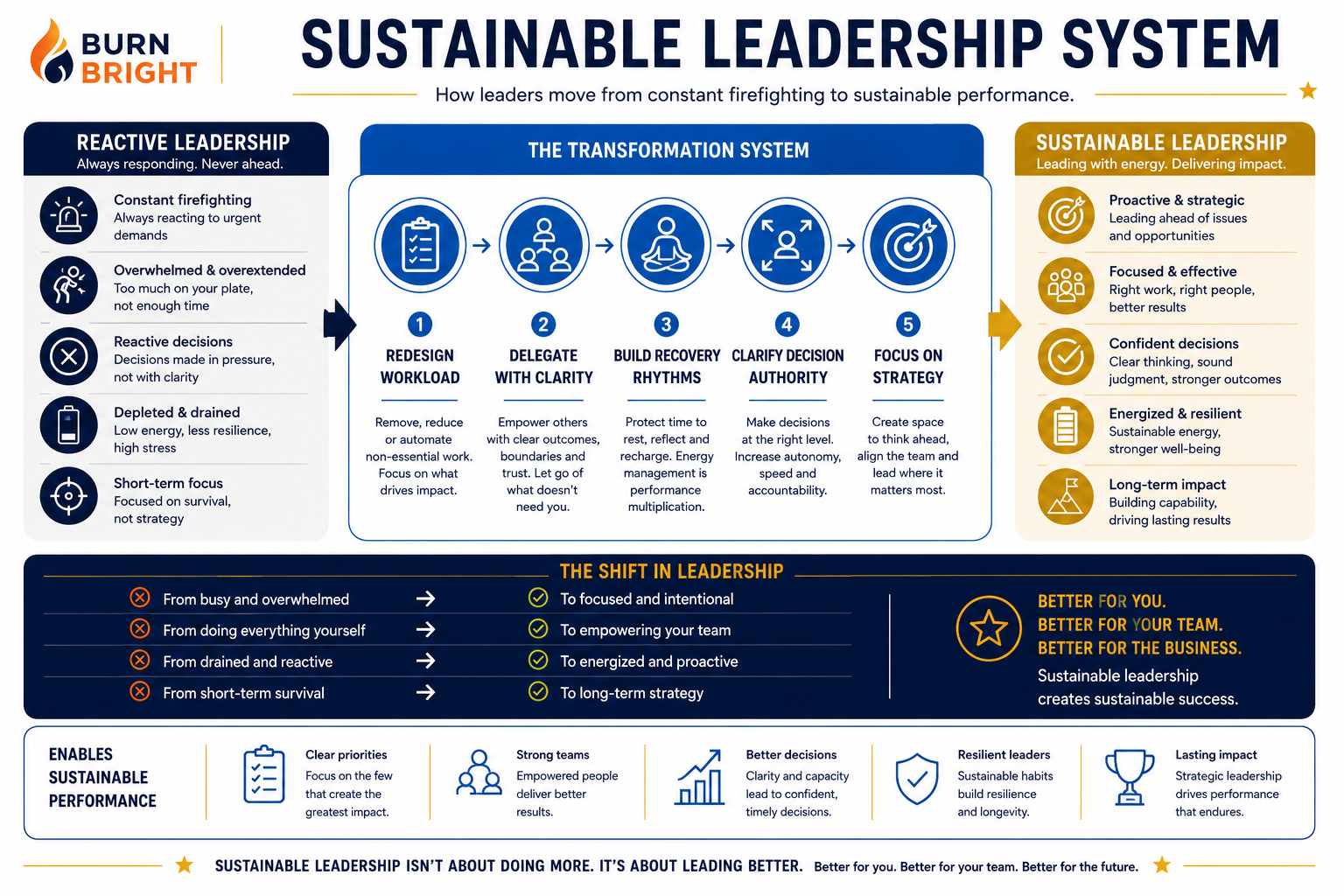
Sustainable leadership is often misunderstood. It is not about doing less. It is about doing the right work. The modern leadership challenge is not effort — it is allocation.
High-performing leaders focus on leverage rather than activity. They ask:
| Traditional Leadership | Sustainable Leadership |
|---|---|
| Solves every problem personally | Builds systems that solve problems |
| Constant availability | Structured accessibility |
| Reacts continuously | Prioritises strategically |
| Measures effort | Measures outcomes |
| Depends on personal sacrifice | Depends on organisational design |
Can Organisations Prevent Leadership Burnout Too?
Absolutely. Individual leaders cannot solve structural problems alone. Organisations play a decisive role.
The strongest burnout prevention programmes focus on reducing unnecessary meetings, clarifying priorities, improving delegation systems, creating realistic workloads, protecting strategic thinking time, and eliminating communication overload.
Organisations that continue treating burnout as an individual issue often pay a substantial culture tax through turnover, disengagement, lost productivity, and leadership instability. The most effective organisations ask how to redesign work — not how to make exhausted people more resilient. That shift changes everything.
Frequently Asked Questions
Can leaders prevent burnout completely?
No system can eliminate all stress. However, leaders can dramatically reduce burnout risk by redesigning workload, authority, communication, and recovery structures before exhaustion becomes chronic.
Is burnout caused by working too many hours?
Not always. Burnout is often caused by lack of control, conflicting priorities, unclear expectations, and chronic overload rather than hours alone.
What is the earliest warning sign of leadership burnout?
Decision fatigue is often one of the earliest indicators. Routine decisions become difficult, concentration declines, and cognitive energy drops before visible burnout symptoms appear.
Why do resilient leaders still burn out?
Resilience cannot compensate indefinitely for poor systems. Highly resilient leaders often stay in unsustainable situations longer, which can delay intervention and worsen eventual burnout.
What is the best burnout prevention strategy?
Structural workload redesign consistently outperforms individual productivity interventions. Better systems create sustainable performance where resilience training alone cannot.
Conclusion
So can leaders prevent burnout? Yes — but prevention requires a different approach.
Burnout is rarely caused by a lack of resilience, discipline, or commitment. More often, it emerges from poorly designed systems, excessive complexity, unclear authority, and chronic overload.
The leaders who avoid burnout do not simply manage time better. They redesign work. They build stronger systems. They create recovery rhythms. They clarify priorities.
Most importantly, they recognise that sustainable leadership is not about enduring exhaustion. It is about creating conditions where performance and wellbeing can coexist.
“Burnout is a system failure, not a personal failure. The organisations that understand this will build stronger leaders, healthier cultures, and more sustainable results.”
— Vincent Walters, Burn Bright Advisory
Free Resource
Take the Free Leadership Burnout Self-Assessment
Identify your current burnout risk and uncover the structural factors driving overload. Free. Instant results.
Free Leadership Intelligence
Get Weekly Leadership Insights
Join thousands of leaders receiving practical strategies on burnout prevention, workload design, and sustainable performance every week.