Quick Answer
Why resilient leaders still burn out is simple: resilience helps leaders absorb pressure, but it does not remove the structural causes of burnout. When workload, decision volume, communication demands, and recovery opportunities remain broken, even highly resilient leaders eventually reach capacity. Sustainable leadership requires system redesign, not just personal resilience.
Key Takeaways
- Resilience delays burnout but does not prevent it.
- Burnout is usually a system failure rather than a personal failure.
- Scope creep, decision overload, and communication chaos are major drivers of leadership exhaustion.
- Sustainable leadership depends on workload architecture and recovery rhythms.
- The solution is structural redesign, not simply becoming more resilient.
Introduction
Why resilient leaders burn out is one of the most misunderstood questions in leadership today.
Many organisations assume burnout happens because leaders lack resilience. The evidence suggests something very different. Some of the most resilient, capable, and committed leaders are often the ones most at risk.
They stay longer. They absorb more pressure. They solve more problems. They protect their teams. They keep performing while systems around them become increasingly unsustainable.
Eventually, even exceptional resilience reaches its limits.
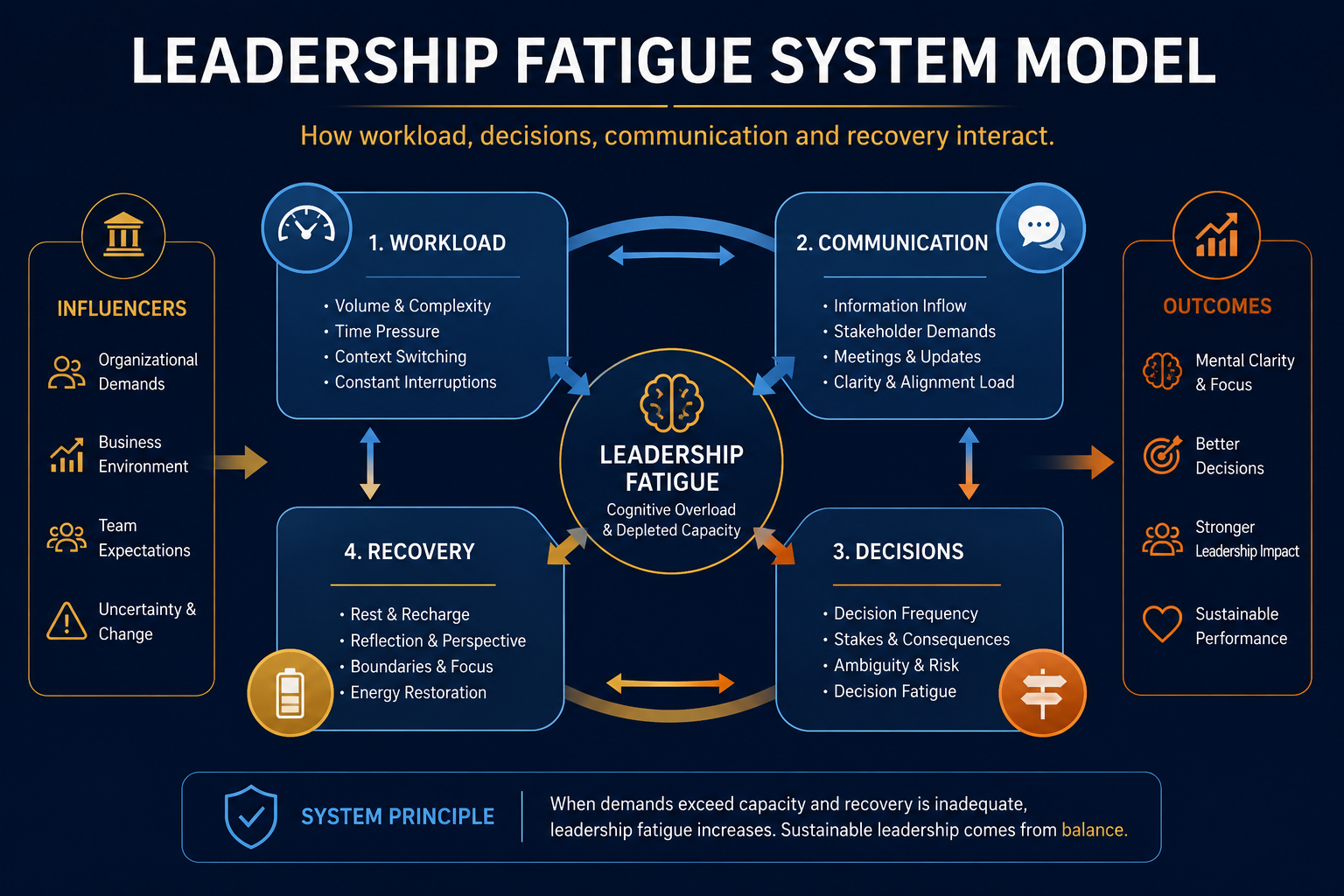
The modern leadership environment has evolved dramatically. Complexity has increased. Communication channels have multiplied. Decision-making demands have expanded. Yet organisational support structures have often remained unchanged. This creates a gap between what leaders are expected to deliver and what humans can sustainably maintain.
This article explains why resilient leaders still burn out, the structural causes behind the problem, and what organisations must do differently.
Definition
Resilient leaders burn out when organisational systems create sustained workload overload, decision fatigue, communication chaos, and insufficient recovery opportunities. Resilience helps temporarily but cannot overcome structural failure indefinitely.
Why Doesn’t Resilience Prevent Burnout?
Resilience is often misunderstood. Most leadership development programmes treat resilience as the ultimate solution — build mental toughness, develop coping mechanisms, improve emotional regulation.
These skills matter. The problem is that resilience was never designed to carry unlimited pressure indefinitely.
Think of resilience like a shock absorber:
Research consistently shows that burnout emerges when demands chronically exceed available resources. The issue is not weakness. The issue is sustained mismatch.
This is why high-performing leaders often surprise colleagues when they burn out. From the outside they appear strong. Internally they have been carrying structural failures for months or years.
Burnout is rarely caused by one difficult week. It is usually caused by hundreds of difficult weeks.
What Structural Problems Cause Resilient Leaders to Burn Out?
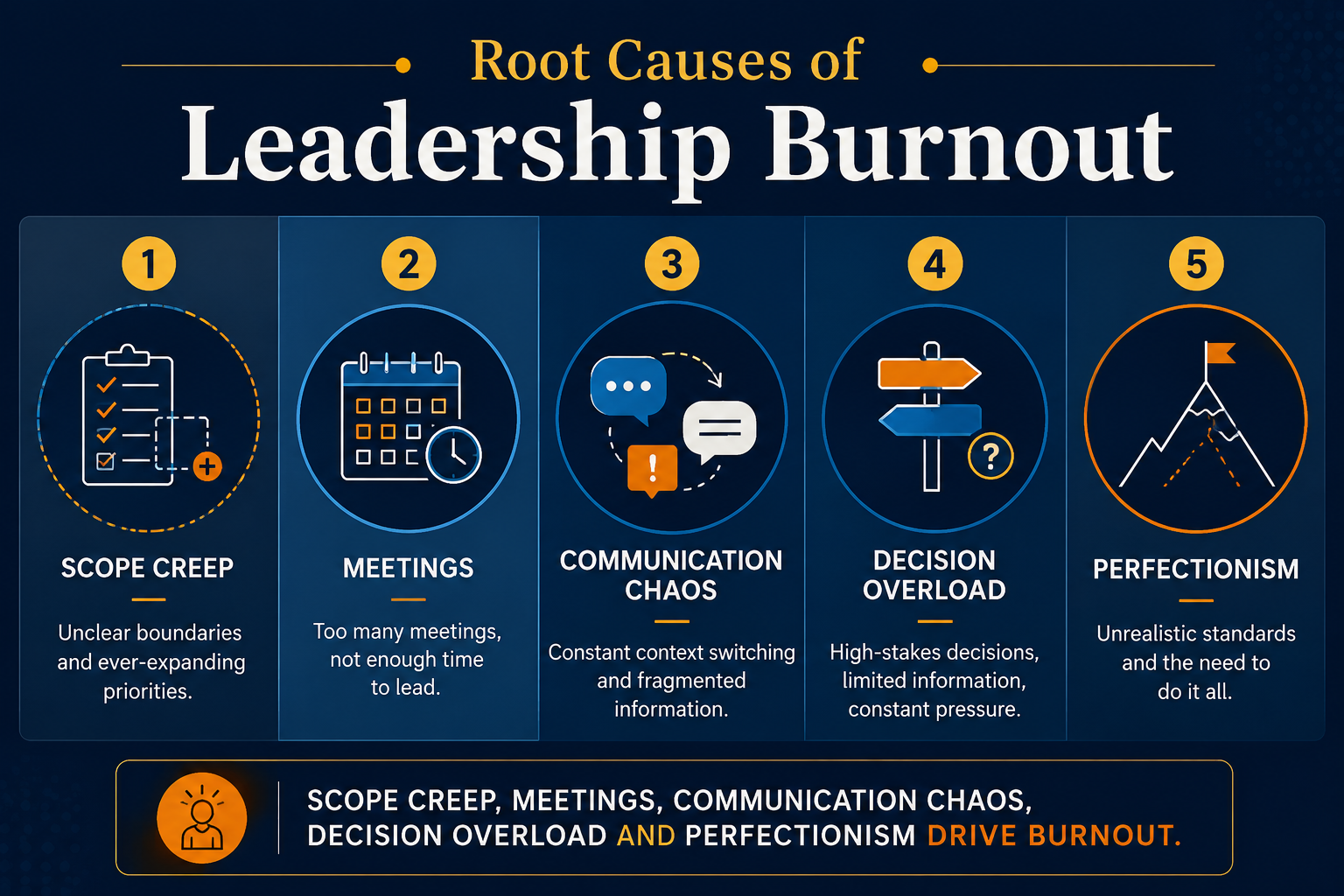
The Burn Bright framework identifies five recurring root causes of burnout:
Scope Creep
Leadership roles continuously expand. New initiatives are added. New compliance requirements appear. New stakeholders emerge. Very little is removed. The result is an ever-growing role that no longer matches available time.
Meeting Culture
Many leaders spend entire days in meetings before attempting actual work after hours. Strategic thinking becomes evening work. Recovery disappears.
Communication Chaos
Email, Teams, Slack, WhatsApp, phone calls, video meetings. Modern leadership increasingly involves managing communication streams rather than completing meaningful work.
Decision Overload
Every decision consumes cognitive energy. Leaders often make hundreds of decisions each day. Eventually quality declines.
Perfectionism Culture
Many leaders become trapped by unrealistic standards. Everything feels important. Everything feels urgent. Nothing can be delegated. The result is predictable exhaustion.
Why Are High Performers Often More Vulnerable?
One of the great leadership paradoxes is that high performers frequently burn out faster. This happens because organisations reward reliability.
Reliable leaders receive more responsibility, more projects, more stakeholders, and more complexity. Over time, competence becomes a penalty. Instead of reducing workload, success increases it.
The High Performer Burnout Cycle
High performer succeeds
Organisation assigns additional responsibilities
Performance remains strong
More responsibilities are added
Capacity is eventually exceeded — burnout
The leader appears resilient throughout the process. In reality, depletion is quietly accumulating. Resilience delays collapse. It does not eliminate it.
How Does Burnout Affect Leadership Effectiveness?
Many leaders assume burnout only becomes a problem when they can no longer function. That assumption is incorrect. Burnout damages leadership performance long before complete exhaustion occurs.
Slower decision-making
Reduced creativity
Increased risk aversion
Emotional detachment
Communication breakdown
Lower strategic thinking capacity
Teams often notice the impact before leaders do. Manager burnout directly influences engagement, innovation, turnover, and performance outcomes. This is why burnout should never be viewed as a personal wellbeing issue alone. It is an organisational effectiveness issue.
When leaders burn out, systems suffer. Burnout is an organisational effectiveness issue — not just a personal wellbeing issue.
What Should Organisations Do Instead?
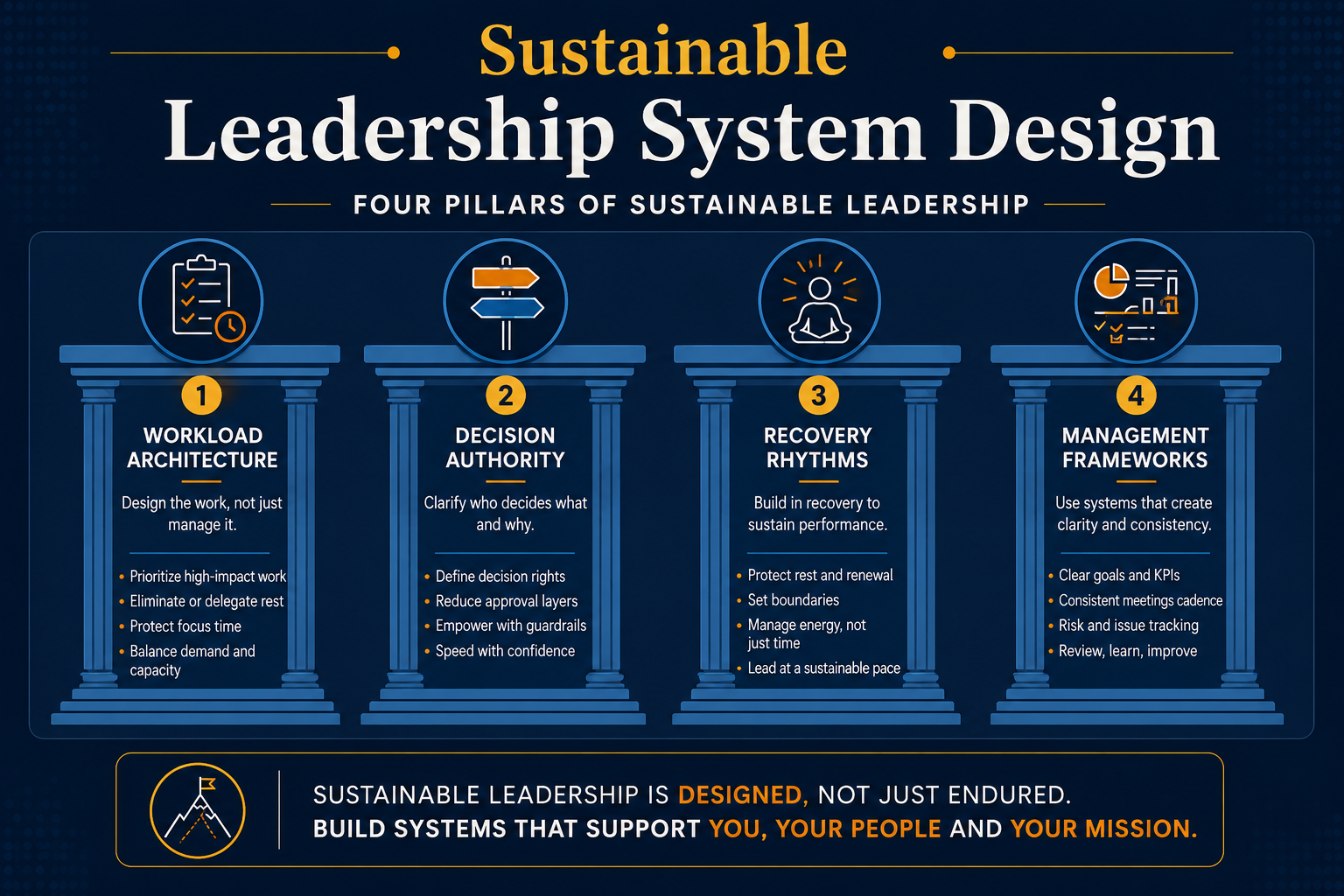
The solution is structural rather than motivational. The Burn Bright framework recommends four core pillars:
Workload Architecture
Redesign roles around realistic capacity. Remove responsibilities before adding new ones.
Decision Authority
Clarify who makes which decisions. Reduce unnecessary escalation. Increase delegation.
Recovery Rhythms
Recovery must become a leadership discipline. Without recovery, performance eventually declines.
Management Frameworks
Leaders need systems that reduce complexity rather than increase it. Frameworks create consistency. Consistency reduces cognitive load.
| Traditional View | Sustainable Leadership View |
|---|---|
| Burnout is a personal weakness | Burnout is a system failure |
| Leaders need more resilience | Leaders need better systems |
| Work harder | Redesign workload |
| Manage time better | Manage capacity better |
| Individual responsibility | Shared organisational responsibility |
| Recovery is optional | Recovery is strategic |
Frequently Asked Questions
Why do resilient leaders burn out faster than expected?
Because resilience increases a leader’s ability to absorb pressure. Organisations often respond by adding more responsibility, eventually creating unsustainable workloads that even the most resilient leaders cannot maintain.
Is burnout caused by weakness?
No. Burnout is typically caused by prolonged mismatch between demands and available resources. Highly capable leaders experience burnout regularly — often more than average performers.
Can resilience training prevent burnout?
Resilience training helps leaders cope with pressure. It cannot eliminate structural workload problems or organisational design flaws. Without structural change, burnout eventually returns.
What is the biggest cause of leadership burnout?
There is rarely one cause. Scope creep, decision overload, meeting culture, communication chaos, and lack of recovery are common contributors that typically act simultaneously.
How can organisations reduce leadership burnout?
Organisations should redesign workload structures, improve delegation systems, clarify decision authority, and build recovery into leadership practices rather than relying on individual resilience alone.
Conclusion
Understanding why resilient leaders burn out changes the conversation completely. The issue is not a lack of resilience. The issue is that resilience has become a substitute for fixing broken systems.
Leaders cannot outwork structural dysfunction indefinitely. They cannot compensate forever for unclear priorities, excessive workload, decision overload, and communication chaos.
The goal is not stronger leaders. The goal is better systems. The organisations that thrive will be those redesigning work to make sustainable performance possible.
“As you look at your own situation today — are you leading from a place of clarity or a place of depletion?”
— Vincent Walters, Burn Bright Advisory
Free Resource
Take the Free Leadership Burnout Self-Assessment
Understand whether your workload, leadership demands, and organisational systems are placing you at risk of burnout. Receive a personalised leadership burnout profile. Free. Instant results.
Free Leadership Intelligence
Get Weekly Leadership Insights
Join thousands of leaders receiving practical strategies on burnout prevention, workload design, and sustainable performance every week.