Quick Answer
Burnout organisational design hidden system failure refers to burnout caused by the way work is structured rather than individual weakness. When workload, decision-making, communication, meetings, and accountability systems are poorly designed, leaders and teams become overwhelmed. Sustainable performance requires redesigning systems, not simply asking people to be more resilient.
Key Takeaways
- Burnout is often a structural problem rather than a personal failure.
- Organisational design directly influences workload, stress, and decision quality.
- Meeting culture, scope creep, and communication overload are major burnout drivers.
- Sustainable leadership depends on system redesign, not individual heroics.
- Better systems outperform more effort over the long term.
Introduction
Burnout organisational design is one of the most misunderstood causes of leadership burnout.
Most burnout conversations focus on resilience, self-care, stress management, or personal habits. While those factors matter, they rarely explain why experienced, capable leaders suddenly find themselves exhausted, overwhelmed, and unable to sustain performance.
The real problem often sits deeper.
Across organisations, leaders are being asked to manage expanding responsibilities, constant communication, increasing complexity, and competing priorities using systems that were never designed for today’s demands. The result is predictable: overload, fatigue, and eventually burnout.
At Burn Bright Advisory, we describe burnout as a system failure, not a personal failure. The evidence increasingly supports that view. Modern leadership roles have expanded dramatically while support structures have remained largely unchanged.
This article explores how organisational design creates burnout, why resilience alone cannot solve it, and what leaders can do to redesign work for sustainable performance.
Definition
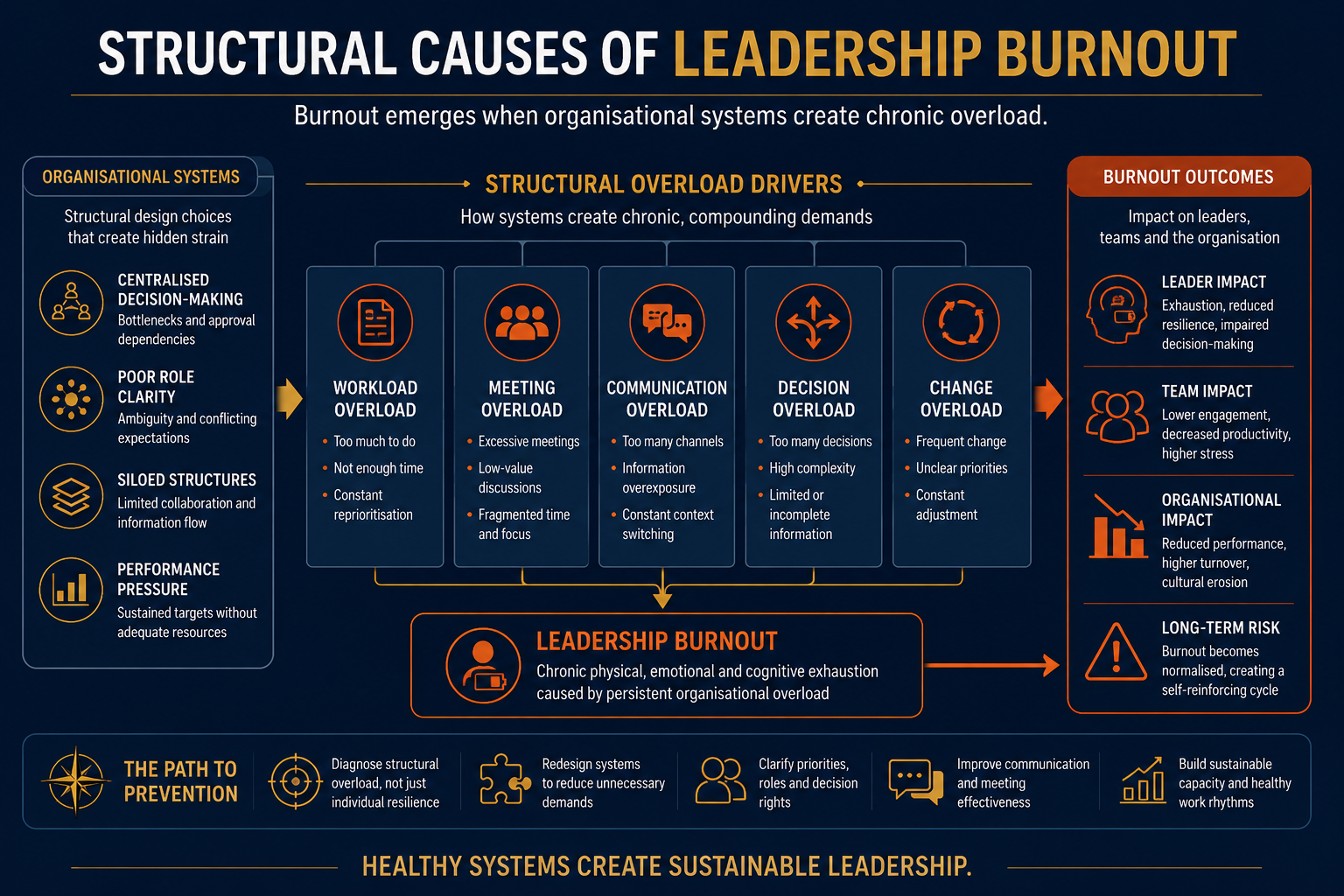
Burnout organisational design is the concept that burnout is created by poorly designed systems, structures, workloads, communication patterns, and decision-making processes rather than individual weakness or lack of resilience.
Why Does Organisational Design Cause Burnout?
Many organisations unknowingly create conditions where burnout becomes inevitable. The challenge begins with workload expansion.
Leadership roles today contain significantly more responsibilities than they did even a decade ago. Managers are expected to be strategists, coaches, analysts, communicators, change leaders, technology adopters, and culture builders simultaneously.
The problem is not simply having more work. The problem is that support structures have not evolved at the same pace.
Vincent Walters’ Burn Bright framework identifies five root causes commonly found in burnout-producing systems:
A leader cannot outwork a broken system.
— Vincent Walters, Burn Bright Advisory
How Does Scope Creep Create Leadership Burnout?
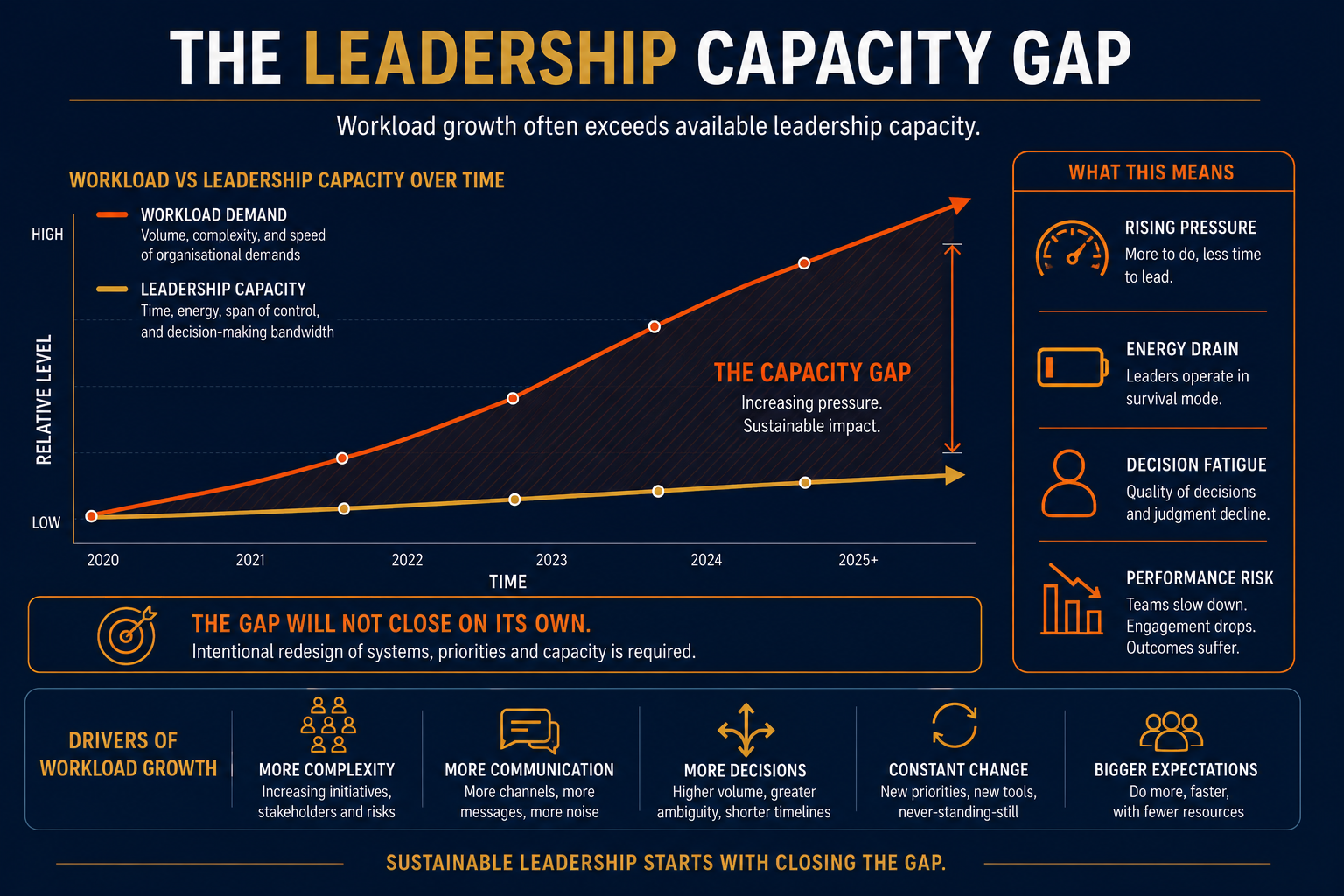
Scope creep is one of the most common structural causes of burnout. Responsibilities accumulate over time — projects are added, reporting requirements increase, new technology platforms appear, additional stakeholders become involved. Yet very little is removed.
The issue is rarely capability. Most leaders can handle complexity temporarily. The issue is sustainability. A role that continuously expands without corresponding support eventually exceeds human capacity.
Three Predictable Outcomes of Scope Expansion
Many organisations mistakenly reward this behaviour. Leaders who absorb increasing demands are often viewed as high performers until burnout emerges. The reality is that organisational design is transferring system problems onto individuals. That is not leadership. That is structural overload.
Why Are Meetings and Communication Systems Driving Burnout?
Technology promised efficiency. Many leaders received complexity instead.
Modern work environments are increasingly dominated by email, Teams, Slack, messaging platforms, project tools, dashboards, and continuous notifications. Instead of enabling deep work, many systems reward responsiveness. Leaders become trapped in perpetual communication.
The Burn Bright framework describes this as communication chaos. The symptoms are familiar:
People are expected to deliver more output while simultaneously managing exponentially more communication. The result is not productivity. The result is exhaustion. Protected focus time becomes impossible. Leaders become operational firefighters. Burnout follows.
How Does Decision Overload Damage Leadership Performance?
Leadership is fundamentally a decision-making role. Every decision requires energy. Every judgement consumes cognitive resources. When decision volume becomes excessive, leaders experience decision fatigue.
Symptoms of Decision Overload
The Decision Overload Cycle
What Does Sustainable Organisational Design Look Like?
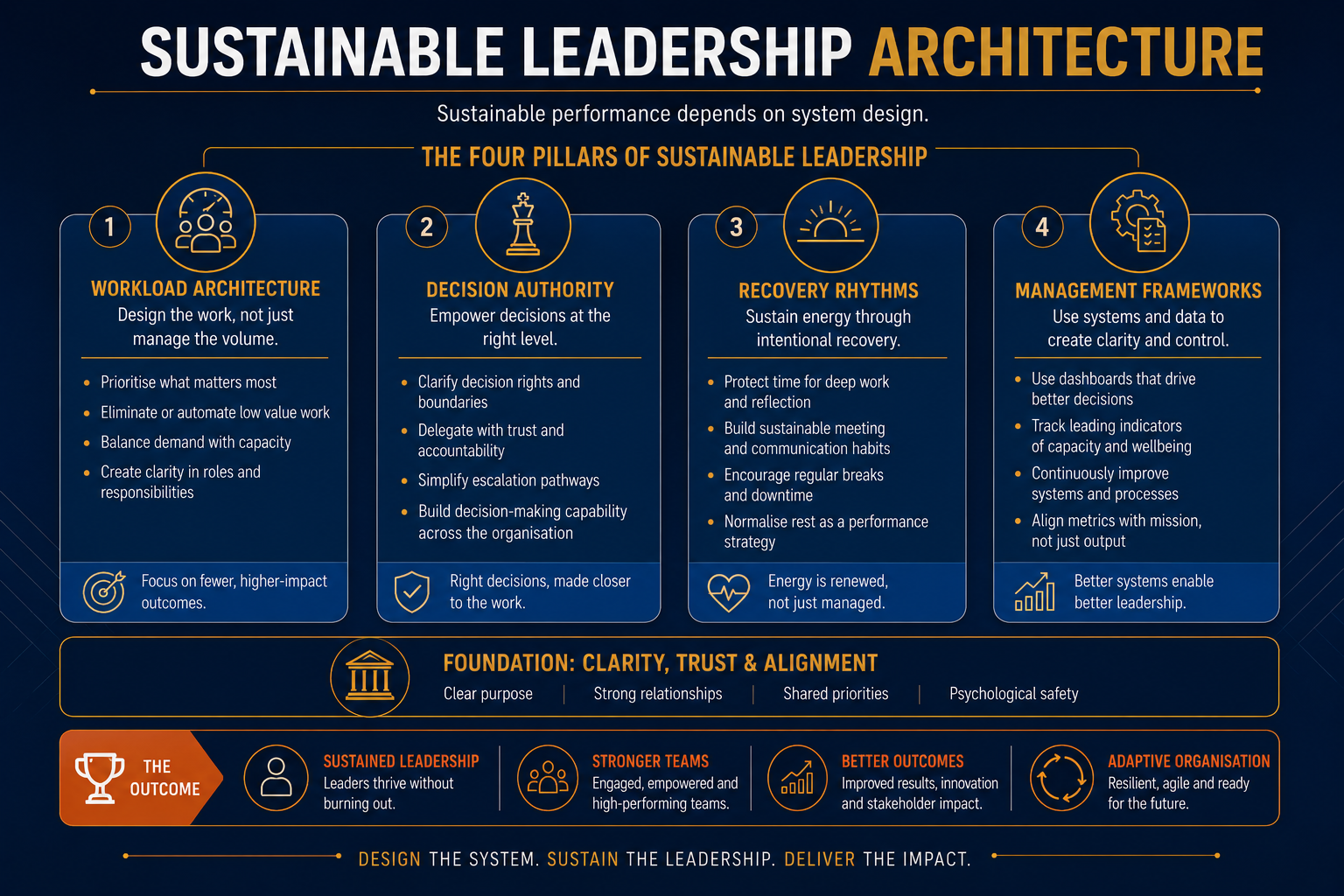
If poor organisational design creates burnout, better design can prevent it. Burn Bright Advisory’s structural transformation model focuses on four pillars:
01
Workload Architecture
Work should be intentionally designed. Leaders need visibility of actual workload demand rather than assumptions. Capacity planning should become a management discipline.
02
Decision Authority
Not every decision should rise to senior leadership. Clear ownership reduces bottlenecks and decision fatigue.
03
Recovery Rhythms
Recovery is not a reward. Recovery is operational maintenance. Sustainable organisations build recovery into work design.
04
Management Frameworks
Frameworks reduce ambiguity. Clear systems create consistency. Consistency reduces cognitive load.
| Traditional Leadership | Sustainable Leadership |
|---|---|
| Individual heroics | System design |
| More effort | Better architecture |
| Constant availability | Protected focus |
| Reactive decisions | Structured decision-making |
| Burnout prevention through resilience | Burnout prevention through redesign |
| Work harder | Work smarter and sustainably |
| Short-term output | Long-term effectiveness |
Frequently Asked Questions
Is burnout organisational design a real issue?
Yes. Increasing evidence shows burnout is heavily influenced by workload design, communication systems, decision structures, and organisational culture rather than individual weakness.
Can resilient leaders still burn out?
Absolutely. Resilience can delay burnout but cannot overcome permanently unsustainable systems. Even highly capable leaders eventually reach capacity limits.
What is the biggest organisational cause of burnout?
Scope creep is often the most common cause. Responsibilities increase continuously while resources and support remain unchanged, creating an ever-widening gap between demands and capacity.
How do meetings contribute to burnout?
Meetings consume time, fragment attention, reduce deep work opportunities, and increase decision fatigue when poorly managed. They are one of the most visible and correctable structural causes of burnout.
Can organisations prevent burnout?
Yes. Organisations can significantly reduce burnout through workload architecture, delegation frameworks, decision clarity, recovery systems, and sustainable leadership practices.
Conclusion
Burnout organisational design challenges one of the biggest myths in leadership. The problem is rarely that leaders are not resilient enough. The problem is that many organisations continue operating with structures that generate overload by design.
When workload expands without limits, communication becomes chaotic, decision volume escalates, and recovery disappears, burnout becomes a predictable outcome.
Burnout is a system failure. Leaders cannot outwork broken systems. The most effective organisations are moving away from heroic leadership and towards sustainable leadership — because better systems outperform more effort.
The question is no longer whether burnout exists. The question is whether organisations are willing to redesign the structures creating it.
“Burnout is a system failure, not a personal failure. Leaders cannot outwork broken systems.”
— Vincent Walters, Burn Bright Advisory
Free Resource
Discover Your Burnout Risk
Take the free leadership burnout assessment and identify the structural pressures affecting your performance today. Free. Instant results.
Free Leadership Intelligence
Get Weekly Leadership Insights
Join thousands of leaders receiving practical strategies on burnout prevention, workload design, and sustainable performance every week.