Quick Answer
Key Takeaways
- Treat email overload as a structural problem. Investigate why messages are generated before trying to process them faster.
- Separate communication from decision-making. Not every message requires a leader’s attention or approval.
- Establish clear response expectations. Urgency should be defined by business impact, not the sender’s impatience.
- Protect uninterrupted leadership time. Strategic thinking requires space away from continuous communication.
- Measure communication effectiveness. Track unnecessary escalation, decision delays and interruptions rather than inbox volume alone.
Is your inbox running your leadership day?
Email Overload for Leaders: Fix the System
By Vincent Walters | Burn Bright Advisory | 23 October 2026
Introduction
Email overload for leaders has become one of the most accepted forms of organisational dysfunction.
A senior leader arrives at work with a clear set of priorities. Within minutes, the inbox takes control.
An urgent request needs approval.
A colleague wants clarification.
Someone has copied the leader into a conversation that does not require their involvement.
Another stakeholder wants an update on work already discussed yesterday.
By mid-morning, the leader has answered dozens of messages but made little progress on the decisions that actually matter.
This is not necessarily a personal productivity problem. It is often evidence of a communication system that has never been properly designed.
Across more than 30 years in leadership roles spanning education, business and the public sector, I have seen how easily communication becomes confused with effectiveness. Being accessible is mistaken for being accountable. Responding quickly is mistaken for making progress.
The result is a leadership culture that rewards constant reaction while leaving insufficient capacity for strategic thought.
In this article, I will explain why email overload develops, how it contributes to burnout and how leaders can redesign communication around clarity, decision authority and sustainable performance.
What Is Email Overload in Leadership?
The first step is to understand the architecture behind the problem. The following framework illustrates how five organisational conditions create a cycle of communication overload.

Email overload rarely exists in isolation. It interacts with meeting culture, unclear responsibilities, decision bottlenecks and expanding workloads. Addressing only the inbox leaves those wider conditions unchanged.
Why Does Email Overload Affect Leaders So Severely?
Email is useful when it transfers information efficiently. It becomes harmful when it starts controlling how leadership work is organised.
The distinction matters. Leaders are not employed simply to respond to requests. They are responsible for setting direction, making judgements, developing people and ensuring that organisational systems deliver results. These responsibilities require concentration.
Yet many leaders work in environments where availability has become an unofficial measure of performance.
A message arrives. The leader responds.
Another message follows. A colleague asks for clarification.
The original task is interrupted again.
Each interruption appears minor. Collectively, they can reshape the entire working day.
The hidden cost of fragmented attention
Microsoft’s 2025 Work Trend Index reported that employees in its telemetry-based analysis were interrupted by a meeting, email or notification roughly every two minutes during core working hours.
That finding does not mean every interruption causes equal damage. It does show the intensity of communication in modern knowledge work.
For leaders, the problem is especially significant because their work frequently involves complex judgements. Consider a headteacher reviewing safeguarding arrangements, a hospital director evaluating staffing risks or a business executive preparing an investment decision.
These are not tasks that benefit from constant interruption. They require sustained attention, access to relevant information and time to consider consequences.
When that time disappears, leaders may compensate by completing strategic work in the evening. The organisation then receives the benefit of daytime accessibility while the individual absorbs the cost through longer working hours.
Why inbox management techniques are insufficient
Traditional advice encourages leaders to use folders, filters, templates and scheduled email sessions. These techniques can help. However, they do not address the underlying reasons that unnecessary messages exist.
- If employees cannot make routine decisions without permission, emails will continue.
- If project responsibilities are unclear, clarification requests will continue.
- If meetings produce no documented decisions, follow-up emails will continue.
- If senior leaders expect immediate responses at all hours, the communication burden will continue.
The issue is not simply how quickly a leader can process information. It is how much information the organisation unnecessarily requires them to process.
This distinction is central to the Burn Bright approach to sustainable leadership: better systems outperform more effort.
How Does Email Overload Contribute to Leadership Burnout?
Email overload contributes to burnout when constant communication creates sustained demands without adequate control, recovery or decision-making space.
The World Health Organization describes burnout as an occupational phenomenon resulting from chronic workplace stress that has not been successfully managed. It identifies three dimensions: exhaustion, increased mental distance or cynicism towards work, and reduced professional efficacy.
Email overload is not itself a diagnosis of burnout. However, it can reinforce conditions that make chronic workplace stress harder to manage.
The relationship between demands and control
A leader may be capable of managing a demanding role when responsibilities are clear and they retain meaningful control over how work is completed. Problems develop when demands expand while control declines.
Email can intensify this imbalance. Every message introduces a potential new responsibility, decision or interruption. The leader may have little influence over when requests arrive, how much information they contain or whether the sender has considered alternative solutions.
This creates a working environment where other people’s priorities continually compete for the leader’s attention.
What research tells us
Gallup’s State of the Global Workplace 2025 reported that global employee engagement declined from 23% in 2023 to 21% in 2024. Manager engagement experienced a particularly notable decline, falling from 30% to 27%.
These figures do not prove that email overload caused the decline. They do demonstrate the broader pressures facing managers and the importance of protecting leadership capacity.
Meanwhile, Microsoft’s 2025 research described an increasingly fragmented working day, with digital communication competing continuously for attention.
The evidence points towards a practical concern: organisations cannot keep increasing communication demands while assuming leaders have unlimited cognitive capacity.
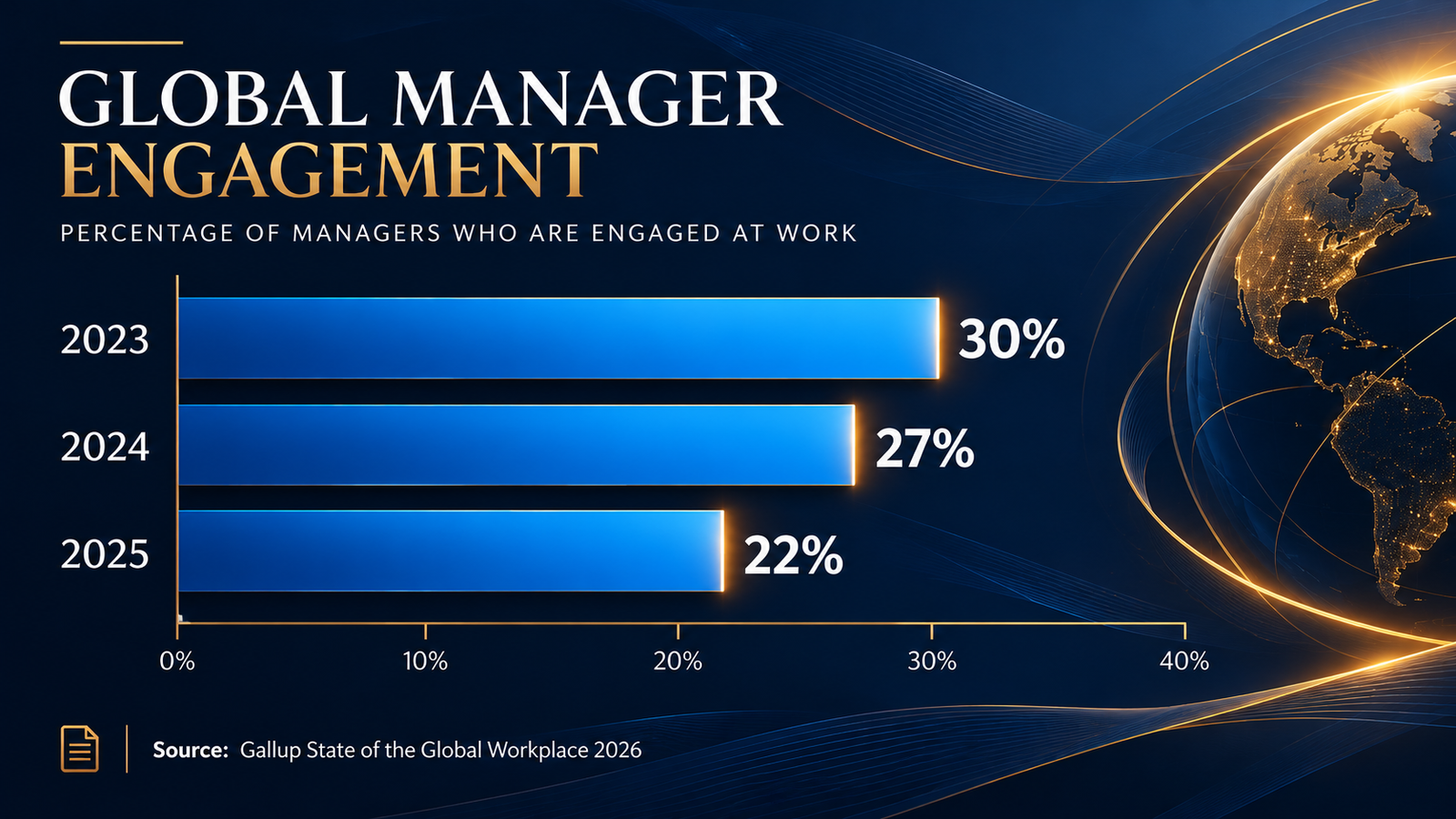
The implication is not that leaders should abandon digital communication. It is that communication demands must be designed around human capacity.
Why the problem spreads beyond the leader
When a leader is overwhelmed, decisions can become delayed. Team members may send reminders, escalate routine issues or copy additional people into conversations. Those responses generate more communication. The leader then faces an even larger inbox.
A self-reinforcing cycle develops:
More messages create slower decisions.
Slower decisions create more follow-ups.
More follow-ups create additional interruptions.
Eventually, the entire team becomes less effective. This is why understanding the structural causes of leadership burnout matters more than simply teaching individuals to work faster.
What Causes Unnecessary Email Overload in Organisations?
Most organisations do not deliberately create excessive communication. It develops gradually.
A new approval requirement is introduced. Another reporting process is added. A manager asks to be copied into more correspondence. A project team creates an additional update routine.
Each decision appears reasonable in isolation. Together, they produce a communication system that consumes increasing amounts of leadership capacity.
Within the Burn Bright Not Out Framework™, communication chaos is one of five structural root causes of burnout. Four patterns deserve particular attention.
When organisations answer that question consistently, unnecessary correspondence begins to decline.
How Can Leaders Redesign Their Communication Systems?
The solution to email overload is communication architecture.
Communication architecture means deliberately designing how information moves, how decisions are made and when leaders are expected to respond. It replaces informal expectations with clear operating rules.
Within the Burn Bright Not Out approach, this connects directly to four pillars of structural transformation: Workload Architecture™, Decision Authority™, Recovery Rhythms™ and Management Frameworks.
Step 1: Audit the Communication Burden
Start with a five-day sample of incoming email. Classify messages into four categories: decisions genuinely requiring your authority; information necessary for your responsibilities; requests that could be resolved elsewhere; and messages requiring no action or meaningful attention. Look for repeated patterns. Are the same questions being asked every week? Are routine approvals unnecessarily reaching senior management? Are employees requesting information that should already be accessible? The purpose is not to calculate how hard you are working. It is to identify where the communication system is creating avoidable demand.
Step 2: Establish Communication Rules
Create a simple team agreement. Define expected response windows for routine communication, which matters are genuinely urgent and how critical issues should be escalated. For example, a team might agree that routine email responses are expected within one working day, while operational emergencies require a telephone call. These are illustrative standards, not universal rules — safeguarding, clinical, legal and other time-critical environments need appropriate escalation arrangements. Clarity reduces the pressure to monitor every message continuously.
Step 3: Redistribute Decision Authority
Use the RACI Delegation Framework™ to clarify who is Responsible, Accountable, Consulted and Informed. The distinction between being accountable and being copied into every conversation is essential. A leader can retain accountability without personally processing every operational detail. Where decisions are delegated, specify the limits of authority and the conditions that trigger escalation. This reduces unnecessary requests while preserving governance.
Step 4: Protect Leadership Attention
Introduce defined communication windows where operationally appropriate. Protect time for decisions, planning and staff development. The objective is not to make leaders inaccessible. It is to ensure that accessibility does not eliminate their ability to lead.
Step 5: Review the System
After 30 days, examine whether unnecessary escalation, repeat requests and decision delays have declined. Ask employees whether they have greater clarity about where to find information and who can authorise action. Adjust the rules where necessary. A communication system is effective when work moves reliably without requiring constant senior intervention.
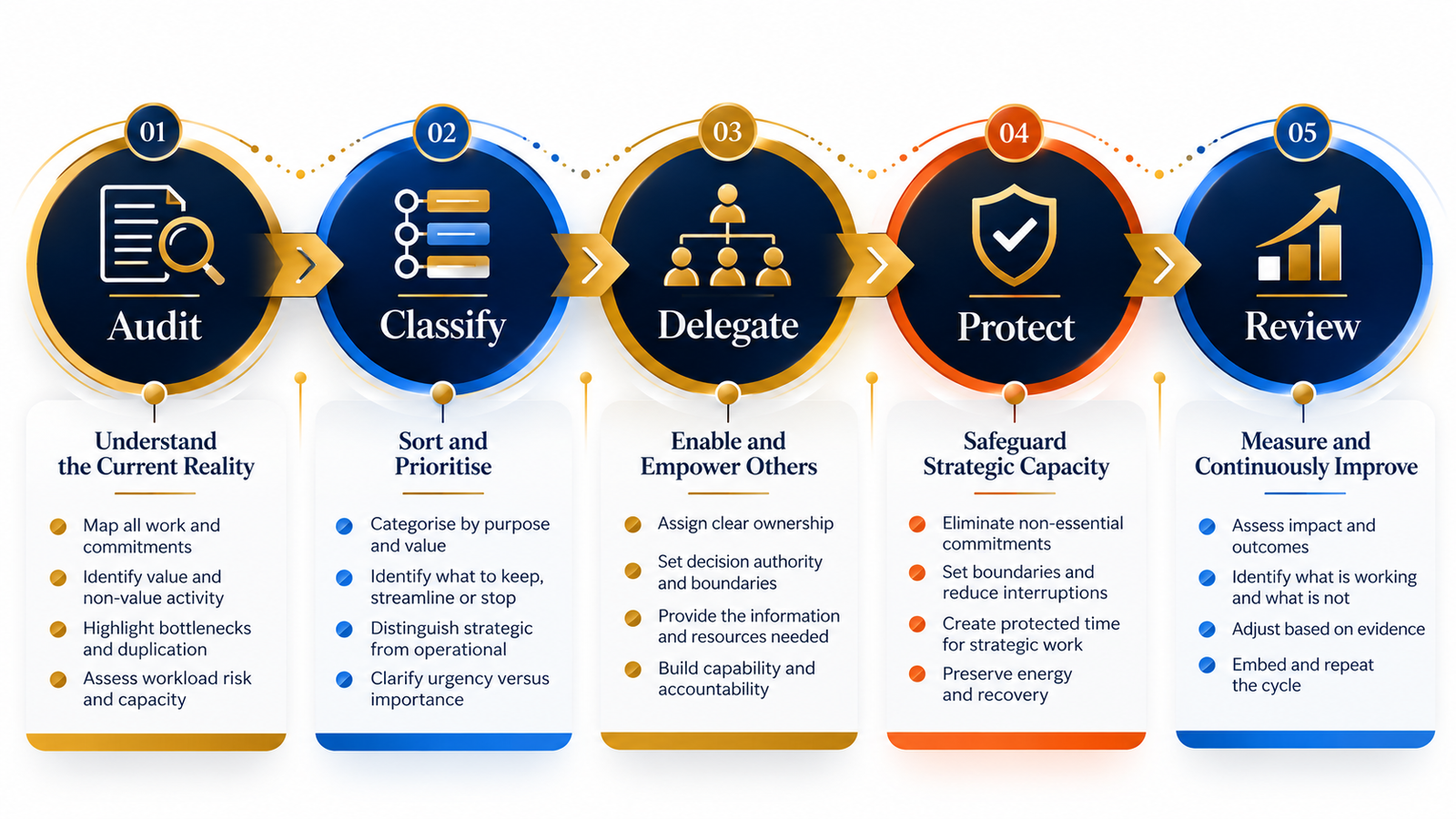
The important shift is from managing messages individually to reducing unnecessary communication structurally.
What Does Sustainable Email Management Look Like in Practice?
Sustainable email management is not defined by an empty inbox. It is defined by reliable communication that supports decisions without consuming disproportionate time and attention.
Consider a hypothetical secondary school leadership team. The deputy head receives frequent messages about timetable adjustments, parental enquiries, staffing arrangements, behaviour incidents and operational decisions. Many messages are legitimate. However, the deputy head is copied into almost every discussion because colleagues are uncertain about responsibility and escalation.
The inbox becomes the school’s unofficial management system.
Before Before Redesign
The deputy head spends substantial time reviewing correspondence, answering routine questions and redirecting requests. Important strategic work moves into evenings. Staff experience delays because they are waiting for senior responses.
Everyone is busy. The system is not effective.
After After Redesign
The leadership team establishes clear responsibility for operational decisions. Routine enquiries are directed to designated role holders. Information is recorded in shared systems rather than repeatedly circulated by email. Urgent safeguarding matters retain immediate escalation procedures.
The deputy head receives exceptions, significant risks and decisions that genuinely require senior authority. This does not remove responsibility. It places responsibility at the correct level.
The same principle applies to business, healthcare, public administration and other complex environments.
Traditional versus sustainable communication
| Traditional Email Culture | Sustainable Communication Architecture |
|---|---|
| Immediate responses expected | Response times defined by urgency |
| Leaders copied into everything | Information shared according to role |
| Routine decisions escalated upwards | Authority delegated within clear limits |
| Inbox used as task management | Work tracked in appropriate systems |
| Availability treated as commitment | Outcomes treated as evidence of effectiveness |
| Strategic work completed after hours | Strategic capacity protected within working hours |
| More messages interpreted as progress | Clearer decisions and less rework measured |
The difference is structural. Traditional systems depend on the leader’s willingness to absorb complexity. Sustainable systems reduce unnecessary complexity before it reaches the leader.
This also changes how technology should be used. AI-assisted summaries, routing rules and automated workflows can help, provided they operate within appropriate confidentiality and information-governance safeguards. But automation must not become an excuse to generate more communication.
How Can Leaders Prevent Email Overload From Returning?
Communication overload often returns because organisations change individual habits without changing underlying expectations.
A leader introduces scheduled email sessions. For two weeks, the system appears to improve. Then a senior stakeholder demands immediate responses. Employees resume copying everyone into messages. A new project introduces another reporting requirement. The original pattern returns.
Preventing recurrence requires governance.
Make communication standards explicit
Include communication expectations in team operating agreements. New employees should understand where information belongs, how decisions are escalated and which response times apply.
Managers must model the same standards. A senior leader who sends routine emails late at night and expects immediate replies undermines the system regardless of what the policy says.
Measure the right indicators
Do not rely exclusively on email volume. A lower message count may indicate improvement, but it could also mean information is not reaching the right people. Instead, monitor a balanced set of indicators:
- Time spent processing routine communication.
- Frequency of unnecessary escalations.
- Average time required for important decisions.
- Number of repeated information requests.
- Employee clarity about responsibilities.
- Protected time available for strategic leadership.
These measures reveal whether the system is becoming more effective.
Connect communication to recovery
Recovery is a leadership discipline. Leaders need periods when work demands are genuinely reduced. That requires more than encouraging employees to switch off. Organisations must establish realistic expectations about out-of-hours contact, emergency coverage and workload.
The NHS, education and other essential services cannot eliminate urgent communication. They can distinguish genuine emergencies from routine matters and design appropriate cover arrangements.
Review the system every quarter
Communication arrangements should evolve as teams, technology and responsibilities change. A quarterly review can identify new approval bottlenecks, duplicated reporting or unnecessary meetings. It can also reveal whether responsibilities have expanded without corresponding resources.
This is where communication architecture becomes part of wider organisational effectiveness. The ultimate goal is not fewer emails at any cost. It is better decisions, clearer accountability and leadership capacity that remains sustainable over time.
Frequently Asked Questions
What causes email overload for leaders?
Email overload usually develops through a combination of unclear responsibilities, excessive copying, weak decision authority, unnecessary reporting and unrealistic response expectations. Leaders often become default approval points for routine work. Reducing the burden requires redesigning communication processes rather than relying exclusively on individual inbox-management techniques.
Can too many emails cause leadership burnout?
Excessive email demands can contribute to chronic workplace stress, particularly when leaders have little control over interruptions or expectations. Email overload alone does not establish a burnout diagnosis. However, when combined with long working hours, unclear priorities and insufficient recovery, it can contribute to conditions associated with exhaustion and reduced effectiveness.
How often should leaders check their emails?
There is no universal frequency. Leaders should establish communication windows that reflect operational needs and risk. Some roles can use scheduled checks, while others require continuous emergency coverage. The critical principle is separating genuine urgent communication from routine correspondence so that strategic work is not interrupted unnecessarily.
Should senior leaders respond to every email?
No. Senior leaders should respond to messages that genuinely require their authority, judgement or input. Routine matters should be handled by appropriately authorised colleagues. Clear delegation and escalation rules allow leaders to remain accountable without becoming involved in every operational conversation.
What is the best way to reduce email overload at work?
Start by auditing message patterns and identifying unnecessary requests. Clarify responsibilities, remove redundant reporting, define response expectations and establish appropriate communication channels. Then measure whether decision delays and repeat requests decline. Sustainable improvement comes from changing how work is coordinated, not simply processing messages faster.
Can AI solve email overload for executives?
AI can assist with summarisation, categorisation and drafting, but it cannot independently correct poor organisational design. Automating unnecessary communication may increase information volume. Leaders should first eliminate redundant messages and clarify decision authority, then use approved technology where it improves communication without introducing confidentiality or governance risks.
Conclusion: Fix the Communication System
Email overload for leaders is not simply an inconvenience. It is a warning that the relationship between communication, decision-making and organisational capacity may be poorly designed.
When leaders spend their days responding to messages and their evenings completing meaningful work, the organisation has a structural problem.
The answer is not another productivity technique. It is a deliberate redesign of how information moves, who makes decisions and which matters genuinely require senior attention.
Effective communication architecture creates clarity. It reduces unnecessary escalation, protects strategic thinking and allows employees to operate with appropriate authority. Most importantly, it makes leadership more sustainable.
As you look at your own situation today — are you leading from a place of clarity or a place of depletion?
Find the Structural Pressures Behind Your Workload
Go beyond the self-assessment with a full diagnostic of leadership capacity, workload and decision authority — the systems that decide how much of your day the inbox takes. £144.
Take the Leadership Burnout Self-Assessment
If constant communication is consuming your leadership capacity, the first step is to understand the wider patterns driving the pressure. Identify the structural pressures behind your workload.
Free Leadership Intelligence
Get Weekly Leadership Insights
Join thousands of leaders receiving practical strategies on burnout prevention, workload design, and sustainable performance every week.