Quick Answer
Key Takeaways
- Most organisations have a vision. Far fewer possess the leadership capability required to deliver it.
- Visionary leadership is not the same as charismatic leadership — confidence can be mistaken for strategic competence.
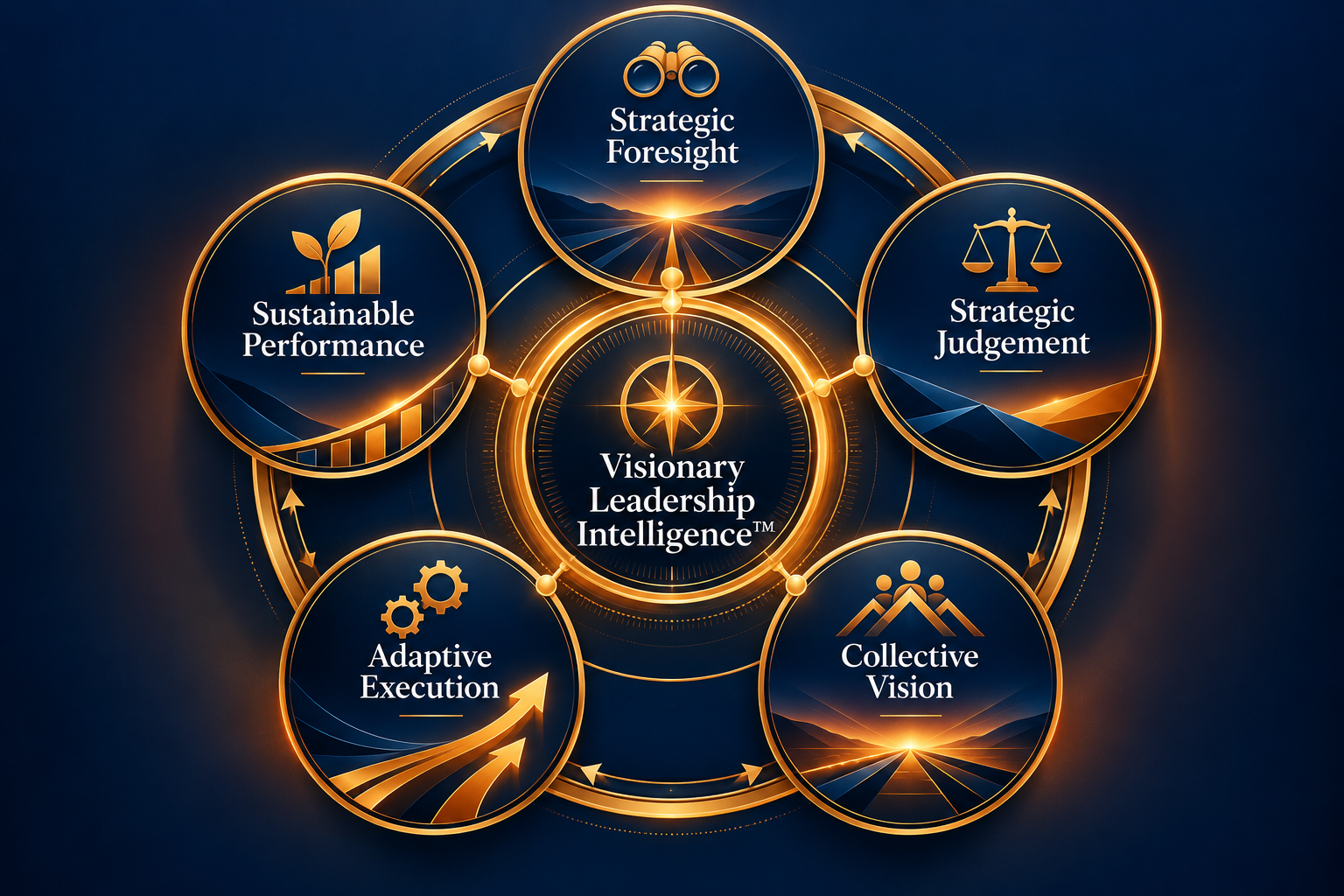
- Five dimensions shape Visionary Leadership Intelligence™: strategic foresight, strategic judgement, collective vision, adaptive execution and sustainable performance.
- Strategic foresight without organisational capacity is not enough — Leadership Capacity™ and Leadership Workload™ must be examined before major initiatives are approved.
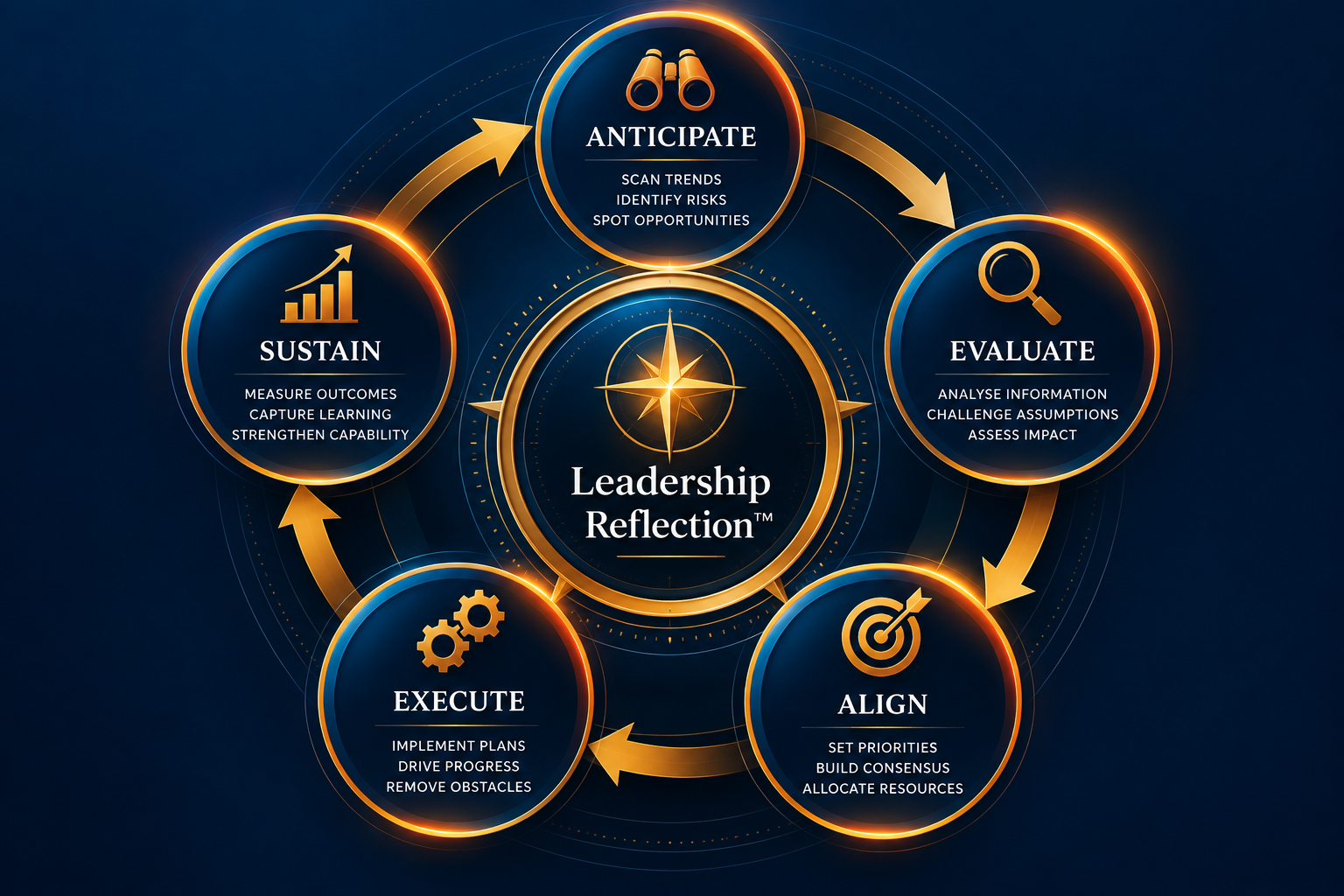
- The Vision-to-Performance Framework moves through five stages: Anticipate, Evaluate, Align, Execute and Sustain.
- Sustainable visionary leadership develops collective capability that outlasts the tenure of any individual leader.
Can your organisation sustain the vision it is pursuing?
Visionary Leadership: Why Strategic Foresight Must Become a Measurable Leadership Capability
How leaders can move beyond inspirational vision statements to build organisations capable of anticipating change, making intelligent decisions and sustaining long-term performance.
Introduction: The Difference Between Having a Vision and Leading Towards One
Most organisations have a vision.
Far fewer possess the leadership capability required to deliver it.
Corporate strategies describe future growth. Schools articulate ambitions for educational excellence. Healthcare organisations establish long-term priorities for patient outcomes. Public institutions publish transformation programmes designed to improve services and strengthen public confidence.
Yet the existence of a compelling vision does not guarantee organisational progress. The critical distinction lies between imagining a desirable future and developing the intelligence, judgement and capacity required to reach it.
- A leader may articulate an ambitious transformation strategy while overlooking the operational pressures experienced by the workforce.
- Another may correctly anticipate technological disruption but underestimate the cultural resistance that prevents meaningful adoption.
- A third may secure widespread enthusiasm for a new direction without establishing the governance, resources or accountability mechanisms necessary for implementation.
In each situation, the problem is not necessarily the absence of vision.
It is the absence of an integrated leadership system capable of converting vision into performance.
This distinction is increasingly important in environments characterised by technological acceleration, workforce pressures, financial constraints, changing stakeholder expectations and institutional uncertainty.
Leadership effectiveness can no longer be assessed solely through a leader’s ability to communicate confidence about the future. It must also be evaluated through their ability to understand emerging conditions, recognise organisational limitations and make decisions that preserve future performance capacity.
This is where Visionary Leadership Intelligence™ becomes strategically significant. Within the Burn Bright Advisory™ Leadership Intelligence Compass™, visionary leadership is connected to a broader set of leadership capabilities that influence how individuals and organisations interpret complexity, make decisions and sustain performance.

What Is Visionary Leadership?
Featured Snippet
A credible vision must answer four fundamental questions:
- What future are we seeking to create?
- Why is that future strategically important?
- What organisational capabilities are required to achieve it?
- How will we determine whether meaningful progress is occurring?
These questions distinguish visionary leadership from aspiration.
An aspiration describes a desirable outcome.
A vision provides direction.
Visionary leadership creates the conditions through which that direction can become organisational reality.
Visionary Leadership Is Not the Same as Charismatic Leadership
Charismatic leaders may generate enthusiasm through confidence, communication and personal influence. Visionary leadership, however, should not depend on personality alone.
A compelling speaker can inspire commitment to an unrealistic strategy. A quieter, analytically minded leader may establish a far more sustainable direction through careful judgement, consultation and disciplined execution.
The distinction matters because organisations can become overly dependent on individual leaders whose confidence is mistaken for strategic competence. When this happens, dissenting perspectives may be dismissed, operational warnings ignored and organisational identity tied too closely to one person’s interpretation of the future.
Visionary Leadership Intelligence™ requires something more demanding. It requires leaders to distinguish between conviction and evidence, ambition and feasibility, and strategic opportunity and organisational risk.

Why Visionary Leadership Matters for Organisational Performance
Visionary leadership matters because organisations must make decisions today whose consequences may not become visible for several years.
Recruitment strategies influence future workforce capability.
Technology investments shape operational flexibility.
Leadership development determines succession strength.
Cultural decisions affect whether employees contribute ideas, challenge assumptions and respond constructively to change.
Each decision contributes to the organisation’s future operating conditions. Without a coherent strategic direction, these decisions can become fragmented. Departments pursue competing priorities. Resources are allocated reactively. Leaders focus on immediate performance indicators without examining whether current success is creating future vulnerability.
A well-developed vision provides a basis for evaluating competing demands. It enables leaders to ask whether an initiative strengthens long-term organisational capability or merely addresses an immediate pressure.
However, visionary leadership becomes counterproductive when strategic ambition is detached from organisational capacity.
Consider a hypothetical healthcare organisation pursuing an ambitious digital transformation programme. The executive team may correctly recognise the potential benefits of integrated patient information, improved clinical coordination and better resource planning. Yet if the programme introduces new systems without sufficient workforce development, clinical consultation or implementation capacity, the transformation may increase operational pressure before delivering its intended benefits.
The strategic direction may be sound. The leadership approach may nevertheless be unsustainable. This illustrates an important principle of Leadership Performance Intelligence™:
Visionary leadership should therefore connect strategic foresight with workforce capability, organisational learning, ethical responsibility and operational sustainability. It is this integration that transforms vision from a statement of intent into a meaningful leadership capability.
The Five Dimensions of Visionary Leadership Intelligence™
Visionary leadership becomes more effective when it is understood as a combination of interdependent capabilities rather than a single leadership characteristic.
Within Burn Bright Advisory’s Leadership Performance Intelligence™ approach, five dimensions provide a practical framework for examining how leaders anticipate change, establish direction and translate future ambitions into organisational performance. These dimensions are proposed as a developmental framework, not as a psychometrically validated assessment scale.
Dimension 1
Strategic Foresight: Understanding What May Come Next
Strategic foresight involves examining emerging trends, uncertainties and potential disruptions before they become immediate operational problems. It differs from forecasting. Forecasting generally attempts to estimate what is likely to happen based on available information. Strategic foresight considers multiple plausible futures and examines how organisations might respond under different conditions.
A school leader considering the future of education may examine developments in artificial intelligence, demographic change, workforce availability and evolving expectations of learning. Rather than assuming that one future is inevitable, the leader explores several possibilities and identifies capabilities that would remain valuable across different scenarios.
Strategic foresight therefore requires intellectual humility. Experience provides valuable insight without guaranteeing that historical assumptions will remain valid.
Dimension 2
Strategic Judgement: Distinguishing Opportunity from Distraction
Not every emerging trend requires an organisational response. Technological innovation, regulatory change, market competition and shifting workforce expectations can create pressure to respond immediately. However, constant strategic adjustment can fragment organisational attention.
Visionary leaders must distinguish between developments that materially affect long-term performance and those that generate temporary urgency. This requires evaluating potential opportunities against organisational purpose, available evidence, implementation costs and future capability requirements.
Strategic judgement is not simply the ability to recognise opportunities. It is also the discipline to decline initiatives that do not support the organisation’s intended direction.
Dimension 3
Collective Vision: Creating Shared Strategic Understanding
A vision cannot become organisational reality if it exists only within the thinking of senior leadership. Employees, managers and stakeholders must understand how the proposed future relates to their responsibilities, professional judgement and everyday decisions.
This requires meaningful engagement, not just a strategic statement. Leaders must create opportunities for individuals to question assumptions, identify practical barriers and contribute knowledge that may not be visible at executive level. This connects Visionary Leadership Intelligence™ with Constructivism Intelligence™.
A collective vision is not necessarily one in which everyone agrees about every decision. It is one in which people understand the direction, recognise the reasoning behind it and have appropriate opportunities to influence its implementation.
Dimension 4
Adaptive Execution: Translating Vision into Organisational Action
Visionary leadership requires the ability to move between long-term strategic thinking and immediate operational decisions. Organisational conditions rarely remain unchanged throughout implementation. Financial pressures emerge. Workforce capabilities evolve. Stakeholder expectations shift. New information challenges previous assumptions.
Adaptive execution requires leaders to maintain clarity about strategic purpose while remaining flexible about the methods used to achieve it. This is where Adaptability Intelligence™ becomes essential.
Adaptability does not mean continuously changing organisational priorities. It means recognising when the evidence justifies adjusting a strategy, reallocating resources or reconsidering established approaches. Effective leaders distinguish between abandoning a vision and improving the pathway towards achieving it.
Dimension 5
Sustainable Performance: Protecting Future Leadership Capacity
The final dimension concerns whether the organisation can sustain the demands created by its strategic ambitions. An ambitious transformation programme may initially generate impressive performance indicators while simultaneously increasing workload, weakening institutional knowledge or creating dependency on a small number of individuals. These vulnerabilities may remain invisible until the organisation encounters unexpected pressure.
Leadership Sustainability™ therefore becomes a fundamental component of visionary leadership. It requires leaders to consider whether current decisions strengthen or diminish the organisation’s capacity to perform in the future.
A strategically successful initiative should not depend indefinitely on excessive individual sacrifice. Sustainable performance requires systems, capabilities and working conditions that can support continuing progress.
Connecting Visionary Leadership to the Leadership Intelligence Compass™
The Leadership Intelligence Compass™ provides a broader perspective on the capabilities that influence leadership effectiveness. Visionary Leadership Intelligence™ is closely connected to several other domains.
| Compass Domain | Contribution to Visionary Leadership |
|---|---|
| Ethics Intelligence™ | Ensures future ambitions respect responsibilities, fairness and stakeholder consequences |
| Constructivism Intelligence™ | Incorporates diverse perspectives into strategic understanding |
| Adaptability Intelligence™ | Enables appropriate responses to changing conditions |
| Reflective Practice Intelligence™ | Encourages examination of assumptions, decisions and outcomes |
| Knowledge Development Intelligence™ | Strengthens the evidence and organisational learning supporting strategy |
| Emotional Intelligence™ | Supports trust, communication and constructive engagement |
| Leadership Sustainability™ | Aligns strategic ambition with sustainable organisational capacity |
These relationships demonstrate why visionary leadership should not be developed in isolation.
- A leader may possess strong strategic foresight but insufficient emotional intelligence to engage others in the proposed direction.
- Another may communicate an inspiring vision but lack the ethical judgement required to recognise its unintended consequences.
- A third may understand the future clearly but fail to develop the organisational knowledge needed for implementation.
The Compass encourages leaders to examine these interdependencies rather than treating leadership competencies as separate achievements.
Strategic Foresight Without Organisational Capacity Is Not Enough
One of the most consequential weaknesses in strategic leadership is the assumption that identifying the right direction is equivalent to being capable of delivering it.
Consider a hypothetical professional services organisation seeking to double its client base within three years. Its leadership team identifies a credible market opportunity and establishes an ambitious growth strategy. However, the organisation has limited management capacity, inconsistent operating processes and a workforce already experiencing substantial workload pressure.
The growth strategy may be commercially attractive. Yet without investment in leadership development, workforce planning and operational infrastructure, expansion could reduce service quality and weaken employee retention.
The problem is not necessarily the strategic vision. It is the failure to evaluate the organisation’s capacity to implement that vision sustainably.
Within Burn Bright Advisory’s Leadership Capacity™ and Leadership Workload™ concepts, this distinction becomes central to strategic decision-making.
- Leadership Capacity™ concerns the capability and available resources required to fulfil leadership responsibilities effectively.
- Leadership Workload™ concerns the volume, complexity and competing demands placed upon leaders.
These concepts are related but not interchangeable. An organisation may have highly capable leaders whose workloads exceed what can reasonably be sustained. Equally, reducing workload without developing capability may not resolve underlying performance limitations. Visionary leadership must therefore consider both dimensions.
Before approving a major strategic initiative, leaders should examine:
- Whether sufficient capability exists to support implementation.
- Whether existing responsibilities can be reduced, redistributed or redesigned.
- Whether additional investment is required.
- Whether the proposed timetable reflects operational realities.
- Whether progress can be monitored without creating excessive reporting demands.
These questions connect future ambition with present organisational conditions. They also challenge the assumption that commitment alone can compensate for structural limitations.
From Strategic Vision to Measurable Leadership Performance
A further challenge is determining whether visionary leadership is producing meaningful results. Traditional performance measures often focus on financial outcomes, project milestones or the completion of strategic initiatives. These indicators are important, but they provide only a partial picture.
An organisation may achieve a transformation milestone while experiencing declining trust, increased workforce pressure or reduced leadership capacity. Conversely, investment in organisational learning and capability development may strengthen future performance before producing immediately visible financial returns.
Leadership Benchmarking™ offers a way to examine performance across multiple dimensions rather than relying on a single outcome. For visionary leadership, a practical measurement approach could consider four areas.
| Measurement Area | Illustrative Indicator |
|---|---|
| Strategic clarity | Employees’ understanding of organisational priorities |
| Adaptive capability | Ability to adjust decisions in response to credible new evidence |
| Execution effectiveness | Progress against agreed strategic milestones |
| Leadership sustainability | Workload, leadership capacity and continuity risks |
These indicators should be interpreted together. No single measure establishes whether a leader is genuinely visionary.
High levels of strategic clarity may indicate effective communication, but they do not establish whether the strategy itself is sound. Similarly, rapid execution may appear impressive while concealing unsustainable pressure on the workforce. Meaningful assessment therefore requires both quantitative information and qualitative leadership reflection.
The objective is not to create another administrative reporting system. It is to improve the quality of strategic judgement. When leaders examine these indicators systematically, they can identify whether their vision is strengthening organisational capability or merely increasing the intensity of current activity.
This is the essential connection between Visionary Leadership Intelligence™ and Leadership Performance Intelligence™. The former concerns how leaders understand and shape the future. The latter provides a broader approach for examining how leadership capabilities, decisions and organisational conditions contribute to performance.
Visionary Leadership in Practice: Applications Across Four Sectors
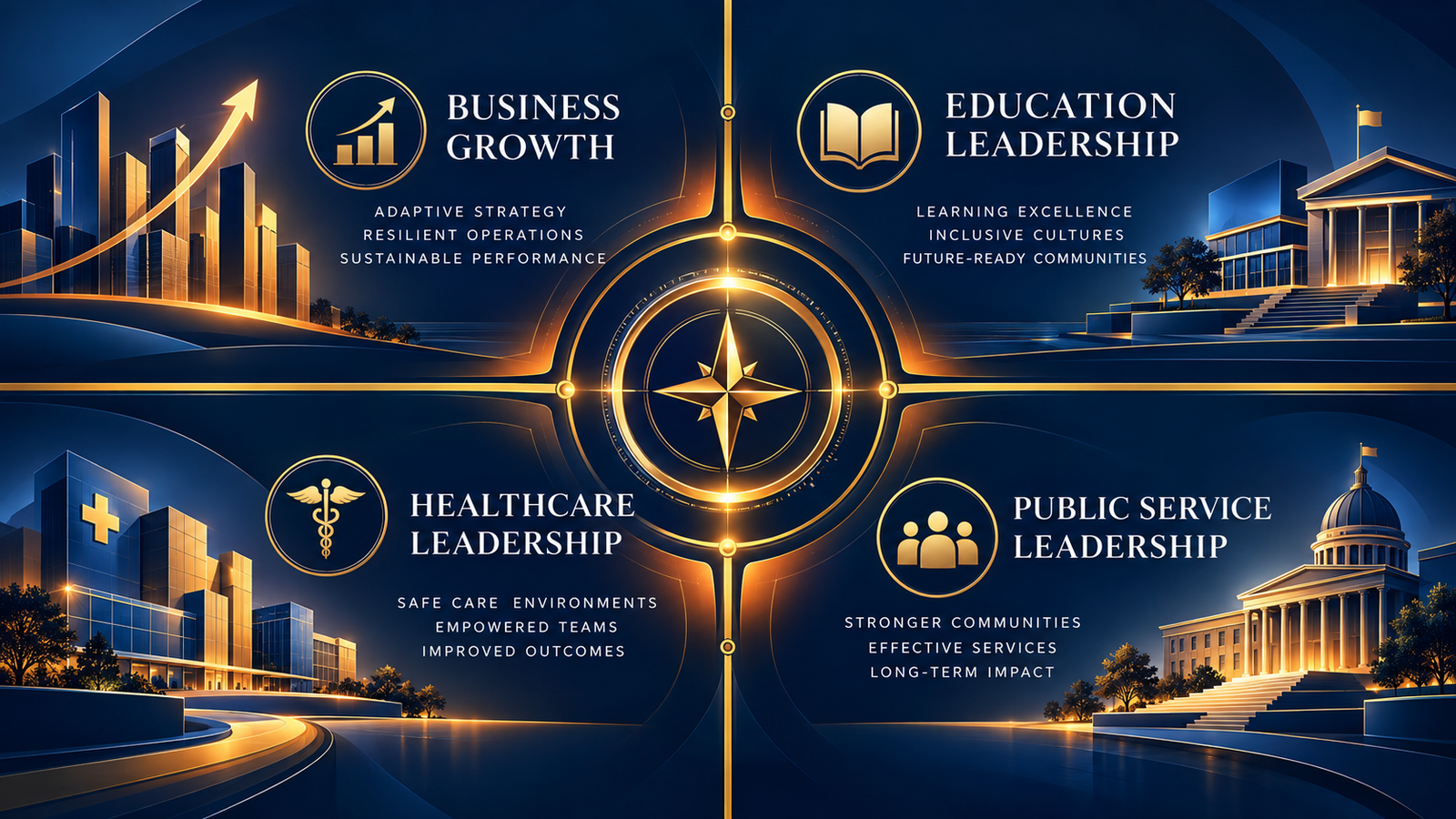
The principles of visionary leadership are relevant across industries, but their practical application depends on organisational purpose, stakeholder expectations and operational constraints. A corporate executive, school principal, healthcare director and public service leader may all require strategic foresight. However, the consequences of their decisions and the conditions under which they operate differ considerably.
🏢 Business Growth Intelligence™: Balancing Expansion with Organisational Readiness
In business, visionary leadership is frequently associated with innovation, competitive advantage and market expansion. However, successful growth requires more than identifying commercial opportunities.
Consider a hypothetical medium-sized business planning to enter three international markets within two years. The executive team identifies promising demand and develops an ambitious expansion strategy. Yet an internal capability review reveals that existing managers are already responsible for extensive operational portfolios, succession arrangements are limited and decision-making depends heavily on the chief executive.
A visionary leader would examine the conditions required for sustainable expansion before committing resources — strengthening middle-management capability, establishing clearer decision rights and introducing phased market entry. The leadership question becomes: Can the organisation develop the capabilities required to sustain the future it intends to create?
🏫 School Leadership Intelligence™: Creating Educational Futures Without Exhausting the Workforce
A school principal may establish a vision for personalised learning supported by digital technology. However, implementation requires more than purchasing new platforms or announcing instructional priorities.
Teachers need appropriate professional development. Middle leaders require time to support implementation. Students need equitable access to learning opportunities, and parents must understand the intended educational benefits. Without these conditions, a promising strategic initiative may create additional workload without improving learning.
A sustainable approach would begin with a clearly defined educational problem, examine available evidence, involve teaching staff in designing the response and evaluate outcomes before expanding implementation. This connects Visionary Leadership Intelligence™ with Constructivism Intelligence™, Reflective Practice Intelligence™ and Leadership Sustainability™.
🏥 Healthcare Leadership Intelligence™: Integrating Innovation, Safety and Workforce Capacity
Consider a hypothetical hospital department introducing artificial intelligence-assisted administrative processes. The intended benefits include reducing repetitive documentation, improving information accessibility and allowing clinicians to devote more attention to patient care.
However, the introduction of new technology may create unfamiliar workflows, training requirements and governance responsibilities. Clinical oversight, data protection, professional judgement and patient safety remain essential. The leader must also determine whether the workforce has sufficient capacity to adopt the technology safely.
Within Healthcare Leadership Intelligence™, visionary leadership is not measured simply by the speed of technological adoption. It is demonstrated through the ability to introduce change responsibly while protecting clinical standards and organisational resilience.
🏛️ Public Service Leadership Intelligence™: Building Long-Term Value Under Public Accountability
A local authority may establish a vision for digitally accessible public services. However, residents have different levels of digital literacy, access to technology and support needs. A transformation strategy focused exclusively on efficiency could unintentionally disadvantage vulnerable communities.
Visionary leadership therefore requires Ethics Intelligence™ alongside strategic foresight. Leaders must consider who benefits from proposed changes, who may experience additional barriers and how public accountability will be maintained.
The central objective is not innovation for its own sake. It is the creation of sustainable public value.
These sector examples are hypothetical illustrations rather than documented case studies.
A Practical Framework for Turning Vision into Strategic Action
The transition from visionary thinking to organisational performance requires a disciplined decision-making process. Burn Bright Advisory™ proposes a five-stage strategic leadership framework that integrates foresight, capability assessment, ethical judgement and sustainable execution.
The Vision-to-Performance Framework
- Anticipate — examine future conditions and uncertainties
- Evaluate — test evidence, assumptions and consequences
- Align — connect ambition with people and capacity
- Execute — implement, learn and adapt
- Sustain — measure outcomes and protect future capability
Stage 1 Anticipate Emerging Conditions
Leaders examine developments that could influence future organisational performance, including technological, economic, social, regulatory and workforce changes. The objective is to identify plausible future challenges and opportunities without assuming that any single scenario is certain.
Stage 2 Evaluate Strategic Assumptions
Leaders test the reasoning supporting their proposed direction. They distinguish evidence from speculation, identify potential unintended consequences and invite constructive challenge. This stage reduces the risk of organisational commitment to an attractive but insufficiently examined strategy.
Stage 3 Align Vision with Organisational Capacity
Strategic priorities are evaluated against available resources, workforce capability and operational demands. Where gaps exist, leaders determine whether to invest in additional capability, redesign existing responsibilities or adjust implementation timescales. Alignment prevents strategic ambition from becoming an unmanaged workload burden.
Stage 4 Execute Through Adaptive Learning
Implementation begins with clear responsibilities, appropriate governance and meaningful performance indicators. Leaders establish opportunities to review progress and respond to emerging evidence. Adaptation is treated as disciplined organisational learning rather than a failure of strategic commitment.
Stage 5 Sustain and Benchmark Performance
Leaders evaluate whether strategic progress is strengthening long-term organisational capability, including outcomes, workforce sustainability, leadership continuity and institutional learning. Leadership Benchmarking™ can support structured comparisons over time, provided indicators are clearly defined and interpreted in context.
The framework creates a continuous process in which organisational experience informs future strategic judgement.
The Risks of Visionary Leadership: When Ambition Becomes a Liability
Visionary leadership is not automatically beneficial. When exercised without sufficient challenge, ethical judgement or organisational awareness, it can create significant risks.
| Inspirational Vision | Visionary Leadership Intelligence™ |
|---|---|
| Confidence mistaken for strategic competence | Conviction distinguished from evidence |
| Forecasting a single likely future | Exploring multiple plausible futures |
| Responding to every emerging trend | Declining initiatives that do not support the intended direction |
| Vision held within senior leadership | Shared strategic understanding across the organisation |
| Commitment expected to compensate for structural limits | Capacity and workload assessed before initiatives are approved |
| Success judged by the ambition of the vision | Success judged by the capacity to deliver it sustainably |
Conclusion: The Future of Visionary Leadership Is Intelligence, Not Inspiration
The central challenge facing contemporary leaders is not a shortage of ambitious visions. It is the difficulty of translating those visions into organisational realities that are strategically credible, ethically responsible and operationally sustainable.
Visionary leadership requires more than identifying a desirable future. It demands the capacity to interpret uncertainty, challenge assumptions, mobilise collective intelligence and align strategic ambition with organisational capability.
A vision that cannot be implemented sustainably remains an aspiration.
A strategy that delivers immediate results while undermining future leadership capacity creates a different form of organisational vulnerability.
Within Burn Bright Advisory’s Leadership Performance Intelligence™ approach, Visionary Leadership Intelligence™ is therefore understood as an interconnected leadership capability. It draws upon strategic foresight, ethical judgement, adaptability, reflective practice, knowledge development and leadership sustainability.
These capabilities help leaders move beyond the traditional emphasis on charismatic vision towards a more disciplined understanding of future-focused organisational performance. The Leadership Intelligence Compass™ provides a means of examining these relationships and identifying areas where leadership development may strengthen strategic effectiveness.
The ultimate measure of visionary leadership is not the sophistication of a strategic statement or the enthusiasm generated by its announcement. It is whether the organisation becomes more capable of understanding change, making intelligent decisions and delivering meaningful outcomes over time.
Leadership Reflection Questions
- Strategic foresight: How systematically do we examine emerging conditions that could influence our organisation’s future performance?
- Strategic assumptions: Which beliefs underpin our current vision, and what evidence might challenge them?
- Collective intelligence: Whose perspectives are currently missing from our strategic decision-making processes?
- Leadership capacity: Does our organisation possess the leadership capability and operational resources required to deliver its ambitions?
- Ethical responsibility: Who could be disadvantaged by our strategic choices, and how are we addressing those risks?
- Adaptive execution: How effectively do we respond when new evidence challenges our implementation plans?
- Leadership sustainability: Are our strategic priorities strengthening future organisational capability or increasing dependency on individual sacrifice?
- Performance intelligence: What evidence demonstrates that our vision is producing meaningful, sustainable outcomes?
These questions can inform Leadership Reflection™ activities and structured leadership development conversations.
Executive Action Steps: A 30-Day Visionary Leadership Review
Week 1 — Examine Strategic Direction
Review the current vision, identify its principal assumptions and document the external developments most likely to affect it.
Week 2 — Assess Organisational Capacity
Examine leadership capability, workload, resources and implementation constraints. Identify material gaps.
Week 3 — Engage Collective Intelligence
Invite structured feedback from relevant employees, managers and stakeholders. Test assumptions and surface overlooked risks.
Week 4 — Establish Measurable Commitments
Agree on strategic indicators, decision owners, review intervals and capacity safeguards.
At the end of the review, the leadership team should be able to identify its most significant strategic assumptions, the capabilities required for implementation and the measures that will indicate sustainable progress.
This process can be supported by the Leadership Intelligence Assessment™ and the diagnostics within the Burn Bright Advisory™ leadership platform.
Frequently Asked Questions
What is visionary leadership?
Visionary leadership is the ability to establish a credible future direction and align people, resources and organisational capabilities towards achieving it. It combines strategic foresight, collective understanding, decision-making and sustainable execution.
Why is visionary leadership important?
Visionary leadership helps organisations anticipate change, prioritise investment and make decisions that support long-term performance. Without strategic direction, organisations risk fragmented priorities and reactive decision-making.
What is Visionary Leadership Intelligence™?
Visionary Leadership Intelligence™ is a domain within Burn Bright Advisory’s Leadership Intelligence Compass™. It concerns the capabilities leaders use to interpret emerging conditions, establish strategic direction, engage others and translate future ambitions into sustainable organisational outcomes.
How does visionary leadership differ from strategic management?
Strategic management concerns the formulation, implementation and evaluation of organisational strategy. Visionary leadership places particular emphasis on understanding future possibilities, establishing direction and developing collective commitment. Effective organisations require both.
Can visionary leadership be measured?
Aspects of visionary leadership can be evaluated through indicators such as strategic clarity, adaptive capability, execution effectiveness and organisational sustainability. These measures should be interpreted collectively and do not, by themselves, constitute a validated measure of visionary leadership intelligence.
What are the greatest risks of visionary leadership?
Key risks include overconfidence, unrealistic ambition, strategic overextension, ethical blind spots and excessive dependence on an individual leader. These risks can be reduced through evidence-informed decision-making, constructive challenge, clear governance and capacity assessment.
How can organisations develop visionary leaders?
Organisations can develop visionary leadership through scenario planning, strategic reflection, cross-functional learning, leadership assessment, ethical decision-making exercises and structured implementation reviews. Development should connect individual capability with organisational conditions.
How does visionary leadership support leadership sustainability?
Visionary leadership supports Leadership Sustainability™ when strategic decisions account for workforce capability, leadership workload, succession, resources and long-term organisational resilience. Sustainable vision requires the capacity to deliver future outcomes without continuously exhausting present resources.
Test Your Strategy Against Your Capacity
Go beyond the self-assessment with a full diagnostic of leadership capacity, workload and sustainability — the conditions that decide whether your vision can be delivered. £144.
Is Your Vision Built on Capacity — or on Sacrifice?
A strategy should not depend indefinitely on excessive individual sacrifice. Find out where your leadership capacity really stands.
Free Leadership Intelligence
Get Weekly Leadership Insights
Join thousands of leaders receiving practical strategies on burnout prevention, workload design, and sustainable performance every week.