Quick Answer
Key Takeaways
- Leadership Performance Intelligence™ treats leadership as an interconnected system rather than a checklist of isolated competencies.
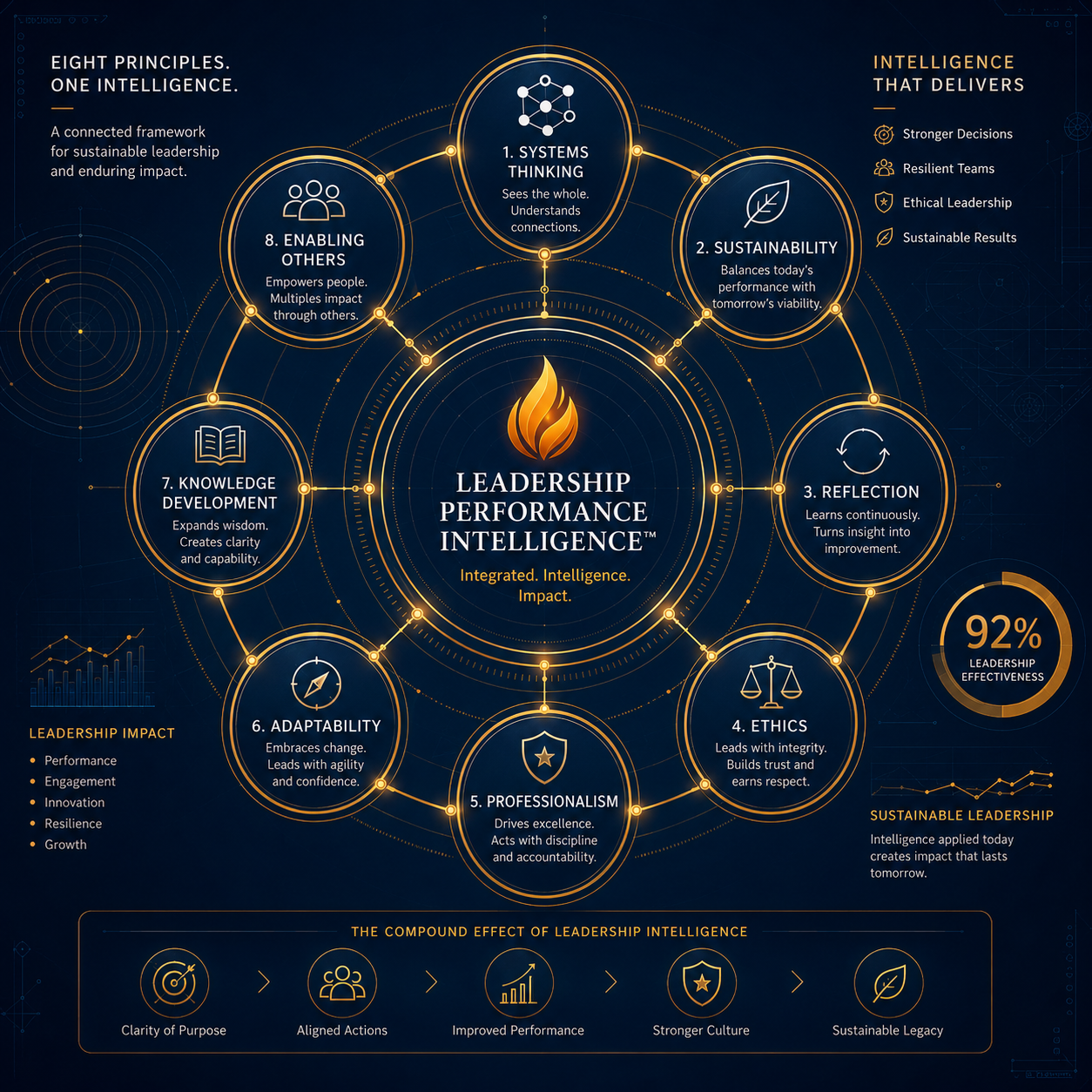
- Eight interconnected principles — from systems thinking to sustainability — shape how leaders think, decide and sustain performance.
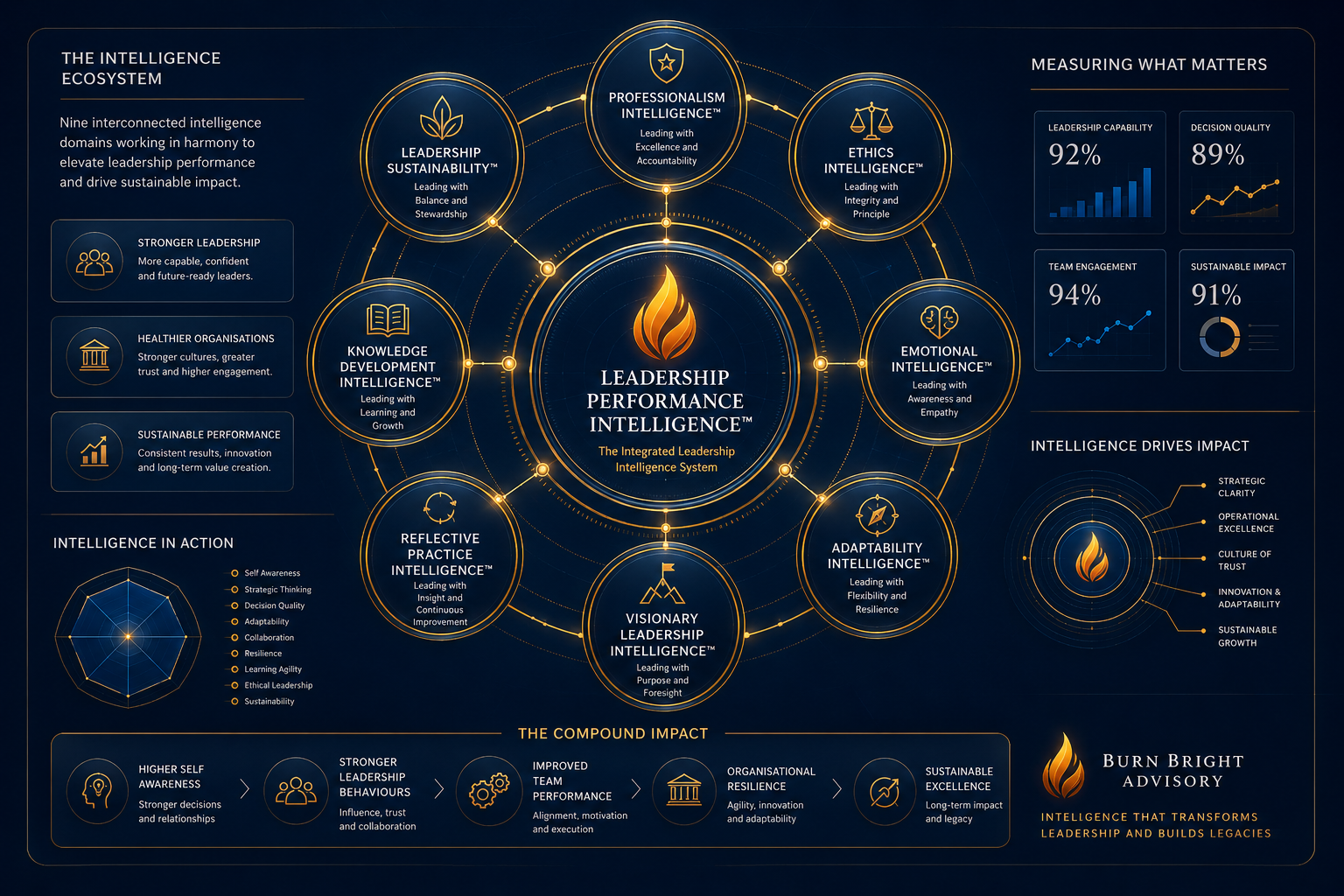
- The Leadership Intelligence Compass™ organises nine complementary intelligence domains into one coherent framework.
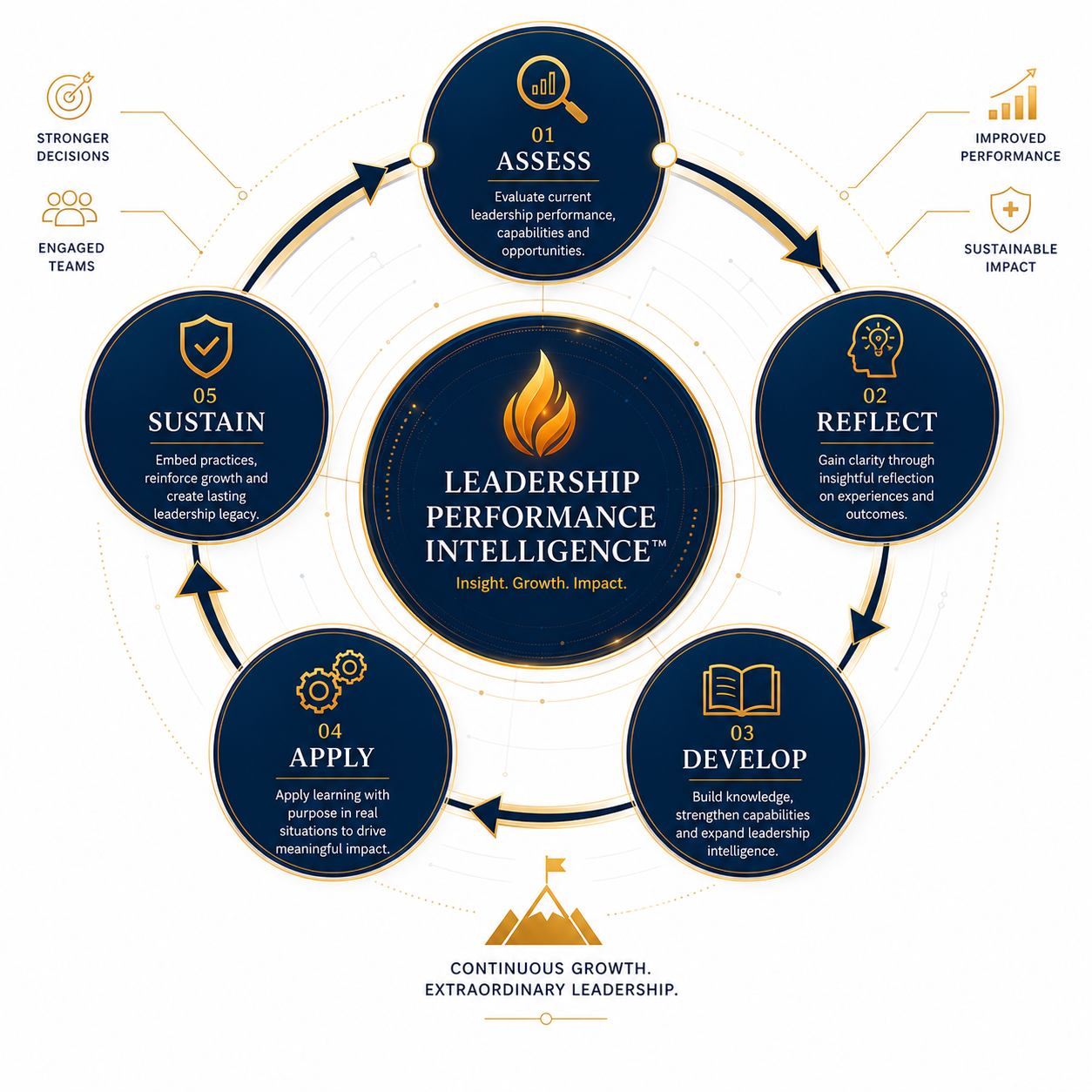
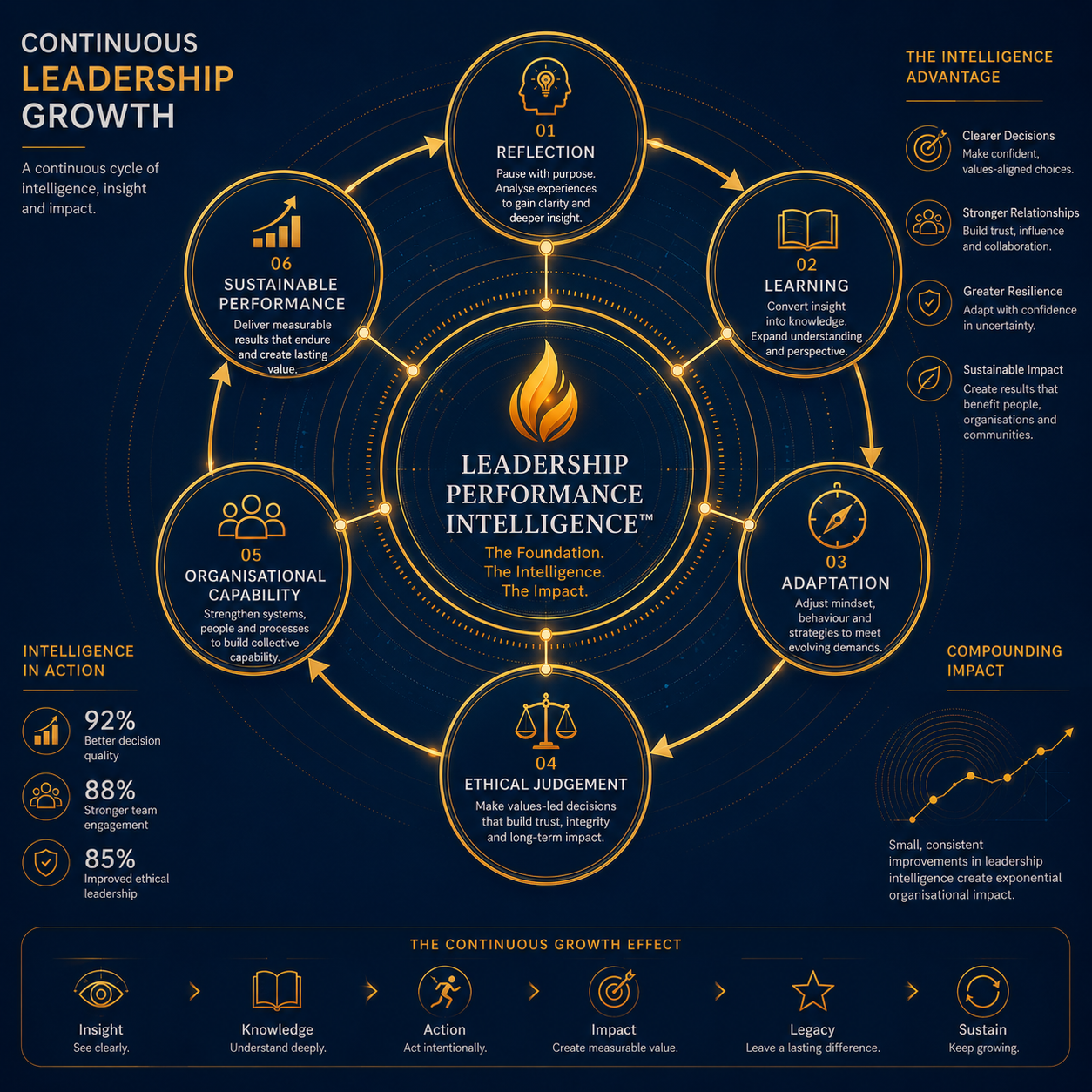
- Development follows a five-stage cycle: Assess, Reflect, Develop, Apply, Sustain.
- Great leadership is measured by how effectively a leader enables others to succeed, not by how indispensable they become.
What Is Leadership Performance Intelligence™? The Foundation for Sustainable Leadership Excellence
Leadership has become significantly more complex than it was even a decade ago. Organisations today operate in an environment defined by continual disruption, rapid technological advancement, shifting workforce expectations, economic uncertainty and increasing public accountability. Leaders are expected to make faster decisions with less certainty, lead increasingly diverse teams, embrace digital transformation, maintain employee wellbeing and deliver sustainable organisational performance — all simultaneously.
Traditional leadership models were not designed for this reality. Many still focus on developing individual competencies in isolation: communication, delegation, emotional intelligence or strategic thinking. While each remains valuable, treating leadership as a checklist of separate skills no longer reflects how effective leadership actually works.
Leadership today functions as an interconnected system. A decision made without ethical consideration affects trust. Poor workload management reduces leadership sustainability. Weak reflective practice limits learning. Low adaptability restricts innovation. Deficiencies in professionalism influence organisational culture. Leadership success is therefore determined less by isolated capability than by how these capabilities interact over time.
This is the foundation of Leadership Performance Intelligence™. Rather than asking whether leaders possess individual skills, it asks a more meaningful question:
Featured Snippet
It is about creating sustainable organisational capability.
It is about building systems rather than relying on individual heroics.
It is about enabling others rather than becoming indispensable.
It is about balancing organisational performance with human sustainability.
Why Leadership Needs a New Operating System
For decades leadership development has largely been competency driven. Organisations identified desirable behaviours, created competency frameworks and delivered training designed to improve those behaviours. While this approach has produced capable managers, it has often overlooked the dynamic relationships between leadership capabilities.
Consider a leader with exceptional strategic thinking but limited emotional intelligence. They may design outstanding organisational strategies while simultaneously damaging engagement through poor interpersonal relationships. Conversely, a highly empathetic leader lacking professionalism or reflective discipline may build excellent relationships but struggle to maintain organisational accountability.
Leadership capability cannot therefore be viewed as independent parts. It functions much more like an ecosystem. Every capability strengthens — or weakens — the others.
Instead of asking whether a leader is emotionally intelligent, ethical, or adaptable in isolation, the framework asks how these capabilities work together, which strengthen organisational sustainability, where leadership blind spots reduce long-term performance, and which capabilities require development first.
Leadership Performance Intelligence™ as an Integrated Framework
Leadership Performance Intelligence™ sits at the centre of the wider Leadership Intelligence Compass™, connecting multiple complementary intelligence domains into a coherent leadership development system. These domains do not compete with one another — they reinforce one another.
Domain Professionalism Intelligence™
Creating credibility, accountability and consistent leadership behaviours.
Domain Ethics Intelligence™
Ensuring decisions align with values, governance and public trust.
Domain Constructivism Intelligence™
Encouraging learning, collaboration and shared knowledge creation.
Domain Adaptability Intelligence™
Responding effectively to change, uncertainty and disruption.
Domain Visionary Leadership Intelligence™
Translating purpose into long-term organisational direction.
Domain Reflective Practice Intelligence™
Learning continuously through disciplined reflection.
Domain Knowledge Development Intelligence™
Transforming information into organisational capability.
Domain Emotional Intelligence™
Strengthening relationships, communication and resilience.
Domain Leadership Sustainability™
Maintaining leadership effectiveness without creating burnout.
The Shift from Leadership Competence to Leadership Intelligence
Competence answers an important question: can someone perform a task? Leadership Intelligence asks a much broader question: can someone continue performing effectively as complexity, uncertainty and responsibility increase?
Many leaders are technically competent. Far fewer consistently demonstrate the judgement, adaptability, ethical reasoning and reflective capability required during prolonged organisational change.
Leadership Performance Intelligence™ therefore focuses not only on capability acquisition but on capability integration. The objective is not merely producing capable leaders — it is developing leaders who continue learning, adapting and improving throughout their careers.
This integrated approach forms the foundation of Burn Bright Advisory’s wider Leadership Development System™, linking diagnostics, planning tools, workshops, sector-specific resources and certification pathways into one coherent framework.
The Eight Principles of Leadership Performance Intelligence™
Leadership Performance Intelligence™ is not built upon isolated leadership traits or personality characteristics. It is founded on a set of interconnected principles that shape how leaders think, decide, behave and sustain performance over time. Rather than functioning independently, each principle strengthens the effectiveness of the others.
Principle 1
Leadership Is a System, Not a Position
A leader’s influence extends far beyond formal responsibilities. Every decision shapes organisational culture, team behaviour, resource allocation and long-term capability. High-performing leaders recognise patterns before they become problems and understand that organisational performance emerges from countless interconnected decisions made consistently over time.
Principle 2
Sustainable Leadership Outperforms Heroic Leadership
Rewarding leaders who appear constantly available and sacrifice their wellbeing often produces exhaustion, dependency and declining organisational capability. Leadership Sustainability™ protects high performance while developing others and strengthening organisational resilience — because burnt-out leaders create burnt-out teams.
Principle 3
Reflection Accelerates Performance
Experience alone does not create expertise — learning from experience does. Reflective Practice Intelligence™ encourages leaders to deliberately examine decisions, stakeholder responses, organisational outcomes and the assumptions that influenced their judgement.
Principle 4
Ethical Judgement Creates Organisational Trust
Employees observe not only what leaders achieve but how they achieve it. Ethics Intelligence™ encompasses fairness, transparency, consistency, integrity and accountability — trust cannot be demanded, it must be earned repeatedly through ethical behaviour.
Principle 5
Professionalism Shapes Organisational Culture
Teams often mirror what leaders consistently demonstrate rather than what leaders formally communicate. Professionalism creates predictability, predictability creates trust, and trust creates high-performing cultures.
Principle 6
Adaptability Enables Organisational Resilience
Change has become a permanent organisational condition. Adaptability Intelligence™ enables leaders to distinguish between principles that remain constant and practices that require change, preventing organisations from becoming either rigid or directionless.
Principle 7
Knowledge Must Become Organisational Capability
Information alone rarely improves performance. Knowledge Development Intelligence™ focuses on transforming information into collective organisational capability by encouraging knowledge sharing and reducing information silos.
Principle 8
Leadership Exists to Enable Others
Leadership success is ultimately measured by what continues after the leader leaves. The strongest leaders are rarely those who solve every problem — they are those who build organisations capable of solving problems without them.
Professionalism strengthens ethical leadership. Reflection improves adaptability. Emotional intelligence enhances professionalism. Knowledge development supports organisational sustainability. Leadership Sustainability™ reinforces every other capability by ensuring leaders retain the capacity to apply them consistently over time.
Leadership Performance Intelligence™ Across Every Sector
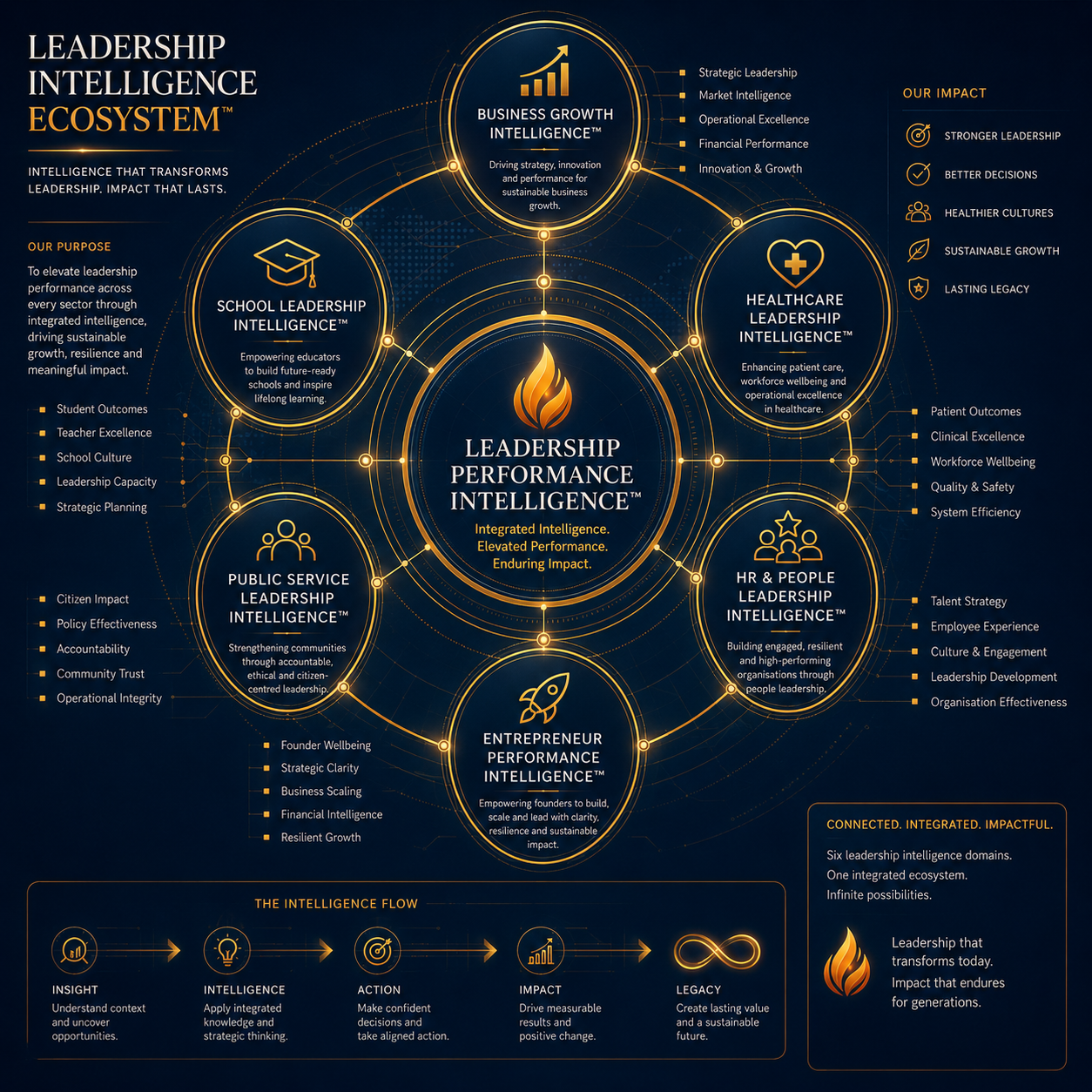
While industries differ in their operational priorities, regulatory requirements and stakeholder expectations, the fundamental challenges of leadership remain remarkably consistent. Leadership Performance Intelligence™ provides a common framework that can be adapted to different organisational contexts while maintaining consistent principles.
Business Growth Intelligence™
Business leaders balance commercial performance with organisational sustainability, aligning strategy with capability, building resilient cultures and leading innovation without creating organisational fatigue.
A growing technology company expands from 40 to 250 employees within three years. Revenue increases significantly, yet employee engagement declines and leadership burnout becomes increasingly common. After adopting Leadership Performance Intelligence™ and evaluating leadership capacity alongside financial outcomes, delegation improves, workload becomes more sustainable, retention strengthens and innovation accelerates — sustainable growth rather than reactive expansion.
School Leadership Intelligence™
School leaders balance curriculum reform, inspection frameworks, safeguarding, staff wellbeing and financial pressures. Leadership Performance Intelligence™ helps distribute leadership capacity rather than relying on heroic headteachers.
A secondary school experiences increasing teacher turnover despite acceptable examination outcomes. Analysis reveals leadership overload and limited reflection opportunities. Redesigning leadership meetings and strengthening Professionalism Intelligence™ improves staff engagement, workload and teacher retention.
Healthcare Leadership Intelligence™
Healthcare leaders balance patient safety, workforce wellbeing, financial sustainability and continuous service improvement. Leadership Sustainability™ becomes particularly important where prolonged stress directly affects decision quality and patient outcomes.
A hospital department experiences increasing clinician burnout alongside growing patient demand. Rather than adding performance targets, senior leaders redistribute leadership responsibilities and introduce routine reflective debriefing — improving staff wellbeing without compromising patient care.
Public Service Leadership Intelligence™
Public service leaders balance political scrutiny, budget constraints and community expectations. Leadership Performance Intelligence™ strengthens ethical governance, transparent decision-making and organisational resilience, making trust a measurable leadership outcome.
HR & People Leadership Intelligence™
HR has evolved from an administrative function into a strategic leadership discipline, using leadership benchmarking, organisational diagnostics and succession planning to build integrated leadership ecosystems.
Entrepreneur Performance Intelligence™
Founders often transition rapidly from technical expertise into organisational leadership without formal development. Leadership Performance Intelligence™ helps entrepreneurs build businesses capable of growing beyond founder dependency.
Leadership Intelligence Compass™ in Practice
The Leadership Intelligence Compass™ acts as the practical application model for Leadership Performance Intelligence™. Rather than treating leadership development as a linear process, it encourages continuous assessment across interconnected intelligence domains, asking which domain represents the greatest strength, which capability is limiting effectiveness, and which should be developed next.
Practical Framework for Developing Leadership Performance Intelligence™
Understanding Leadership Performance Intelligence™ is only the beginning. The real value emerges when leaders intentionally develop it through disciplined practice, structured reflection and continuous capability building — what Burn Bright Advisory calls the Leadership Development System™.
Stage 1 — Assess
Effective development begins with understanding current capability. Assessment creates objective awareness across leadership strengths, decision-making patterns, sustainability and workload management, providing a baseline for meaningful development.
Stage 2 — Reflect
Assessment without reflection produces little improvement. Reflection transforms information into insight, helping leaders distinguish between activity and effectiveness.
Stage 3 — Develop
Development should be intentional. Rather than improving everything simultaneously, leaders focus on high-impact capabilities that strengthen the wider leadership system — because the Compass™ is interconnected, improving one capability frequently strengthens several others.
Stage 4 — Apply
Learning without application creates little organisational value. Every meeting, coaching conversation and decision becomes an opportunity to strengthen capability and transform theory into organisational performance.
Stage 5 — Sustain
Leadership capability must be continually renewed through ongoing reflection, regular benchmarking, workload management and annual reassessment — creating a cycle of continuous improvement rather than isolated development events.
Common Leadership Development Mistakes
Leadership Performance Intelligence™ also helps leaders avoid several common development traps.
Measuring Leadership Performance Intelligence™
Unlike traditional leadership assessments that focus only on behaviours, Leadership Performance Intelligence™ evaluates multiple dimensions simultaneously, including:
- Professionalism Intelligence™ — accountability, consistency, credibility
- Ethics Intelligence™ — trust, governance, decision quality
- Adaptability Intelligence™ — innovation, change readiness, resilience
- Reflective Practice Intelligence™ — learning behaviours, improvement cycles
- Emotional Intelligence™ — relationships, communication, influence
- Leadership Sustainability™ — workload balance, resilience, wellbeing
- Leadership Capacity™ — succession readiness, delegation, team capability
- Organisational Performance — engagement, retention, innovation, productivity
Together these measures provide a far richer understanding of leadership effectiveness than traditional competency models alone.
Leadership as a Continuous Journey
Leadership Performance Intelligence™ rejects the idea that leaders ever “finish” developing. Complexity continues to evolve, organisations continue to change, and technology continues to advance. Leadership therefore remains a lifelong learning process.
The most effective leaders are not those who claim to have all the answers.
They remain curious.
Reflective.
Ethical.
Professional.
Adaptable.
Committed to continuous improvement.
Most importantly, they recognise that developing themselves ultimately enables others to perform at their very best.
Reflection Questions — Personal Leadership
- Which leadership decisions have created the greatest positive impact during the past six months?
- Which decisions would I approach differently today?
- Which Leadership Intelligence™ domain currently represents my greatest strength?
- Which domain most limits my effectiveness?
- How consistently do my behaviours align with my stated leadership values?
Reflection Questions — Leadership Sustainability™
- Am I leading at a pace that is sustainable over the next five years?
- What aspects of my workload create unnecessary pressure?
- Have I unintentionally become a bottleneck within my organisation?
- Where could delegation strengthen both performance and leadership capacity?
- How effectively do I model healthy leadership behaviours for others?
Reflection Questions — Organisational Capability
- Does my team rely on me too heavily?
- Am I developing future leaders or simply solving today’s problems?
- Which organisational systems need strengthening rather than additional effort?
- Where are knowledge silos limiting organisational performance?
- How effectively does our culture support learning and innovation?
Action Steps
Reading about leadership creates awareness. Consistent action creates transformation.
Week One
Complete a structured leadership self-assessment. Identify your three strongest Leadership Intelligence™ domains and two highest-priority development areas. Begin a weekly leadership reflection journal.
Month One
Introduce structured reflection after significant leadership decisions. Review leadership workload and delegation practices. Assess organisational capability rather than individual performance alone.
Quarter One
Complete the Leadership Intelligence Assessment™. Benchmark leadership capability across your organisation. Develop an individual Leadership Development Plan aligned with the Leadership Intelligence Compass™.
Long-Term
Integrate Leadership Performance Intelligence™ into recruitment, onboarding, succession planning, coaching, performance reviews and organisational strategy — leadership becomes stronger when embedded into systems rather than treated as an occasional initiative.
What is Leadership Performance Intelligence™?
Leadership Performance Intelligence™ is Burn Bright Advisory’s integrated framework for developing sustainable leadership capability. It combines multiple intelligence domains — including professionalism, ethics, emotional intelligence, adaptability and reflective practice — to improve long-term organisational performance.
How is Leadership Performance Intelligence™ different from traditional leadership models?
Traditional models often focus on individual competencies in isolation. Leadership Performance Intelligence™ views leadership as an interconnected system where capabilities influence one another and collectively determine organisational outcomes.
Who is Leadership Performance Intelligence™ designed for?
The framework is applicable across sectors including business, education, healthcare, public service, HR and entrepreneurship, and supports executives, senior leaders, middle managers and emerging leaders alike.
Why does Leadership Sustainability™ matter?
Leadership Sustainability™ recognises that long-term organisational success depends on leaders maintaining the capacity to make sound decisions, develop others and perform effectively without chronic overload or burnout.
Can Leadership Performance Intelligence™ be measured?
Yes. Through structured diagnostics, benchmarking and continuous assessment, organisations can evaluate leadership capability across the Leadership Intelligence Compass™ and identify opportunities for targeted development.
How does the Leadership Intelligence Compass™ support development?
It provides a practical framework for assessing interconnected leadership capabilities, helping leaders understand strengths, identify blind spots and prioritise development that has the greatest organisational impact.
How can organisations implement Leadership Performance Intelligence™?
Implementation typically begins with assessment, followed by structured reflection, targeted development, practical application and continuous review, supported through diagnostics, planning tools, workshops and certification pathways.
Conclusion
Leadership is entering a new era. Increasing organisational complexity, rapid technological change and rising stakeholder expectations demand more than technical expertise or isolated leadership competencies. They require leaders capable of integrating knowledge, judgement, ethics, adaptability, reflection and sustainability into a coherent approach to leadership.
Leadership Performance Intelligence™ provides that integrated framework. Rather than viewing leadership as a collection of disconnected skills, it recognises leadership as an evolving system of capabilities that interact to influence organisational performance, culture and long-term resilience.
Organisations that invest in Leadership Performance Intelligence™ move beyond short-term performance improvements. They build leadership capacity, strengthen organisational learning, improve decision quality and create cultures capable of adapting to continual change.
As leadership challenges continue to evolve, the organisations that thrive will not simply have better leaders. They will have better leadership systems.
Where Does Your Leadership Intelligence Stand Today?
Benchmark your leadership capability across the Leadership Intelligence Compass™ with the free Leadership Burnout Self-Assessment.
Free Leadership Intelligence
Get Weekly Leadership Insights
Join thousands of leaders receiving practical strategies on burnout prevention, workload design, and sustainable performance every week.