Quick Answer
Key Takeaways
- Capacity planning is about designing sustainable leadership, not managing impossible workloads.
- Burnout often occurs because responsibility expands faster than organisational capacity.
- Protecting leadership capacity improves decision-making, innovation and team performance.
- Sustainable organisations manage leadership workload as carefully as financial resources.
- Better systems consistently outperform greater personal effort.
Capacity Planning for Leaders: Prevent Burnout Before It Starts
Introduction
Capacity planning for leaders has become one of the most important leadership disciplines in modern organisations. Yet very few organisations actively measure whether the workload placed on managers is actually achievable.
Instead, successful leaders are often rewarded with additional projects, larger teams and greater responsibility until their role becomes structurally unsustainable. What begins as recognition gradually becomes overload.
This is one of the central misconceptions surrounding leadership burnout. Organisations frequently assume burnout is caused by resilience, mindset or poor time management. In reality, the evidence increasingly points towards something far more fundamental.
Burnout is usually a structural problem.
When leadership demand continually exceeds leadership capacity, even highly capable people eventually reach a breaking point. More hours temporarily delay the problem but never solve it.
The Burn Bright framework treats burnout as a systems failure rather than a personal failure. Sustainable leadership starts by redesigning workload architecture so leaders have the capacity to think strategically instead of constantly reacting. This philosophy sits at the centre of the Burn Bright methodology and the Burn Bright Not Out framework.
In this guide you’ll discover why capacity planning matters, the hidden causes of leadership overload, and practical frameworks that help organisations build sustainable performance instead of rewarding unsustainable effort.
Understanding the Leadership Capacity Gap
The framework below illustrates why so many leaders feel permanently behind. As responsibilities expand, available capacity rarely grows at the same rate.
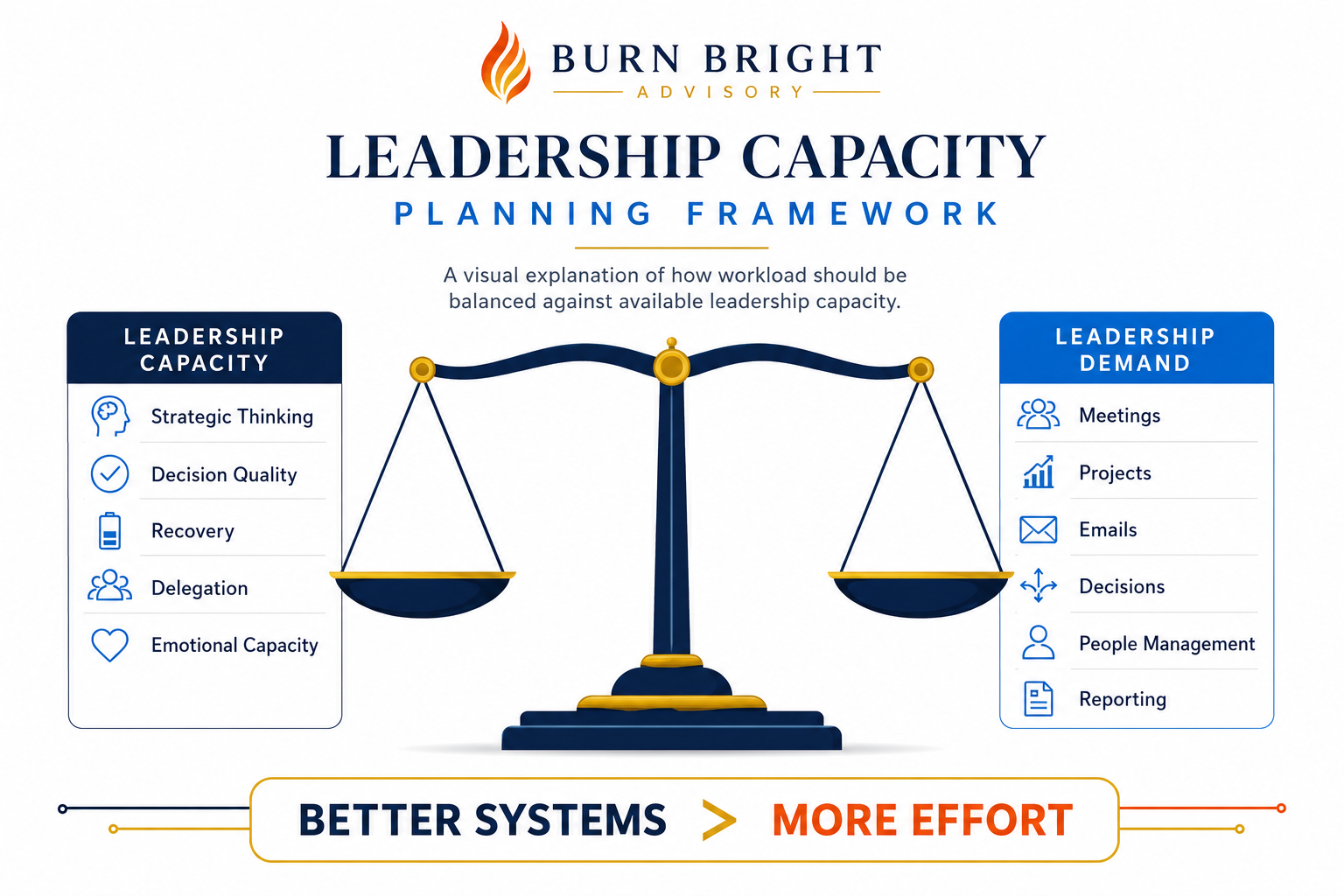
The illustration demonstrates that leadership effectiveness declines once demand consistently exceeds available capacity. The solution is not working harder—it is redesigning the system.
Featured Snippet
What Is Capacity Planning for Leaders?
Most organisations understand capacity planning when it comes to production, manufacturing or project delivery.
They forecast demand.
They estimate available resources.
They identify constraints.
They adjust plans before problems appear.
Curiously, very few organisations apply exactly the same thinking to leadership.
Instead, managers become the organisation’s overflow mechanism. Whenever priorities increase, leaders simply absorb more work. That approach may succeed temporarily, but eventually every leader reaches a natural limit.
Gallup research consistently reports that managers experience significantly higher levels of stress and burnout than non-managers, with manager wellbeing directly influencing employee engagement and organisational performance. Likewise, the World Health Organization recognises burnout as an occupational phenomenon resulting from chronic workplace stress that has not been successfully managed.
Neither of these findings points towards individual weakness.
They point towards organisational design.
Leadership capacity consists of far more than available hours in the diary. It includes:
- Mental capacity for complex decisions
- Emotional capacity for leading people
- Strategic capacity for planning
- Physical energy
- Recovery time
- Delegation authority
- Organisational support
When any one of these becomes constrained, leadership performance declines. This explains why two leaders with identical calendars can experience completely different levels of effectiveness.
One has capacity.
The other has constant overload.
Within the Burn Bright methodology, five structural causes repeatedly reduce leadership capacity:
- Scope creep
- Meeting culture
- Communication chaos
- Decision overload
- Perfectionism culture
The goal of capacity planning is therefore not to create busier leaders. It is to create leaders who have sufficient capacity to make better decisions, develop people and improve systems. That shift changes everything.
Why Do Leaders Run Out of Capacity?
Most leadership roles don’t become overwhelming overnight. They grow gradually.
A new project here.
Another committee there.
Extra reporting requirements.
A larger team.
More meetings.
Greater accountability.
Very little is ever removed.
Researchers often describe this as scope creep, but in leadership it becomes something even more damaging—role expansion without structural redesign. Every additional responsibility appears reasonable when viewed individually. Collectively, they become impossible.
The Burn Bright framework identifies scope creep as the first and most significant driver of leadership burnout because organisations continually add expectations without redesigning workload architecture.
Consider a typical senior manager. Five years ago they may have supervised a local team. Today they may also be expected to:
- Lead hybrid teams
- Manage wellbeing conversations
- Analyse dashboards
- Respond instantly across multiple communication platforms
- Drive organisational change
- Mentor future leaders
- Navigate AI adoption
- Report additional compliance data
None of these responsibilities replaced existing work. They were added to it.
Technology has accelerated this problem. Rather than reducing workload, digital communication has multiplied interruptions and fragmented attention. Leaders now manage dozens of simultaneous conversations while attempting to complete strategic work. This pattern is explored extensively throughout the Burn Bright research and reflects the wider structural shift affecting leaders across sectors.
Eventually leaders reach what could be called capacity bankruptcy.
Everything feels urgent.
Nothing receives sufficient attention.
Decision quality falls.
Recovery disappears.
Burnout follows.
Capacity planning interrupts this cycle before it begins. Instead of asking “Can this leader do more?” it asks a better question: “Does the system have enough leadership capacity to achieve what we’re asking?”
That single question changes the conversation from individual resilience to organisational responsibility.
How Can Leaders Build an Effective Capacity Planning Framework?
Most organisations measure financial performance with extraordinary precision.
They forecast revenue.
Monitor expenditure.
Track productivity.
Review operational risk.
Yet very few measure one of their most valuable organisational assets—leadership capacity. That omission creates predictable consequences. When leadership capacity is unmanaged, organisations unknowingly create bottlenecks, slower decision-making, increased employee turnover and eventually leadership burnout.
The Burn Bright framework approaches capacity planning through structural redesign rather than personal productivity. Instead of teaching leaders to fit more work into the same number of hours, it redesigns how work enters, flows through and exits the organisation.
The Burn Bright Structural Transformation Framework identifies four areas that every organisation should evaluate:
Framework 1 Workload Architecture
Every leadership responsibility should have a clear purpose. Ask: does this activity create value? Can it be delegated? Can it be automated? Can it be removed completely?
Many organisations discover that 20–30% of leadership workload exists simply because “it has always been done.” Removing unnecessary work creates capacity faster than improving efficiency.
Framework 2 Decision Authority
Decision overload quietly drains leadership energy. Every unnecessary approval consumes cognitive resources that should be reserved for strategic judgement.
Instead of requiring senior leaders to approve routine operational decisions, organisations should clarify decision ownership using frameworks such as RACI. When decision rights are clearly defined:
- Teams respond faster
- Leaders experience less decision fatigue
- Accountability improves
Framework 3 Recovery Rhythms
Recovery should never be viewed as a reward. It is part of organisational infrastructure. Elite athletes schedule recovery because continuous performance is impossible. Leadership should be treated no differently. Recovery includes:
- Protected thinking time
- No-meeting periods
- Digital boundaries
- Annual leave that is genuinely uninterrupted
- Workload reduction following sustained periods of crisis
Without recovery, capacity continually declines regardless of competence.
Framework 4 Management Frameworks
Frameworks reduce cognitive effort. When leaders repeatedly solve identical problems from scratch, they waste valuable mental capacity. Standard operating frameworks for delegation, prioritisation, communication and decision-making allow leaders to preserve energy for genuinely complex issues.
This structural approach shifts leadership away from firefighting and towards sustainable performance.
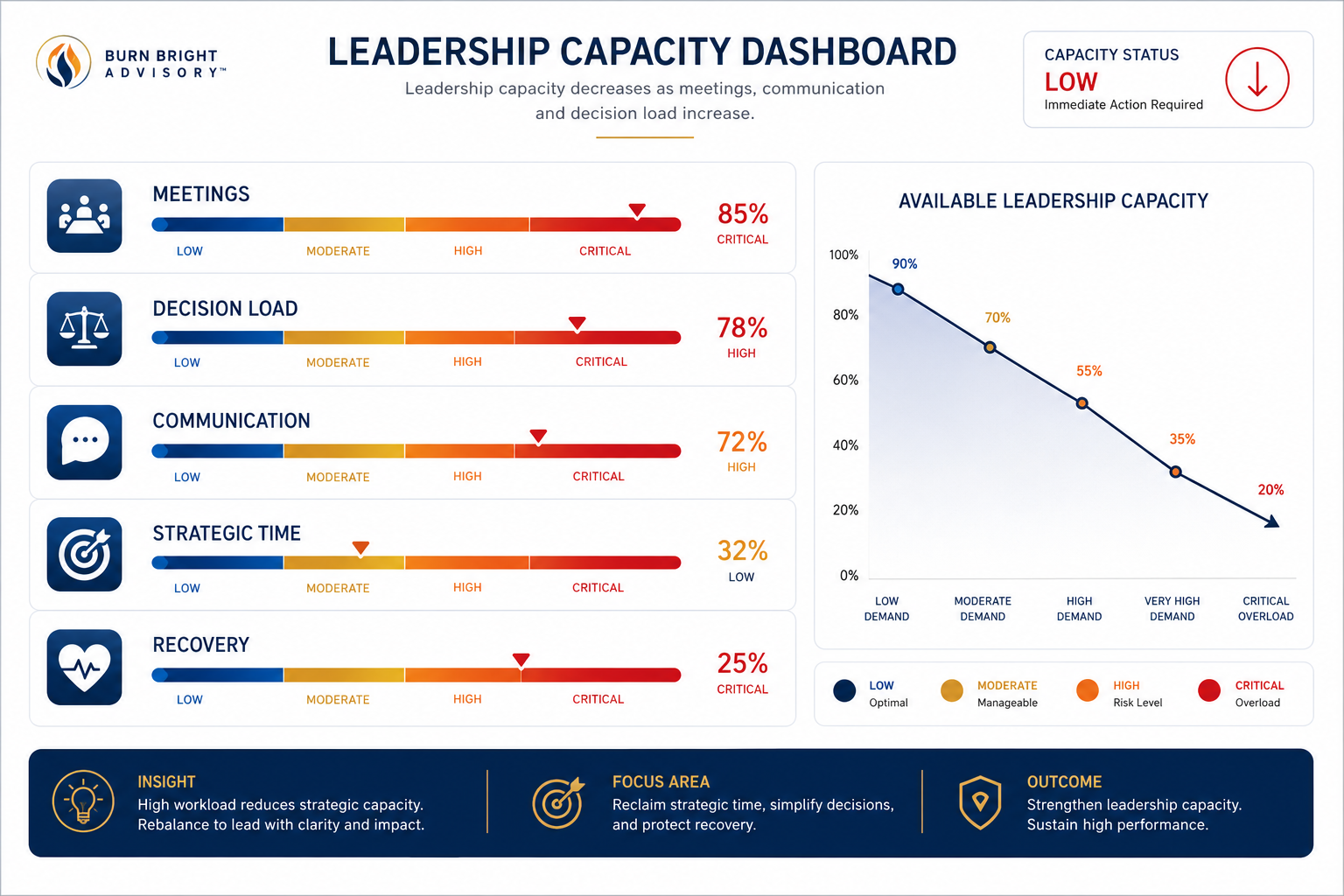
Creating Visibility Through Capacity Dashboards
Most organisations have financial dashboards. Sales dashboards. Risk dashboards. Very few maintain leadership capacity dashboards. Yet capacity is measurable.
A simple leadership dashboard might include:
| Capacity Indicator | Healthy | Warning | Critical |
|---|---|---|---|
| Weekly meeting hours | <15 | 15–22 | >22 |
| Strategic thinking time | >8 hrs | 4–8 hrs | <4 hrs |
| Decision backlog | Low | Moderate | High |
| Delegation rate | High | Moderate | Low |
| Annual leave utilisation | Regular | Delayed | Cancelled |
These indicators provide an early warning system before burnout becomes visible. Like any organisational metric, problems become easier to solve when they are measured early.
Data Supports Structural Planning
Research consistently demonstrates that organisations investing in leadership sustainability outperform those relying on individual resilience alone.
Gallup has found that managers account for approximately 70% of the variation in employee engagement, making leadership capacity one of the strongest predictors of organisational performance.
McKinsey has similarly reported that organisations with healthier leadership practices experience higher productivity, stronger retention and faster organisational change.
Burn Bright’s own structural framework highlights the financial implications of ignoring leadership capacity. Replacing a middle manager typically costs around £75,000, while replacing senior leaders can exceed £500,000 once recruitment, onboarding, lost productivity and organisational disruption are included. Leadership transitions also produce an estimated 34% productivity loss, while structural redesign initiatives have demonstrated returns exceeding 250% ROI in some organisational settings.
Building Capacity Before Crisis
The most effective organisations never wait until burnout appears. Instead, they ask better questions every quarter:
- Has leadership workload increased?
- Have responsibilities been removed as new ones were added?
- Are managers making too many operational decisions?
- Are meetings replacing strategic thinking?
- Is recovery built into organisational design?
These questions shift organisations from reacting to burnout towards preventing it. That is the difference between resilient organisations and exhausted ones.
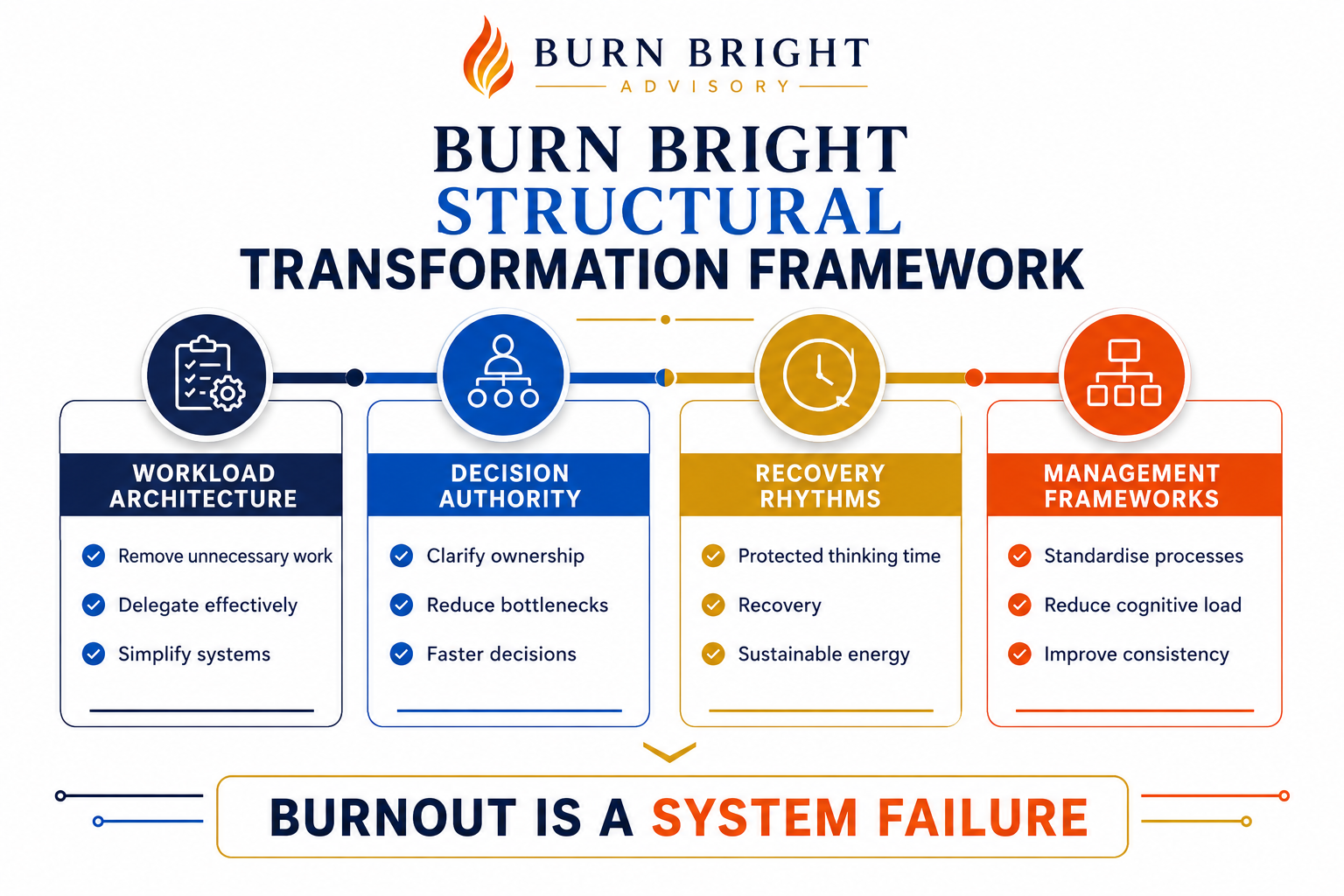
Notice that every intervention focuses on organisational design rather than asking leaders to become more resilient. Sustainable organisations build capacity into the system instead of expecting individuals to compensate for structural weaknesses. This reflects the core Burn Bright philosophy that burnout is a system failure, not a personal failure.
What Mistakes Destroy Leadership Capacity?
Many organisations genuinely care about employee wellbeing. Unfortunately, they often address the wrong problem. The most common mistakes include:
Capacity Planning vs Traditional Leadership
| Traditional Leadership | Sustainable Capacity Planning |
|---|---|
| Leaders absorb more work | Workload is redesigned |
| Success measured by hours | Success measured by outcomes |
| More meetings solve problems | Better decisions solve problems |
| Individual resilience is expected | Organisational systems provide support |
| Recovery is optional | Recovery is scheduled |
| Burnout is viewed personally | Burnout is recognised as structural |
What is capacity planning for leaders?
Capacity planning for leaders is the process of aligning responsibilities, authority, time and organisational resources so leaders can perform sustainably without chronic overload or burnout.
Why is capacity planning important?
It prevents leadership overload, improves decision quality, increases employee engagement and reduces costly turnover by ensuring leadership demand matches available organisational capacity.
How does capacity planning reduce burnout?
By identifying workload imbalances before they become crises. Instead of expecting leaders to continually work longer hours, organisations redesign responsibilities, meetings and decision-making structures.
What causes leaders to exceed capacity?
The most common causes include scope creep, excessive meetings, communication overload, decision fatigue and perfectionism-driven organisational cultures. These structural pressures gradually consume available leadership capacity.
Is capacity planning only for senior executives?
No. Every leadership level benefits from capacity planning. Team leaders, middle managers and executives all require realistic workloads if they are to make good decisions and support high-performing teams.
Conclusion
Capacity planning for leaders is no longer optional. As organisations become more complex, leadership roles continue to expand faster than the systems designed to support them. That mismatch explains why burnout has become increasingly common across every sector.
The answer is not asking leaders to become tougher.
It is designing organisations that are smarter.
When workload architecture, decision authority, recovery rhythms and management frameworks are intentionally designed, leaders gain the space to think strategically, develop people and make better decisions. That is the central philosophy behind Burn Bright.
Ready to Understand Your Own Leadership Capacity?
Take the Leadership Burnout Self-Assessment to identify the structural factors affecting your workload and discover practical actions for creating sustainable leadership performance.
Free Leadership Intelligence
Get Weekly Leadership Insights
Join thousands of leaders receiving practical strategies on burnout prevention, workload design, and sustainable performance every week.