Quick Answer
Key Takeaways
- Traditional leadership models focused on style and personality are no longer sufficient for the pace of modern change.
- Leadership Performance Intelligence™ integrates professional judgement, ethics, adaptability, emotional intelligence, reflective practice, knowledge development and Leadership Sustainability™ into a single system.
- The Leadership Intelligence Compass™ organises leadership capability across nine interconnected domains.
- Leadership capacity is an organisational asset, not simply an individual trait, and it can be intentionally developed.
- Sustainable leadership is a strategic capability—not a wellbeing add-on—because burnt-out judgement is unreliable judgement.
Leadership Foundations: Why Leadership Performance Intelligence™ Is the Future of Effective Leadership
Leadership has never been more important—or more difficult.
Across business, healthcare, education, public services and the third sector, leaders are operating in environments defined by accelerating change, economic uncertainty, workforce transformation, digital disruption and increasing public accountability. The expectations placed upon leaders continue to expand while the time, resources and certainty available to meet those expectations continue to diminish.
For decades, leadership development has largely centred on behaviours, personality traits, communication styles and competency frameworks. While these approaches have contributed valuable insights, many organisations continue to experience declining engagement, increasing leadership burnout, inconsistent decision-making and fragile organisational cultures.
That raises an important question. If leadership development has become a global industry worth billions, why do so many organisations continue to struggle with leadership effectiveness?
The answer may be that we have been developing leaders in fragments rather than as integrated systems.
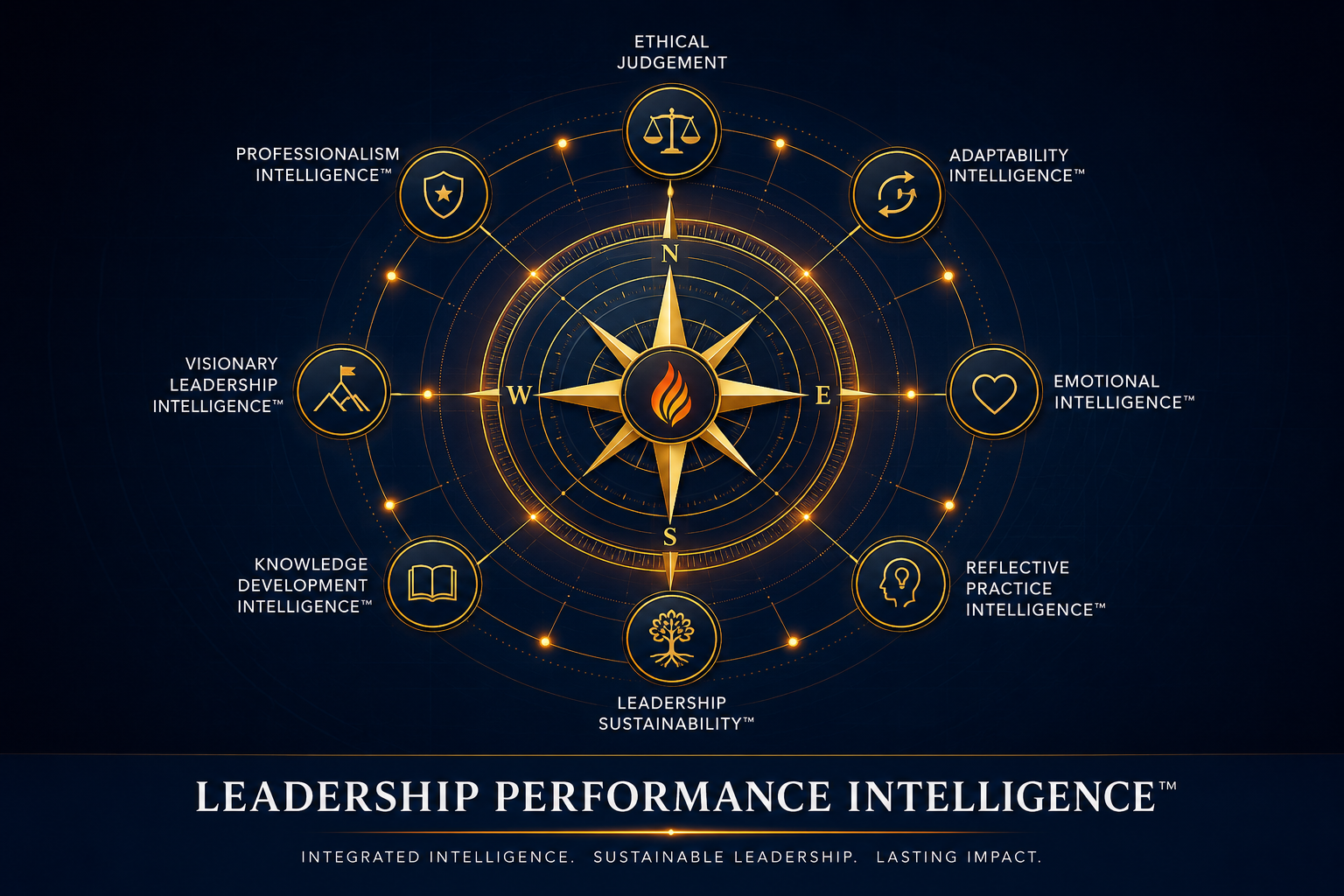
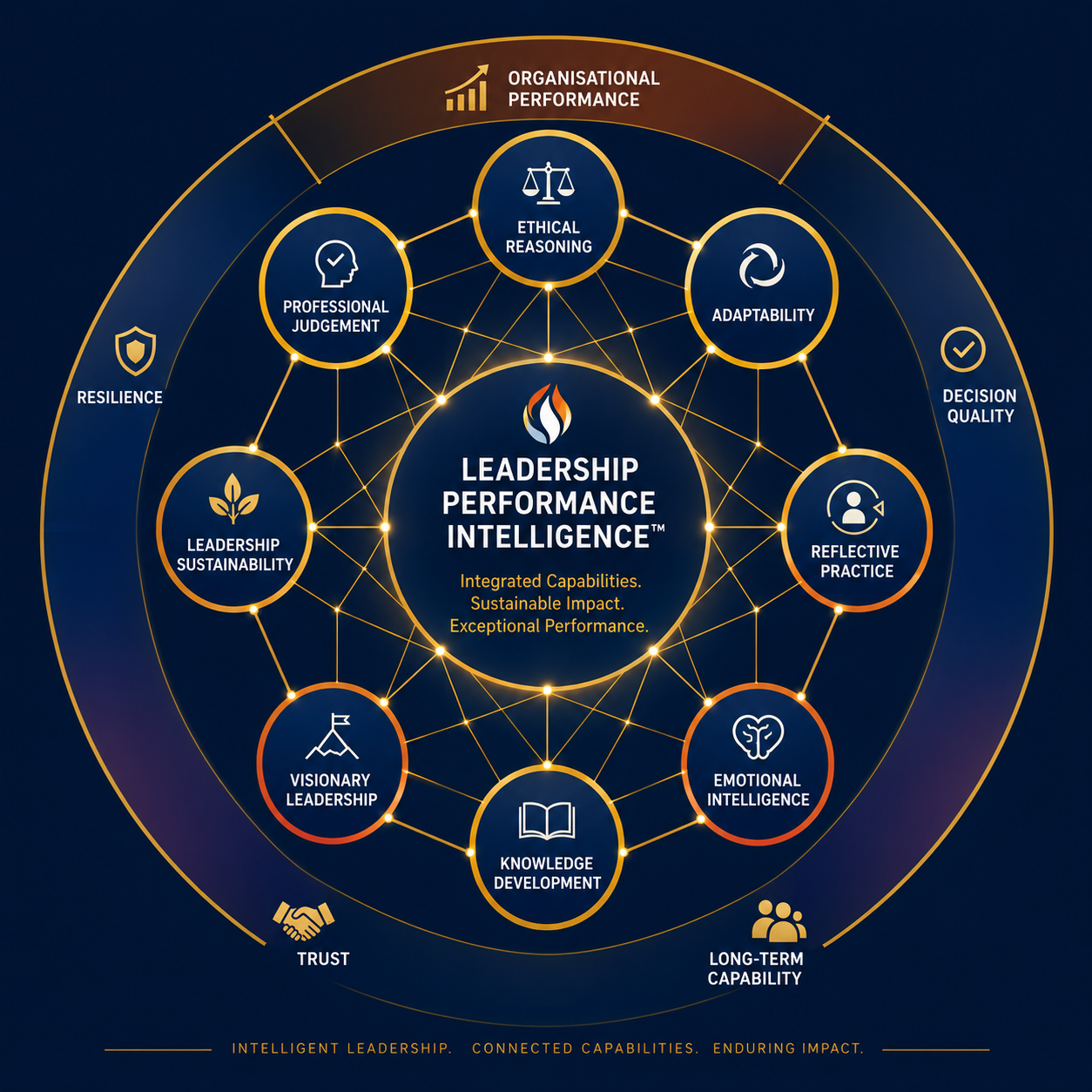
At Burn Bright Advisory™, we believe effective leadership cannot be understood through isolated competencies alone. Sustainable leadership emerges from the interaction of professional judgement, ethical reasoning, adaptability, emotional intelligence, reflective practice, knowledge development, strategic thinking and personal sustainability. This integrated capability is what we define as Leadership Performance Intelligence™.
Rather than asking leaders to adopt another leadership style, Leadership Performance Intelligence™ equips them to think more effectively, make better decisions, develop stronger organisations and sustain high performance throughout increasingly demanding careers.
Leadership Is No Longer About Position
Leadership has traditionally been associated with authority. Managers supervised. Executives directed. Principals instructed. Clinical directors controlled. Political leaders commanded.
Today, those assumptions are rapidly disappearing. Knowledge has become decentralised. Technology has reduced information asymmetry. Employees expect collaboration rather than command. Stakeholders demand transparency rather than certainty. Innovation increasingly depends upon diverse perspectives rather than individual expertise.
Leadership has therefore shifted from controlling work to enabling performance. The modern leader is expected to:
- Navigate ambiguity
- Manage competing priorities
- Build trust
- Support wellbeing
- Encourage innovation
- Make ethical decisions
- Develop future leaders
- Create psychologically safe environments
- Sustain organisational performance during continuous change
This expanded role requires considerably more than technical competence or positional authority. It requires leadership intelligence.
Why Traditional Leadership Models Are Becoming Insufficient
Leadership literature has historically focused on identifying the “best” leadership style. Organisations have adopted transformational leadership, servant leadership, authentic leadership, distributed leadership, adaptive leadership, instructional leadership and numerous other frameworks. Each contributes valuable perspectives, yet organisations frequently experience inconsistent results because leadership effectiveness is rarely determined by one style alone.
A leader may demonstrate exceptional communication while struggling with ethical judgement. Another may excel at strategic planning but fail to build trust. Some leaders inspire vision but lack reflective practice. Others maintain operational excellence while gradually exhausting themselves and their teams.
Just as elite athletes develop strength, endurance, recovery, nutrition and technical skills simultaneously, leaders require multiple interconnected capabilities to perform consistently. Leadership Performance Intelligence™ recognises leadership as an integrated system rather than a collection of independent competencies.
Introducing Leadership Performance Intelligence™
Leadership Performance Intelligence™ is Burn Bright Advisory™’s evidence-informed framework for sustainable leadership development. It represents the integration of cognitive, behavioural, emotional, ethical and strategic capabilities that enable leaders to perform effectively under pressure while strengthening organisational performance over time.
Rather than concentrating on individual leadership behaviours, Leadership Performance Intelligence™ focuses on developing the underlying capabilities that consistently influence decision quality. These include:
- Professional judgement
- Ethical reasoning
- Reflective thinking
- Adaptability
- Emotional intelligence
- Knowledge development
- Visionary leadership
- Leadership Sustainability™
Featured Snippet
Together, these capabilities create leaders who remain effective not only during periods of stability but also throughout complexity, uncertainty and organisational transformation. Leadership therefore becomes less about reacting to events and more about building enduring capability.
Leadership Intelligence Rather Than Leadership Style
One of the most significant shifts within Leadership Performance Intelligence™ is moving attention away from leadership styles and towards leadership intelligence.
Leadership style describes how someone behaves.
Leadership intelligence explains why they consistently make effective decisions.
Two leaders may communicate similarly while producing dramatically different organisational outcomes. The difference often lies beneath observable behaviour. Leadership intelligence influences:
- How information is interpreted
- How evidence is evaluated
- How competing priorities are balanced
- How ethical dilemmas are resolved
- How uncertainty is managed
- How relationships are developed
- How organisational learning is encouraged
Developing leadership intelligence therefore creates far greater long-term adaptability than attempting to master any single behavioural model. As organisations become increasingly complex, adaptable thinking becomes more valuable than fixed leadership approaches.
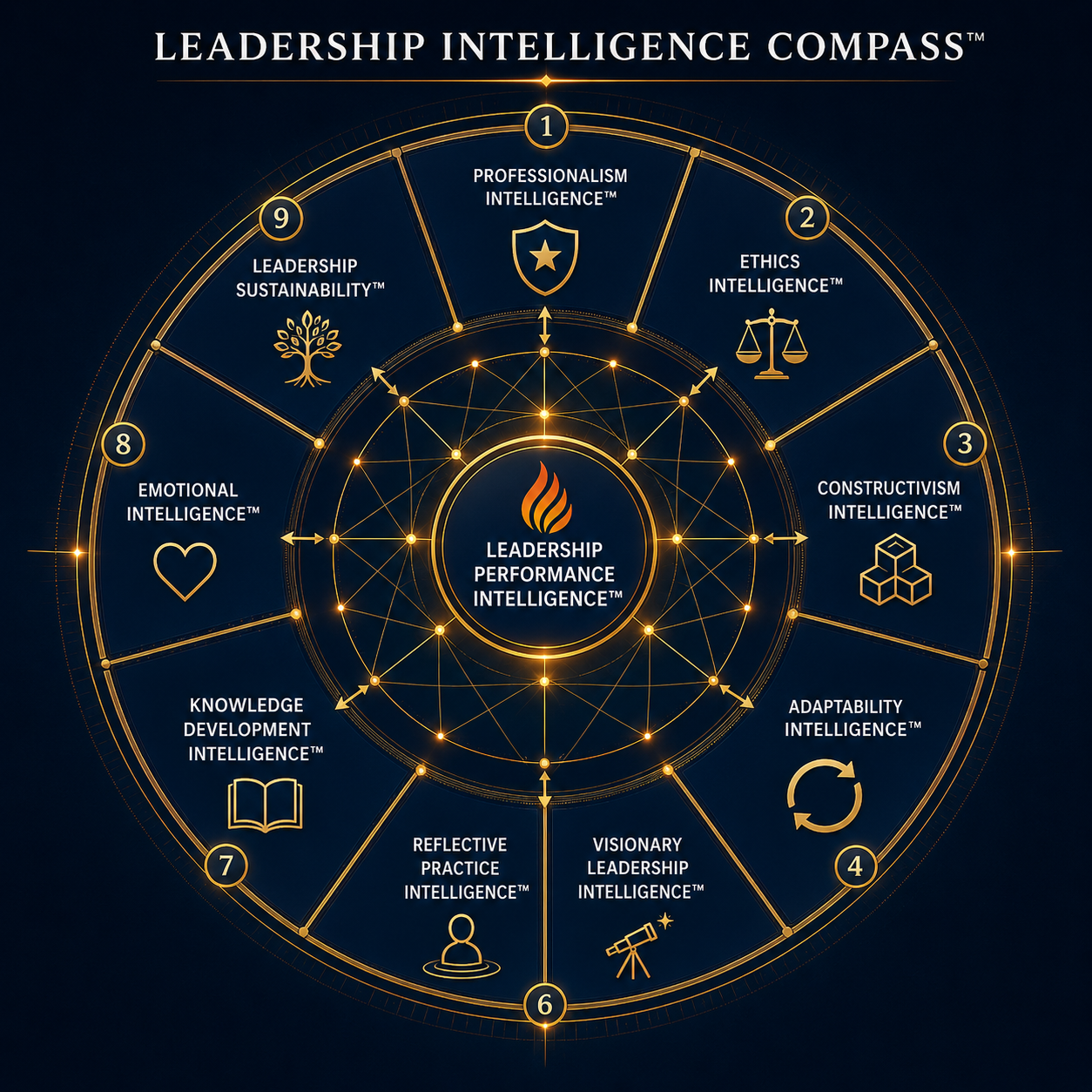
The Leadership Intelligence Compass™
Leadership Performance Intelligence™ is organised through the Leadership Intelligence Compass™, Burn Bright Advisory™’s integrated model of leadership capability. Rather than presenting isolated competencies, the Compass demonstrates how multiple forms of intelligence interact continuously during leadership practice. These domains should not be viewed independently—each strengthens the effectiveness of every other domain.
Compass Domain
Professionalism Intelligence™
Maintaining credibility, accountability and professional standards.
Compass Domain
Ethics Intelligence™
Making principled decisions under pressure.
Compass Domain
Constructivism Intelligence™
Creating learning cultures where knowledge is continuously developed.
Compass Domain
Adaptability Intelligence™
Responding effectively to uncertainty and change.
Compass Domain
Visionary Leadership Intelligence™
Translating long-term purpose into practical organisational direction.
Compass Domain
Reflective Practice Intelligence™
Learning systematically from experience.
Compass Domain
Knowledge Development Intelligence™
Transforming information into organisational capability.
Compass Domain
Emotional Intelligence™
Understanding emotions, relationships and human behaviour.
Compass Domain
Leadership Sustainability™
Maintaining personal and organisational performance over time.
The result is an integrated leadership system capable of supporting sustainable organisational performance.
Why Sustainable Leadership Matters More Than Ever
Leadership has traditionally rewarded endurance—the leader who worked the longest hours, the executive who never switched off, the principal who solved every problem, the healthcare manager who absorbed every crisis. These behaviours were often celebrated as evidence of commitment and resilience.
Yet modern research increasingly suggests the opposite. Leaders who consistently operate beyond sustainable capacity experience declining judgement, reduced creativity, poorer decision-making, emotional fatigue and increased risk of burnout. The consequences extend far beyond the individual leader: teams become reactive rather than proactive, innovation slows, trust declines and organisational performance begins to deteriorate.
Leadership Performance Intelligence™ therefore positions Leadership Sustainability™ as a strategic capability rather than a wellbeing initiative. Leadership sustainability asks a different question:
Sustainable leaders deliberately manage cognitive workload, emotional energy, reflective time, professional learning, organisational boundaries, recovery and long-term capability development. Rather than measuring success solely by immediate results, sustainable leadership evaluates whether today’s decisions strengthen tomorrow’s organisational capacity.
High performance should never depend upon continual personal sacrifice. Instead, exceptional leadership creates systems that continue performing because people remain capable of performing.
Leadership Capacity™ Is an Organisational Asset
Many organisations view leadership as an individual capability. Leadership Performance Intelligence™ views leadership capacity as an organisational asset that exists across executive teams, middle management, emerging leaders, project leaders and informal influencers.
When organisations neglect leadership development, this collective capacity gradually declines. Symptoms become increasingly visible: slower decision-making, reactive leadership, inconsistent communication, higher staff turnover, reduced innovation, increased workplace conflict, declining trust and leadership succession challenges.
Conversely, organisations that intentionally invest in leadership intelligence gradually increase organisational capability. Leadership becomes distributed rather than concentrated, knowledge is shared, decision-making improves, future leaders emerge naturally, and organisational resilience strengthens. Leadership Performance Intelligence™ therefore shifts the focus from developing individual leaders to building leadership ecosystems.
Reflection as a Leadership Capability
One of the most overlooked dimensions of leadership is reflection. Modern leaders are exceptionally busy—meetings replace thinking, email replaces learning, urgency replaces perspective. As workload increases, reflective practice is often the first activity to disappear.
Ironically, reflection is precisely what enables leaders to improve judgement. Reflective Practice Intelligence™ encourages leaders to ask why a decision succeeded, what assumptions influenced their thinking, what evidence they ignored, what patterns are emerging, and what they would do differently.
Reflection transforms experience into knowledge.
Without reflection, experience simply becomes repetition.
The most experienced leader is not necessarily the most effective. The most reflective leader often is.
Ethical Intelligence Builds Organisational Trust
Every leadership decision carries ethical consequences. Sometimes these consequences are obvious. Most often they are subtle—should performance be prioritised over wellbeing, should difficult information be communicated immediately or gradually, should short-term financial gains outweigh long-term organisational culture? These decisions rarely have perfect answers.
Leadership Performance Intelligence™ recognises that ethical leadership is not simply compliance. It is disciplined judgement under uncertainty. Ethics Intelligence™ enables leaders to evaluate fairness, transparency, accountability, responsibility, integrity and long-term consequences.
Organisations with strong ethical intelligence frequently experience greater employee trust, stronger stakeholder confidence, improved reputation, better collaboration, higher engagement and stronger decision quality. Ethics therefore becomes a strategic advantage rather than merely a governance requirement.
Adaptability Has Become a Core Leadership Capability
The pace of organisational change continues to accelerate—artificial intelligence, digital transformation, hybrid working, economic uncertainty, changing workforce expectations, global competition. The challenge is no longer predicting change. The challenge is building leaders who can adapt continuously.
Adaptability Intelligence™ allows leaders to recognise changing environments quickly, challenge outdated assumptions, respond without panic, maintain strategic direction, support others through uncertainty and balance stability with innovation.
Adaptable leaders avoid two common mistakes: resisting every change, and embracing every trend. Instead, they develop disciplined flexibility. They know what should remain constant and what must evolve. This capability increasingly separates resilient organisations from vulnerable ones.
Emotional Intelligence™ Strengthens Organisational Performance
Leadership is fundamentally relational. Every decision influences people. Every conversation shapes culture. Every response affects trust. Technical expertise alone cannot sustain effective leadership.
Emotional Intelligence™ enables leaders to understand motivation, behaviour, conflict, communication, empathy, resilience and influence. Importantly, emotional intelligence is not about avoiding difficult conversations—it enables leaders to conduct those conversations more effectively.
Leaders with high emotional intelligence can challenge respectfully, provide constructive feedback, manage conflict productively, build psychological safety, encourage innovation and develop future leaders. The result is stronger organisational culture and higher collective performance.
Leadership Development Must Become Systematic
Many organisations continue to approach leadership development reactively: an individual is promoted, leadership problems emerge, training is purchased, performance temporarily improves, and old behaviours gradually return.
Leadership Performance Intelligence™ advocates a different approach. Leadership development should become a continuous organisational system, intentionally integrating leadership assessment, benchmarking, reflective practice, coaching, professional learning, workload management, capability planning, succession development and organisational diagnostics.
Leadership therefore becomes embedded within organisational culture rather than isolated within training programmes. Capability develops continuously rather than occasionally. The strongest organisations are not those with exceptional individual leaders—they are organisations that consistently produce exceptional leaders.
Leadership Performance Intelligence™ Across Every Sector
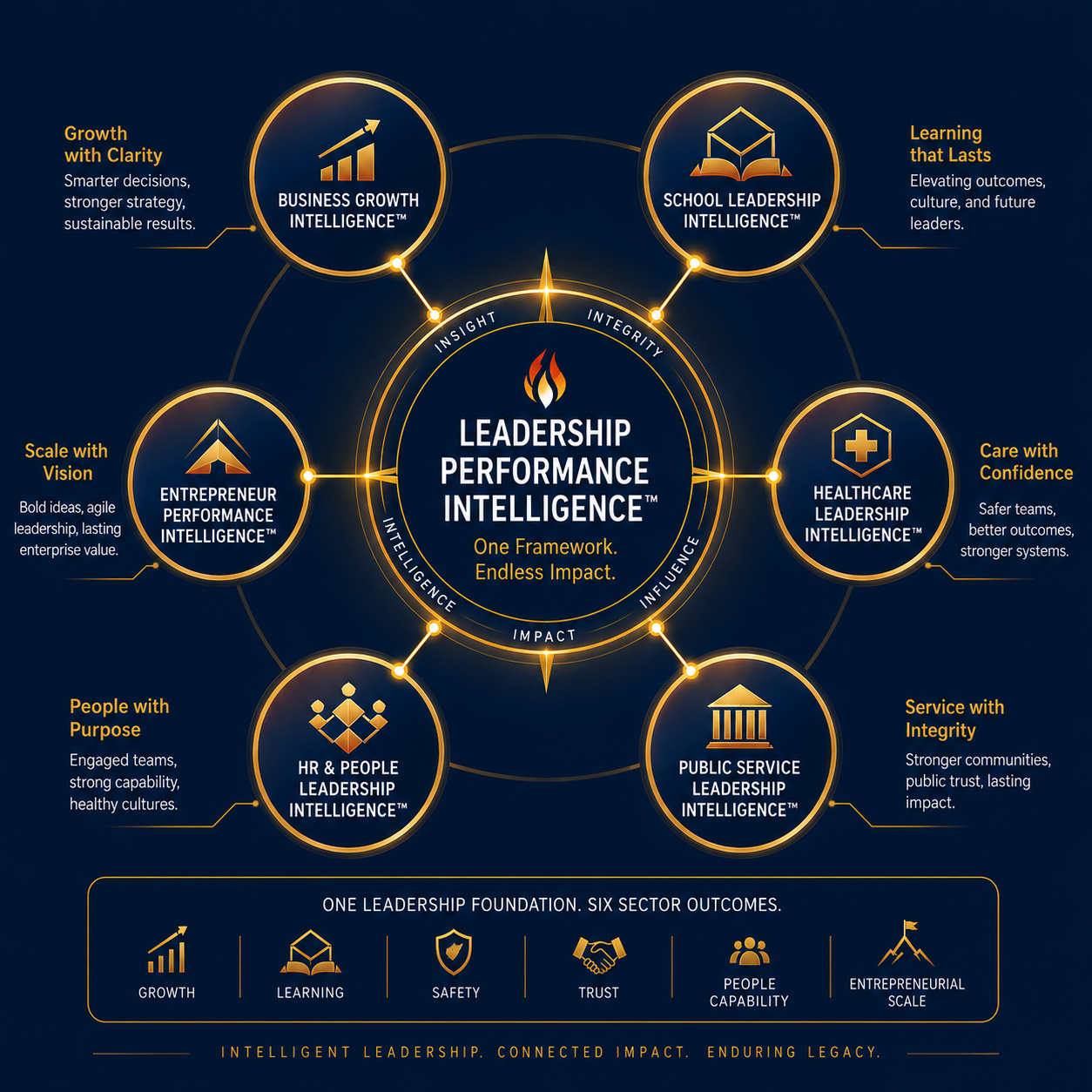
While the context of leadership varies considerably between industries, the underlying principles of effective leadership remain remarkably consistent. Whether leading a multinational organisation, a primary school, a hospital department, a local authority or a growing business, leaders are ultimately responsible for enabling people to perform at their best while delivering meaningful outcomes.
Business Growth Intelligence™
Commercial organisations increasingly compete through innovation, culture and agility rather than scale alone. Leaders who develop Leadership Performance Intelligence™ make faster strategic decisions, improve customer experience, strengthen innovation capability and retain high-performing talent.
School Leadership Intelligence™
Educational leadership extends far beyond operational management. Leadership Performance Intelligence™ strengthens instructional decision-making, professional learning cultures, reflective practice and sustainable leadership capacity. Better leadership creates better learning environments.
Healthcare Leadership Intelligence™
Healthcare leaders make decisions where quality, safety, wellbeing and operational performance intersect every day. Leadership Performance Intelligence™ improves multidisciplinary collaboration, ethical clinical leadership, workforce resilience and patient-centred decision-making.
Public Service Leadership Intelligence™
Public sector organisations operate under constant public scrutiny while balancing political priorities, limited resources and complex stakeholder expectations. Leadership Performance Intelligence™ strengthens evidence-informed decision-making, governance, ethical accountability and public trust.
HR & People Leadership Intelligence™
Modern HR leaders shape organisational capability through leadership development, workforce planning and talent strategy. Leadership Performance Intelligence™ provides an integrated framework for leadership assessment, succession planning and capability benchmarking.
Entrepreneur Performance Intelligence™
Entrepreneurs often possess exceptional vision but face extraordinary pressure, and rapid growth frequently exposes weaknesses in leadership systems before weaknesses in business models. Leadership Performance Intelligence™ enables founders to move from working in the business towards leading the business.
A Practical Framework for Building Leadership Performance Intelligence™
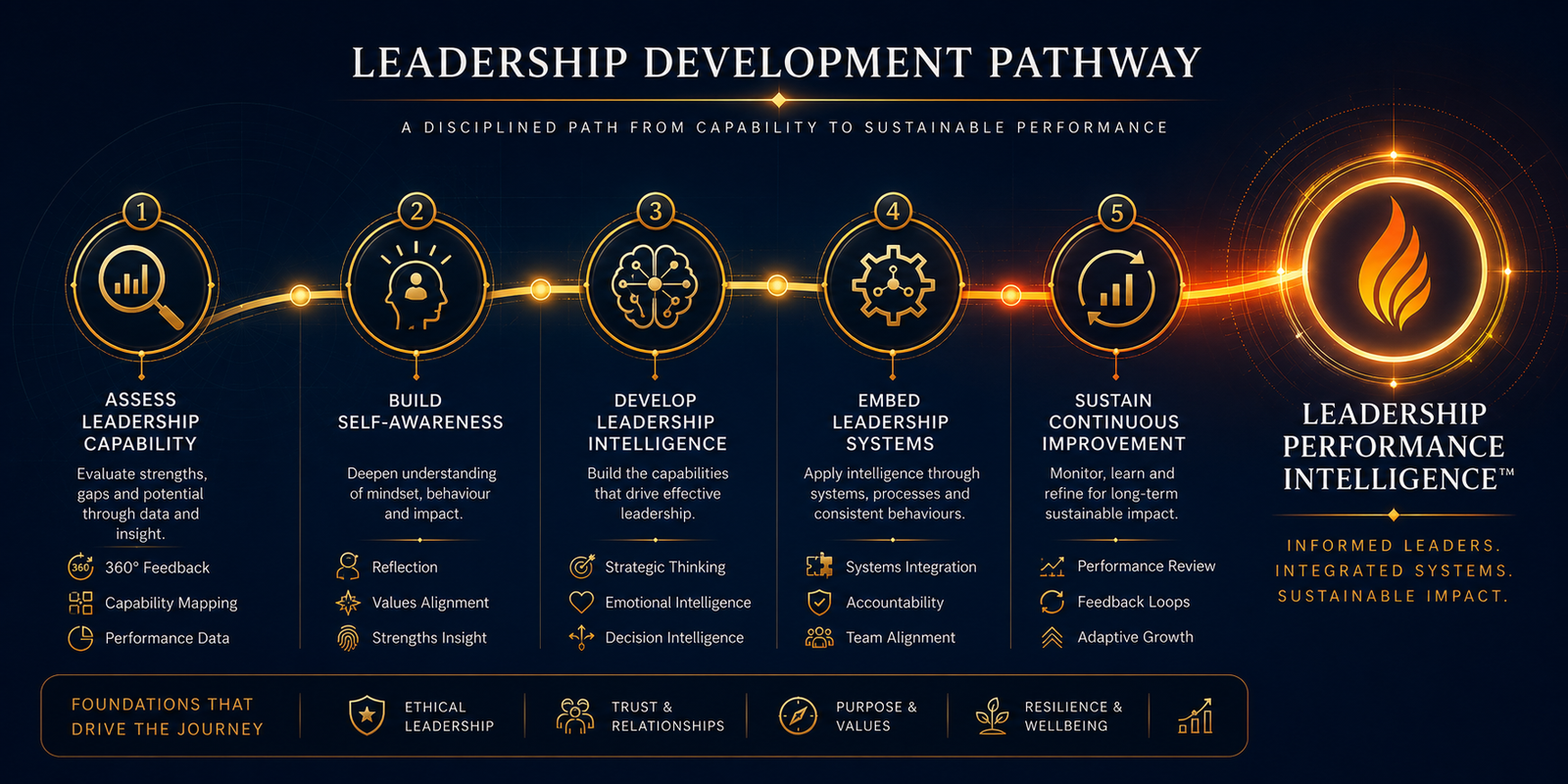
Developing leadership intelligence is not achieved through a single workshop or qualification. It requires continuous, intentional development. Burn Bright Advisory™ recommends five interconnected stages.
1. Assess Current Leadership Capability
Every development journey begins with understanding current strengths, blind spots and capability gaps—across decision quality, reflective practice, ethical judgement, adaptability, emotional intelligence, workload sustainability and organisational influence. Measurement creates clarity.
2. Build Leadership Self-Awareness
Leaders improve when they understand not only what they do, but why they do it. Reflection, coaching, benchmarking and structured feedback create deeper awareness of leadership patterns that influence organisational outcomes.
3. Develop Integrated Capability
Leadership capability should develop as an interconnected system. Professionalism supports ethics. Reflection strengthens adaptability. Knowledge development improves strategic thinking. Emotional intelligence improves collaboration. Leadership Sustainability™ protects long-term performance. Each capability reinforces every other capability.
4. Embed Leadership Within Organisational Culture
Leadership should never depend upon individual personalities. It should become embedded within recruitment, induction, coaching, professional development, performance reviews, succession planning and strategic planning.
5. Sustain Continuous Improvement
Leadership intelligence is never finished. Changing environments require continual adaptation, so high-performing organisations establish routines for reflection, benchmarking, organisational learning, capability reviews and strategic evaluation.
Leadership Is a Capability, Not a Position
Perhaps the greatest misconception surrounding leadership is that leadership belongs to those with titles. Leadership Performance Intelligence™ challenges this assumption. Leadership is fundamentally a capability—it exists wherever individuals influence decisions, relationships, learning, culture or organisational performance.
Titles may grant authority. Leadership intelligence earns trust.
Authority may secure compliance. Leadership intelligence inspires commitment.
Position may create responsibility. Leadership intelligence creates lasting impact.
As organisations continue navigating unprecedented complexity, those that invest in leadership capability rather than leadership status will possess a significant strategic advantage.
Reflection: Evaluating Your Own Leadership Performance Intelligence™
Leadership Performance Intelligence™ is developed through deliberate reflection as much as through experience. Use the questions below individually, within leadership teams, or as part of structured coaching conversations.
Leadership Reflection Questions
- How would I describe my leadership philosophy in one sentence—and does my daily behaviour consistently reflect it?
- What evidence tells me that my leadership is effective? Am I measuring activity or genuine organisational impact?
- Do I consistently model the professional standards I expect from others?
- When faced with competing priorities, how do I decide what is right—and would my team describe my leadership as fair and consistent?
- How comfortable am I leading through uncertainty, and what assumptions about leadership may no longer be serving me?
- How often do I intentionally pause to think about my leadership, and what recurring patterns have I noticed in myself?
- How accurately do I recognise the emotions influencing my decisions, and do people feel psychologically safe around me?
- Could I continue leading at my current pace for another five years? What activities consistently replenish my leadership capacity?
- Do we develop future leaders systematically, and is leadership viewed within my organisation as a position or a capability?
- Where is leadership workload creating unnecessary risk, and what systems support long-term leadership performance?
Moving From Insight to Action
Reading about leadership is valuable. Reflecting on leadership is essential. Applying leadership learning consistently is transformational.
Alongside self-assessment and reflection, leaders can strengthen Leadership Performance Intelligence™ through a few consistent habits:
Schedule Weekly Leadership Reflection
Reserve 30–60 minutes each week to reflect on significant decisions, difficult conversations, mistakes and emerging challenges. A dedicated leadership journal helps surface recurring patterns over time.
Strengthen One Capability at a Time
Attempting to improve everything simultaneously often produces little meaningful progress. Instead, focus on one Leadership Intelligence Compass™ domain for six to eight weeks before moving to the next.
Seek High-Quality Feedback
Leadership performance is measured by impact, not intention. Actively seek structured feedback from peers, direct reports, mentors and coaches on what to continue, stop and improve.
Protect Leadership Sustainability™
Review workload, delegation, recovery, learning time and boundaries regularly. Protecting leadership capacity protects organisational capability.
Organisations can accelerate this further by embedding Leadership Performance Intelligence™ into recruitment, onboarding, performance reviews, succession planning and organisational learning—benchmarking progress through indicators such as employee engagement, retention of high performers, succession readiness and decision quality. A simple phased approach looks like this:
| Timeframe | Focus | Expected Outcome |
|---|---|---|
| Days 1–30 | Assess current leadership capability and identify development priorities | Increased self-awareness and a clear development baseline |
| Days 31–60 | Focus on one Leadership Intelligence Compass™ domain while practising structured reflection | Noticeable improvement in targeted leadership behaviours and decision-making |
| Days 61–90 | Apply new learning, gather feedback, refine approaches and share insights with others | Sustainable leadership habits and stronger organisational impact |
These outcomes are unlikely to occur simultaneously. Leadership intelligence develops progressively through deliberate practice and continuous learning. The journey begins with a single commitment: choose one leadership capability to strengthen this week, take one deliberate action to improve it, and reflect on the impact.
What is Leadership Performance Intelligence™?
Leadership Performance Intelligence™ is Burn Bright Advisory™’s integrated framework for developing sustainable leadership capability, bringing together professional judgement, ethical reasoning, adaptability, reflective practice, emotional intelligence, knowledge development, visionary thinking and Leadership Sustainability™ into a single evidence-informed model.
How is Leadership Performance Intelligence™ different from traditional leadership models?
Traditional models focus primarily on behaviours, personality traits or leadership styles. Leadership Performance Intelligence™ takes a systems-based approach, asking what capabilities enable consistently effective leadership and how they can be developed sustainably.
What is the Leadership Intelligence Compass™?
The Leadership Intelligence Compass™ is the central framework within Leadership Performance Intelligence™, organising leadership capability across nine interconnected domains: Professionalism, Ethics, Constructivism, Adaptability, Visionary Leadership, Reflective Practice, Knowledge Development, Emotional Intelligence™ and Leadership Sustainability™.
Who is Leadership Performance Intelligence™ designed for?
It is applicable across all sectors and leadership levels, including executive leaders, senior managers, school leaders, healthcare leaders, HR professionals, public sector leaders, business owners, entrepreneurs and emerging leaders.
Why is Leadership Sustainability™ important?
Leaders who consistently operate under excessive workload or prolonged pressure experience declining judgement, reduced innovation and increased risk of burnout. Managing workload, reflection, recovery and learning protects both the leader’s effectiveness and the organisation’s long-term performance.
How does reflective practice improve leadership?
Reflection enables leaders to convert experience into learning. Without it, leaders may repeat ineffective habits despite years of experience. Reflective Practice Intelligence™ improves judgement, adaptability and strategic thinking over time.
Can Leadership Performance Intelligence™ improve organisational performance?
Yes. Leadership capability influences employee engagement, decision quality, innovation, collaboration, culture, succession planning, retention and stakeholder confidence—improvements are often seen across multiple operational and cultural measures.
How can organisations begin implementing Leadership Performance Intelligence™?
Implementation typically begins with assessing current leadership capability, benchmarking strengths and development priorities, developing leaders across all Compass domains, embedding development into organisational systems, and reviewing progress regularly.
How does Leadership Performance Intelligence™ support future leadership?
Adaptability, ethical judgement, emotional intelligence, reflective practice and continuous learning provide leaders with the flexibility required to navigate future challenges involving complexity, uncertainty and technological change.
What is the first step towards developing Leadership Performance Intelligence™?
The first step is honest self-assessment. Leaders should evaluate their current strengths, identify capability gaps, and commit to strengthening one capability at a time through reflection, learning, practical application and feedback.
Conclusion
The future of leadership will not be determined by charisma, authority or management technique alone. It will belong to leaders who can think critically, act ethically, adapt confidently, learn continuously, develop others intentionally and sustain performance over the long term.
By integrating the capabilities represented within the Leadership Intelligence Compass™, organisations move beyond fragmented leadership development towards a coherent, evidence-informed system that strengthens both individual leaders and organisational capability. The goal is not to create perfect leaders. The goal is to create leaders who continually grow, reflect, adapt and improve while enabling others to do the same.
Leadership is no longer simply about directing organisations. It is about building organisations capable of thriving long after individual leaders have moved on.
Where Does Your Leadership Intelligence Stand Today?
Take the Leadership Burnout Self-Assessment to identify the structural factors affecting your leadership capacity and discover practical actions for building sustainable performance.
Free Leadership Intelligence
Get Weekly Leadership Insights
Join thousands of leaders receiving practical strategies on burnout prevention, workload design, and sustainable performance every week.