Quick Answer
Key Takeaways
- Time poverty is a structural leadership problem, not a personal productivity problem.
- Modern leaders experience expanding responsibilities without equivalent increases in resources or authority.
- Constant meetings, communication overload and decision fatigue create invisible workload pressures.
- Sustainable leaders redesign work systems instead of relying on longer hours.
- Organisations that address structural workload issues improve retention, performance and long-term effectiveness.
Time Poverty in Leadership
Introduction
Time poverty in leadership has become one of the defining challenges of modern management. Leaders are working longer hours than ever, yet many finish each day feeling permanently behind. The issue is rarely a lack of commitment or capability. It is a mismatch between the demands placed upon leaders and the capacity available to meet them.
Over the past decade leadership has fundamentally changed. Managers are expected to lead hybrid teams, respond instantly across multiple communication platforms, analyse increasing volumes of data, support employee wellbeing, manage organisational change and deliver better results with fewer resources. Every new responsibility has been added, but very few old responsibilities have been removed.
This creates what Burn Bright Advisory™ describes as time poverty—a condition where leaders simply do not have enough available time to meet the expectations of their role sustainably. Rather than fixing the leader, organisations need to redesign the work itself.
In this article, you’ll discover why time poverty has become so common, how it damages leaders and organisations, and the practical frameworks that help restore strategic capacity without sacrificing performance. These ideas build directly on the Burn Bright philosophy that sustainable leadership begins by fixing systems rather than blaming individuals.
The framework below illustrates why leadership time disappears long before the working day ends.
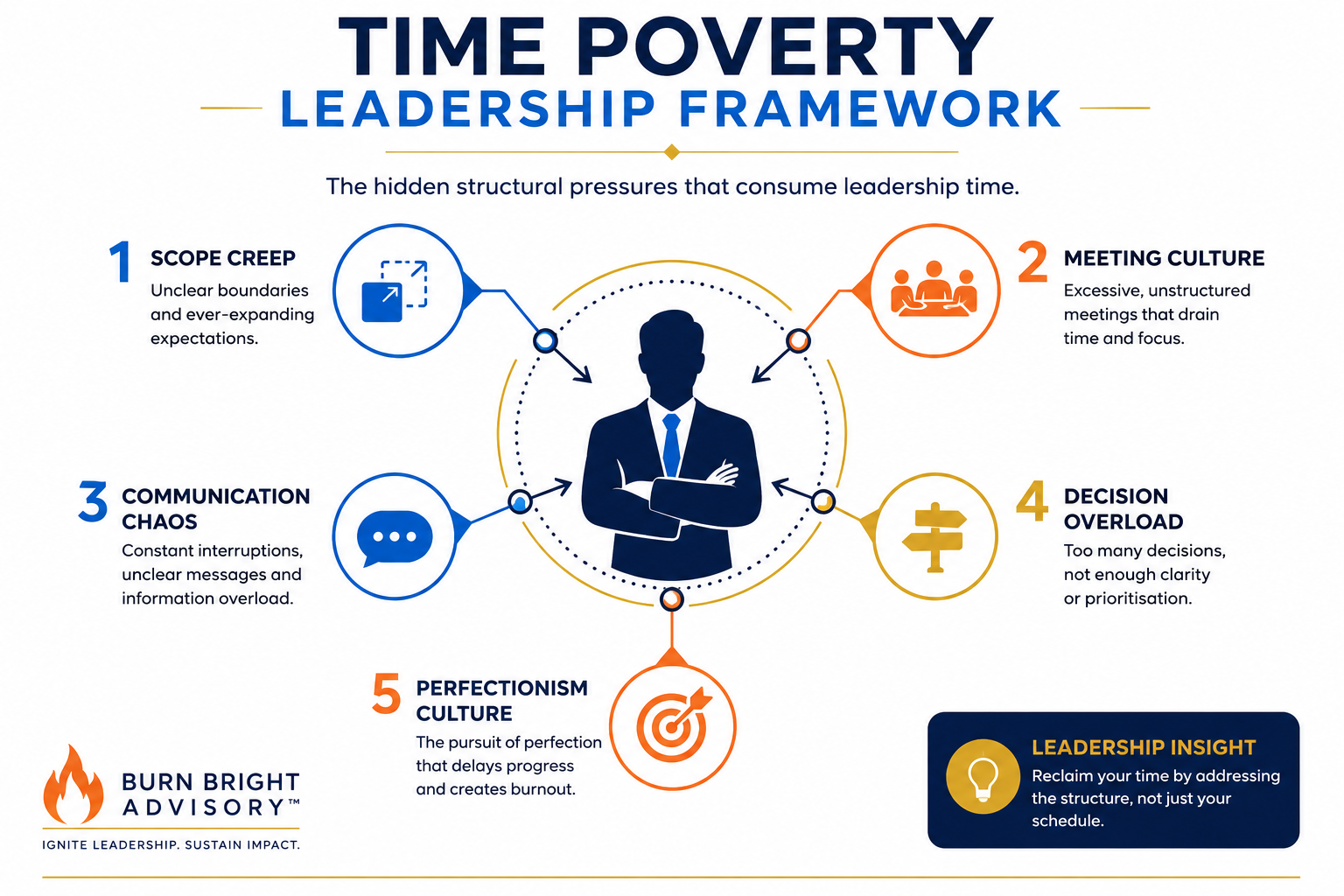
Most leaders do not lose time because they are disorganised. They lose time because expanding responsibilities, fragmented communication and constant reactive work consume the hours originally intended for strategic leadership.
Featured Snippet
Why Are Leaders Experiencing Time Poverty?
Time poverty is often mistaken for poor diary management. It is not. The real issue is that leadership roles have expanded faster than organisations have redesigned them.
Twenty years ago, many managers focused on supervising people, making decisions and delivering operational outcomes. Today they are expected to be coaches, mentors, change leaders, technology adopters, data analysts, wellbeing champions and strategic planners—all while remaining constantly available.
Gallup continues to report that managers are among the most stressed groups in the workforce, while research from Deloitte and McKinsey consistently identifies increasing workload complexity as one of the biggest threats to leadership effectiveness. The problem is not effort. It is structural overload.
Burn Bright Advisory™ describes this as scope creep—one of the five root causes of burnout. New responsibilities are continually added, but almost nothing is removed. Eventually, every calendar becomes overcommitted before the working week even begins.
Consider a typical senior leader’s day:
- Three hours of meetings
- Hundreds of emails and messages
- Multiple approval requests
- Staff wellbeing conversations
- Crisis management
- Strategic planning
- Performance reviews
- Budget oversight
Each activity is legitimate.
Collectively, they become impossible.
The consequence is predictable. Leaders abandon strategic work because urgent work always wins. Strategic thinking becomes something squeezed into evenings, weekends or holidays rather than an integral part of leadership itself.
What Creates Time Poverty in Leadership?
Time poverty rarely has a single cause. Instead, several structural problems interact until leaders become trapped in permanent reaction mode.
Burn Bright Advisory™ identifies these five structural pressures as the foundation of leadership burnout—not personal weakness.
The data below illustrates how expanding workload steadily erodes strategic leadership capacity.
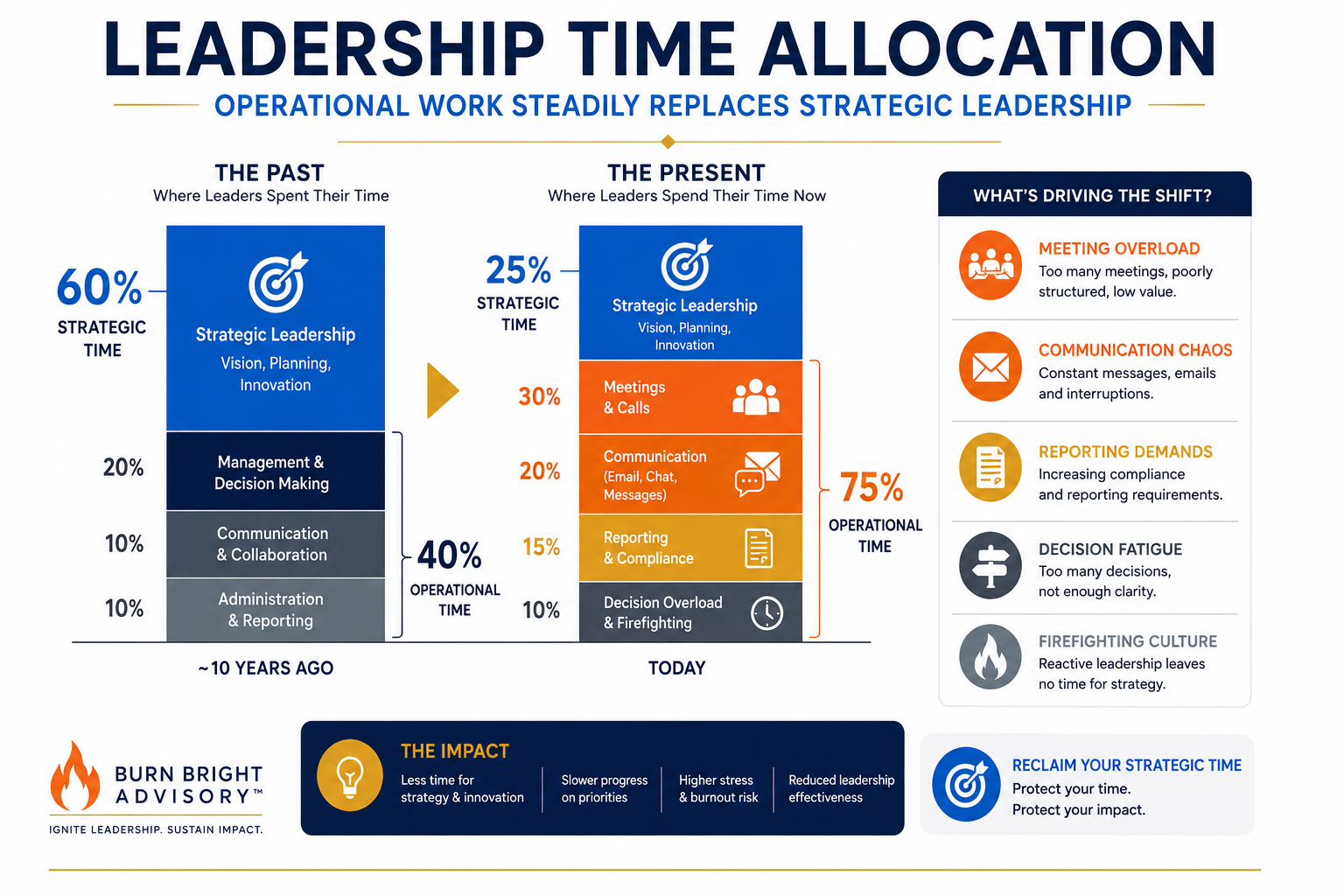
Every additional layer of meetings, communication and reactive decision-making consumes capacity that should be devoted to strategic leadership. Eventually, leaders become permanently operational rather than genuinely strategic.
How Can Leaders Escape Time Poverty?
Escaping time poverty does not begin with buying a new productivity app or colour-coding a calendar. Those approaches may improve personal organisation, but they cannot solve structural overload.
Sustainable leaders redesign work before they redesign themselves. This requires four structural shifts.
Shift 1 Redesign Workload Architecture
Every responsibility should fit into one of three categories: strategic work, leadership work, or operational work. The mistake many leaders make is allowing operational work to dominate their week. Workload architecture deliberately protects capacity for high-value activities such as:
- Long-term planning
- Coaching senior staff
- Organisational improvement
- Innovation
- Relationship building
- Strategic decision-making
Instead of asking “How do I fit more into my week?” sustainable leaders ask “Which work should be redesigned, delegated or removed?”
Shift 2 Clarify Decision Authority
One of the fastest ways to reclaim time is reducing unnecessary decision-making. Many organisations unintentionally create leaders who become approval bottlenecks for holiday requests, minor purchases, routine operational issues and simple customer complaints.
The Burn Bright framework recommends redesigning decision authority rather than increasing decision speed. Clear decision rights create faster organisations, more confident managers, reduced cognitive overload and better leadership capacity.
Shift 3 Build Recovery Rhythms
Time poverty is not simply about hours—it is also about energy. Research consistently shows that performance declines after prolonged periods of uninterrupted decision-making. Effective recovery rhythms include protected strategic thinking time, no-meeting periods, walking meetings where appropriate, reflection after major decisions, and digital boundaries outside working hours.
Recovery is not lost productivity. It protects future productivity.
Shift 4 Create Sustainable Management Systems
Individual resilience cannot compensate for broken organisational systems. Leaders who appear exceptionally resilient often become the first casualties because organisations continually load more work onto those who perform well. Sustainable organisations instead build clear delegation frameworks, standard decision processes, defined communication protocols, meeting governance, capacity planning and regular workload audits.
Traditional Leadership vs Sustainable Leadership
| Traditional Leadership | Sustainable Leadership |
|---|---|
| Works longer hours | Redesigns workload |
| Solves every problem personally | Builds systems that solve problems |
| Attends every meeting | Protects strategic thinking time |
| Makes every decision | Delegates decision authority |
| Measures effort | Measures organisational impact |
| Rewards availability | Rewards sustainable performance |
| Accepts burnout as normal | Prevents burnout through structural design |
The difference is profound. Traditional leadership assumes the leader must adapt endlessly. Sustainable leadership assumes the organisation must continually improve the system. That is the difference between surviving leadership and sustaining it.
The framework below shows how sustainable leadership restores capacity through structural redesign rather than personal sacrifice.
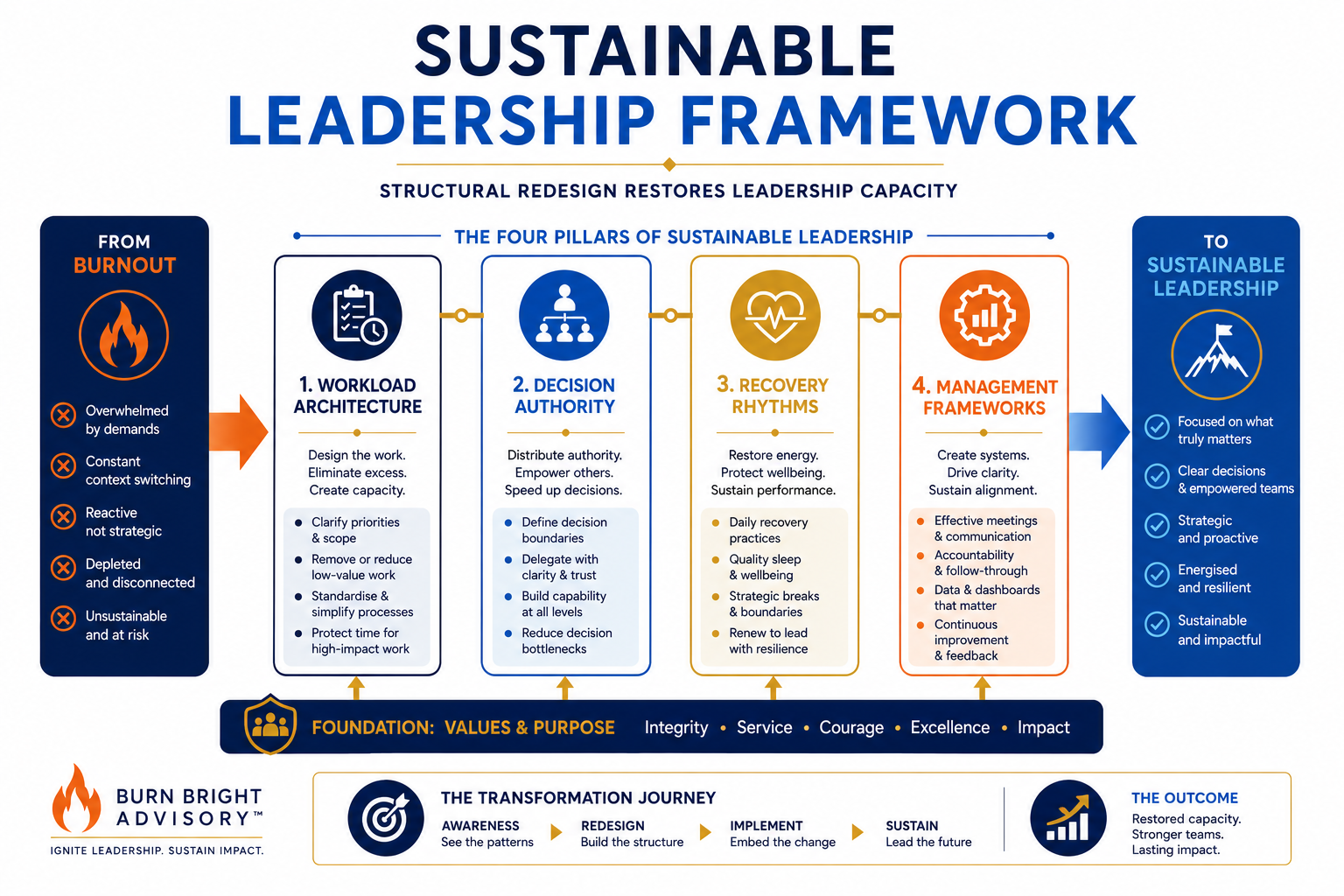
Sustainable leadership begins by redesigning workload, clarifying decision authority, embedding recovery rhythms and strengthening management systems. These changes create long-term capacity instead of relying on individual endurance.
What is time poverty in leadership?
Time poverty in leadership occurs when the responsibilities of a leadership role consistently exceed the time available to perform them effectively. Unlike poor time management, it is caused by structural issues such as excessive meetings, communication overload, unclear decision ownership and expanding workloads. The solution is to redesign the work rather than simply expecting leaders to become more productive.
Is time poverty the same as being busy?
No. Busy periods are temporary and usually have a clear end point. Time poverty is chronic—leaders remain permanently overloaded because organisational expectations continually exceed available capacity, and even after completing one project, another immediately replaces it. This creates sustained pressure that significantly increases the risk of burnout.
Can better time management solve leadership time poverty?
Only partially. Time management techniques can improve personal organisation, but they cannot remove unnecessary meetings, reduce duplicated reporting or redesign decision-making processes. Lasting improvements require structural changes to workload, communication and organisational systems rather than better personal productivity alone.
Why do senior leaders experience time poverty more than other employees?
Senior leaders sit at the centre of organisational decision-making, managing competing priorities, multiple stakeholders, strategic planning, operational oversight and people leadership simultaneously. Without clear delegation, decision authority and workload boundaries, every new demand naturally flows towards leadership, creating an unsustainable concentration of work.
How can organisations reduce time poverty?
Organisations should begin with a structural workload audit rather than another productivity initiative—reviewing unnecessary meetings, clarifying decision ownership, eliminating duplicated reporting, strengthening delegation, protecting strategic thinking time and building recovery into leadership routines. These changes increase organisational capacity while reducing burnout risk across leadership teams.
Conclusion
Time poverty in leadership is one of the greatest hidden threats to organisational performance. It quietly erodes strategic thinking, weakens decision-making and leaves capable leaders feeling permanently behind despite working harder than ever.
The answer is not another productivity system or a longer working day.
It is recognising that burnout is rarely created by individual weakness.
It is created by organisational design.
When leaders redesign workload architecture, clarify decision authority, establish recovery rhythms and strengthen management systems, they recover more than time. They recover the capacity to think strategically, lead confidently and build healthier organisations.
The strongest organisations are not those with the busiest leaders. They are those that deliberately protect leadership capacity through better systems.
As you look at your own situation today—are you leading from a place of clarity or a place of depletion?
Reclaim Your Leadership Capacity
If today’s article describes your experience, take the Leadership Burnout Self-Assessment to identify the structural pressures affecting your leadership and receive practical recommendations for creating sustainable performance.
Free Leadership Intelligence
Get Weekly Leadership Insights
Join thousands of leaders receiving practical strategies on burnout prevention, workload design, and sustainable performance every week.